Understanding the Differences between FLAC, MP3, M4A, OGG, and WAV Audio Formats


Free Download Mp4Gain
picture

Understanding the Differences between FLAC, MP3, M4A, OGG, and WAV Audio Formats
Understanding the Differences between FLAC, MP3, M4A, OGG, and WAV Audio Formats


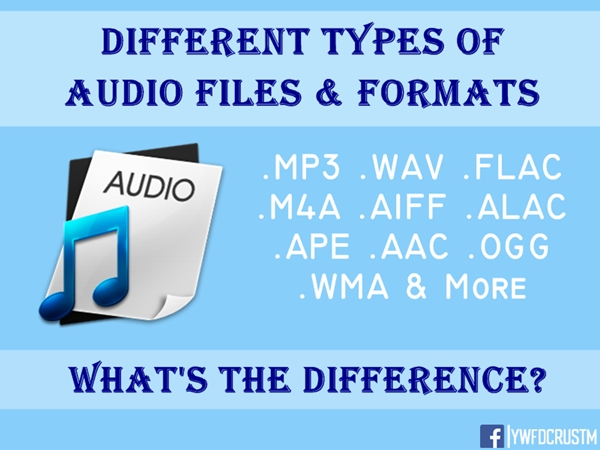
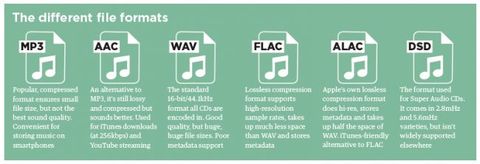
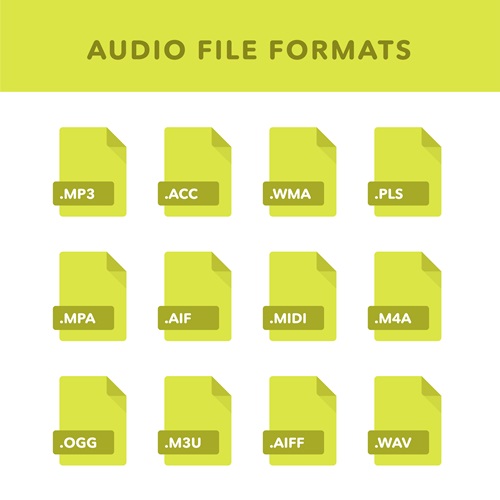
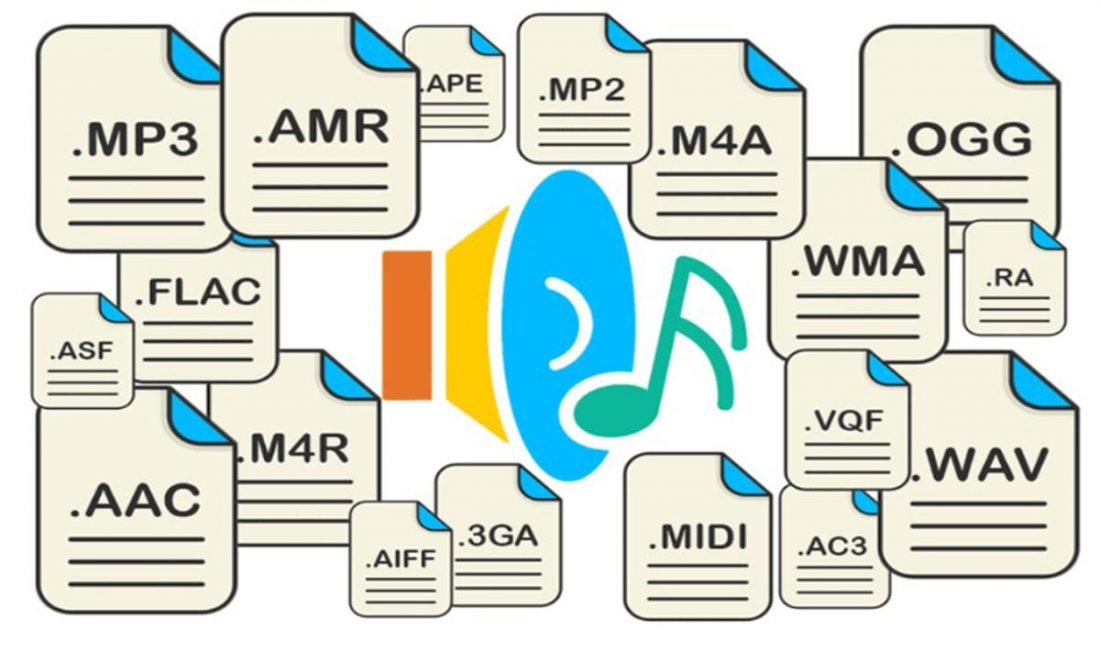
When it comes to digital audio, there are a plethora of different file formats to choose from. Each format has its own set of advantages and disadvantages, making it important to understand the differences between them in order to choose the best option for your needs. In this article, we will take a closer look at five popular audio formats: FLAC, MP3, M4A, OGG, and WAV.
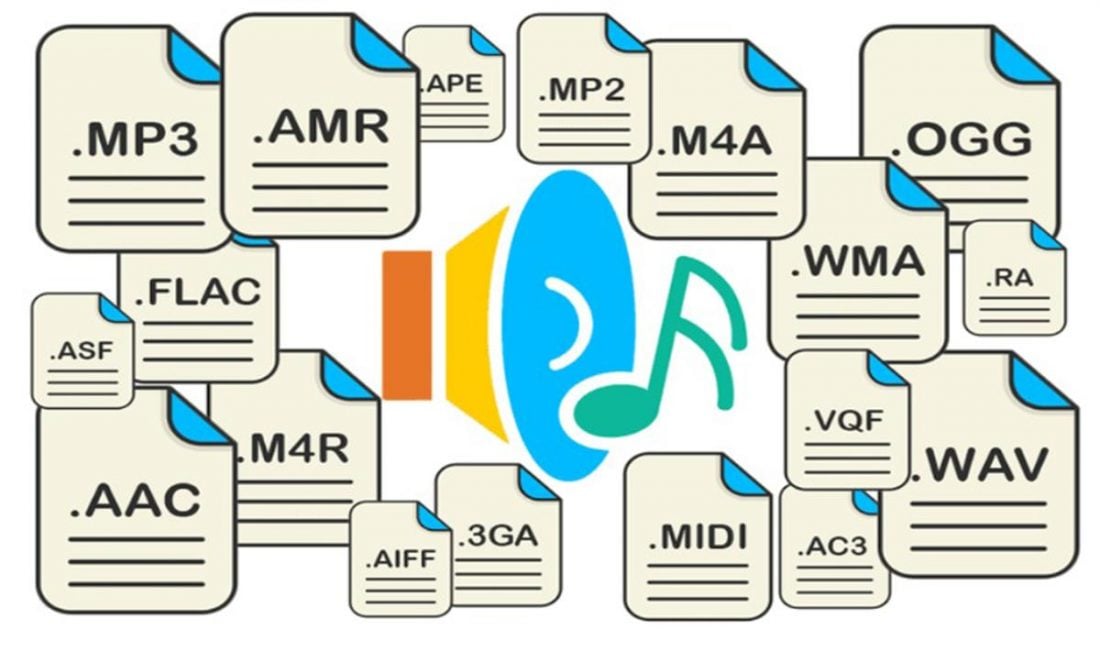
Understanding the Differences between FLAC, MP3, M4A, OGG, and WAV Audio Formats

FLAC

FLAC, or Free Lossless Audio Codec, is a popular open-source format that is known for its lossless compression. This means that, unlike some other formats, FLAC does not lose any audio quality during the compression process. This makes FLAC a great option for audiophiles who want the highest quality audio possible. However, FLAC files are typically larger than other formats, which can be an issue for those with limited storage space.

MP3

MP3, or MPEG Audio Layer III, is one of the most widely used audio formats. It uses a lossy compression method, which means that some audio quality is lost during the compression process. However, MP3 files are significantly smaller than FLAC files, making them a great option for those who want to store a large amount of music on their device. Additionally, the MP3 format is supported by a wide range of devices and software, making it a very convenient option.

M4A

M4A, or MPEG-4 Audio, is a file format that is commonly used for music and other audio files. It is similar to MP3 in that it uses a lossy compression method, but M4A files are typically smaller than MP3 files. Additionally, M4A files can contain advanced features such as chapters and artwork, making them a great option for audiobooks and other spoken-word content. However, it is important to note that not all devices and software support M4A files.

OGG

OGG, or Ogg Vorbis, is a free and open-source format that is similar to MP3 and M4A. It uses a lossy compression method and is known for providing a good balance of audio quality and file size. OGG files are typically smaller than FLAC files but larger than MP3 and M4A files. Additionally, OGG files can contain advanced features such as tags and chapters, making them a great option for audiobooks and other spoken-word content. However, it is important to note that not all devices and software support OGG files.

WAV

WAV, or Waveform Audio File Format, is a popular format that is known for its high audio quality. It is a lossless format, which means that no audio quality is lost during the compression process. However, WAV files are typically larger than other formats, making them an option for those who want the highest quality audio possible but have limited storage space. Additionally, WAV files are supported by a wide range of devices and software, making them a convenient option.


Free Download Mp4Gain
picture


Mp4Gain Main Window
picture


Mp4Gain Features
picture


Free Download Mp4Gain
picture

Explore 4 main audio formats

Explore 4 main audio formats

audio file formats
audio file formats

Let’s take a look at the main audio formats and the differences between them.

audio file formats
audio file formats

The audio format is directly related to the quality and purpose of the audio track, i.e. where and on what device it will be played and what its purpose is.

However, before discovering the difference between them and choosing the best audio format for your music, you should know what categories they fall under. Let’s go ahead!

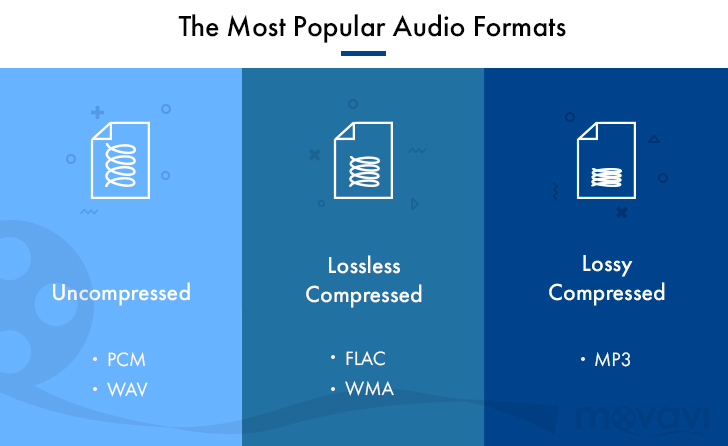
Uncompressed audio is like a picture, uncompressed audio is better quality, larger in file size and safer to copy, with nearly the same detail as the original sound.

WAV is the most widely used audio format of this type and reproduces music with precision similar to that of a recording.

compressed audio
When music is compressed, the file is smaller and can be easily stored on your device. Because of this advantage, compressed audio is often more of an option for users.

However, it should be remembered that some audio formats in this category may lose quality depending on the option selected, just like MP3 and AAC .

What is the best audio format?
As we said before, the first step in deciding on an audio format is to know the final objective of the track. Whether it’s for music lessons, performances, karaoke, auditions, or recording versions, you need to understand the pros and cons of each option.

WAV
WAV (Waveform Audio File Format) is an uncompressed format, therefore sufficient storage space is required. This is for those who already work with music, such as experts in the field or users who want to edit audio.

At high fidelity, WAV faithfully reproduces the elements and character of the original soundtrack. Furthermore, this format allows the selection of different bit and sample rates, and can be used on multiple platforms.

FLAC
FLAC (Free Lossless Audio Codec) is one of the most widely used compression formats by music lovers today.

Digital audio encoding allows you to preserve its quality, but the resulting file will be smaller. Over the years, this format has become more widely used and is compatible with different devices and platforms.

FLAC is free and open source, ready to use and can be easily played on smartphones and other devices.

MP3
Before deciding on the best audio format, it is worth taking a look at the most famous format in the music world: MP3.

MP3 is one of the main audio compression formats, and has become synonymous with the convenience and efficiency of generating files quickly, with smaller files and a certain level of quality.

Many devices and programs can play this format. But MP3 is difficult to use in professional audio processing and advanced audio editing.

As is known, this format exists on almost all platforms and is ideal for sharing audio.

Another interesting factor is its bit rate, although it is a compressed format, it can vary depending on the user’s goals and improvements in quality.

AAC Like MP3, Advanced Audio Coding (AAC) is a more efficient audio format than its predecessor.

To create smaller files with less storage space, AAC is a great option for users to reduce file size and keep high-quality audio tracks.

Principle of mp3 and file format analysis. Part4

Principle of mp3 and file format analysis. Part4

MP3

The three bytes starting at 1397H are 54 41 47, which store the “TAG” character, indicating that this file has ID3 V1.0 information.

MP3

The 30 bytes starting at 139AH store the name of the song, the first 4 bytes that are not 00 are 54 45 53 54, which means “TEST”;
the 4 bytes starting at 13F4H are 04 19 14 03 and the year of storage is “04/25/2003” ”;
the last byte is 4E, which represents the music category, and the code name is 78, that is, “Rock&Roll”; the
other bytes are all 00, and no information is stored.

4 Conclusions
As an important multimedia data type, people are always looking for more efficient compression methods and new sound file formats. In the MP3 file, the MDCT transform is used, which is a quasi-optimal transform with a simple structure and easy programming, which avoids the problem that the optimal transform (KL) is difficult to solve for the eigenvalues ​​and eigenvectors of the covariance. matrix.

Through the analysis of the MP3 file format, it is not difficult to find its shortcomings. Each frame of an MP3 file has the same 4-byte frame header, which requires some space overhead for an MP3 file with a large number of frames. ID3 stores the music description information. The proprietary, copyright, and other information in the frame header is also description information. The music description information is a bit messy.

In any case, the development of MP3 is unstoppable. MP3 has become a recognized sound data format. MP3 is becoming a hot spot in the field of multimedia information processing along with JPEG images and PDF documents.

Principle of mp3 and file format analysis. Part 3

Principle of mp3 and file format analysis. Part 3

Mp3tag

The ID3 standard MP3 frame header does not consider storing complex information such as song title, author, album name, year, etc., except some simple music description information such as privacy, copyright and original, which are very necessary in MP3 applications.

mp3 tag


In 1996, in the “Studio 3” project, FricKemp proposed to add description information for storing songs at the end of the MP3 file and formed the ID3 standard. Until now, ID3 V1.0, V1.1, V2 .0, V2, .3 and V2.4 standards have been formulated. The higher the version, the richer and more detailed the relevant information is recorded.
The ID3 V1.0 standard is not complete and the information stored is too small to store lyrics, album covers, images, etc. V2.0 is a fairly complete standard, but it brings difficulties in writing software, although there are many people in favor of this format, very few are actually implemented in software. The vast majority of MP3s still use the ID3 V1.0 standard. This standard uses the last 128 bytes at the end of the MP3 file to store ID3 information. See Table 3 for instructions on using these 128 bytes.
Table 3 Final ID3 V1.0 File Description
length in
byte (byte) Description
1-3 3 Stores the “TAG” character, which indicates the ID3 V1.0 standard, followed by the song information.
4-33 30 Song name
34-63 30 Author
64-93 30 Album name
94-97 4 Year
98-127 30 Notes
128 1 MP3 music category, a total of 147 types.

3.3 File example
Open a file called test.mp3 in VC++ with the following content:
000000 FF FB 52 8C 00 00 01 49 09 C5 05 24 60 00 2A C1
000010 19 40 A6 00 00 05 96 41 34 18 20 80 08 26 48 29
000020 83 04 00 01 61 41 40 50 04 00 C1 2 41 50 64

0000d0 Fe FF FB 52 80 01 EE 90 65 6E 02 30
0000E0 32 0C CD CD CD CD 46 16 41 89 B8 408 89 300 408
0000F0 33 B7 00 00 01 02 FF FF FF F4 E1 2F FF FF FF FF
……
0001A0 DF FF FF FF FB 52 8C 12 00 E 01 FE 90 58 6E 09 A0 02
000150 8513 B0 AC 45 F6 19 61 26 26
0001C0 05 AC B4 20 28 94 FF FF FF FF FF FF FF FF FF FF

001390 7F FF FF FF FD 4E 00 54 41 47 54 45 53 54 00 00
0013A0 00 00 00 00 00 00 00 00 00 00 00 00 00 00 00 00 00 00 00 00 00 00 00 00 00 00 00 00 00 00 00 00 00 00 00 00
001400
00 00 00 00 00 00 00 00 00 00 00 00 00 00 00 00 00 00 00 00 00
00 00 00 00 00 00 00 00 00 00 00
001410 00 00 00 00 00 00 4E
File length is 1416H (5.142K), frame header is: FF FB 52 8C, converted to binary:
11111111 11111011
01010010
10001100T

Principle of mp3 and file format analysis. Part 2

Principle of mp3 and file format analysis. Part 2

mp3

MP3 uses perceptual audio coding (Perceptual Audio Coding) this distortion algorithm.

mp3

The frequency range of sound perceived by the human ear is 20 Hz to 20 kHz. MP3 cuts out a lot of redundant signals and irrelevant signals. The encoder transforms the original sound into the frequency domain through a mixed filter bank and uses a psychoacoustic model. to estimate that it may be only The perceived noise level is quantized and converted to Huffman coding to form an MP3 bit stream. The decoder is much simpler, its task is to extract the sound signal from the encoded spectral line components through inverse quantization and inverse transformation. The MP3 encoding and decoding process is shown in Figure 1.
2.4 Modified Discrete Cosine Transform The cosine transform
Modified Discrete CT (MDCT) refers to converting a time-domain data set to frequency-domain data in order to know the changes in the time domain. MDCT is an enhancement of the DCT algorithm. The first fast algorithm is fast Fourier transform (FFT), but FFT has complex operations, MDCT are real operations, easy to program.
When compressing audio data, first divide the original sound data into fixed blocks, and then perform direct MDCT (direct MDCT) to convert the value of each block into MDCT 512 coefficients. The 512 coefficients are restored to the original sound data, and The original before and after sound data is inconsistent because redundant and irrelevant data is removed during the compression process. The FMDCT transformation formula is:
k=0, 1,
.
n0=(N/2+1)/2, X(n) is the time domain value, X(k) is the frequency domain value. If N takes 1024 points, it becomes 512 frequency domain values.
The IMDCT transformation formula is:

n=0, 1, …, N-1
MDCT itself does not compress data, it simply maps the signal to another domain, and quantization compresses the data. When bit allocation is done on the quantized transformed samples, the entire quantized block must be considered the smallest, which is called lossy compression.
3 File Format Analysis
MP3 MP3 file data is made up of multiple frames, and the frame is the smallest unit of the MP3 file. Each frame, in turn, consists of a frame header, additional information, and sound data. The playback time of each frame is 0.026 seconds and its duration varies with the bit rate. Some MP3 files have extra bytes at the end that contain description information for non-audio data.

Principle of mp3 and file format analysis.

Principle of mp3 and file format analysis.

Principle of mp3 and file format analysis

Principle of mp3 and file format analysis

Principle of mp3 and file format analysis

1. Introduction
With the rapid development of file compression technology, MP3 has become the most popular music format today. High-quality music spreads rapidly around the world with the arrangement of 0 and 1, which shakes people’s hearts. What is MP3? The full name of MP3 is MPEG Audio Layer 3, which is an efficient computer audio coding scheme. It converts audio files into smaller files with an .MP3 extension with a higher compression ratio, basically maintaining the sound quality of the original file. MP3 is part of the ISO/MPEG standard, which describes audio compression using a high-performance perceptual coding scheme. This standard has been continuously updated to meet the pursuit of “high quality and low quality”, and has now formed MPEG Layer 1, Layer 2, Layer 3 three audio encoding and decoding schemes. MPEG Layer 3 compression ratio can reach 1:10 to 1:12, 1M of MP3 file can be played for 1 minute and 1 minute of CD-quality WAV file (44100Hz, 16bit, dual channel, 60 seconds) occupies 10M space, so Calculated, the playing time of a 650M MP3 disc should be more than 10 hours, and the playing time of a CD of the same capacity is about 70 minutes. The advantage of MP3 is that the CD is incomparable.
2 Analysis of the principle of MP3
2.1 audio standard
MPEG MPEG (Moving Picture Experts Group) is a group of dynamic picture experts under ISO, the MPEG standard which makes it widely used in various multimedia. The MPEG standards include audio and video standards, of which the audio standards have been established as MPEG-1, MPEG-2, MPEG-2 AAC, and MPEG-4.
The MPEG-1 and MPEG-2 standards use the same family of audio codecs: Layer 1, 2, 3. A new feature of MPEG-2 is the use of low sample rate expansion to reduce the data stream, and another feature is multichannel expansion, which increases the number of main channels to 5. The MPEG-2 AAC (MPEG-2 Advanced Audio Coding) standard was released by Fraunhofer IIS and AT&T in 1997 to significantly reduce data traffic. The MDCT (Modified Discrete Cosine Transform) algorithm adopted by MPEG-2 AAC has a sampling frequency between 8KHz and 96KHz, the number of channels can be between 1-48.
The three layers of MPEG Audio Layer 1, 2, and 3 use the same filter bank, bitstream structure, and header information, and the sampling frequency is 32KHz, 44.1KHz, or 48KHz. Layer 1 is designed for DCC (Digital Compact Cassette) compressed digital tape, the data rate is 384kbps, Layer 2 has made a compromise between complexity and performance, and the data rate is reduced to 256kbps-192 kbps. Layer 3 is designed for low data traffic from the start, and the data traffic is 128Kbps-112Kbps. Layer 3 adds MDCT transformation to make its frequency resolution 18 times that of layer 2. Layer 3 also uses average information similar to MPEG video. Entropy Encoding reduces redundant information. The vast majority of MP3s use the MPEG-1 standard.
2.2 Purpose of audio compression
The MP3 format began in the mid-1980s, when the Fraunhofer Institute in Erlangen, Germany, dedicated itself to encoding high-quality, low-data-rate sound. Let’s look at an example: you want to sample a song you like that is about 4 minutes long, store it on a disk, sample it in CD-quality WAV format, at a sample rate of 44.1 kHz, that is, receive a value of 44100 per second, stereo, each sampled data is 16 bits (2 bytes), so the space this song occupies is:
44100 x 2 channels x 2 bytes x 60 seconds x 4 minutes = 40.4 MB
If you download this song from the Internet, assuming the transmission speed is 56 kbps, the download time is:
40.4x106x8/56x103x60=96 minutes
Even a 1M broadband network requires more than 5 minutes, it can be seen that audio compression is particularly important to reduce audio data storage space.
2.3 Encoding and decoding
MP3 MP3 audio compression consists of two parts: encoding and decoding. Encoding converts the data in a WAV file into a highly compressed bitstream, and decoding takes the bitstream and reconstructs it into a WAV file.

THE MOST COMMON FORMATS FOR MUSIC AND OTHER AUDIO FILES AND HOW THEY ARE RELATED TO EACH OTHER PART 2

THE MOST COMMON FORMATS FOR MUSIC AND OTHER AUDIO FILES AND HOW THEY ARE RELATED TO EACH OTHER PART 2

mUSIC fORMATS

AUDIO CONVERTER

Music Formats

With an audio converter the situation is even simpler. Programs of this type are specially designed to convert between audio formats quickly, without explicit user intervention. Unlike audio editors, converters, we can say, use batch mode, that is, they allow you to convert MP3 files in a single operation, for example, not a single copy, and make several pieces at once. Depending on the app’s function, there may be dozens or hundreds.

Audiobooks in MP3 format

Once again, the operation of such a package is simple. Just select the source material (usually it can be a completely different file type) and install the final format. Then press a special button to start the process, the output user gets all files of a certain type. Your save usually occurs in the folder set in the app’s default settings, but the save location can of course be changed by yourself. By the way, the same applies to basis functions, which will be used during the transformation. However, any program initially provides the user with a specific set of criteria to use with a specific type of audio file. They can also change.

The beauty of these apps is that they have a complete process that will automate as much as possible and do all the required processes without much time. However, if we use a music or audio editor, comparing them in terms of improving the same sound quality especially cannot be dispersed here.

MUSICAL ARRANGEMENT
This is another type of software, most of which have built-in editors for MP3, WAV, etc. In this sense, they work on a similar principle to audiorekatorami, but their abilities are slightly broader.

Convert to MP3 format

First of all, it deals with the fact that the entire composition can consist of fragments of different types (MP3, MIDI, WAV, OGG, VST-library or DX-tool, etc. D.). After recording all sound tracks, for example mixing and mastering with virtual synthesizers or prescription parties, the resulting files can be saved in the desired format. Mostly it is an MP3 or WAV, or the program’s project file. In some applications, there is also a recording function to disk. Do you want an audio CD? No problem! In addition to the audio editor, it may take a few minutes to perform the necessary operations and get the tracks on the output disc in CDA format.

If we talk about the benefits of this type of application, it is obvious that only a few formats of the same union, and then saving or exporting to some of the most common are its greatest advantages. Also, you need to pay attention to the fact that the very overlay effect or change of any track parameters happens in real time, that is, the result will not necessarily wait; can be heard immediately by turning some knobs, for example. , or another option. Of course, this is only a small part of what packages are capable of.

HOW SHOULD I USE IT?
Finally, we come to the question of choosing the software to use with the MP3 format, or any other sound to record to. As is clear, normal listening to music or audiobooks is enough and a humble player (software or “iron”), or more commonly a DVD player.

Converting files to other formats, so to speak, in a hurry, is the perfect audio converter. However, if the output needs to achieve crystal clear sound quality, or even convert one file type to another, it is indispensable without powerful dedicated software. Of course, this requires ordering more, and without any experience, time to get the same high-quality MP3 files as the first time and you can’t get. However, with at least some in-depth study from audio editors, let alone professional music studios, the results will exceed everyone’s expectations.

THE MOST COMMON FORMATS FOR MUSIC AND OTHER AUDIO FILES, AND HOW THEY ARE RELATED TO EACH OTHER

THE MOST COMMON FORMATS FOR MUSIC AND OTHER AUDIO FILES, AND HOW THEY ARE RELATED TO EACH OTHER

Music Formats


And for the direct competitors of the universal MP3 format, they can count on a lot today.

Music Formats

Due to continuing inconsistencies in home storage of the WAV format, it was eventually discontinued. But for professional studios, he says, the basics of the job. Especially when recording live vocals or instruments. Just convert the recorded material from WAV to MP3 at the final stage.

music format

However, music can be represented in some other popular formats nowadays. For example, many times (especially the Internet) they use these data types like OGG, AIFF, AMR, etc. But the real competitor of MP3 has become the newest and best audio FLAC etc. Of course, for MP3 you can convert all parameters to the maximum, but the playback quality of FLAC represents much higher. Also, it is a single file and the separation occurs directly on the track due to the player or startup software. In other words, listeners see each track individually, but can switch between playback tracks. For the MP3 format, this also seems possible to merge multiple tracks through it, thus creating a single file. But here it is in this version fast switching between tracks will not be possible (normal fast forward should be used, that’s all).

However, not everything is bad. The fact that music or audiobooks are all popular formats today allows them to be easily converted, even keeping the original parameters of the audio material. Based on this, and for sound processing and conversion and audio editors, almost all programs call converters. Any program of this type (MP3 editor or converter) detects the original and final type of audio files, is unambiguous and can produce direct and reverse transformations. Let’s explain this specific example.

WAVE THEORY AUDIO EDITOR FOR MP3 FILES
Many types of software are used in audio processing today. First, look at the narrow application of so-called audio editors. The most prominent representatives of these can be called giants Sony Audio Forge, Sintrillium Cool Editing Pro, which was later acquired by Adobe and renamed Audition, Acoustica Mixcraft, ACID Pro and many others.

mp3 editor

The principle on which they operate is that, for convenience, all MP3 audio programs have a typical waveform, as originally used for WAV files. This method determines the appearance and opportunity enough to edit any type of conventional audio material in WAV format. Other than that, the fact that you can do basic copy, cut, paste, etc. E., it’s just a matter of getting the frequency characteristics and bitrate changes, not to mention using a lot of extra effects that plug into VSTs via DirectX or a generic host bridge studio thing.

In its simplest form, the conversion can be done using the standard file menu, which contains the line “Save As…” (Save As…) or the export function present in MP3 format. Thus, all the process is reduced to just the final selection of the format (MP3 here as an example) and activation of the recording mode. In this case the conversion will be done automatically saving the current configuration parameters and the frequency characteristics. I don’t like the original version? ?Nothing is easier than changing the format to MP3, pre-specified with higher settings. However, one thing needs to be considered here: if the raw material is of such poor quality that special remediation or even professional tools will not work for audio it is necessary to use Repairs here, the intervention of various filters, etc. D. For the layman, it will cause great difficulties.

As is clear, there is absolutely no difference between the audiobooks we are dealing with: MP3, music or just recorded voice or noise. By the way, audiobooks are supposed to have a much lower sound quality by default. This is understandable, since the file has to take up minimal space and, in general, the perceived sound characteristics of speech are not that important. Finally, is this a professional recording of a particular set of albums?

However, if you use some standard operations, even without specific knowledge, it’s fine to achieve good results, especially since there are such built-in templates, based on any application for specific operations. Of course, it will be very difficult for the first time to achieve a perfect sound, but if you study the plan and understand how it works, it will work like clockwork, and as a result, it will take a lot of time.

[Music] File format types Part 3

[Music] File format types Part 3

Audio Formats

Lossless compression format

Audio Files Formats


This format compresses the original data while preserving it.

FLAC
A THE C
During playback, it can be decompressed and returned to the original uncompressed format, so the sound quality is the same as the original data.

Although the file size can be reduced compared to the uncompressed format, it is still about half, so the file size is larger than the lossy compressed format and it takes longer to encode and decode.

Also, at present, it is often not handled by major music distribution sites, and the number of devices that can play it is less than that of uncompressed formats. The most common of these formats is “FLAC”, and Apple uses a unique format called “ALAC”.

FLAC (Free Lossless Audio Codec)
A lossless audio codec developed as open source.

It is not subject to patent restrictions, is not owned by any company, and has no license fees for its use.

Also, the sampling frequency is 1Hz – 655.3kHz (655,350Hz), and the number of quantization bits is 4 to 32 bits, so the so-called high-resolution music (including the frequency elements beyond the range human audible) can also be encoded. . However, since it is lossless, the compression rate is low and the file size is only about half. First of all, iOS 11 now supports playback from the “File” app.

ALAC (Apple Lossless)
Apple Lossless is a lossless compression format developed by Apple for iPod.

It can maintain the same sound quality as a music CD, but the compression ratio is not as good as lossy compression formats like MP3. With lossy compression, the deterioration in sound quality is noticeable, so it may be better to use it for classical music only.

This format was released as open source on October 27, 2011. You can use it freely under the free Apache license.

Relationship between bit depth, sample rate, and bit rate
Music data has numbers like bit depth and sample rate that indicate the amount of music data per second.

And the product of the two is the “bit rate”.

Sampling rate
Also known as the sample rate. Shows how many tens of thousands of sounds are collected per second.

The higher the value, the greater the number of divisions, which results in a smoother sound and improved sound quality.

By the way, the CD is 44100Hz.

Bit depth
Also known as quantization bit count, bid reduction, sample bit count.

This shows how much capacity is given to the split data.

The louder the sound, the better the sound and the sound quality will be improved.

The CD is 16 bit.

Bit rate
It is displayed as bps and shows the amount of data per second.

It is the product of the “sample rate” and the “bit depth” mentioned above.

In the case of a stereo file, there are two sounds, so if you formulate it …

Sampling rate (Hz) x bit depth (bits) x 2 = bit rate (bps)

A high bit rate means that the “sample rate” and “bit depth” are large and the sound quality is good.

By the way, in the case of CD

44100 (Hz) x 16 (bits) x 2 = 1411200 (bps)

Will be.

Why is there so much format
Each has its advantages and disadvantages, and you can make better use of your data by using it correctly.

For example, if you want to save this album with the best sound quality because you don’t care about the amount of data, import it with “WAV” or “AIFF” and save it with the highest possible bit rate. If you have a compatible device, “FLAC” and “ALAC” are also storage saving options.

“Sound quality is secondary! I want to import a lot of songs to my smartphone!” For those who want to import with “MP3”, they can import at as low a bit rate as possible (although 128 kbps or less is not often used as a music file). It may be convenient to use music as data according to the style.

By the way, the Apple Music I use is 256kbps of “AAC”, so it can be said that it is a format that emphasizes the balance between sound quality and data savings.

[Music] File format types Part 2

[Music] File format types Part 2

audio file format

Lossy compression format

audio file format

This compression format is probably the one you use the most.

MP3
CAA
WMA
Vorbis
This is the file format.

“The human audible range is 20Hz ~ 20000Hz”
This file format has the advantage that the file size can be suppressed while maintaining a certain level of sound quality by compressing and truncating the high-frequency part that humans cannot hear.

However, the downside is that the sound quality is lower than the original data.

Among them, “MP3” is the most popular file format, and as a successor, “AAC” is often used, which was created to achieve higher sound quality. Furthermore, “WMA” and “Vorbis” are also in this format.

MP3 (MPEG-1 Audio Layer 3)
It is one of the audio formats used in the “MPEG-1” video compression standard.

It is a popular format and many popular digital audio players support it. If you compress it into this format, you can play it on many players other than iPod.

It is generally said that if you specify a bit rate of 192 kbps or higher for MP3, it will be almost indistinguishable from the original music.

Recently, the capacity of the player has increased, so I think it is good to capture at 320 kbps, which is the highest sound quality of MP3.

There is also a method called VBR (variable bit rate), which efficiently obtains optimal data while changing the bit rate in a song, as opposed to CBR (constant bit rate).

However, when using VBR, the bit rate may be partially higher than necessary depending on the song, and some players may experience problems such as interrupted sound due to insufficient performance.

AAC (advanced audio coding)
It is one of the audio formats used in the “MPEG-2” and “MPEG-4” video compression standards.

ITunes has selected this AAC format as the standard compression format as a highly efficient and superior alternative to MP3.

However, there have been times when compatibility between products was poor in the past, and in rare cases, AAC files created by third-party software may not be playable on iPod. When using the AAC format, the bit rate should be 128 kbps or higher, especially 256 kbps or higher if you want high sound quality. The songs that are managed in the iTunes store are also in AAC format and have the extension “.m4a”.

WMA (Windows Media Audio)
A music compression format developed by Microsoft for the Windows operating system.

It is used in many Windows music distribution software and digital audio players. It is said that the file size can be reduced to half that of MP3 if the sound quality is the same. WMA format files are converted to AAC / MP3 format when imported into iTunes.

However, it is not possible to convert downloaded and purchased songs with copyright protection (DRM) to AAC format / MP3 format.