THE MOST COMMON FORMATS FOR MUSIC AND OTHER AUDIO FILES, AND HOW THEY ARE RELATED TO EACH OTHER


Free Download Mp4Gain
picture

THE MOST COMMON FORMATS FOR MUSIC AND OTHER AUDIO FILES, AND HOW THEY ARE RELATED TO EACH OTHER
Music Formats


And for the direct competitors of the universal MP3 format, they can count on a lot today.

Music Formats

Due to continuing inconsistencies in home storage of the WAV format, it was eventually discontinued. But for professional studios, he says, the basics of the job. Especially when recording live vocals or instruments. Just convert the recorded material from WAV to MP3 at the final stage.

music format

However, music can be represented in some other popular formats nowadays. For example, many times (especially the Internet) they use these data types like OGG, AIFF, AMR, etc. But the real competitor of MP3 has become the newest and best audio FLAC etc. Of course, for MP3 you can convert all parameters to the maximum, but the playback quality of FLAC represents much higher. Also, it is a single file and the separation occurs directly on the track due to the player or startup software. In other words, listeners see each track individually, but can switch between playback tracks. For the MP3 format, this also seems possible to merge multiple tracks through it, thus creating a single file. But here it is in this version fast switching between tracks will not be possible (normal fast forward should be used, that’s all).

However, not everything is bad. The fact that music or audiobooks are all popular formats today allows them to be easily converted, even keeping the original parameters of the audio material. Based on this, and for sound processing and conversion and audio editors, almost all programs call converters. Any program of this type (MP3 editor or converter) detects the original and final type of audio files, is unambiguous and can produce direct and reverse transformations. Let’s explain this specific example.

WAVE THEORY AUDIO EDITOR FOR MP3 FILES
Many types of software are used in audio processing today. First, look at the narrow application of so-called audio editors. The most prominent representatives of these can be called giants Sony Audio Forge, Sintrillium Cool Editing Pro, which was later acquired by Adobe and renamed Audition, Acoustica Mixcraft, ACID Pro and many others.

mp3 editor

The principle on which they operate is that, for convenience, all MP3 audio programs have a typical waveform, as originally used for WAV files. This method determines the appearance and opportunity enough to edit any type of conventional audio material in WAV format. Other than that, the fact that you can do basic copy, cut, paste, etc. E., it’s just a matter of getting the frequency characteristics and bitrate changes, not to mention using a lot of extra effects that plug into VSTs via DirectX or a generic host bridge studio thing.

In its simplest form, the conversion can be done using the standard file menu, which contains the line “Save As…” (Save As…) or the export function present in MP3 format. Thus, all the process is reduced to just the final selection of the format (MP3 here as an example) and activation of the recording mode. In this case the conversion will be done automatically saving the current configuration parameters and the frequency characteristics. I don’t like the original version? ?Nothing is easier than changing the format to MP3, pre-specified with higher settings. However, one thing needs to be considered here: if the raw material is of such poor quality that special remediation or even professional tools will not work for audio it is necessary to use Repairs here, the intervention of various filters, etc. D. For the layman, it will cause great difficulties.

As is clear, there is absolutely no difference between the audiobooks we are dealing with: MP3, music or just recorded voice or noise. By the way, audiobooks are supposed to have a much lower sound quality by default. This is understandable, since the file has to take up minimal space and, in general, the perceived sound characteristics of speech are not that important. Finally, is this a professional recording of a particular set of albums?

However, if you use some standard operations, even without specific knowledge, it’s fine to achieve good results, especially since there are such built-in templates, based on any application for specific operations. Of course, it will be very difficult for the first time to achieve a perfect sound, but if you study the plan and understand how it works, it will work like clockwork, and as a result, it will take a lot of time.


Free Download Mp4Gain
picture


Mp4Gain Main Window
picture


Mp4Gain Features
picture


Free Download Mp4Gain
picture

Advantages and disadvantages of the main formats

Formats

The MP4 file format

The MP4 file format has long been one of the most popular video formats on the web. Thanks to good compression coupled with good video file quality, excellent compromises can be achieved. The codecs used for MP4 are mainly H.264 or H.265.

Advantage

The format offers a good compromise between image quality and compression and is particularly compelling due to the simple ability to bundle multiple audio tracks and additional elements into a single format.

Disadvantages

MP4 files are often heavily compressed using standard codecs, making processing and creation difficult.

The AVI file format

The abbreviation AVI stands for Audio Video Interleave and means that in this format the video and audio tracks are directly linked to each other. The format is widespread, but technically obsolete.

Advantage

This format is mainly characterized by a very high level of acceptance. There is hardly any player and hardly any browser that does not support AVI files.

Disadvantages

The technical limitations of the file format and, above all, the lack of ability to use multiple audio tracks mean that fewer and fewer users are using the AVI file format.

The MKV file format

The MKV format is currently one of the most popular video formats on the net. It is a powerful container format that can integrate not only video files but also audio tracks, menus, and many other functions.

Advantage

The MKV format is particularly compelling due to the high quality of video files and the wide range of functions in which the format can be used. The format can only be used with the appropriate codec, but it is freely available on the net.

Disadvantages

The disadvantages of the format are mainly the low compression properties, so it is not possible to create very compact files.

The MOV file format

This video format was developed by Apple and is designed primarily for use with Quicktime. However, the format is no longer up to date and is therefore rarely used for network applications.

Advantage

The advantages of the format are mainly the ease of use in an Apple environment and the very high compression, which allows to obtain small files.

Disadvantages

Due to the very high compression of video files, there is a consequent loss of images and information. While relatively small and compact files can be created, in most cases the result is not as convincing.

The OGG file format

The OGG video file format was developed, among other things, to bring more flexibility to the market structure, which is often controlled by the rights holders. The OGG format was one of the first formats to be used in a widespread environment such as Linux, and thus it was able to establish itself in the market very quickly.

Advantage

The OGG file format has the advantage of being very widespread and not having authorization keys. Therefore, most browsers can extract it and use it natively. As a result, this video file format is often used to embed video files on your website.

Disadvantages

Despite the wide distribution, there are also downsides. Both the Safari browser and the older Internet Explorer only partially support the format, which can lead to display issues.

The VOB file format

The VOB video file format was established relatively early as the standard for DVD and was therefore developed primarily for these media. The format is not suitable for network use due to lack of licenses and low compression.

Advantage

The format can be easily read by any DVD player and also offers the advantage of low compression. It also allows you to merge different audio tracks.

Disadvantages

The VOB format is not suitable for network use as it cannot be uploaded on various platforms or on your own website. To play the format, you need your own codec, which is not freely available.

The WMV file format

The WMV format was developed by Microsoft and is still widely used today. Since this format supports digital rights management (DRM), it is generally used whenever the copyright of the video file is required.

Advantage

The format is recognized as reliable on all common devices with the Microsoft operating system and can be used without problems.

Disadvantages

As the format is older, very large video files are only partially supported. There are also limitations on file size and video quality.

What audio and video formats exist?

When we talk about the quality of videos or audio, many doubts arise in people’s minds, as there are many terms that are very confusing for the user. For example, people talk about kbs, people talk about bitrate, the sample rate and many other terms that are not clear in people’s mentality are mentioned.

But in the end the question is always the same, what is it that is truly decisive to have a better video quality or better audio quality? The answer can be simple if we summarize it: because the difference in quality will depend on the amount of information that is stored, because the more we will have more detail.

When we talk about video formats within the different types that are applied to digital video and that there are three important parts to distinguish in them on the Internet or on a DVD:

The video and its codec (When the video is so heavy, it must always be encoded and subsequently decoded). They are simply mathematical algorithms to compress and decompress the video file.
The audio and its different formats or containers.
The file that contains the audio and video. The container
Let’s see which are the most popular and try to explain them:

Digital Video Formats

MPEG: Moving Pictures Expert Group (Mpeg1, Mpeg2, Mp4 or Mpeg4)
AVI: It is the standard format but the one with the most weight. (Xvid or Divx)
WINDOWS MEDIA: Format developed by Microsoft. (. Mp4 or .asf)
MOV: Format developed by Apple. Quicktime needed to read it. Low weight.Ideal for Web (.m4v or .mov)
FLV: Adobe Flash format. Use Sorensen Spark codec. (.flv)
Digital Audio Formats

Mp3 or MPEG-1 Audio Layer 3: Tablet with imperceptible signal loss for humans. (1Mb / Min)
Aiff: Audio Interchange File Format. It has no compression and uses PCM modulation so they are very heavy (10 Mb / Min.)
AAC: Advanced Audio Coding. Mpeg-2 compression. Suitable for surround or surround sounds
Windows Media Audio: The worst quality of all the above, is the Windows format.
Formats of Digital Audio and Video Containers

.mp4
.mov
.avi
.mkv
.flv
.swf
.m4v
The truth is that it is a world and more when the big companies live thinking only of leading their own markets and not from the point of view of the user they have had abandoned for years. Obviously these are not all there are but if I wanted to include the best known.

But if we are talking about a file or files that any DVD or download from the Internet can have in any format or container type Mp4, mkv, avi with greater quality, we must remember that the important thing is the amount of information that they carry inside, it is say the Mbs to which this video is exported.

It is as if we have a 16-ton truck and we put a box of oranges inside when it can carry 1000 boxes of oranges. What we are going to see is oranges but with a very low quality.

I hope I have shed some light on this world of digital video and how the next time you face a file of this type you will be able to understand what each of the things that are attached to it means. I must admit that it is not easy but that with that global vision and knowing what each one means you feel better when facing him.

And you know some kind of format that you are using and do you think it is missing here? This is a live article to be developed among all and thus clarify all more.

Understanding digital audio formats

Understanding digital audio formats

When it comes to digitally distributing our music it is important that we understand what they are
the different formats, which are the most used and which are the best in terms of the
Relationship between size and quality.

PCM digital audio

WAVE

The name comes from the acronym waveform audio file format and is a used file
usually on computers with the Windows operating system.
WAV or WAVE files contain audio in LPCM format (Linear Pulse Code
Modulation) This is a way to encode an analog audio signal to the domain
digital by using equidistant samples over time of amplitude values
of the analog signal.
The quantity of samples is given by the sampling rate or sampling rate,
while the amount of possible amplitude values ​​is determined by the
Bit depth or bit rate.
The sampling frequency of the CDAUDIO for example is 44.1 kHz and 16 bits. exist
higher sampling rates such as 48 kHz, 88.2 kHz, 96 kHz up to 192 kHz at
this system.
On the other hand, WAV files are uncompressed audio and are generally used in
stages of recording, editing, mixing and mastering for being of high quality.
The higher the sample rate and the greater the number of bits, the file size will be
our hard drive
In general for professional uses at least a frequency of
44.1 kHz sampling and a depth of 24 bits preferably.
The standard extension for this type of file is: .wav

AIFF

The name comes from Audio Interchange File Format or audio file format
interchangeable, this format was developed by Apple computers and is used to save
and manipulate audio on computers.
It is like WAV a file type without compression or lossles therefore allows
Processing for professional applications such as recording, editing, mixing and
mastering as well as for professional video uses.
Another similarity with WAV files is that it is PCM audio (press code
modulation) that for practical purposes it is the same as the LPCM.
The standard extension for this type of files is .aiff

MP3

Also known as MPEG1 or MPEG2 audio layer, it is a form of coding
of digital audio in which psychoacoustic models discard information from
Audio that is presumed is not audible to most users.
As an example a file created with a resolution of 128 kbits / s is equivalent to 1/11
the size of a file on an audio CD.
The main purpose of using this type of coding is to reduce the size of the
files and be able to send / download faster, especially through
from Internet.
Being a file type reduced in quality IS NOT RECOMMENDED for
recordings, editing, mixing or mastering of professional audio.
For this reason we recommend NOT to use it to send us your clues to
mix / master

Why are there so many audio formats and video formats?

People wonder what the reason is, and why there are so many different audio formats and so many different video formats.
This whole issue of audio formats and video formats seems a great confusion. Most users are not very clear because there are so many possibilities, or which are better for their needs.
In general they are guided by what some people tell them, without actually understanding in depth about the subject, but they are simply guided by some reading, by a video from your YouTube, by someone’s comment, and so on.

codec

What are audio formats or video formats?

The easiest way to explain it would be to say that the sound in raw form, without any kind of compression saves a lot of information so it occupies a large amount of space and also the use of the computer cpu when playing it. If you do a detailed analysis, you will realize that some of this raw data does not need to be saved either because they are redundant, because they are inaudible, etc.

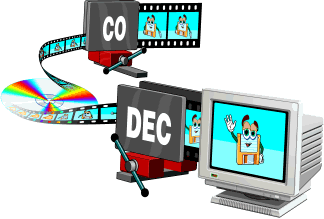
Therefore a large number of organizations and companies have decided to create their codecs to be able to compress and decompress the audio and video. Precisely the term codec comes from CODify and DECodify. That is to say, each one of these organizations or companies creates its own method to encode or compress the audio or video and at the same time has a decoder to be able to listen or watch the audio or video.

Obviously each of these codex have been implemented following different paradigms, looking for different objectives, having different objectives. For example, for some codecs, compression has been the priority, that is, saving space, while others have sought to save space, but without losing quality or details in the audio or video.

video formats

Each of these codecs produces different files that can only be encoded and decoded by the specific codec of that organization or that company, this causes that file to have a different name. From there we understand that there is a great variety of options and not always one is better than the others but it depends on what we are looking for. Which of the options will work better for us. It is not the same what is appropriate for a person who wants to play music on a computer with a high quality audio card and who will use high quality speakers, which will be very different from what is appropriate for a person what will Listen to the music using a small smartphone that perhaps has low quality speakers. Therefore, it would be unnecessary to store the music in a format that will take up more space but maintain a quality that the phone is not able to play. The same applies to any device that is capable of playing music or video files, you should always use that format that saves the files in a quality that is what the device can play. That way we avoid saving poor files that have a lower quality than our device could have played, or on the contrary save files that have too much information and quality that cannot be played by the device we are going to use.

Then we will understand that those people, often extremists and their opinions about audio and video, who ensure that an audio or video format should always be used, may be exaggerating and their recommendation may not be the most optimal. Most likely, we will have to see where we are going to play that audio and depending on the Audio Response Range and the video response range it is what we end up indicating which is the most appropriate format for our need.