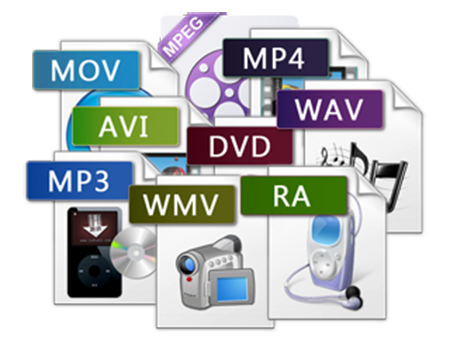
Advantages and disadvantages of the main formats


Free Download Mp4Gain
picture

Formats

The MP4 file format

The MP4 file format has long been one of the most popular video formats on the web. Thanks to good compression coupled with good video file quality, excellent compromises can be achieved. The codecs used for MP4 are mainly H.264 or H.265.

Advantage

The format offers a good compromise between image quality and compression and is particularly compelling due to the simple ability to bundle multiple audio tracks and additional elements into a single format.

Disadvantages

MP4 files are often heavily compressed using standard codecs, making processing and creation difficult.

The AVI file format

The abbreviation AVI stands for Audio Video Interleave and means that in this format the video and audio tracks are directly linked to each other. The format is widespread, but technically obsolete.

Advantage

This format is mainly characterized by a very high level of acceptance. There is hardly any player and hardly any browser that does not support AVI files.

Disadvantages

The technical limitations of the file format and, above all, the lack of ability to use multiple audio tracks mean that fewer and fewer users are using the AVI file format.

The MKV file format

The MKV format is currently one of the most popular video formats on the net. It is a powerful container format that can integrate not only video files but also audio tracks, menus, and many other functions.

Advantage

The MKV format is particularly compelling due to the high quality of video files and the wide range of functions in which the format can be used. The format can only be used with the appropriate codec, but it is freely available on the net.

Disadvantages

The disadvantages of the format are mainly the low compression properties, so it is not possible to create very compact files.

The MOV file format

This video format was developed by Apple and is designed primarily for use with Quicktime. However, the format is no longer up to date and is therefore rarely used for network applications.

Advantage

The advantages of the format are mainly the ease of use in an Apple environment and the very high compression, which allows to obtain small files.

Disadvantages

Due to the very high compression of video files, there is a consequent loss of images and information. While relatively small and compact files can be created, in most cases the result is not as convincing.

The OGG file format

The OGG video file format was developed, among other things, to bring more flexibility to the market structure, which is often controlled by the rights holders. The OGG format was one of the first formats to be used in a widespread environment such as Linux, and thus it was able to establish itself in the market very quickly.

Advantage

The OGG file format has the advantage of being very widespread and not having authorization keys. Therefore, most browsers can extract it and use it natively. As a result, this video file format is often used to embed video files on your website.

Disadvantages

Despite the wide distribution, there are also downsides. Both the Safari browser and the older Internet Explorer only partially support the format, which can lead to display issues.

The VOB file format

The VOB video file format was established relatively early as the standard for DVD and was therefore developed primarily for these media. The format is not suitable for network use due to lack of licenses and low compression.

Advantage

The format can be easily read by any DVD player and also offers the advantage of low compression. It also allows you to merge different audio tracks.

Disadvantages

The VOB format is not suitable for network use as it cannot be uploaded on various platforms or on your own website. To play the format, you need your own codec, which is not freely available.

The WMV file format

The WMV format was developed by Microsoft and is still widely used today. Since this format supports digital rights management (DRM), it is generally used whenever the copyright of the video file is required.

Advantage

The format is recognized as reliable on all common devices with the Microsoft operating system and can be used without problems.

Disadvantages

As the format is older, very large video files are only partially supported. There are also limitations on file size and video quality.


Free Download Mp4Gain
picture


Mp4Gain Main Window
picture


Mp4Gain Features
picture


Free Download Mp4Gain
picture

different audio formats

different audio formats

Many times people ask themselves what makes one format different from another and the answer is quite simple because the difference is how the data is stored and how this data is reproduced.


What does an audio file contain? You could say what it contains is an encoding that shows the voltage of the audio which makes it play shows the level of signal a channel has.

Types of audio formats

You could say that in general terms there are three types of audio formats. First of all we have uncompressed formats such as WAV For example.

Secondly, we could talk about formats without loss of quality such as flac and other well-known ones.

Thirdly we will find the formats that have loss of quality. That is to say that to compress they use some method where they discard information for being redundant or for being outside the Auditory Range of the human being among these formats the best known and important is the MP3

Then once understanding what there are three different types of audio formats. The first one, as we mentioned, is about pcm formats such as the WAV type where there is no compression and for example recording a minute of silence occupies more or less the same space as recording a minute of music.

A second type as we have already said is one that uses a compression algorithm that among other things discards silence and redundancy to compress and save space. But without losing information, we know that quality is not lost. The latter is very easy to understand, if the information contained in the file is the same Then there is no loss and therefore the quality is the same as the files without compression with the advantage that here you save at least half of the space.

And as we noted earlier, the third type of audio formats is one in which information is discarded which may be, for example, redundant information or that which is considered to be outside the auditory field of the human ear and therefore it is assumed that It would mean a noticeable loss of quality. However, there are frequencies that we do not hear but if we feel them especially the serious frequencies and this can be understood by anyone who goes to a danceable place. And it will make us that the dance floor not only listens to the bass and the percussions but also feels and that if we remove this information we feel we would be losing quality. There is a lot of information that is lost in the MP3s, for example, which manage to have a very good sound but if we get very demanding without attacking that there is a loss of quality that can become noticeable for people who have a hearing training or a very good ear.

As a summary we will say that today we have a large number of available formats according to our needs and preferences. There is a program called mp4gain which manages to normalize the most popular files of the three types and can also do other things How to modify the Pitch without affecting the speed or on the contrary modify the speed without affecting the Pitch. Which is very interesting. It also offers the possibility of equalizing, which still achieves a greater resemblance between all the files so that the difference is less noticeable when finishing a song and starting the next one.

Why are there so many audio formats and video formats?

People wonder what the reason is, and why there are so many different audio formats and so many different video formats.
This whole issue of audio formats and video formats seems a great confusion. Most users are not very clear because there are so many possibilities, or which are better for their needs.
In general they are guided by what some people tell them, without actually understanding in depth about the subject, but they are simply guided by some reading, by a video from your YouTube, by someone’s comment, and so on.

codec

What are audio formats or video formats?

The easiest way to explain it would be to say that the sound in raw form, without any kind of compression saves a lot of information so it occupies a large amount of space and also the use of the computer cpu when playing it. If you do a detailed analysis, you will realize that some of this raw data does not need to be saved either because they are redundant, because they are inaudible, etc.

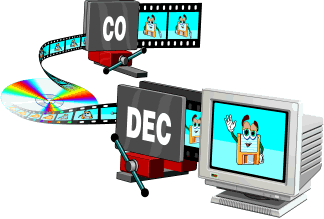
Therefore a large number of organizations and companies have decided to create their codecs to be able to compress and decompress the audio and video. Precisely the term codec comes from CODify and DECodify. That is to say, each one of these organizations or companies creates its own method to encode or compress the audio or video and at the same time has a decoder to be able to listen or watch the audio or video.

Obviously each of these codex have been implemented following different paradigms, looking for different objectives, having different objectives. For example, for some codecs, compression has been the priority, that is, saving space, while others have sought to save space, but without losing quality or details in the audio or video.

video formats

Each of these codecs produces different files that can only be encoded and decoded by the specific codec of that organization or that company, this causes that file to have a different name. From there we understand that there is a great variety of options and not always one is better than the others but it depends on what we are looking for. Which of the options will work better for us. It is not the same what is appropriate for a person who wants to play music on a computer with a high quality audio card and who will use high quality speakers, which will be very different from what is appropriate for a person what will Listen to the music using a small smartphone that perhaps has low quality speakers. Therefore, it would be unnecessary to store the music in a format that will take up more space but maintain a quality that the phone is not able to play. The same applies to any device that is capable of playing music or video files, you should always use that format that saves the files in a quality that is what the device can play. That way we avoid saving poor files that have a lower quality than our device could have played, or on the contrary save files that have too much information and quality that cannot be played by the device we are going to use.

Then we will understand that those people, often extremists and their opinions about audio and video, who ensure that an audio or video format should always be used, may be exaggerating and their recommendation may not be the most optimal. Most likely, we will have to see where we are going to play that audio and depending on the Audio Response Range and the video response range it is what we end up indicating which is the most appropriate format for our need.