Understanding the Differences between FLAC, MP3, M4A, OGG, and WAV Audio Formats


Free Download Mp4Gain
picture

Understanding the Differences between FLAC, MP3, M4A, OGG, and WAV Audio Formats
Understanding the Differences between FLAC, MP3, M4A, OGG, and WAV Audio Formats


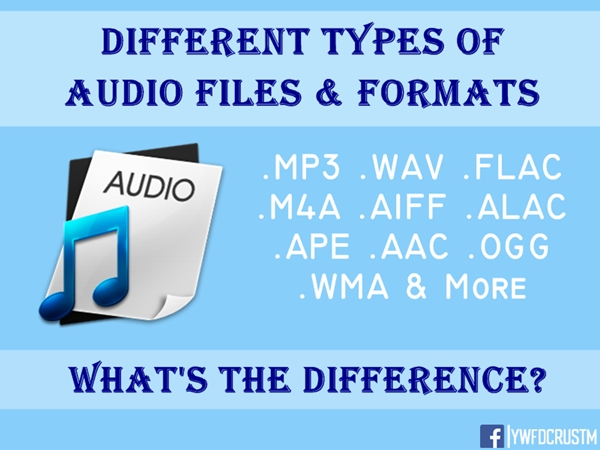
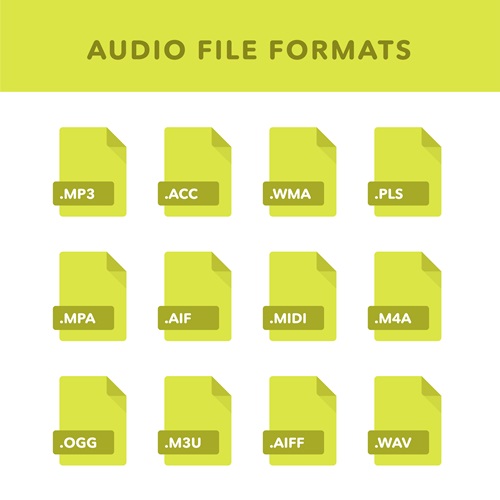
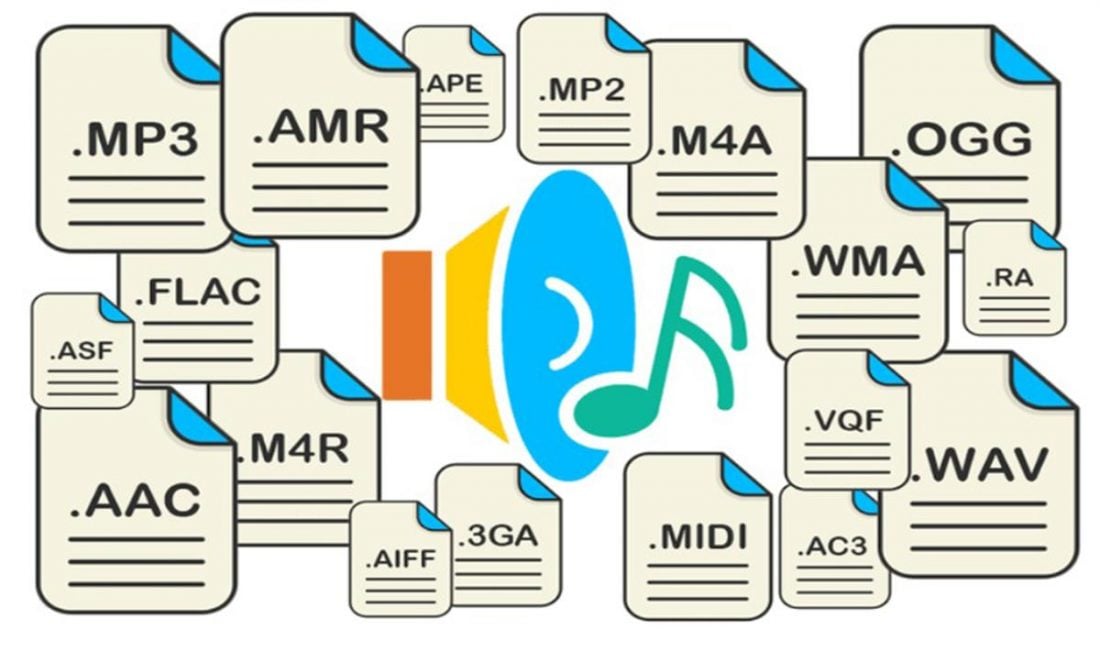
When it comes to digital audio, there are a plethora of different file formats to choose from. Each format has its own set of advantages and disadvantages, making it important to understand the differences between them in order to choose the best option for your needs. In this article, we will take a closer look at five popular audio formats: FLAC, MP3, M4A, OGG, and WAV.
Understanding the Differences between FLAC, MP3, M4A, OGG, and WAV Audio Formats

FLAC

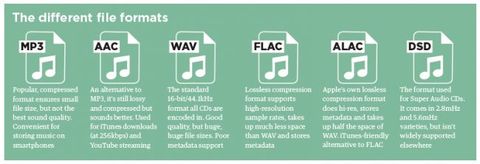
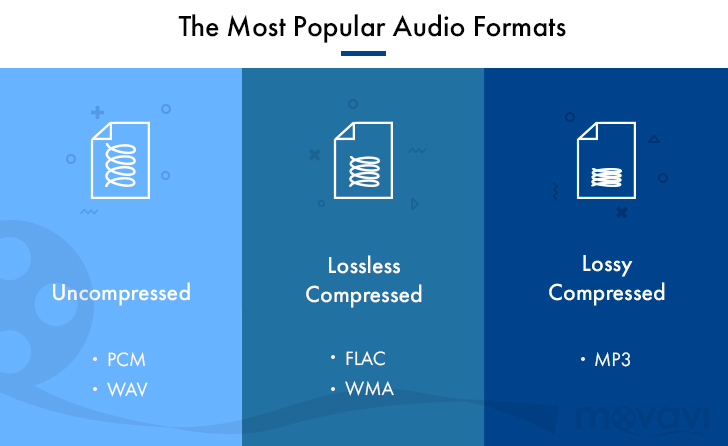
FLAC, or Free Lossless Audio Codec, is a popular open-source format that is known for its lossless compression. This means that, unlike some other formats, FLAC does not lose any audio quality during the compression process. This makes FLAC a great option for audiophiles who want the highest quality audio possible. However, FLAC files are typically larger than other formats, which can be an issue for those with limited storage space.

MP3

MP3, or MPEG Audio Layer III, is one of the most widely used audio formats. It uses a lossy compression method, which means that some audio quality is lost during the compression process. However, MP3 files are significantly smaller than FLAC files, making them a great option for those who want to store a large amount of music on their device. Additionally, the MP3 format is supported by a wide range of devices and software, making it a very convenient option.

M4A

M4A, or MPEG-4 Audio, is a file format that is commonly used for music and other audio files. It is similar to MP3 in that it uses a lossy compression method, but M4A files are typically smaller than MP3 files. Additionally, M4A files can contain advanced features such as chapters and artwork, making them a great option for audiobooks and other spoken-word content. However, it is important to note that not all devices and software support M4A files.

OGG

OGG, or Ogg Vorbis, is a free and open-source format that is similar to MP3 and M4A. It uses a lossy compression method and is known for providing a good balance of audio quality and file size. OGG files are typically smaller than FLAC files but larger than MP3 and M4A files. Additionally, OGG files can contain advanced features such as tags and chapters, making them a great option for audiobooks and other spoken-word content. However, it is important to note that not all devices and software support OGG files.

WAV

WAV, or Waveform Audio File Format, is a popular format that is known for its high audio quality. It is a lossless format, which means that no audio quality is lost during the compression process. However, WAV files are typically larger than other formats, making them an option for those who want the highest quality audio possible but have limited storage space. Additionally, WAV files are supported by a wide range of devices and software, making them a convenient option.


Free Download Mp4Gain
picture


Mp4Gain Main Window
picture


Mp4Gain Features
picture


Free Download Mp4Gain
picture

Why are there so many video and audio formats, and is there a difference?

Why are there so many video and audio formats, and is there a difference?

Audio File Formats
Audio File Formats

I found that there are many video and audio formats, what is the difference between them? Is there a player that supports most audio and video playback formats?

Audio File Formats
Audio File Formats

The difference lies in the encoding method. Original video and audio require a lot of storage space. In the era when the storage device was still in MB as a large drive, various lossy compression encoding formats began to appear. The difference between various encoding formats is the compression ratio. The pros and cons of height and reduction ratio.

Basically, there are more advanced encodings that can provide high-quality audio and video effects with higher compression ratio.

1. Format
MP3 MP3 uses MPEG Audio Layer 3 technology to compress music into a file with a smaller capacity at a compression ratio of 1:10 or even 1:12. Files are compressed to a smaller size. But also very good at keeping the original sound quality. It is precisely because of the small size and high sound quality of MP3 that the MP3 format has become almost synonymous with online music. The music per minute MP3 format is only 1 MB in size, so the size of each song is only 3-4 megabytes.

Supplement: the highest bit rate is 320K, and there is no high frequency part is its default. The sound quality is not high!

2. Format
WMA WMA achieves a higher compression ratio by reducing data traffic while maintaining sound quality. The compression rate can generally reach 1:18, and the generated file size is only half of the corresponding MP3 file. This is very important for models that only assemble 32M. It supports both WMA and RA formats, which means that the 32M space is virtually expanded by 2 times. In addition, WMA can also add copy prevention through the DRM scheme, or add restrictions on playback time and number of playbacks, or even restrictions on playback machines, which can effectively prevent piracy.
Supplement: 128 kbps is the optimal compression ratio of wma, 128 kbps wma = 192 kbps mp3

[Music] File format types Part 3

[Music] File format types Part 3

Audio Formats

Lossless compression format

Audio Files Formats


This format compresses the original data while preserving it.

FLAC
A THE C
During playback, it can be decompressed and returned to the original uncompressed format, so the sound quality is the same as the original data.

Although the file size can be reduced compared to the uncompressed format, it is still about half, so the file size is larger than the lossy compressed format and it takes longer to encode and decode.

Also, at present, it is often not handled by major music distribution sites, and the number of devices that can play it is less than that of uncompressed formats. The most common of these formats is “FLAC”, and Apple uses a unique format called “ALAC”.

FLAC (Free Lossless Audio Codec)
A lossless audio codec developed as open source.

It is not subject to patent restrictions, is not owned by any company, and has no license fees for its use.

Also, the sampling frequency is 1Hz – 655.3kHz (655,350Hz), and the number of quantization bits is 4 to 32 bits, so the so-called high-resolution music (including the frequency elements beyond the range human audible) can also be encoded. . However, since it is lossless, the compression rate is low and the file size is only about half. First of all, iOS 11 now supports playback from the “File” app.

ALAC (Apple Lossless)
Apple Lossless is a lossless compression format developed by Apple for iPod.

It can maintain the same sound quality as a music CD, but the compression ratio is not as good as lossy compression formats like MP3. With lossy compression, the deterioration in sound quality is noticeable, so it may be better to use it for classical music only.

This format was released as open source on October 27, 2011. You can use it freely under the free Apache license.

Relationship between bit depth, sample rate, and bit rate
Music data has numbers like bit depth and sample rate that indicate the amount of music data per second.

And the product of the two is the “bit rate”.

Sampling rate
Also known as the sample rate. Shows how many tens of thousands of sounds are collected per second.

The higher the value, the greater the number of divisions, which results in a smoother sound and improved sound quality.

By the way, the CD is 44100Hz.

Bit depth
Also known as quantization bit count, bid reduction, sample bit count.

This shows how much capacity is given to the split data.

The louder the sound, the better the sound and the sound quality will be improved.

The CD is 16 bit.

Bit rate
It is displayed as bps and shows the amount of data per second.

It is the product of the “sample rate” and the “bit depth” mentioned above.

In the case of a stereo file, there are two sounds, so if you formulate it …

Sampling rate (Hz) x bit depth (bits) x 2 = bit rate (bps)

A high bit rate means that the “sample rate” and “bit depth” are large and the sound quality is good.

By the way, in the case of CD

44100 (Hz) x 16 (bits) x 2 = 1411200 (bps)

Will be.

Why is there so much format
Each has its advantages and disadvantages, and you can make better use of your data by using it correctly.

For example, if you want to save this album with the best sound quality because you don’t care about the amount of data, import it with “WAV” or “AIFF” and save it with the highest possible bit rate. If you have a compatible device, “FLAC” and “ALAC” are also storage saving options.

“Sound quality is secondary! I want to import a lot of songs to my smartphone!” For those who want to import with “MP3”, they can import at as low a bit rate as possible (although 128 kbps or less is not often used as a music file). It may be convenient to use music as data according to the style.

By the way, the Apple Music I use is 256kbps of “AAC”, so it can be said that it is a format that emphasizes the balance between sound quality and data savings.

[Music] File format types Part 2

[Music] File format types Part 2

audio file format

Lossy compression format

audio file format

This compression format is probably the one you use the most.

MP3
CAA
WMA
Vorbis
This is the file format.

“The human audible range is 20Hz ~ 20000Hz”
This file format has the advantage that the file size can be suppressed while maintaining a certain level of sound quality by compressing and truncating the high-frequency part that humans cannot hear.

However, the downside is that the sound quality is lower than the original data.

Among them, “MP3” is the most popular file format, and as a successor, “AAC” is often used, which was created to achieve higher sound quality. Furthermore, “WMA” and “Vorbis” are also in this format.

MP3 (MPEG-1 Audio Layer 3)
It is one of the audio formats used in the “MPEG-1” video compression standard.

It is a popular format and many popular digital audio players support it. If you compress it into this format, you can play it on many players other than iPod.

It is generally said that if you specify a bit rate of 192 kbps or higher for MP3, it will be almost indistinguishable from the original music.

Recently, the capacity of the player has increased, so I think it is good to capture at 320 kbps, which is the highest sound quality of MP3.

There is also a method called VBR (variable bit rate), which efficiently obtains optimal data while changing the bit rate in a song, as opposed to CBR (constant bit rate).

However, when using VBR, the bit rate may be partially higher than necessary depending on the song, and some players may experience problems such as interrupted sound due to insufficient performance.

AAC (advanced audio coding)
It is one of the audio formats used in the “MPEG-2” and “MPEG-4” video compression standards.

ITunes has selected this AAC format as the standard compression format as a highly efficient and superior alternative to MP3.

However, there have been times when compatibility between products was poor in the past, and in rare cases, AAC files created by third-party software may not be playable on iPod. When using the AAC format, the bit rate should be 128 kbps or higher, especially 256 kbps or higher if you want high sound quality. The songs that are managed in the iTunes store are also in AAC format and have the extension “.m4a”.

WMA (Windows Media Audio)
A music compression format developed by Microsoft for the Windows operating system.

It is used in many Windows music distribution software and digital audio players. It is said that the file size can be reduced to half that of MP3 if the sound quality is the same. WMA format files are converted to AAC / MP3 format when imported into iTunes.

However, it is not possible to convert downloaded and purchased songs with copyright protection (DRM) to AAC format / MP3 format.

[Music] File format types

[Music] File format types

Music File Formats

Does everyone like music?

digital-formats

I think many people enjoy music downloading or streaming instead of CD these days, but what kind of format is music stored as data?

I researched the differences, advantages, and disadvantages of each format.

Types of audio compression

For music file format

Uncompressed
Lossy compression
Lossless compression
There are three types:
File-based compression can reduce file size and reduce download time and storage capacity.
Uncompressed format
As the name implies, it is an uncompressed file. The point is the original data.

The most used formats are:

Wav
AIFF
The advantage is the accuracy of the data. However, it also has the disadvantage of a large file size and uses approximately 10MB for a 1 minute audio file.

It is common to use “WAV” for Windows and “AIFF” for Macintosh.

WAV (WAVE)
A standard Windows audio file format established by Microsoft and IBM, also known as the WAVE format.

It is generally uncompressed and has good sound quality, but it is a very large file.

WAV format files are converted to AAC / MP3 format when imported into iTunes. You can specify compression for WAV, but there seem to be not many usage examples.

AIFF (Audio Interchange File Format)
This is a standard Macintosh audio file format established by Apple Inc. Like WAV, it is not compressed and has good sound quality, but it is a very large file. There is also AIFC, an extended format with lossy compression.

Advantages and disadvantages of the main formats

Formats

The MP4 file format

The MP4 file format has long been one of the most popular video formats on the web. Thanks to good compression coupled with good video file quality, excellent compromises can be achieved. The codecs used for MP4 are mainly H.264 or H.265.

Advantage

The format offers a good compromise between image quality and compression and is particularly compelling due to the simple ability to bundle multiple audio tracks and additional elements into a single format.

Disadvantages

MP4 files are often heavily compressed using standard codecs, making processing and creation difficult.

The AVI file format

The abbreviation AVI stands for Audio Video Interleave and means that in this format the video and audio tracks are directly linked to each other. The format is widespread, but technically obsolete.

Advantage

This format is mainly characterized by a very high level of acceptance. There is hardly any player and hardly any browser that does not support AVI files.

Disadvantages

The technical limitations of the file format and, above all, the lack of ability to use multiple audio tracks mean that fewer and fewer users are using the AVI file format.

The MKV file format

The MKV format is currently one of the most popular video formats on the net. It is a powerful container format that can integrate not only video files but also audio tracks, menus, and many other functions.

Advantage

The MKV format is particularly compelling due to the high quality of video files and the wide range of functions in which the format can be used. The format can only be used with the appropriate codec, but it is freely available on the net.

Disadvantages

The disadvantages of the format are mainly the low compression properties, so it is not possible to create very compact files.

The MOV file format

This video format was developed by Apple and is designed primarily for use with Quicktime. However, the format is no longer up to date and is therefore rarely used for network applications.

Advantage

The advantages of the format are mainly the ease of use in an Apple environment and the very high compression, which allows to obtain small files.

Disadvantages

Due to the very high compression of video files, there is a consequent loss of images and information. While relatively small and compact files can be created, in most cases the result is not as convincing.

The OGG file format

The OGG video file format was developed, among other things, to bring more flexibility to the market structure, which is often controlled by the rights holders. The OGG format was one of the first formats to be used in a widespread environment such as Linux, and thus it was able to establish itself in the market very quickly.

Advantage

The OGG file format has the advantage of being very widespread and not having authorization keys. Therefore, most browsers can extract it and use it natively. As a result, this video file format is often used to embed video files on your website.

Disadvantages

Despite the wide distribution, there are also downsides. Both the Safari browser and the older Internet Explorer only partially support the format, which can lead to display issues.

The VOB file format

The VOB video file format was established relatively early as the standard for DVD and was therefore developed primarily for these media. The format is not suitable for network use due to lack of licenses and low compression.

Advantage

The format can be easily read by any DVD player and also offers the advantage of low compression. It also allows you to merge different audio tracks.

Disadvantages

The VOB format is not suitable for network use as it cannot be uploaded on various platforms or on your own website. To play the format, you need your own codec, which is not freely available.

The WMV file format

The WMV format was developed by Microsoft and is still widely used today. Since this format supports digital rights management (DRM), it is generally used whenever the copyright of the video file is required.

Advantage

The format is recognized as reliable on all common devices with the Microsoft operating system and can be used without problems.

Disadvantages

As the format is older, very large video files are only partially supported. There are also limitations on file size and video quality.

What audio and video formats exist?

When we talk about the quality of videos or audio, many doubts arise in people’s minds, as there are many terms that are very confusing for the user. For example, people talk about kbs, people talk about bitrate, the sample rate and many other terms that are not clear in people’s mentality are mentioned.

But in the end the question is always the same, what is it that is truly decisive to have a better video quality or better audio quality? The answer can be simple if we summarize it: because the difference in quality will depend on the amount of information that is stored, because the more we will have more detail.

When we talk about video formats within the different types that are applied to digital video and that there are three important parts to distinguish in them on the Internet or on a DVD:

The video and its codec (When the video is so heavy, it must always be encoded and subsequently decoded). They are simply mathematical algorithms to compress and decompress the video file.
The audio and its different formats or containers.
The file that contains the audio and video. The container
Let’s see which are the most popular and try to explain them:

Digital Video Formats

MPEG: Moving Pictures Expert Group (Mpeg1, Mpeg2, Mp4 or Mpeg4)
AVI: It is the standard format but the one with the most weight. (Xvid or Divx)
WINDOWS MEDIA: Format developed by Microsoft. (. Mp4 or .asf)
MOV: Format developed by Apple. Quicktime needed to read it. Low weight.Ideal for Web (.m4v or .mov)
FLV: Adobe Flash format. Use Sorensen Spark codec. (.flv)
Digital Audio Formats

Mp3 or MPEG-1 Audio Layer 3: Tablet with imperceptible signal loss for humans. (1Mb / Min)
Aiff: Audio Interchange File Format. It has no compression and uses PCM modulation so they are very heavy (10 Mb / Min.)
AAC: Advanced Audio Coding. Mpeg-2 compression. Suitable for surround or surround sounds
Windows Media Audio: The worst quality of all the above, is the Windows format.
Formats of Digital Audio and Video Containers

.mp4
.mov
.avi
.mkv
.flv
.swf
.m4v
The truth is that it is a world and more when the big companies live thinking only of leading their own markets and not from the point of view of the user they have had abandoned for years. Obviously these are not all there are but if I wanted to include the best known.

But if we are talking about a file or files that any DVD or download from the Internet can have in any format or container type Mp4, mkv, avi with greater quality, we must remember that the important thing is the amount of information that they carry inside, it is say the Mbs to which this video is exported.

It is as if we have a 16-ton truck and we put a box of oranges inside when it can carry 1000 boxes of oranges. What we are going to see is oranges but with a very low quality.

I hope I have shed some light on this world of digital video and how the next time you face a file of this type you will be able to understand what each of the things that are attached to it means. I must admit that it is not easy but that with that global vision and knowing what each one means you feel better when facing him.

And you know some kind of format that you are using and do you think it is missing here? This is a live article to be developed among all and thus clarify all more.

Why are there so many audio formats and video formats?

People wonder what the reason is, and why there are so many different audio formats and so many different video formats.
This whole issue of audio formats and video formats seems a great confusion. Most users are not very clear because there are so many possibilities, or which are better for their needs.
In general they are guided by what some people tell them, without actually understanding in depth about the subject, but they are simply guided by some reading, by a video from your YouTube, by someone’s comment, and so on.

codec

What are audio formats or video formats?

The easiest way to explain it would be to say that the sound in raw form, without any kind of compression saves a lot of information so it occupies a large amount of space and also the use of the computer cpu when playing it. If you do a detailed analysis, you will realize that some of this raw data does not need to be saved either because they are redundant, because they are inaudible, etc.

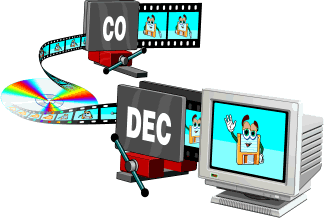
Therefore a large number of organizations and companies have decided to create their codecs to be able to compress and decompress the audio and video. Precisely the term codec comes from CODify and DECodify. That is to say, each one of these organizations or companies creates its own method to encode or compress the audio or video and at the same time has a decoder to be able to listen or watch the audio or video.

Obviously each of these codex have been implemented following different paradigms, looking for different objectives, having different objectives. For example, for some codecs, compression has been the priority, that is, saving space, while others have sought to save space, but without losing quality or details in the audio or video.

video formats

Each of these codecs produces different files that can only be encoded and decoded by the specific codec of that organization or that company, this causes that file to have a different name. From there we understand that there is a great variety of options and not always one is better than the others but it depends on what we are looking for. Which of the options will work better for us. It is not the same what is appropriate for a person who wants to play music on a computer with a high quality audio card and who will use high quality speakers, which will be very different from what is appropriate for a person what will Listen to the music using a small smartphone that perhaps has low quality speakers. Therefore, it would be unnecessary to store the music in a format that will take up more space but maintain a quality that the phone is not able to play. The same applies to any device that is capable of playing music or video files, you should always use that format that saves the files in a quality that is what the device can play. That way we avoid saving poor files that have a lower quality than our device could have played, or on the contrary save files that have too much information and quality that cannot be played by the device we are going to use.

Then we will understand that those people, often extremists and their opinions about audio and video, who ensure that an audio or video format should always be used, may be exaggerating and their recommendation may not be the most optimal. Most likely, we will have to see where we are going to play that audio and depending on the Audio Response Range and the video response range it is what we end up indicating which is the most appropriate format for our need.