FLAC Volume Booster

FLAC Volume Booster

FLAC Volume Booster
FLAC Volume Booster
FLAC Volume Booster
FLAC Volume Booster

If you’re looking to enhance the audio experience of your FLAC files, you’ve come to the right place. FLAC (Free Lossless Audio Codec) is known for its high-quality sound, but sometimes you may find that certain tracks are quieter than others or just not hitting the right volume level. Here, we’ll explore various methods and tools to boost the volume of your FLAC files effectively.

FLAC Audio Normalization

Audio normalization is the process of adjusting the volume of an audio file to a standardized level, making it consistent across all tracks. Many software applications and audio players offer this feature, allowing you to normalize your FLAC files with ease. By doing so, you can eliminate the hassle of manually adjusting the volume for each track and ensure a consistent listening experience.

FLAC Gain Adjustment

FLAC files often come with metadata tags that store information about the audio, including its volume level. Some audio players and software can read these tags and adjust the playback volume accordingly. By tweaking the gain or volume adjustment settings in your FLAC player or editor, you can fine-tune the volume to your liking without altering the original audio quality.

FLAC Volume Boosting Software

If you’re dealing with a large collection of FLAC files and want a quick and efficient way to boost their volume, consider using specialized FLAC volume boosting software. These tools are designed to analyze and amplify the audio within your FLAC files, ensuring that they sound louder and clearer without distortion.

FLAC Equalization

Equalization (EQ) is another technique that can help you achieve the desired volume for your FLAC files. It involves adjusting specific frequency bands in the audio to enhance or reduce certain aspects of the sound. By carefully applying EQ settings, you can make your FLAC tracks sound louder and more balanced.

FLAC Audio Converters

Converting your FLAC files to a different audio format can also impact their volume. Some formats, such as MP3, have built-in volume normalization during the encoding process. By converting your FLAC files to a format like MP3 with volume normalization enabled, you can ensure consistent volume levels across your music library.

FLAC Playback Enhancements

Exploring your audio player’s settings and features can often reveal hidden options for volume enhancement. Some players offer dynamic range compression (DRC) or volume leveling features that can automatically adjust the volume of your FLAC files as they play.

FLAC Replay Gain Tags

Replay Gain is a standardized method of calculating and storing volume adjustment information within audio files. Many FLAC files come with Replay Gain tags that can be utilized by compatible audio players to adjust playback volume automatically. Enabling this feature can simplify the process of achieving consistent audio levels.

FLAC Batch Processing

If you have numerous FLAC files that require volume adjustment, consider using batch processing tools. These applications allow you to apply volume boosting or normalization settings to multiple files simultaneously, saving you time and effort.

FLAC Volume Control Hardware

For audiophiles seeking precise control over their FLAC playback volume, dedicated hardware solutions are available. These devices offer analog or digital volume control to ensure that your FLAC files sound just the way you want them to.

FLAC Volume Boosting Apps

Mobile users can also enjoy enhanced FLAC audio with volume boosting apps. These apps are designed for smartphones and tablets, providing a convenient way to increase the volume and overall audio quality of your FLAC files on the go.

Final Words

Boosting the volume of your FLAC files can significantly improve your listening experience. Whether you prefer software-based solutions, hardware enhancements, or specialized apps, there are plenty of options to choose from. Experiment with these methods to find the one that suits your needs and enjoy your FLAC music at the perfect volume.

Flac Normalizer – How to Normalize FLAC Files with mp4gain

How to Normalize FLAC Files with mp4gain

Flac Normalizer
Flac Normalizer
Flac Normalizer
Flac Normalizer


FLAC is a lossless audio format that offers excellent sound quality. However, the volume of FLAC files can vary, which can be annoying when listening to music. Normalization is the process of adjusting the volume of audio files so that they have a consistent level. This can help to ensure that your FLAC files sound their best, regardless of the playback device or software you use.

There are a number of different ways to normalize FLAC files. One popular option is to use mp4gain. mp4gain is a tool that can be used to normalize FLAC files on Windows.

To use mp4gain, simply download the software and install it on your computer. Once installed, open mp4gain and select the FLAC files that you want to normalize. You can then adjust the target volume level. The default target volume level is 89dB, but you may want to adjust this level depending on your preferences.

Once you have set the target volume level, click on the “Normalize” button. mp4gain will then normalize the FLAC files and save them to your computer.

Why Normalize FLAC Files?

There are a few reasons why you might want to normalize FLAC files. First, normalization can help to improve the overall sound quality of your FLAC files. When FLAC files are not normalized, the volume of each file can vary, which can make it difficult to listen to music in a consistent way. Normalization helps to ensure that all of your FLAC files have a consistent volume level, which can make your music sound better.

Second, normalization can help to prevent clipping. Clipping occurs when the volume of an audio file is too high and the waveform reaches the maximum level. This can cause distortion and make your music sound unpleasant. Normalization can help to prevent clipping by ensuring that the volume of your FLAC files is not too high.

Finally, normalization can help to make your FLAC files more compatible with different playback devices and software. Some playback devices and software have different volume settings, which can make it difficult to get your FLAC files to sound the same on all devices. Normalization can help to ensure that your FLAC files sound consistent regardless of the playback device or software you use.

How to Use mp4gain

Using mp4gain to normalize FLAC files is very simple. Here are the steps involved:

Download and install mp4gain on your computer.
Open mp4gain and select the FLAC files that you want to normalize.
Adjust the target volume level. The default target volume level is 89dB, but you may want to adjust this level depending on your preferences.
Click on the “Normalize” button. mp4gain will then normalize the FLAC files and save them to your computer.
**

Final Words About Normalization

Normalization is a simple but effective way to improve the sound quality of your FLAC files. If you want to make sure that your FLAC files sound their best, I recommend using mp4gain to normalize them.

What is the difference between MP3 and FLAC

What is the difference between MP3 and FLAC

Flac vs Mp3
Flac vs Mp3

Know what the different types of audio files offer

Flac vs Mp3
Flac vs Mp3

The recent launch of Pono’s music player and service aims to provide high-quality audio for music lovers who, more than looking for portability and practicality, are interested in enjoying compositions as the artist intended them to be heard. In order to deliver the highest level of digital audio, PonoPlayer will rely on FLAC type files.


But what is the problem with the popular MP3 or why is FLAC of better quality? Actually, in addition to these 2 formats, there are others with different specifications that differentiate them from each other.

In this article we will talk about the most important formats and their characteristics, so you can choose the one that suits you best.

What is bitrate?
The difference in file size is noticeable
You’ve probably heard this term before, but in case you don’t remember it or don’t know what it refers to, I’ll explain it. The bitrate is translated as the speed of transmission of bits, that is, the number of bits or data that are processed in a unit of time. When referring to audio, we usually use the measure of kilobits per second (Kbps). For example, the music available on iTunes is usually 256 Kbps, which means that there are 256 kilobits of information stored in each second of the song.

The higher the bitrate of a file, the more space it takes up on your hard drive. A music CD usually uses a large amount of memory space, so back in the early 1990s, researcher Karlheinz Brandenburg developed the audio compression standard we now know as MP3. When an audio file is compressed, the space allocated for it is less, however, this means that it loses some of its sound quality. For that reason the different available audio formats are divided into 2 categories: lossy and lossless.

What is the difference between flac and mp3

What is the difference between flac and mp3

FLAC vs MP3
FLAC vs MP3

First, the sound quality is different.

FLAC vs MP3
FLAC vs MP3

1. flac: It will not destroy any original audio information, so you can restore the sound quality of music CD.

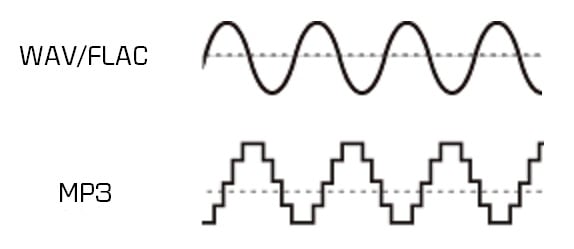
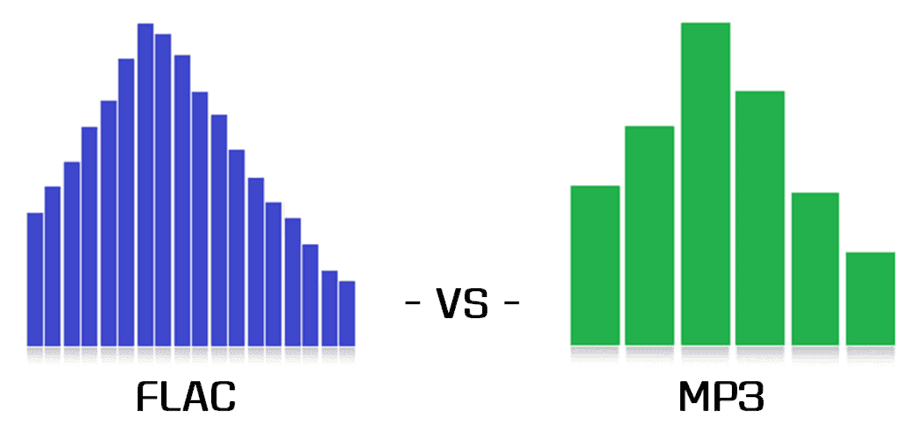
2, mp3: is designed to greatly reduce the amount of audio data. Using MPEG Audio Layer 3 technology, music can be compressed into a smaller capacity file with a compression ratio of 1:10 or even 1:12.

Second, the audio is different.

1. flac: After compressing the audio with FLAC encoding, no information will be lost. After restoring the FLAC file to a WAV file, the content of the WAV file before compression is the same.

2. mp3: The human ear is not sensitive to high-frequency sound signals. The time domain waveform signal is converted to a frequency domain signal and divided into multiple frequency bands. Different compression ratios are used for different frequency bands, and the high-frequency compression ratio increases (even ignoring the signal) uses a small compression ratio for low-frequency signals to ensure that the signal is not distorted.

What format is flac? Can you play mp3 in flac format?

What format is flac? Can you play mp3 in flac format?

flac file

How to play flac format?

FLAC

FLAC is short for Free Lossless Audio Codec, which can be interpreted as lossless audio compression coding in Chinese. FLAC is a well-known free audio compression codec, which is characterized by lossless compression. Unlike other lossy compression codes such as MP3 and AAC, it does not destroy any original audio data, so it can restore the sound quality of music discs. It is now compatible with many software and hardware audio products. To play flac format in MP3, you need to convert the format. The specific operation method is as follows: 1. Download the format factory class format conversion software, install it and open it. 2. Click the FLAC format on the open interface, and open the FLAC format file to convert on this page. It is equivalent to inputting the file in this format into the software. 3. On the opened page, browse and select the MP3 format to be output, and then select the sound quality effect to be output, and then click Start or OK. 4. After the conversion is complete, connect the MP3 player to the computer. 5. Copy the converted files to MP3 storage. 6. Safely eject the device, remove the MP3 player and start playing the music.

FLAC stands for Free Lossless Audio Codec – Free lossless audio compression. In short, FLAC is similar to MP3, but it has lossless compression, which means that the audio is compressed in FLAC without losing any information. This compression is similar to Zip, but FLAC will give you a higher compression ratio, because FLAC is a compression method specially designed for the characteristics of audio, and you can use the player to play FLAC compressed files like you normally play MP3 files (there are already there are many FLAC-compatible car players and home audio equipment, and you can find links to these equipment manufacturers on the FLAC website). General hi-fi players can be used, and normal MP3 generally supports MP3 and WAV formats. Common lossless formats are: FLAC, APE, TTA, TAK, ALAC APE is the most popular lossless audio, APE is featured on major resource stations and even in many people’s minds, only APE is lossless. This is thanks to the promotion of the APE encoder by Monkey’s Audio. In fact, the compression rate of APE is very good and the encoding speed is fast enough.

Normalize FLAC – FLAC loudness normalizer

Normalize FLAC – FLAC loudness normalizer

FLAC

Normalize the volume of a FLAC file

flac

Mp4Gain is capable of normalizing the loudness of FLAC, Ogg, etc. files. And also videos.

You can normalize the volume level (volume leveler, volume enhancer) of your FLAC files.

All this with the push of a button.

What is a FLAC?

FLAC can be interpreted as lossless audio compression coding. FLAC is a well-known free audio compression codec, which is characterized by lossless compression. Unlike other lossy compression codes, such as MP3 and AAC, it does not destroy any original audio information, so it can restore the sound quality of music discs [1] . It has been compatible with many software and hardware audio products (such as CDs, etc.) since 2012.

FLAC is different from MP3 .MP3 is a lossy audio compression encoding, but FLAC is a lossless compression, which means no information will be lost after the audio is compressed with the FLAC encoding. After the file is restored FLAC to a WAV file, the contents of the WAV file before compression itself. This compression is similar to ZIP, but FLAC has a higher compression rate than ZIP and RAR because FLAC is a compression method specially designed for the characteristics of PCM audio. And you can use the player to play FLAC compressed files directly, just like MP3 files (there are many car players and home audio equipment that support FLAC, you can find links to these equipment manufacturers on the FLAC website) .

FLAC is free and is supported by most operating systems, including Windows.

Now major websites have FLAC music downloads, and publishers usually take the .cda audio track directly into .flac after buying the CD to ensure the original lossless quality of the CD.
Lossless formats work very well with good headphones.

Really terrifying audio compression

Really terrifying audio compression

FLAC


Check the deterioration of sound quality by “appearance”!


FLAC


■ What format do you choose when copying? AIFF, ALAC, AAC … Check the sound quality of each by “appearance”

Music files are the main audio playback source for Imadoki. Except when purchased from online distribution, the sound quality of the music files used here is largely related to the work of reading audio data from a CD to a PC, the so-called “ripping” setting. This time I would like to review that part in a little more detail.

The first half of this article describes the basics of the extraction format for those who want to know what quality of sound to choose when extracting. Perhaps this first half is common information to many file and web readers.

However, the highlights are beyond that. “Really Terrifying Audio Compression” … So, in the second half of the article, “How much does the compressed file actually deteriorate the sound?” And “How much does the sound quality change depending on the bit rate value?” you will check with (→ Visually check the sound quality of AIFF, ALAC, AAC!). I would like you to stay with us until the end.

■ Not to mention now … First, let’s review the basics

The scheme of the options for copying is “compression format (file format)” and “bit rate”. These two determine the sound quality and file size, which is another important factor.

“Compressed format (file format)” refers to formats such as AAC, MP3, Apple Lossless, and FLAC. This selection determines the sound quality, file size, and playback environment.

The “bit rate” is the amount of data allocated per second of audio. The higher the value (kbps), the higher the sound quality, but the larger the file size.

In the case of iTunes, call this screen “Load Settings” from the environment settings and configure the extraction.

Please refer to the following table based on that. We have summarized the characteristics of typical compression formats and bit rate settings.

The item “Sample bit rate settings” in the table is cited from the default settings provided in iTunes (* iTunes does not support FLAC)

First, pay attention to the second item from the left of the table. Compression formats can be broadly classified into “lossy compression”, “lossless compression” and “uncompressed”.

The “lossy compression” method, which AAC and MP3 belong to, achieves a high compression rate = a significant reduction in file capacity by reducing some of the data when compressing audio data. In contrast, the original audio data cannot be fully restored during playback and deterioration in sound quality is inevitable. The degree of deterioration in sound quality changes depending on the bit rate setting. The lower the value of the bit rate, the greater the deterioration in sound quality and, conversely, the higher the value of the bit rate, the more mitigated.

The “lossless compression” method, to which Apple Lossless and FLAC belong, is a method that can fully restore the original audio data during playback, at the cost of a low compression rate. The file size is large, but the sound quality is equivalent to that of a CD. The bit rate fluctuates automatically according to the content of the audio data, and the compression rate is not constant accordingly.

AIFF and WAV are “uncompressed” methods. Extract the original audio data and create a file as is. It does not compress, so it has a lot of capacity, but the sound quality is perfect.