What is the difference between MP3 and FLAC


Free Download Mp4Gain
picture

What is the difference between MP3 and FLAC

Flac vs Mp3
Flac vs Mp3

Know what the different types of audio files offer

Flac vs Mp3
Flac vs Mp3

The recent launch of Pono’s music player and service aims to provide high-quality audio for music lovers who, more than looking for portability and practicality, are interested in enjoying compositions as the artist intended them to be heard. In order to deliver the highest level of digital audio, PonoPlayer will rely on FLAC type files.


But what is the problem with the popular MP3 or why is FLAC of better quality? Actually, in addition to these 2 formats, there are others with different specifications that differentiate them from each other.

In this article we will talk about the most important formats and their characteristics, so you can choose the one that suits you best.

What is bitrate?
The difference in file size is noticeable
You’ve probably heard this term before, but in case you don’t remember it or don’t know what it refers to, I’ll explain it. The bitrate is translated as the speed of transmission of bits, that is, the number of bits or data that are processed in a unit of time. When referring to audio, we usually use the measure of kilobits per second (Kbps). For example, the music available on iTunes is usually 256 Kbps, which means that there are 256 kilobits of information stored in each second of the song.

The higher the bitrate of a file, the more space it takes up on your hard drive. A music CD usually uses a large amount of memory space, so back in the early 1990s, researcher Karlheinz Brandenburg developed the audio compression standard we now know as MP3. When an audio file is compressed, the space allocated for it is less, however, this means that it loses some of its sound quality. For that reason the different available audio formats are divided into 2 categories: lossy and lossless.


Free Download Mp4Gain
picture


Mp4Gain Main Window
picture


Mp4Gain Features
picture


Free Download Mp4Gain
picture

What is the difference between flac and mp3

What is the difference between flac and mp3

FLAC vs MP3
FLAC vs MP3

First, the sound quality is different.

FLAC vs MP3
FLAC vs MP3

1. flac: It will not destroy any original audio information, so you can restore the sound quality of music CD.

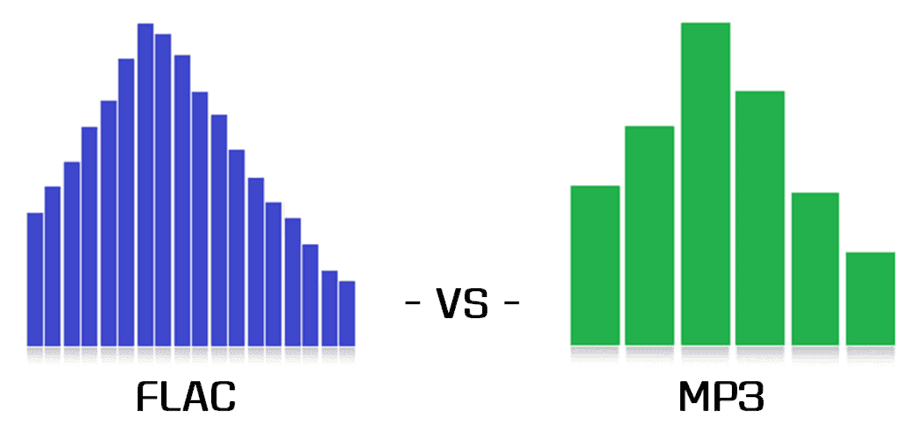
2, mp3: is designed to greatly reduce the amount of audio data. Using MPEG Audio Layer 3 technology, music can be compressed into a smaller capacity file with a compression ratio of 1:10 or even 1:12.

Second, the audio is different.

1. flac: After compressing the audio with FLAC encoding, no information will be lost. After restoring the FLAC file to a WAV file, the content of the WAV file before compression is the same.

2. mp3: The human ear is not sensitive to high-frequency sound signals. The time domain waveform signal is converted to a frequency domain signal and divided into multiple frequency bands. Different compression ratios are used for different frequency bands, and the high-frequency compression ratio increases (even ignoring the signal) uses a small compression ratio for low-frequency signals to ensure that the signal is not distorted.

Is FLAC better than Mp3? Expert opinion.

Is FLAC better than Mp3? Expert opinion.

FLAC vs. MP3
FLAC vs. MP3

Many wonder if FLAC is really better than mp3.

FLAC vs. MP3
FLAC vs. MP3


This is a question that we receive frequently and not only regarding FLAC, but also ogg, m4a, etc.

The answer is simple, but it retains its complexity.

Simple because in strictly mathematical, acoustic, digital terms, if FLAC is superior.

But the complexity is: can an ordinary person using a normal (not quite professional) hi-fi or ordinary equipment tell the difference?

The answer is: in 99% of cases, not even a music professional will tell the difference if more than 190 kbs and at least 44,100 samplerates are used in the mp3.

With that quality in the mp3, which is not unusual or very high quality, it is already enough that most people, including people with audio training, cannot tell the difference.

So, it is a purist claim to say as an absolute answer, that FLAC is superior to Mp3.

For the common user there will be no major difference and on the other hand they will have certain points against them, such as the fact that there are not so many teams that accept or handle FLAC well or that if they are going to listen to it, for example, in the car, it does not make much sense to put time, money and effort to use a format that will sound the same, the only advantage is to tell his friends that he uses a better format.

MP3 and FLAC: who wins?

MP3 and FLAC: who wins?

Mp3 & FLAC

Music lovers from all countries have been arguing for many years: is it possible to distinguish a high-quality MP3 from a lossless one in a blind test (FLAC, APE, etc.)? How much does compression loss affect the perception of music? Should you give up MP3? Let’s try to answer these questions.

FLAC vs MP3

A little history
In the early 1990s, experts understood that the future of music was digital. However, hard drives were expensive then and fans preferred to store their music collections on cassettes and CDs. The researchers faced a problem: they needed a suitable format to store records on computers. At the same time, every hundred kilobytes were counted – you can slightly sacrifice quality compared to CDs, but save precious hard drive space.

In the late 1980s, the first functional prototypes of a new lossy compressed audio storage format, MP3, were created. The first publicly available MP3 encoder appeared in 1994, and the first playback software soon followed. The first encoding algorithms made it possible to obtain files with slightly “chopped” high frequencies. The sound quality was not comparable to that of a CD, but the output file sizes were quite acceptable.

In the early 2000s, volumes on hard drives were growing rapidly and other audio formats that provide lossless compression began to appear. Relatively speaking, an audio track of this format can be restored to the original WAV from a lossless CD. Perhaps the most popular lossless compression format was FLAC, introduced in 2001. It is suitable for both storing home audio collections and playing music on professional computers. However, a FLAC file can be 6-10 times heavier than a good quality MP3 (256 or 320 kbps). But does file size and losslessness mean consistently high sound quality?

find 10 differences
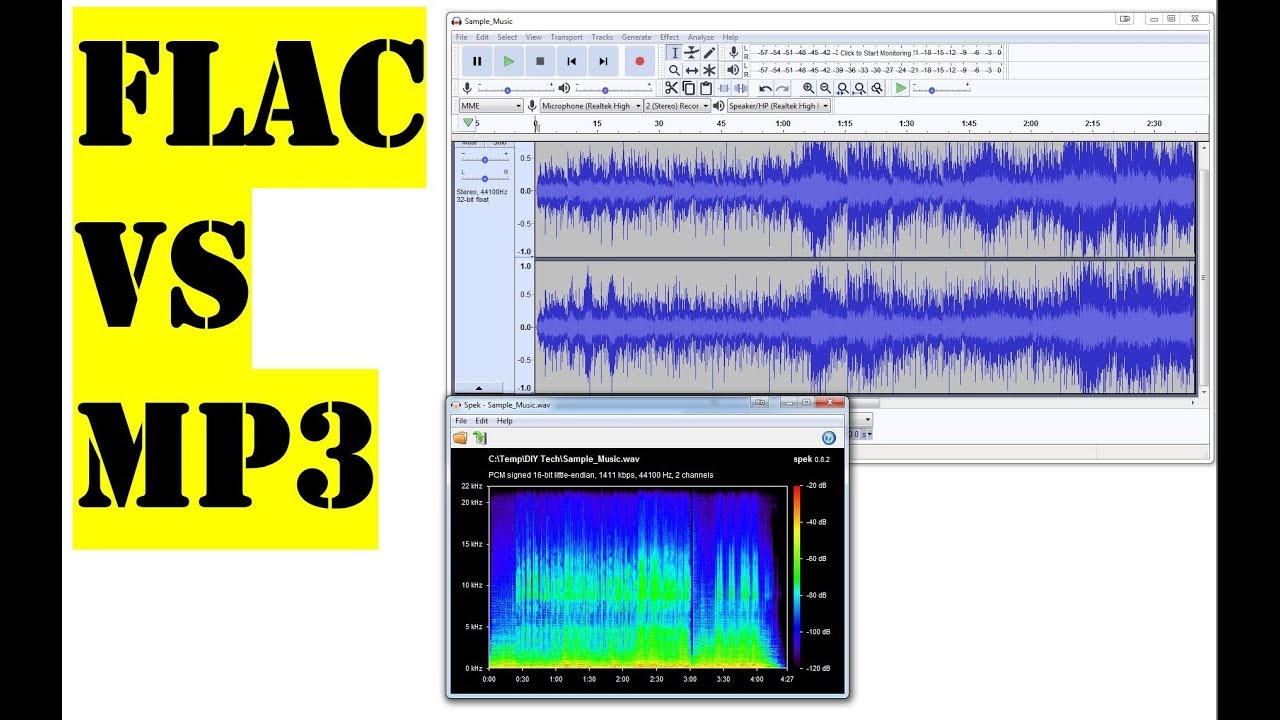
Compare, for example, two spectrograms of the same song (DAT ADAM – Hydra 3D): it is easy to see that MP3 “cuts” high frequencies compared to lossless compression (left – MP3 320 kbps, right – FLAC spectrogram, obtained by digitizing CD). But the question is different: will you hear the difference?

A bit of anatomy: The human ear is theoretically capable of hearing sounds from 16 Hz to 20 kHz. However, much depends on the age and individual characteristics of the listener. The author of this article can hear sound with a frequency of 16 kHz, but not 17 kHz and above, but there are adults (25 years and older) who can still perceive 18 kHz. All of these frequencies are quite successfully supported by the MP3 format. If you are exceptionally clear, you will be able to hear some difference in the high frequencies, but the difference is almost subtle for most people.

Flac vs mp3

Flac vs mp3

FLAC vs MP3

Recently, FLAC-compatible players, which are highly appreciated by most audiophiles, have developed rapidly. What is the secret of the format? Why is the popular mp3 format not suitable for music lovers?

Mp3 vs Flac

The birth of mp3

In the early days of digital audio, the first music format was Wave, which was widely used on CD-Audio discs. There were no large hard drives at the time and the 700MB album seemed very large. With the advent of high-performance microcircuits, the mp3 format was invented, allowing music to take up 10 times less disk space (~ 70MB vs. 700MB). This made it possible to significantly increase the number of musical compositions stored by listeners at home on a computer and early Flash players. Due to its high weight, the original format was replaced by the mp3 boom.

Many people remember the incredibly popular iriver players that support mp3 and ogg, but the time for those players has passed and iriver has released Astel & Kern players that support FLAC in high resolution.

Compression of information in mp3 and quality How does mp3 take up less space? It is based on two technologies: archiving and psychoacoustic compression. The conventional file is not very efficient and is only used in lossless formats like flac, ape, and wavepack. Psychoacoustic compression is added to mp3 and this format belongs to the Lossy group (lossy compression).

Psychoacoustic compression dilutes data according to a simple principle: anything that the listener potentially does not hear (for example, quiet sounds against the background of loud sounds) is mercilessly discarded. There are many parallels with the video and the photos. For example, in the jpg format, pixels with similar colors are grouped into large squares of the same color and when forming an image, we usually do not notice that various hues have disappeared. But if we want to take a closer look, we will definitely see it!

The quality of the same mp3 bit rate is different

There are a large number of mp3 encoders, and each has its own priority level in the algorithm, what is least important in music and what to remove first with low compression and last with high. The higher the compression, the more meaningful information is removed and the easier it is to listen to on simple audio equipment.

Unfortunately, the sound quality of mp3 depends not only on the degree of compression expressed in bitrate, but also on the codec with which it was compressed and with what settings. Very often, a high bit rate on the order of 320 kB / s is used, but with the fast and less resource consuming encoding mode. The file encodes very quickly, but as a result, it subjectively sounds worse than encoded at 128 kB / s in long, resource-intensive mode.

Almost all “mp3 producers” in the form of websites and CD compilations use fast algorithms. They believe that most will not hear the difference on their phones anyway, and will be guided by the purchase only by the bitrate. Why spend the extra effort if they buy well?

The differences between the 320 kB / s mp3 encoded in high quality and resource intensive mode and the original Wave are actually very small and sometimes difficult to distinguish even with good audio equipment, but these mp3s are usually very few and far between. they just make them enthusiastic. Most of the mp3 leaves a depressing impression.

Much also depends on the decoder, which determines the quality of the final sound. There are still battles on the forums, which software or hardware player sounds better with which decoder.

At the height of mp3 development, the quality of players and sound cards left much to be desired, especially considering that the main mp3 users were those who could not afford to listen to music on a good hi-fi system. . Quality issues were hardly noticed, similar to JPG compression issues when viewed through a cell phone screen. But on a good audio route, it was obvious. Recently, technology has advanced and the quality of most fonts has increased and consequently the disadvantages of mp3 have become more obvious. What are the main disadvantages of mp3 sound?

The absence or unnaturalness of the high frequencies (due to the strong decimation of the high frequencies, which most supposedly cannot hear)
Wheezing and distortion in vocals, unnatural timbres of instruments
Violation of the location of sources in space.
But most importantly, you never know how high quality an mp3 will sound, how much information is actually lost on it.

MP3 and FLAC: who wins?

MP3 and FLAC: who wins?

FLAC vs MP3

Music lovers from all countries have been arguing for many years: is it possible to distinguish a high-quality MP3 from a lossless one in a blind test (FLAC, APE, etc.)? How much does compression loss affect the music experience? Should you give up MP3? Let’s try to answer these questions.

FLAC vs MP3 320 kbps
A little history

In the early 1990s, experts understood that the future of music was digital. However, hard drives were expensive then and fans preferred to store their music collections on cassettes and CDs. The researchers faced a problem: they needed a suitable format to store records on computers. At the same time, they were counted every hundred kilobytes – you can slightly sacrifice quality compared to CD discs, but save precious hard drive space.

In the late 1980s, the first functional prototypes of a new lossy compressed audio storage format, MP3, were created. The first publicly available MP3 encoder appeared in 1994, and the first playback software soon followed. The first encoding algorithms made it possible to obtain files with slightly “chopped” high frequencies. The sound quality was not comparable to that of a CD, but the output file sizes were quite acceptable.

In the early 2000s, the sizes of hard drives were growing rapidly and other audio formats that provide lossless compression began to appear. Relatively speaking, an audio track in this format can be restored to its original WAV from a lossless CD. Perhaps the most popular lossless compression format was FLAC, introduced in 2001. It is suitable both for storing home audio collections and for playing music on professional computers. However, a FLAC file can be 6-10 times heavier than a good quality MP3 (256 or 320 kbps). But does file size and losslessness mean consistently high sound quality?

A bit of anatomy: The human ear is theoretically capable of hearing sounds from 16 Hz to 20 kHz. However, much depends on the age and individual characteristics of the listener. The author of this article can hear sound with a frequency of 16 kHz, but not 17 kHz and above, but there are adults (25 years and older) who can still perceive 18 kHz. All of these frequencies are quite successfully supported by the MP3 format. If you are exceptionally clear, you will be able to hear some difference in the high frequencies, but the difference is almost subtle for most people.

Even if your favorite song in the spectrogram is clipped to 20 kHz, you won’t hear any distortion (unless of course you’re 8 years old).

The vast majority of people cannot, for natural anatomical reasons, distinguish between high-quality 320 kbps MP3 and FLAC (as long as both digital recordings are obtained from the same source). Of course, if you compress more MP3, for example, up to 96 kbps, the difference will be clearly audible even with cheap headphones. But in the age of terabyte drives, no one listens to music with such compression.

Of course, the equipment used for listening has a significant impact on the perception of music. It is impossible to listen to all the high frequencies in the recording of a symphony orchestra on headphones for 300 rubles, even if you have wonderful hearing and a high-quality recording. However, many specialists are dedicated to mixing music, taking into account the capabilities of the most popular audio equipment among consumers. Bill Ward (Black Sabbath drummer) said that while working on his solo album Accountable Beasts (2015), he first tried to achieve a clear and distinct sound from each note, but then realized that almost all listeners would use inexpensive equipment. and they wouldn’t hear all tones and halftones. As a result, Bill bought several relatively inexpensive headphones from a nearby store and mixed the album in them.

In the case of a file obtained from the Internet (even bought honestly), it is extremely difficult to understand which input was the original source. The sound quality of a file obtained by digitizing vinyl or CD (with or without remastering) will differ from a quality recording of Internet radio broadcasts, although all files can have the same bit rate.

Thus, we come to an obvious conclusion: the difference between high-quality MP3 and high-quality FLAC will only be heard by a trained music lover (most likely young, since after 40 years the range of audibility is reduced ). In addition, you will need quite expensive equipment to appreciate all the characteristics of the sound.

MP3 and FLAC Audio Formats – We Use It Wisely

MP3 and FLAC Audio Formats – We Use It Wisely

FLAC vs MP3

In this post, I want to talk about how to get the best results when compressing music in FLAC and MP3 formats. In the age of mass distribution of audio and video streaming services, this topic may seem of little relevance, however, as practice shows, this is not the case.

FLAC vs MP3

First, not everyone wants to depend on third-party resources, which can behave as they please at any time, from the introduction of various access restrictions to content to its complete removal. Second, there are many places in the world where the Internet is slow, dreary, and with lunch breaks. Third, the sound quality when listening online is usually quite acceptable for most users, but it can plunge sophisticated listeners with good equipment into depression. Considering all the above, we can assume

Basic concepts

PCM (pulse code modulation), also known as PCM (pulse code modulation) is a method of representing an analog signal in digital form. It works like this: electrical vibrations are fed into the input of a device called the ADC (analog to digital converter), which is an analog audio signal. The ADC measures the level of this signal with a certain frequency and transmits the obtained values ​​to the outside, where they are stored. Thus, a data matrix is ​​formed, which is a sequence of values ​​of the amplitude of the original signal. The process described is called “digitization”. The main problem with storing PCM data in “naked” form is its rather large volume, therefore, for a more rational use of space on the carrier, various digital audio compression algorithms are used.

Encoder (or “encoder” from English “encoder”) is a software designed to convert WAV to any other format in order to reduce the amount of stored data.

Decoder – Software or hardware used to play files compressed in the appropriate format or convert them to uncompressed format.

Lossy is the generic name for a family of audio formats that use lossy data compression. Typical members of the family are MP3, AAC, WMA, Ogg Vorbis. The main characteristic of lossy formats is that when the material is compressed in any of them, a significant part of the original audio information is irretrievably lost and cannot be restored later in any way. Because of this, a high degree of compression is achieved, while the loss is barely perceptible or generally invisible to the ear, as only data that is not critical to human perception is discarded.

Lossless is the generic name for a family of audio formats that use lossless data compression. Typical family members: FLAC, Monkey’s Audio (APE), ALAC, WavPack. Unlike lossy formats, here no information is lost during compression, everything happens in the same way as in normal filing cabinets. Paying for complete data security is significantly lower compression ratio compared to loss.

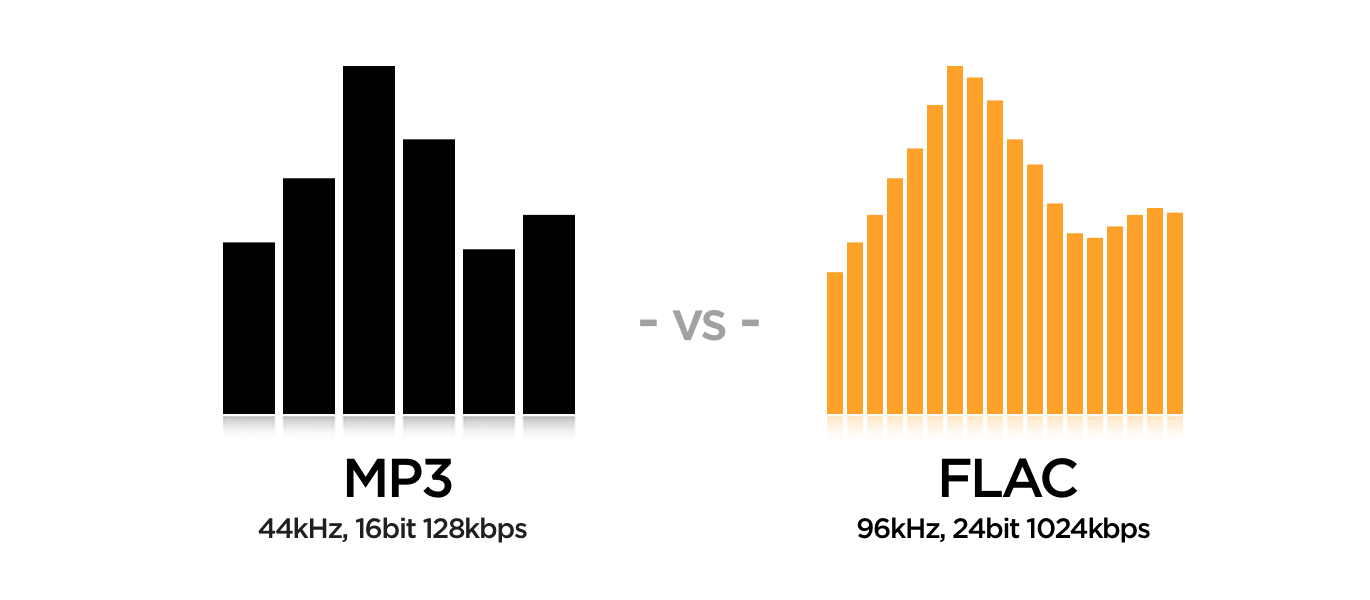
MP3 (MPEG-1 Layer 3) is historically the first and most widespread lossy compression format. Despite the fact that, due to the era of MP3, today it does not shine with the efficiency of compression, its popularity remains very high due to its versatility: any plate can reproduce this format. At the same time, if a suitable encoder and decoder are used, the MP3 sound quality is at a very decent level. The combination of these two factors justifies the use of the format today. The MP3 compression ratio while maintaining high sound quality is 6 to 9 times. The average bit rate of such an MP3 with 16-bit / 44.1 kHz stereo parameters is 150 to 240 kbps, the file size of a five-minute recording in this form is 6 to 9 MB.

FLAC (Free Lossless Audio Codec) is currently the most popular lossless audio compression format. If lossless support is claimed for any software or equipment, this software / equipment can almost certainly play FLAC. The format is the de facto standard among lovers of quality sound. The FLAC compression ratio is 1.3-2.8 times. FLAC bitrate with parameters 16 bit / 44.1 kHz / stereo – 500-1100 kbps, the file size of a five minute recording in this form is 18-40 MB.

FLAC or MP3: these are the differences

FLAC vs MP3

FLAC and MP3 are common audio formats. We explain their similarities and differences in this practical tip.

Similarities Between FLAC and MP3

At first glance, FLAC and MP3 have a lot in common:
FLAC and MP3 are audio formats. Detailed information on FLAC files can be found in this practical tip.

Mp3 vs Flac
The audio information is compressed in both formats.
With both, compression works in several steps. One of them can be lossless mid-side encoding for both.
Strictly speaking, both MP3 and FLAC are codecs, that is, pairs of an encoder to compress and a decoder to play the file.
Both formats allow the addition of metadata as tags.
Streaming is possible with both formats, that is, near real-time streaming.
WAV file in wave format

Differences between FLAC and MP3

Despite the similarities, there are essential differences between FLAC and MP3:
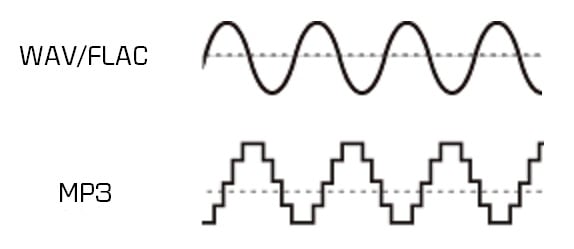
MP3 is a psychoacoustic compression process, which means it changes the signal as you can see in the image. FLAC just changes the way the data is presented so that the file can be saved more efficiently.
MP3 is leaky due to the way it works. This means that the information in the original file is lost and errors occur. On the other hand, FLAC files can be used to restore the original without errors.
MP3 achieves a file compression of approximately one-tenth the original size. FLAC reduces the size of the source file by approximately half.
PCM files, like WAV, store continuous fluctuations in sound pressure as discrete values ​​over time. With a high sampling frequency and depth, this process is virtually lossless. FLAC files store data from WAV files in a different way. However, the PCM file can be regenerated from it at any time.
MP3 files generate noise especially before the strong amplitude increases and reduces the dynamics of some frequencies and thus irreparably falsifies the output signal. However, if the encoding is good, the differences are subliminal
There is already a huge market for MP3 music, editing software and playback devices. Until now, FLAC has barely established itself in the area of ​​music downloading, audio processing software, and in terms of playback devices.

FLAC or MP3: which is better?

The differences between FLAC and MP3 in particular show which format is more suitable for which application:
MP3 has the immense advantage of being available, widespread, and compatible with common hardware and software. In addition, there is the huge compression rate, which is particularly suitable for fast streams and large music collections.
FLAC has a decisive force: it encodes lossless audio files and is much more flexible and more compressed than ZIP or RAR files. FLAC is particularly ideal in the recording studio, but also for highly dynamic music or simply for archiving lossless audio CDs.

Placebo effect? Can you distinguish an mp3 320 kbs vs a FLAC?

Studies have shown that most people can NOT distinguish an mp3 at 323 kbs (That is, with the best quality) from a FLAC file.

MP3 vs FLAC

We all know that in theory an mp3 is a format that discards information to achieve a small size; or, indeed, due to this ability to take up little space on the disk, but sounding very similar to the original wav was what propelled fame to mp3.

The Mp3 is dead.

Dozens of times it has been written about the undeniable advantages of the formats that do not lose information (looseless), it could be thought that people would turn their backs on the mp3.

MP3 vs FLAC

Some have warned that it is not so likely that this will happen, since most of the audio players (for example, those that come from the factory with the cars) play mp3s but not Flac.

Placebo effect?

But others have pointed out that untrained human hatred CANNOT distinguish an mp3 recorded at its highest quality from the FLAC.
For which to show yourself as a lover of FLAC and a fanatic defender of that format, it is more a snobbery full of blah, blah blah and technicalities that ignore that the human ear is not a robot and that in reality most people they cannot distinguish between one and the other.

And we combine the convenience of using mp3s because the devices are designed for mp3 and not for FLAC, together with the fact that in reality most people cannot distinguish one from the other … this should explain that that the mp3 is dead, is more a product of fanaticism than realism.

Also, they forget another problem.

When digital music is recorded it requires using a compressor … which did not happen with music recorded on tape, that is, vinyl.

That is why there is another faction that does not proclaim and sing songs in favor of FLAC but rather the return to vinyl (forgetting all the advantages and comforts of digitization).

In other words, all these discussions seem more like a mixture of snobbery and puritanism than something realistic.

What studies have shown

What we cannot ignore is that undoubtedly 99% of people (including many experts, musicians, etc. who talk hours about bitdepth, bitrate, etc.) can NOT distinguish a WAV, from a FLAC, from an mp3 recorded at qualities superior to 160 kbs.

Personally, we celebrate that all these formats exist and that we are coming to the time where every person can use and love the format of their choice and even defenestrate and even hate other formats and discuss long hours about their technical knowledge.

But yes, it seems that it is basically a placebo effect.

Flac vs Mp3, differences

In today’s world, it is important to understand the difference between the different audio files available.

The most common and current files are practically the files in the formats MP3, Flac and WAV.

Is there really a difference between MP3, Flac and WAV files? The answer is absolutely yes.
flac vs mp3

The difference is in the audio quality that these files can play.

What is the difference between MP3, Flac and Wav files? MP3 files are of lower quality because they are more compact and smaller. Flac files are a kind of compromise. With files in Flac format, it can be of very good quality and remain true to the original, which in any case is compressed by a certain percentage. Finally, there are the WAV files that do not use compression.

Therefore, the quality is better, but the size of these files is quite large, it is not compatible with any device these days.

It may not be easy to understand which audio file to use for your work, especially if you are a beginner in this area.

However, you don’t have to be afraid of it.

flac vs mp3

Once you’ve learned all the differences between the three audio files, you can really fix the problems by always using the appropriate file.

What are the differences between the categories in detail and when should you use a specific audio file?

Here’s a complete analysis for each audio file format that really helps you understand everything you need to know about MP3, Flac, and WAV files.

What is an MP3 file?
It starts with one of the most common files in the world of information technology, namely the one called MP3.

MP3 files have been around for years, so their development is common.

But what an MP3 file really represents.

Well, a general audio file is a series of numbers obtained by sampling the analog signal.

This scan responds to some parameters, which are the frequency measured in Khz and the resolution expressed in bits.

The MP3 file represents the most compressed form of an audio file, so to speak.

Finally, you need to understand that the MP3 file can remove all unnecessary parts of the digital file from the sequence and the final sampling, taking advantage of some imperfections of the human body to give it a clear and clean melody.

On the other hand, the MP3 file significantly reduces the quality of the sounds played.

In fact, all the different nuances of a certain melody come to the bone.

An MP3 is small if you speak it from the perspective of the memory. You should think of it as a kind of concentrate that gives you a remarkable but not 100% complete end result.

In the most extreme cases, an MP3 file can reduce the original tones and nuances of music or melodies to a percentage of 90%.

However, these formats are widely appreciated and used because they are not only practical and direct, but are now compatible with all technological devices, e.g. B. MP3 players, for which we recommend that you read our guide.

This means you can take them with you at any time and any product you have can read an MP3 file.

What is a flac file?
So at this point you need to understand what a Flac file is.

Well, it should be said that the Flac file has some major differences from its MP3 counterpart.

In fact, a Flac file is much more complex than a regular file and can be reduced by 90%.

First, you need to understand that Flac is actually an acronym that stands for Free Lossless Audio Codec.

It is always a format that is somewhat compressed, but files with this name have a certain property.

In fact, the file is lossless with no loss and maintains higher fidelity than the original sound.

With a Flac file, you have a clearer quality of the audio file, so you can clearly hear some details that can be lost if you use a different audio format.

The limited storage space when using the Flac format is very small and can reach a maximum of 50%.

However, when using such files, you should be aware that their use on the storage hard drive is important.

Not surprisingly, Flac files take up a lot more space than regular MP3s. In some cases, a special reader must be downloaded to read them. Many home theaters and receivers support this compression format.