MP3 and FLAC: who wins?


Free Download Mp4Gain
picture

MP3 and FLAC: who wins?
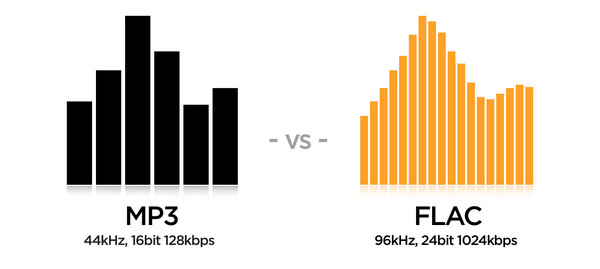
Mp3 & FLAC

Music lovers from all countries have been arguing for many years: is it possible to distinguish a high-quality MP3 from a lossless one in a blind test (FLAC, APE, etc.)? How much does compression loss affect the perception of music? Should you give up MP3? Let’s try to answer these questions.
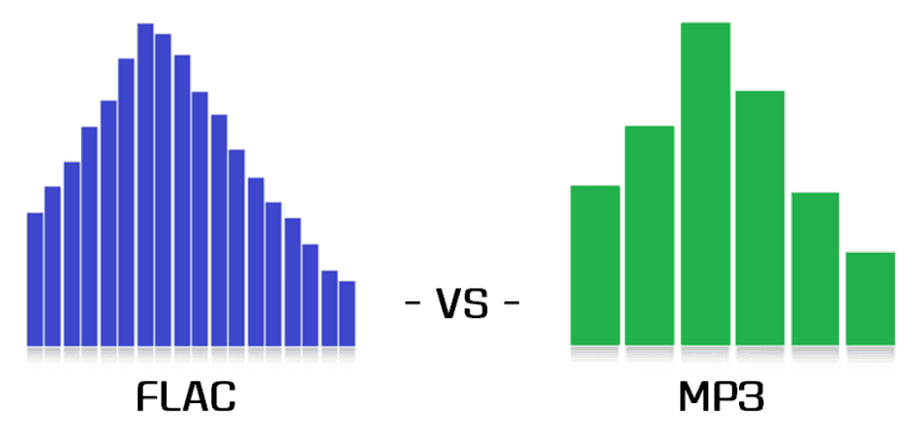
FLAC vs MP3

A little history
In the early 1990s, experts understood that the future of music was digital. However, hard drives were expensive then and fans preferred to store their music collections on cassettes and CDs. The researchers faced a problem: they needed a suitable format to store records on computers. At the same time, every hundred kilobytes were counted – you can slightly sacrifice quality compared to CDs, but save precious hard drive space.

In the late 1980s, the first functional prototypes of a new lossy compressed audio storage format, MP3, were created. The first publicly available MP3 encoder appeared in 1994, and the first playback software soon followed. The first encoding algorithms made it possible to obtain files with slightly “chopped” high frequencies. The sound quality was not comparable to that of a CD, but the output file sizes were quite acceptable.

In the early 2000s, volumes on hard drives were growing rapidly and other audio formats that provide lossless compression began to appear. Relatively speaking, an audio track of this format can be restored to the original WAV from a lossless CD. Perhaps the most popular lossless compression format was FLAC, introduced in 2001. It is suitable for both storing home audio collections and playing music on professional computers. However, a FLAC file can be 6-10 times heavier than a good quality MP3 (256 or 320 kbps). But does file size and losslessness mean consistently high sound quality?

find 10 differences
Compare, for example, two spectrograms of the same song (DAT ADAM – Hydra 3D): it is easy to see that MP3 “cuts” high frequencies compared to lossless compression (left – MP3 320 kbps, right – FLAC spectrogram, obtained by digitizing CD). But the question is different: will you hear the difference?

A bit of anatomy: The human ear is theoretically capable of hearing sounds from 16 Hz to 20 kHz. However, much depends on the age and individual characteristics of the listener. The author of this article can hear sound with a frequency of 16 kHz, but not 17 kHz and above, but there are adults (25 years and older) who can still perceive 18 kHz. All of these frequencies are quite successfully supported by the MP3 format. If you are exceptionally clear, you will be able to hear some difference in the high frequencies, but the difference is almost subtle for most people.


Free Download Mp4Gain
picture


Mp4Gain Main Window
picture


Mp4Gain Features
picture


Free Download Mp4Gain
picture

Flac vs mp3

Flac vs mp3

FLAC vs MP3

Recently, FLAC-compatible players, which are highly appreciated by most audiophiles, have developed rapidly. What is the secret of the format? Why is the popular mp3 format not suitable for music lovers?

Mp3 vs Flac

The birth of mp3

In the early days of digital audio, the first music format was Wave, which was widely used on CD-Audio discs. There were no large hard drives at the time and the 700MB album seemed very large. With the advent of high-performance microcircuits, the mp3 format was invented, allowing music to take up 10 times less disk space (~ 70MB vs. 700MB). This made it possible to significantly increase the number of musical compositions stored by listeners at home on a computer and early Flash players. Due to its high weight, the original format was replaced by the mp3 boom.

Many people remember the incredibly popular iriver players that support mp3 and ogg, but the time for those players has passed and iriver has released Astel & Kern players that support FLAC in high resolution.

Compression of information in mp3 and quality How does mp3 take up less space? It is based on two technologies: archiving and psychoacoustic compression. The conventional file is not very efficient and is only used in lossless formats like flac, ape, and wavepack. Psychoacoustic compression is added to mp3 and this format belongs to the Lossy group (lossy compression).

Psychoacoustic compression dilutes data according to a simple principle: anything that the listener potentially does not hear (for example, quiet sounds against the background of loud sounds) is mercilessly discarded. There are many parallels with the video and the photos. For example, in the jpg format, pixels with similar colors are grouped into large squares of the same color and when forming an image, we usually do not notice that various hues have disappeared. But if we want to take a closer look, we will definitely see it!

The quality of the same mp3 bit rate is different

There are a large number of mp3 encoders, and each has its own priority level in the algorithm, what is least important in music and what to remove first with low compression and last with high. The higher the compression, the more meaningful information is removed and the easier it is to listen to on simple audio equipment.

Unfortunately, the sound quality of mp3 depends not only on the degree of compression expressed in bitrate, but also on the codec with which it was compressed and with what settings. Very often, a high bit rate on the order of 320 kB / s is used, but with the fast and less resource consuming encoding mode. The file encodes very quickly, but as a result, it subjectively sounds worse than encoded at 128 kB / s in long, resource-intensive mode.

Almost all “mp3 producers” in the form of websites and CD compilations use fast algorithms. They believe that most will not hear the difference on their phones anyway, and will be guided by the purchase only by the bitrate. Why spend the extra effort if they buy well?

The differences between the 320 kB / s mp3 encoded in high quality and resource intensive mode and the original Wave are actually very small and sometimes difficult to distinguish even with good audio equipment, but these mp3s are usually very few and far between. they just make them enthusiastic. Most of the mp3 leaves a depressing impression.

Much also depends on the decoder, which determines the quality of the final sound. There are still battles on the forums, which software or hardware player sounds better with which decoder.

At the height of mp3 development, the quality of players and sound cards left much to be desired, especially considering that the main mp3 users were those who could not afford to listen to music on a good hi-fi system. . Quality issues were hardly noticed, similar to JPG compression issues when viewed through a cell phone screen. But on a good audio route, it was obvious. Recently, technology has advanced and the quality of most fonts has increased and consequently the disadvantages of mp3 have become more obvious. What are the main disadvantages of mp3 sound?

The absence or unnaturalness of the high frequencies (due to the strong decimation of the high frequencies, which most supposedly cannot hear)
Wheezing and distortion in vocals, unnatural timbres of instruments
Violation of the location of sources in space.
But most importantly, you never know how high quality an mp3 will sound, how much information is actually lost on it.