What Is Audio Sampling Rate: A Comprehensive Explanation


Free Download Mp4Gain
picture

What Is Audio Sampling Rate: A Comprehensive Explanation
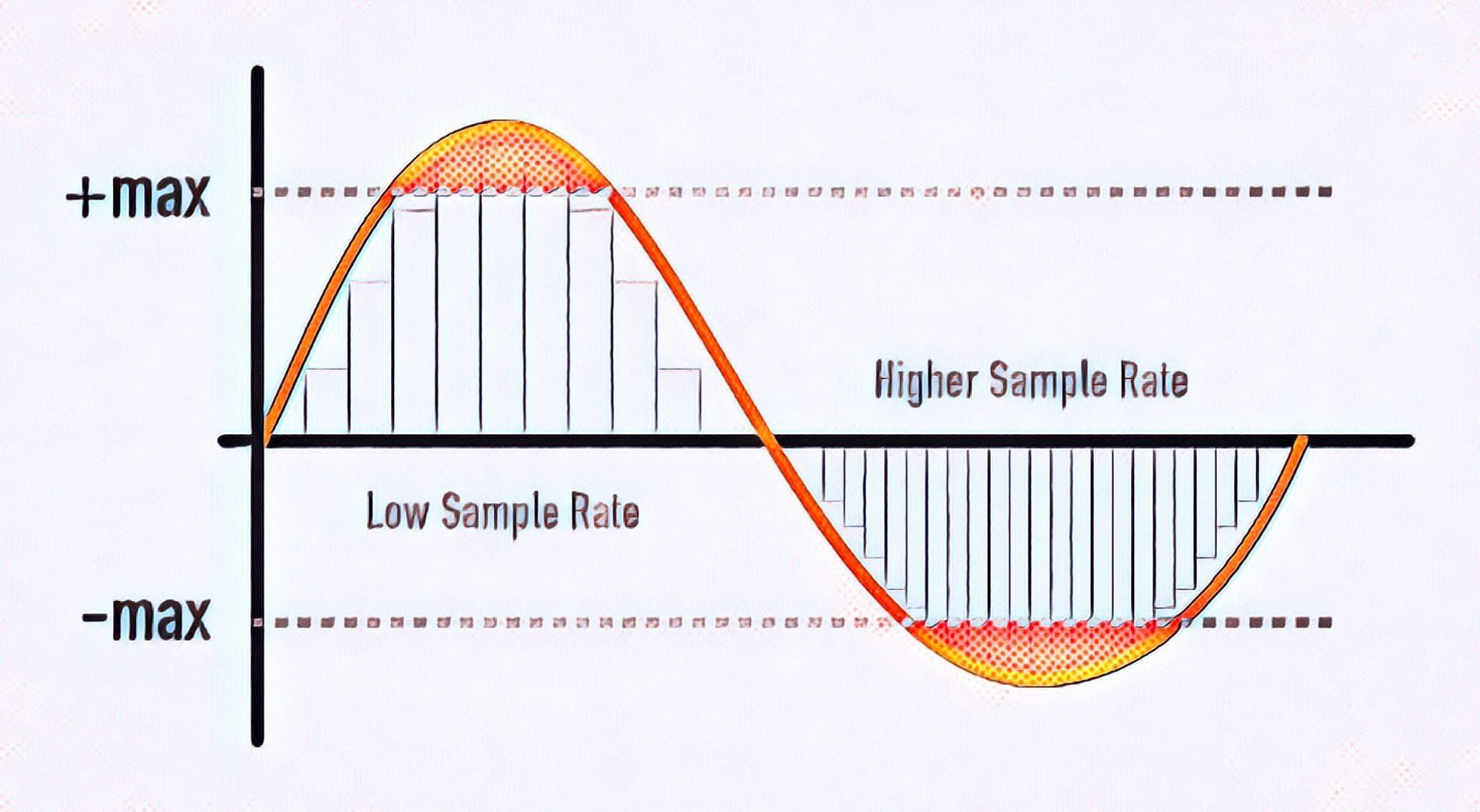
Sample Rate
Sample Rate

Introduction

Sample Rate
Sample Rate

Audio sampling rate is a fundamental concept in digital audio that refers to the number of samples per second used to represent an analog audio signal in digital form. In this article, we’ll explore the technical details of audio sampling rate, its importance in digital audio, and its impact on audio quality and file size.

Sampling Rate Fundamentals

The concept of audio sampling rate is based on the Nyquist-Shannon sampling theorem, which states that in order to accurately represent an analog signal in digital form, the sampling rate must be at least twice the highest frequency present in the signal. This means that a signal with a highest frequency of 20kHz (the upper limit of human hearing) must be sampled at a rate of at least 40kHz in order to be accurately represented.

Sampling rate is measured in Hertz (Hz), which refers to the number of samples per second. Common sampling rates in digital audio range from 44.1kHz (used in CDs) to 192kHz (used in some high-resolution audio formats).

Sample Rate Conversion

In some cases, it may be necessary to convert audio from one sampling rate to another. Sample rate conversion involves resampling the audio data to a different rate, which can be done using digital signal processing techniques. However, sample rate conversion can introduce artifacts and reduce audio quality, especially when downsampling from a higher rate to a lower rate.

There are various reasons why sample rate conversion may be necessary, such as when mixing audio tracks with different sampling rates, or when preparing audio for distribution on different platforms with varying requirements.

Audio Quality and Sampling Rate

The sampling rate has a significant impact on audio quality, with higher sampling rates generally resulting in better fidelity and more accurate representation of the original signal. However, the benefits of higher sampling rates are limited by the limitations of human hearing and the practical limitations of digital audio technology.

While there is debate about the benefits of “high-resolution audio” formats with sampling rates above 44.1kHz, it is generally accepted that sampling rates above 96kHz provide little additional benefit in terms of audio quality.

Bit Depth and Sampling Rate

The bit depth of an audio sample refers to the number of bits used to represent the amplitude of the signal at each sample point. Higher bit depths allow for more precise representation of the signal, but also result in larger file sizes. The bit depth and sampling rate are related, as increasing the bit depth requires more data to be stored for each sample.

There is a trade-off between sampling rate and bit depth, as higher sampling rates require more data to be stored per second, which can limit the maximum bit depth that can be used without exceeding practical file size limits. However, this trade-off can be mitigated by using efficient audio compression techniques.

Sample Rate in Practice

Common sampling rates in digital audio include 44.1kHz (used in CDs), 48kHz (used in digital video), 88.2kHz, 96kHz, 176.4kHz, and 192kHz. Streaming services such as Spotify and Apple Music typically use lower sampling rates for their audio streams, with 44.1kHz being a common choice.

The Nyquist Theorem, named after the Swedish-American physicist Harry Nyquist, states that the sampling rate should be at least twice the highest frequency component in the signal being sampled. This is why the standard CD quality sampling rate is 44.1 kHz, which is just above the upper limit of human hearing.

However, it is important to note that there are higher sampling rates available, such as 48 kHz, 96 kHz, and even 192 kHz. These higher sampling rates can provide more detail and accuracy in the digital representation of the analog signal. However, they also require more storage space and processing power.

Another important factor to consider is the bit depth, which is the number of bits used to represent each sample. The more bits used, the more accurate and detailed the representation of the analog signal. CD quality uses a bit depth of 16 bits, but higher bit depths such as 24 bits are also available.

It is worth noting that some argue that higher sampling rates and bit depths may not necessarily result in audible improvements in sound quality, especially when considering the limitations of human hearing. Additionally, some argue that the increased storage and processing requirements may not be worth the potential improvements.

In conclusion, the sampling rate is a crucial component in the digital representation of analog audio signals. A higher sampling rate can provide more detail and accuracy in the digital representation, but also requires more storage and processing power. The Nyquist Theorem provides a guideline for choosing the appropriate sampling rate based on the highest frequency component in the signal. Additionally, the bit depth is another factor to consider in the accuracy and detail of the digital representation. While higher sampling rates and bit depths are available, the potential improvements in sound quality must be balanced against the increased storage and processing requirements.


Free Download Mp4Gain
picture


Mp4Gain Main Window
picture


Mp4Gain Features
picture


Free Download Mp4Gain
picture

The impact of Sample Rate on the audio quality of your MP3s

The impact of Sample Rate on the audio quality of your MP3s

The impact of Sample Rate on the audio quality of your MP3s

What is the Sample Rate and how does it work?

The impact of Sample Rate on the audio quality of your MP3s

The Sample Rate, also known as sampling frequency, refers to the number of times sound is measured per second in an audio file. It is measured in hertz (Hz) .

The higher the sample rate, the more detailed the sound will be captured and played back. However, this also means that the file will be larger in size.

How to choose the right Sample Rate?

Choosing the right Sample Rate will depend on how you will use the file. For music files, a sampling frequency of at least 44.1 kHz is recommended for decent sound quality. However, if you want higher sound quality, you can go for a higher sample rate, such as 48 kHz or even 96 kHz.

For voice audio files, a sampling rate of 22 kHz is sufficient for clear sound quality. However, if you want higher sound quality, you can opt for a higher sample rate, such as 44.1 kHz.

How is Sample Rate related to bitrate and number of channels?

Sample Rate, bitrate and number of channels are important factors that affect the audio quality of an MP3 file. It is important to choose an appropriate combination of these factors to obtain the best sound quality. A high sample rate combined with a high bitrate and high channel count will provide superior sound quality, but will also require a larger file. On the other hand, a low sample rate combined with a low bitrate and a low number of channels will provide lower sound quality, but the file size will be smaller. It is important to find a balance between these factors according to your needs and preferences.

Conclusion

In conclusion, Sample Rate is a crucial factor in the audio quality of an MP3 file. It is important to choose an appropriate sample rate, as well as take into account other factors such as bitrate and the number of channels to obtain the best sound quality. Consider your needs and preferences to find the right balance.

It is also important to note that the Sample Rate is not the only factor that affects the audio quality in an MP3 file, as the bitrate and the number of channels are also involved. It is important to find the right balance between these factors to get the best possible sound quality. In addition, it is also important to consider the end use of the file, as a higher sample rate may be required for music files, while a lower sample rate may be sufficient for voice audio files.</ p>

In short, the Sample Rate is an important factor in the audio quality of an MP3 file, and it is important to choose the right rate to get the best possible sound quality. Be sure to balance this with other factors like bitrate and number of channels, and take into account the end use of the file. With these factors in mind, you will be able to enjoy a high-quality audio listening experience.

The difference between 44,100 Hz (music industry) and 48,000 Hz (video industry)

The difference between 44,100 Hz (music industry) and 48,000 Hz (video industry)

44100 vs 48000 sample rate

In video production, record the frame rate for shooting and the sample rate for recording. Remember this is one of the basics for shooting and recording.

SAMPLE RATE

First, about the difference in sampling frequency. Generally speaking

44,100Hz (44.1kHz) is the standard in the music industry

48,000Hz (48kHz) is the sound standard in the video industry

The difference between the two sample rates is just that. I talked about the sample rate as
the frame rate in video in another article, “Sound Principles Required for Video Production,” Sample Rate and Bit Depth. ”
In other words, the higher the sample rate in Hz, the softer the sound will be.

There are several theories about the historical background of 44,100Hz.
I would like to introduce you to one of the most logical.

First, when sampling sound, you need a sample rate that is at least twice the highest frequency you are recording. This is the sample rate necessary to obtain a minimum of the waveform. This is because it is not possible to record a sound that has the character of a wave if there is only one place to take a sample. Most people say that the audible range is 50 Hz to 16,000 Hz. Double is 32 kHz, but it seems that the harmonic components that make up the tone need to be recorded in order to record the voice correctly. Only when this is taken into account does it appear that up to 44,100Hz is required. Click here for more details.

Sound Processing “I want to hear my voice clearly” (link outside of Vook’s site)

What happens when the sample rate is low?
When digitizing analog information, if the sampling rate is not high, the high-frequency information will be hidden in the low-frequency information.
Then the high-frequency sound will be recorded as low-frequency sound.

In any case, by definition, 48,000 Hz has better sound quality than 44,100 Hz. The video industry has introduced 48,000 Hz.

One problem that sometimes occurs is that “I was recording 48 kHz video and the separately recorded microphone was set to 44.1 kHz.” At first I thought that different sample rates would be a big deal, but it doesn’t really seem to be the case.

Sound recorded at a small sample rate just has a small number of samples per second, but since there is almost no difference between 44.1 kHz and 48 kHz, I think you can barely tell the difference when you listen to the sound normally. At 96 kHz, the sound quality is even higher, but the number of samples is so large that ordinary people cannot hear it at all.

In some cases, the sample rate is really important.

1) By writing the audio actually recorded with a different sample number as a video file. This is because the sample rate must be converted to a video sample rate that is different from the conventional 44.1 kHz and 96 kHz sample rates, that is, 48 ​​kHz. Software that specializes in video editing seems to have sound distortion at this point.

2) When recording a 48 kHz music video to match the music played at 44.1 kHz on the site. In this case, it can be very difficult to match performance lips to post-production due to the different sample rates of the sound being played. It’s called sink drift.

3) Another point It seems that this is a problem that occurs at the time of recording, but there is a problem that the sound changes gradually when the sound recorded separately using a cheap recorder is synchronized with the sound recorded in the reference of the video. it seems that there are moments. In this case, it seems that you need to manually fast-forward the video a little and match it to the audio file, or extract a few frames at the important points in the audio and sync it up. It seems that this has nothing to do with the sample rate, so I will describe it so as not to cause misunderstandings.

What is the sample rate and how does it help improve the quality of the audio or video?

What is the sample rate and how does it help improve the quality of the audio or video?

It is important to distinguish what is a sample, as opposed to what is analog audio.
When digitizing the music, a digital equipment takes an X amount of “samples”, saves the values ​​of each one of them and thus it will be able to “reconstruct” a sound (a video too).

Sample Rate

As sound and video contain much information, it is necessary to take many samples, in order to obtain as much information as possible to later reconstruct one signal, very similar to the original.

Sample rate

There is a theorem that explains why the number of 44 thousand 100 samples per second was reached, but we will not enter from such a technical point of view.

What is important for you to know is that the minimum for HD quality audio to be considered is 44100 samples per second.

With less it will sound like talking on a landline phone or even talking on a walkie talkie.

With 44100 samples per second, the sinusoidal wave can be reconstructed without the existence of “closing teeth” in the wave, rather it will be possible to obtain a very detailed curvature, without peaks or ridges, without areas with squares.

Some use 48,000 samples per second, already reaching very high levels of audio quality. Of course, the greater the number of samples per second, the greater the use of disk space, whether you use an mp3, aac, flac, etc. But nowadays with large storage disks, that is not a problem, because these formats continue to be small.

If you manage to combine a sample rate of at least 44100 and preferably 48000 and a bitrate of more than 160 kbs, your music will sound very good, really good.

What will be good is that you buy headphones or speakers that are capable of delivering a good quality of audio, as well as the device that will compute this audio. Be it a computer, a player, an ipod, etc.

And obviously, starting from an “original” good. That is, get original audio that has a good quality.

By following these simple steps, without having to go into very technical details, you will have a very good sound quality.

Obviously Mp4Gain is the perfect software to mormalize the volume and even give other touches or tweaks like correcting the equalization, etc.