What is the maximum video bit depth supported by MP4?


Free Download Mp4Gain
picture

What is the maximum video bit depth supported by MP4?


Mp4 video bit depth
Mp4 video bit depth
Mp4 video bit depth
Mp4 video bit depth

Understanding the MP4 Video File Format

As video technology has advanced, so too has the number of video file formats available. One of the most popular video file formats today is the MP4 format. The MP4 format is known for its versatility and compatibility with a wide range of devices and platforms.

One of the key features of the MP4 file format is its ability to compress video data without sacrificing quality. This is achieved through the use of video compression algorithms, which reduce the amount of data required to store video content while maintaining its visual fidelity.

Maximizing Video Quality in MP4

To ensure that your MP4 videos look their best, it’s important to understand the maximum video bit depth supported by the format. Bit depth refers to the number of bits used to represent each color in a video image. The higher the bit depth, the more colors that can be represented, resulting in smoother gradients and more accurate color reproduction.

The maximum video bit depth supported by MP4 is 10 bits per channel, which allows for a total of 1.07 billion possible colors. This is a significant improvement over the 8-bit color depth supported by many other video file formats, which only allows for 16.7 million colors.

To take advantage of the higher bit depth supported by MP4, it’s important to use a video encoder that supports 10-bit color depth. This will ensure that your videos have the maximum possible color accuracy and quality.

Ensuring Compatibility and Playback

While MP4 is a widely supported video file format, it’s important to ensure that your videos are compatible with the devices and platforms you intend to use them on. This includes checking the video codec used in your MP4 files, as well as the audio codec and other technical specifications.

In addition, it’s important to consider the playback software or hardware that will be used to view your MP4 videos. Not all devices and software support the maximum video bit depth of 10 bits per channel, so it’s important to test your videos on a range of devices to ensure they will play back correctly.

Final Words

In conclusion, understanding the maximum video bit depth supported by MP4 is important for ensuring the best possible video quality. By using a video encoder that supports 10-bit color depth and testing your videos on a range of devices, you can ensure that your MP4 videos look their best and are compatible with a wide range of platforms.


Free Download Mp4Gain
picture


Mp4Gain Main Window
picture


Mp4Gain Features
picture


Free Download Mp4Gain
picture

The impact of Sample Rate on the audio quality of your MP3s

The impact of Sample Rate on the audio quality of your MP3s

The impact of Sample Rate on the audio quality of your MP3s

What is the Sample Rate and how does it work?

The impact of Sample Rate on the audio quality of your MP3s

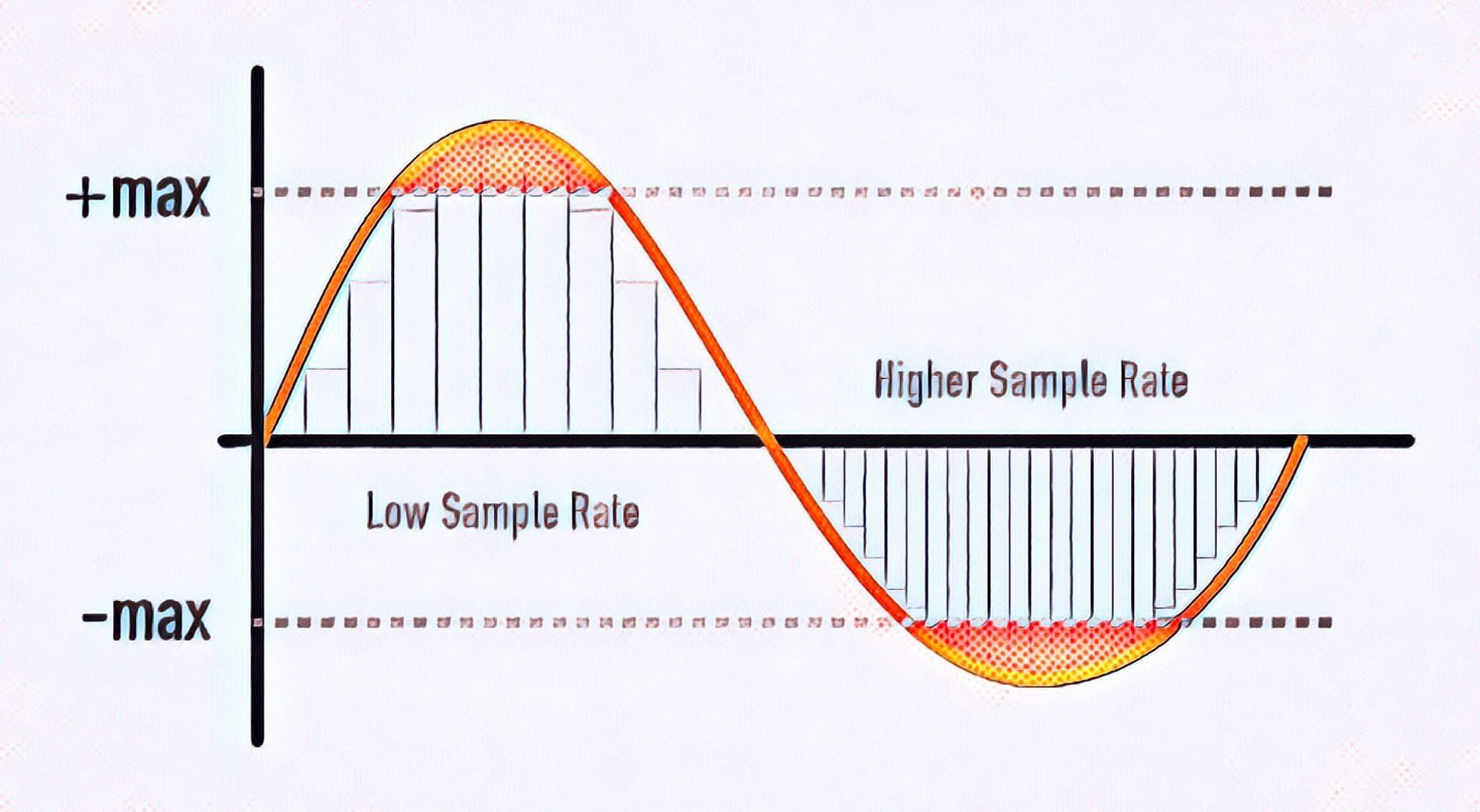
The Sample Rate, also known as sampling frequency, refers to the number of times sound is measured per second in an audio file. It is measured in hertz (Hz) .

The higher the sample rate, the more detailed the sound will be captured and played back. However, this also means that the file will be larger in size.

How to choose the right Sample Rate?

Choosing the right Sample Rate will depend on how you will use the file. For music files, a sampling frequency of at least 44.1 kHz is recommended for decent sound quality. However, if you want higher sound quality, you can go for a higher sample rate, such as 48 kHz or even 96 kHz.

For voice audio files, a sampling rate of 22 kHz is sufficient for clear sound quality. However, if you want higher sound quality, you can opt for a higher sample rate, such as 44.1 kHz.

How is Sample Rate related to bitrate and number of channels?

Sample Rate, bitrate and number of channels are important factors that affect the audio quality of an MP3 file. It is important to choose an appropriate combination of these factors to obtain the best sound quality. A high sample rate combined with a high bitrate and high channel count will provide superior sound quality, but will also require a larger file. On the other hand, a low sample rate combined with a low bitrate and a low number of channels will provide lower sound quality, but the file size will be smaller. It is important to find a balance between these factors according to your needs and preferences.

Conclusion

In conclusion, Sample Rate is a crucial factor in the audio quality of an MP3 file. It is important to choose an appropriate sample rate, as well as take into account other factors such as bitrate and the number of channels to obtain the best sound quality. Consider your needs and preferences to find the right balance.

It is also important to note that the Sample Rate is not the only factor that affects the audio quality in an MP3 file, as the bitrate and the number of channels are also involved. It is important to find the right balance between these factors to get the best possible sound quality. In addition, it is also important to consider the end use of the file, as a higher sample rate may be required for music files, while a lower sample rate may be sufficient for voice audio files.</ p>

In short, the Sample Rate is an important factor in the audio quality of an MP3 file, and it is important to choose the right rate to get the best possible sound quality. Be sure to balance this with other factors like bitrate and number of channels, and take into account the end use of the file. With these factors in mind, you will be able to enjoy a high-quality audio listening experience.

What do sample rate and bit rate mean in a song? Part 2

What do sample rate and bit rate mean in a song? Part 2

MP3 Sample rate
MP3 Sample rate

The meaning of sampling:

MP3 Sample rate
MP3 Sample rate

Sound is actually a type of energy wave, so it also has the characteristics of frequency and amplitude, with frequency corresponding to the time axis and amplitude corresponding to the level axis. The wave is infinitely smooth and the chain can be considered to be made up of innumerable points. Since storage space is relatively limited, points in the string must be sampled in the digital encoding process.

The sampling process consists of extracting the frequency value of a certain point. Obviously, the more points that are extracted in one second, the richer the frequency information that can be obtained. To restore the waveform, there must be two sampling points in one vibration. The highest frequency that can be felt is 20kHz.

Therefore, to meet the auditory requirements of the human ear, at least 40k samples per second are required, expressed in 40kHz, and these 40kHz are the sampling frequency. Our common CD has a sample rate of 44.1 kHz.

Video and audio synchronization is very important in the acquisition process, it is not enough to have frequency information, we must also obtain the energy value of this frequency and quantify it to represent the strength of the signal. The number of quantization levels is an integer power of 2, and the sample size of our common CD bit is 16 levels, that is, 2 raised to the fourth power.

Sample size is more difficult to understand than sample rate, because it makes it seem abstract. For example, if a wave is sampled 8 times, the energy values ​​corresponding to the sample points are A1-A8, but we just use a sample size of 2 bits, as a result we can only keep the values ​​of 4 points in A1-A8 and discard the other 4.

If we use the 3bit sample size, all 8 points of information is recorded. The larger the sample rate and sample size values, the closer the recorded waveform is to the original signal.