What you need to know about lossless FLAC

In the late 1990s, a compressed music format, MP3, was taking off. Thanks to the rise of the music sharing site Napster, the music format has been widely linked to piracy.

However, due to the excellent performance of the MP3 format, it has inevitably become more and more popular.
Thanks to the official launch of PonoPlayer, the FLAC music format has also started to receive attention. This is a lossless format that perfectly replicates the information on the CD with less than 50% of the file size. This format can be played on many mobile phones (including the iPhone, via app support), portable music players (eg PonoPlayer), and hi-fi equipment. Also, in online stores, music sold in the FLAC format is sold for about the same price as the MP3 format, and the former is of much better quality.
To understand FLAC’s past and present, readers need only look at the history of its predecessor, MP3, the “lossy” format. In 1999, MP3.com was the first site in the world to sell music, and specialized MP3 players like the Rio PMP300 were facing several lawsuits from the recording industry. Later, with the introduction of the iPod in 2001, the format became legal, and today MP3 files are widely used for online music sales.
turned out FLAC
Until recently, FLAC had a reputation similar to that of MP3, due to its lack of copyright protection mechanisms, the outside world has generally associated this format with piracy. But the format has the potential to capture the general public, with the exception of music lovers and techies. Currently, providers such as Merge and Warner are already using this format.
FLAC first appeared in 2001 as an open plugin to other lossless formats. At the time, other formats that existed on the market included ALAC from Apple, WAV, and WMA from Microsoft. Each of these lossless formats has one or another weakness. ALAC can only be used on iPods and iPhones; WAV files are too large and cannot hold tag data (artist, album title, lyrics, etc.). FLAC not only supports data signing, but is also compatible with a large number of devices.
What is the difference between MP3 and FLAC?
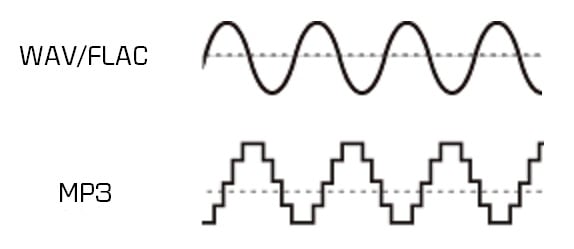
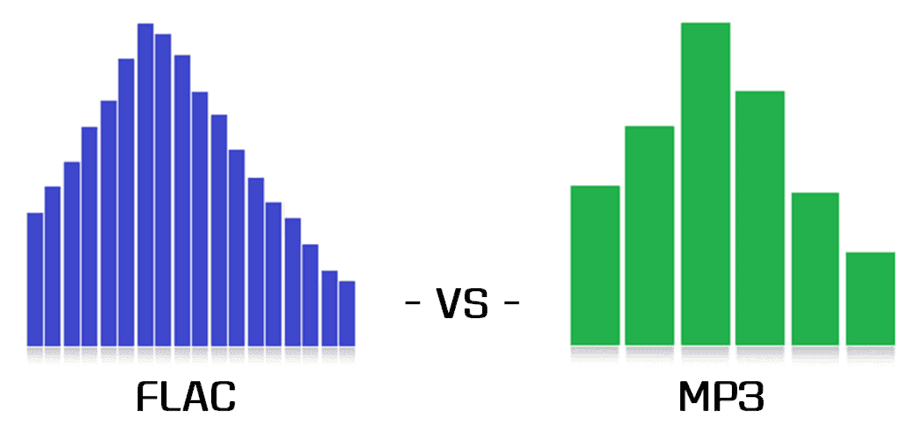
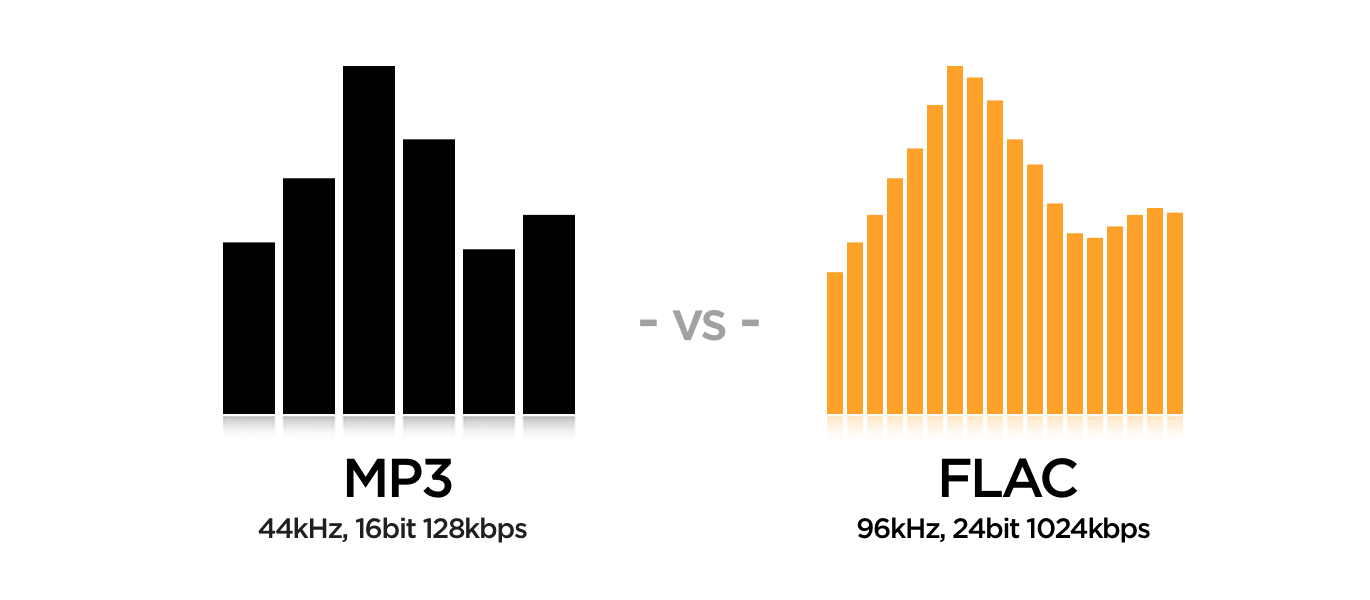
MP3 is a lossy music format, which means that some of the music data needs to be discarded to reduce the file size. Music played with certain instruments, such as guitars, is heavily influenced by the MP3 format, especially files that were recorded incorrectly or compressed too much, and will show noticeable distortion on playback.
Like MP3 before it, FLAC gained acceptance in the recording industry as a cost-effective means of delivering CDs or better sound quality. If you use hi-fi as an analogy, MP3 is equivalent to Sony’s MD format and FLAC is equivalent to CD. (Although the analogy is a bit nondescript)
FLAC is usually 6 times larger than MP3 in terms of volume. The advantage is that the former can store more information and provide high quality to users. Previously, for lossless quality, you could only choose uncompressed CD formats like CDA or WAV, which consume twice the storage space of FLAC. Also, FLAC is not limited to CD quality and users can purchase FLAC files up to 24bit/192kHz for a better experience. While there is a lot of debate about whether it needs to outperform CDs, companies like Pono intend to use FLAC to give people a great music experience.