MP3, FLAC, WAV and others: digital audio formats, from compression to high definition
Let’s try to take some marks in the jungle in digital audio formats …
For a few months, Neil Young has opened a public debate on the quality of digital music, made a crusade against MP3 and announced his project to launch Pono, a portable music player dedicated to reading digital files in Very High Definition. . In addition to the sarcasm that is already on fire, as Trent Reznor compares Pono’s design to a Toblerone, one might wonder if this hype is not the implementation of a beautiful marketing operation, inspired by Dr. Their success Beats helmets?

Neil Young presents his Pono on the David Letterman show
Because the prophecy announced by Neil Young has already been fulfilled: audiophile digital music players are there: we can especially mention music players from the manufacturers Sony (Japan), Cowon, Astell & Kern (Korea) or Fiio (China), HifiMAN (USA) ), Colorfly (Germany). This type of player’s contribution is to reproduce high quality files.
Add to this that the latest generation of Android smartphones can also play high-resolution files with the appropriate player (Poweramp type, Neutron Music Player). Likewise, the latest generation of Apple products (Iphone, Ipad, Ipod) are partially compatible with HD audio (today with up to 24 bit / 48 kHz resolution with ALAC, AIFF, WAV formats).
Sony, Fiio, Cowon brand audio players
CD quality / High resolution, what difference does it make?
The audio files on a CD are encoded in 16 bits at a frequency of 44 kHz.
High resolution (or high definition) files (such as SA-CD or Blu-ray Pure Audio) are in 24-bit frequency 44, 48, 88, 96 or 192 kHz
What does it mean?
16 bits – 44 kHz = 65,536 bits (2 at the effect of 16) x 44,100 Herz x 2 (stereo) per Second
24 bit – 192 kHz = 16,777,216 bits (2 at the power of 24) x 192,000 Herz x 2 (stereo) per second So,
an hour of high-resolution music takes over 2 GB vs. 635 MB for CD quality
. We measure the gap in information volume and computing power between a CD quality file and a high-definition file.
Which format should you choose?
We must first distinguish between:
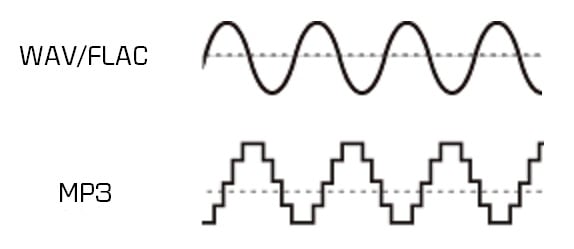
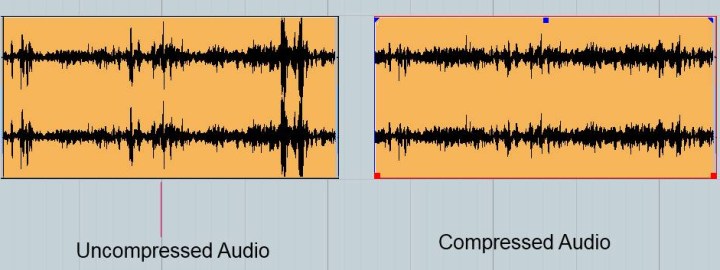
Tabbed compression formats: MP3, AAC, Ogg Vorbis, WMA
Lossless or compression-free compressed formats: AIFF, ALAC, FLAC, WAV, DSD, mono sound, lossless WMA
Today, if we are looking for sound quality, we have to choose from 3 requirements:
-High quality: MP3 from 196 to 320 kb / s, AAC from 128 to 256 kb / s, OGG vorbis from 160 to 320 kb / s
Loss without CD quality: FLAC, ALAC, WMA, WAV, AIFF (16 bit – 44.1 kHz)
– High resolution quality: FLAC, ALAC, WMA, WAV, AIFF, DSD (24-bit – 44, 48, 88, 96, 192 kHz)
Choosing MP3 encoding at 320 kbs or FLAC (16-bit – 44.1 kHz) seems like a good compromise.
And streaming?

Audio format selection is also important for streaming platforms (especially as it is subject to bandwidth and bandwidth limitations):
Deezer uses MP3 format with 2 quality levels:
128 Kbits / s for the free version,
320 Kbits / s (HQ audio) for the paid version of the transmission
Qobuz uses 2 formats:
MP3 at 320 MHz for your “premium” service and
CD quality FLAC (16 bit 44.1 kHz) for Hi-Fi option
(Qobuz also sells 24-bit master study quality files ranging from 44.1 kHz to 192 kHz in WAV, AIFF, FLAC, ALAC, lossless WMA format)
Spotify uses the Ogg Vorbis format for streaming with three quality levels:
96 kbps: Spotify app “Low Speed” setting
160kbps: standard transmission quality for the mobile application / “High quality” setting of the mobile application
320 kbps: “High quality” setting available in Spotify Premium / “Extreme Quality” setting of mobile app (currently available on iOS and Android only)
YouTube uses the AAC audio format at 128 or 192 kbps to transfer the sound of medium and high resolution videos (and also 64 kbps MP3, to low resolution videos) (source)
Equip yourself with a portable listening system
Equipping yourself with a hi-fi player means paying attention to all the elements of the “chain”: the quality of the initial recording, encoded file, streaming material, software (player) and headphones. . This requires a comparative and empirical approach to evaluate each parameter separately. For example, if you Can listen to 24-bit 88Mhz files with an Android smartphone, the rendering is not the same, depending on the choice of audio playback application