What’s behind the MP3 Audio Format?


Free Download Mp4Gain
picture

What’s behind the MP3 Audio Format?

MP3 Audio Format
MP3 Audio Format

When most people hear the word MP3, they usually think of songs, podcasts, and other compressed audio files. While it’s worth acknowledging the role these uncompressed files have played in the world of music, the goal of this guide is to explain in detail what’s behind these files, how they work, and what makes them so popular. Through this understanding guide, we hope to cover the core concepts behind the MP3 audio format, such as bitrate and samplerate, as well as offer some tips and tricks to ensure you’re getting the best audio quality from your MP3 files.

MP3 Audio Format
MP3 Audio Format

What is MP3 Format?

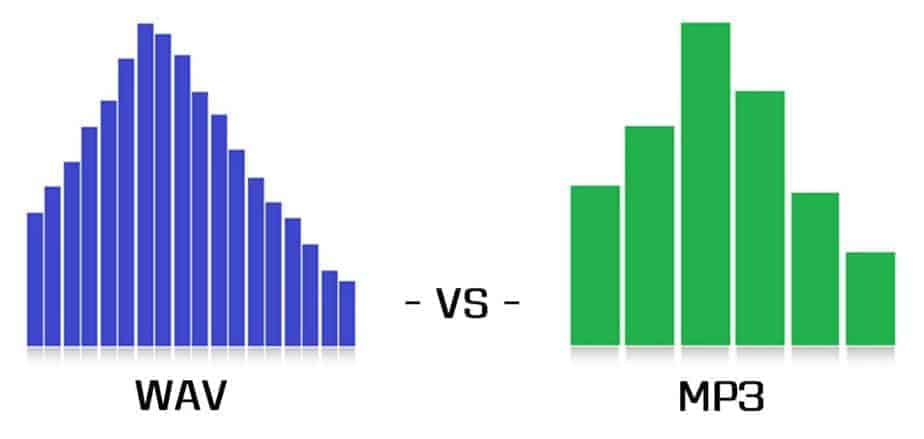
MP3 is a digital audio format used to compress audio files without losing quality. This is made possible by an audio compression algorithm called MPEG-1 Audio Layer 3, also known as MP3. Compression technology involves reducing the amount of data without losing the fundamental attributes of the original audio. Compressed data can be saved as a higher quality audio file in a much smaller size. This means MP3 files are easier to stream and share online.

MP3 files can be compressed at different bit rates depending on the user. Bitrate is generally in kilobits per second. For example, a 128 kbps (kilobits per second) MP3 file uses 128,000 bits to encode the audio every second. While bitrate is an important factor in determining the quality of an audio file, there are other factors as well, such as samplerate. The samplerate is the number of audio samples taken every second. An audio file recorded at a sample rate of 44.1 kHz (kilohertz) means that 44,100 audio samples were taken every second. The higher the samplerate, the better the audio quality.

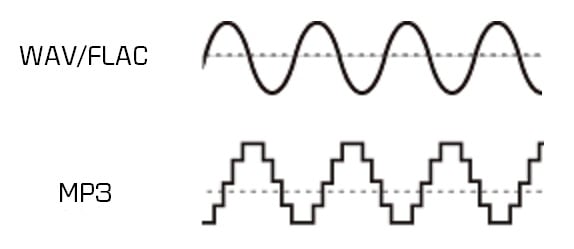
The magic behind the MP3 format lies in its ability to shed unnecessary data without compromising audio quality. This is accomplished by removing inaudible components from the audio. These inaudible components are called high and low frequencies. MP3 is a lossy audio compression codec, which means that deleted data cannot be recovered. This is why an MP3 file encoded at a small size cannot recover the audio quality of a file encoded at a larger size. MP3 is an extremely popular audio format, as it allows you to compress audio files without losing quality.

How You Can Improve the Quality of MP3 Audio Files

How can you improve the quality of audio files in MP3 format? The answer to this is to use an audio conversion program like MP3gain to adjust the volume of your audio files. MP3Gain is a free and open source tool that you can use to normalize the volume of your audio and video files. This tool is not only useful for improving audio quality, but also for saving space on your hard drive, as MP3 files encoded at lower sample rate and bitrate are smaller in size.

Of course, there is a downside to MP3 audio compression. As with any type of compression, there is a chance that the audio may become distorted or lose quality. While MP3 files encoded at a small size will have lower audio quality than those encoded at a larger size, if the proper bitrate and samplerate are selected, the audio will not be excessively distorted. The key is to find the balance between file size and sound quality.

Conclusion

We hope this guide has provided you with a clear and simple explanation of the concepts behind the MP3 audio format. While this article has mainly focused on the basics and technology behind MP3 audio files, we hope we’ve also provided some helpful tips on how to get the best audio quality out of your MP3 files. Finally, it is also important to mention the importance of using an audio conversion program like MP4Gain to normalize the volume of all audio and video files.


Free Download Mp4Gain
picture


Mp4Gain Main Window
picture


Mp4Gain Features
picture


Free Download Mp4Gain
picture

What is the difference between MP3 and lossless sound quality?

What is the difference between MP3 and lossless sound quality?

MP3 LOSSLESS
MP3 LOSSLESS


Is it possible to distinguish Mp3 quality from CD Quality?


mp3 lossless
mp3 lossless


Although the sound quality of a CD does not reach the true hearing limit of the human ear, it is impossible for most people to tell the difference between a CD and a higher sampling rate, so everyone assumes that the CD sound quality is 44.1 kHz can be converted to lossless sound quality.

In the past, the capacity of storage media was not large. To store more music and make it easier to stream, we used to compress large CD audio files. High frequency and low volume sounds are removed to achieve the purpose of reducing file size. Similar formats include 3GP, M4A, AA3, WMA, etc.

With the development of the Internet and storage media, the size of audio files is no longer important, so lossless compression has gradually become popular. Common formats are APE, FLAC, etc., which are similar to the beginning of ZIP compressed files, compress audio files AND packed, the final file size is basically only half of the original CD file. Here it is emphasized that the WAV format we often say is a waveform record file, which uses uncompressed PCM encoding, which is also a relatively large WAV file. 44.1 kHz 16-bit WAV audio can also be considered uncompressed. Lossless sound quality.

Since different devices support different audio compression formats, we often need to transcode, and each transcode will cause some loss in audio. For example: If you convert MP3 to lossless format, you can only achieve the sound quality of the original MP3 file. This lossless can also be called false lossless. This is the case for most lossless music provided by music portals.

I have been recording for many years and have used speakers ranging from tens of thousands to millions of dollars. Why do I rarely use speakers under 10,000 yuan? Because speakers under 10,000 yuan cannot be used as monitors. I advise everyone not to charge money for listening to music on music portals for lossless sound quality. Untrained ears will not be able to hear the difference between true and false without loss. For normal ears, MP3 with a bit rate of 320 kbps is already the best.

What is the difference between MP3 and lossless sound quality?

What is the difference between MP3 and lossless sound quality?

Mp3 Lossless
Mp3 Lossless

Now, many people think that it is impossible to listen to MP3, so they search for lossless music everywhere on the Internet.

Mp3 Lossless
Mp3 Lossless

So what is the difference between lossless music and MP3? What about the various lossless music formats?

A few days ago, a friend of mine bought a Porsche sports car and then came to ask me for lossless sound quality music. I told him there was no need to play MP3s, but people weren’t happy. The sound in the car was fine. Playing MP3 is a loss of audio.

Now there are many music websites that give lossless to the myth, but do you know what lossless is? What is the difference between lossless music and ordinary MP3? Today I come to talk to you about those things that have no losses.

I remember when Apple held the Iphone4 conference, it came up with a definition: retina display. In short, it has been replaced by a high resolution screen with pixels that exceed the recognition limit of the human eye since the Iphone4. I must say that Mr. Qiao’s trick is very good, he defines a word that everyone can accept and makes Apple mobile phones sell all over the world.

However, the same concept is much older in the world of acoustics. Sound is a type of energy wave. After the experimental research of countless generations of ancestors, it is believed that 40 kHz is a value that can well restore the sound heard by the human ear. Later, for various commercial reasons, some record companies defined the sample rate of CDs at 44.1 kHz, which they considered to be the “retina display” that the ears could hear. Later, 44.1 kHz brought innumerable problems to subsequent generations, because it is not an integer and cannot be divided and multiplied simply by performing SRC sampling, so early Inter defined the output sample rate of the sound card as 48 kHz to save problem. , which creates a sample rate conversion problem that all sound engineers hate

Mp3 is still the best audio format

Mp3 is still the best audio format


Mp3 Audio
Mp3 Audio

Does this phrase remind you of the fear of being dominated by “storage space” in those years?

Mp3 Audio
Mp3 Audio

This also shows from the side that in the years when storage technology was underdeveloped, MP3, which could compress the file size, was like a “black technology” for users at that time.

But after MP3 became popular, controversy also followed. Since MP3 allows anyone to rip CDs, make, copy and distribute music files to anyone, to a certain extent, it can be said that MP3’s dominance of the “global music format” is based on rampant pirated music. . However, from another perspective, these problems that MP3 brings with it are also forcing the music industry to start thinking about legalizing digital music.


What is the origin of the AAC?

AAC (Advanced Audio Coding) and MP3 are lossy compressed audio data formats. In 1997, it was jointly developed by Fraunhofer IIS, Dolby Laboratories, AT&T, Sony, and other companies to replace the MP3 format.

AAC is much younger than MP3, and the technology it was born into has far surpassed MP3. According to public information, AAC uses a new algorithm for encoding, which is more efficient and has a higher “cost performance”. As Fraunhofer IIS says, AAC looks better than MP3 in every way.

Although AAC is better than MP3, but MP3’s market share is too high. It is almost impossible for AAC to change the “MP3 inertia” of the user.

Fortunately, not everyone refuses to support AAC. Apple is one of the supporters of AAC. It started to provide AAC format for users to download as soon as possible. Li Chujie, founder of MOZIK music player, said:

In 2006, I bought my first iPod from Apple and it supported AAC files. All MP3 formats that I download from the Internet are converted to AAC files. It was also through this that I noticed the difference in sound quality and byte size between MP3 and AAC.


In the early days, apart from Apple, there were devices like Sony Walkman (NWZ-A, NWZ-S, NWZ-E, NWZ-X series), Nintendo NDSi, and Meizu that supported AAC. Later, as more and more music lovers paid attention to AAC, users gradually recognized its advantages. Both the number and category of hardware devices that support AAC have grown rapidly.

Mp3 is still the best audio format

Mp3 is still the best audio format

Mp3 Audio
Mp3 Audio

MP3, the king of music formats, has retired from the stage of history and been replaced by AAC. What is the origin?

Mp3 Audio
Mp3 Audio

Even someone who knows nothing about audio encoding may not have listened to MP3.

This audio format emerged in the 1990s. For most post-80s and post-90s generations, having an MP3 player capable of playing this audio format is one of the best childhood memories.


But now it’s time to say goodbye to MP3s. Recently Fraunhofer IIS, which invented this audio format, announced that it had rescinded some patents related to MP3 and officially took it off the stage of history.

Furthermore, Matthias Rose, director of the institute, said:

The Advanced Audio Coding (AAC) format has become the standard for mobile music and video downloads. This format is more efficient, more functional, and has a lower bit rate than MP3, and is used in both broadcast TV and radio to deliver high-quality audio.

This means that Fraunhofer IIS wants to replace MP3 with the AAC format below.

How did MP3 become the king of music formats?
There are generally two main types of audio file formats, one is a lossless compressed data format and the other is a lossy compressed data format.

MP3 is the most popular digital audio encoding and lossy compression format, and is supported by almost all terminals and software.

The birth of MP3, but also for 30 years. In 1987, Fraunhofer IIS in Germany began the development of the music compression format. They spent 4 years to improve the algorithm and sound quality, and finally developed this very advanced lossy compression audio format in 1993 and determined the extension .mp3.


The purpose of developing this audio compression technology is to greatly reduce the amount of audio data. Knowing that hard drives at the time were relatively small (like 500 MB), compressing all compressible data was essential for any computer user.

How does Fraunhofer IIS do it? During the invention of MP3, developers studied psychoacoustics and determined that some of the audio data is not important to the human ear. MP3 achieves the purpose of compressing the file size by discarding this part of the data, and can successfully compress the audio file to 1/10 of the original size.

After that, from the first half of 1995 to the end of the 1990s, MP3 began to flourish on the Internet. The “much smaller file but also good sounding” MP3 began its era of dominating audio formats. There were even many people at the time who believed that all digital music files were MP3s.

How is the audio compressed?

How is the audio compressed?

mp3 vs lossless
mp3 vs lossless

How was it achieved that the mp3 occupies much less disk space?

mp3 vs lossless
mp3 vs lossless

We explained in a previous article that when talking about quality in audio files (wav, flac, ogg, mp3, etc) we must be careful, because we are not interested in a neutral “quality”, but one that is related to human hatred.

For example, if we only talk about dry quality, we could think that a file that detects and saves all the frequencies has better quality.
But if we refer specifically to the human ear, then we would not be interested in it being able to detect and store frequencies that the human ear cannot hear. It would be useless and unusable and would only take up space on the hard drive.

Some animals can hear frequencies that the human ear cannot and it is useless for us as humans to have a format that can store those frequencies and, as we said, it is just a waste of space.

Therefore, when talking about quality and formats, we must avoid falling into the situation of talking about audio at a neutral level.

Because it becomes a sterile and quite fundamentalist discussion.

In that sense, the information that necessarily in FLAC format (any lossless format) necessarily has better quality than an mp3 that has a high bitrate and a samplerate of at least 44100, is inaccurate.

In general terms, it will be enough for an mnp3 to have 192 kbps and 44100 so that not even people with auditory training can distinguish the difference.

There are people who only rely on data they read, or who are audio fundamentalists, who as if it were a religious belief, definitely assert that lossless formats are superior to mp3 and that is not so true.

Perhaps if we use specific software we can see that those lossless files captured frequencies that the mp3 did not capture, but that is something that we will see in that software but we will hardly hear it and in the end the audio is to be heard.

In a following article we will continue with the topic.

An mp3 has lower sound quality than a wav?

An mp3 has lower sound quality than a wav?

Mp3 High Quality
Mp3 High Quality

The format is used to know which audio file has the highest quality?

Mp3 High Quality
Mp3 High Quality

No, the answer is nmo for both questions.

The first thing that should be clearly stated is that what we call audio quality is expressed and only thought of in terms of human hearing, human ears.

Because we don’t listen like many animals. Each one has its most efficient frequencies and others that it does not perceive, according to its survival needs. Exactly how some animals see better in the dark or perceive colors differently, and all this has been so because of the environment where they live and where they must survive.

Even a child or teenager can often perceive that an adult cannot.

Then, we will have to understand that quality is not synonymous with an absolute capacity to reproduce all frequencies, but rather that for us quality is something that sounds in a certain way to the human ear.

With that understood, we will say that an mp3 with 192 kbs and 44100 or more samplerate is of sufficient quality and can hardly be distinguished from other formats.

Only less than 1% of the population can perceive a slight and uncertain difference if the mp3 has that quality.

We will see in other articles how it is that those frequencies that we cannot perceive are the ones used to compress the audio and that is why a good quality mp3, which only eliminated frequencies that the human ear cannot distinguish, sounds 99.9999999% the same as other files promoted as better quality.

Vinyl vs Mp3

Vinyl vs Mp3

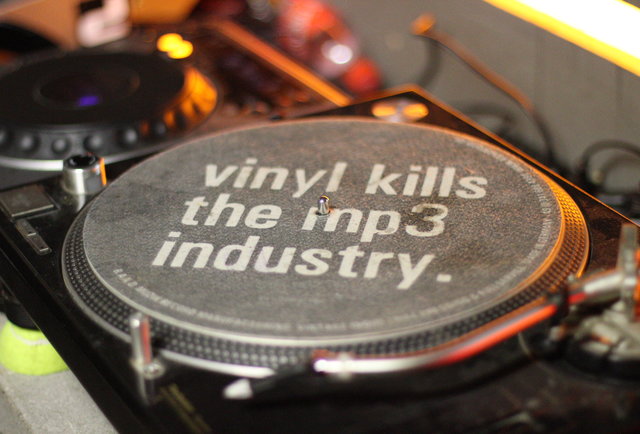
It is surprising how a format with as many drawbacks as vinyl was, is held in such high regard. I imagine that partly because of handling it with my hands, I can understand that, but what I don’t understand is how there are still people who defend the sound quality of vinyl over a CD or an mp3.

There is a lot of talk about the sound limitations of an mp3, that if it masks some frequencies with others and if it is not capable of reproducing the treble or bass well … the bass? for the love of God! If there is an audible deficiency, why would it be on the frequencies that need the least amount of information to register? The truth is that in a low quality mp3 such as 128 or 160Kbps, deficiencies in the treble can be noticed, but I personally am unable to hear any difference between a 192Kbps and a WAV.

Vinyl

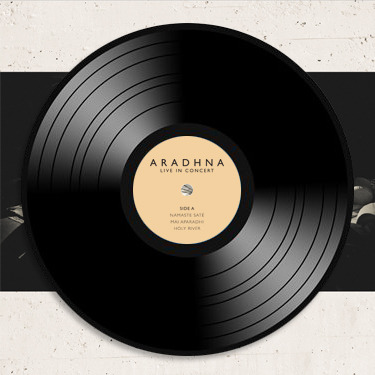
But let’s go back to vinyl and detail a few flaws of this legendary format, some known, but others mostly not so much:

Clicks and Pops: Vinyl is conducive to charging with static electricity, which causes small audible discharges in the form of pops. Static electricity in turn traps dust, which can also be heard in the form of clicks and other noises.

Abrasion of the groove: The needle, in each reproduction, literally sanding the information contained in the groove. In other words; The more you click it the worse it sounds.

Angular speed (this is my favorite): The vinyl rotates at a constant angular speed (45 or 33 rpm), but the needle travels the groove at a variable linear speed, leading to loss of quality as the needle goes approaching the center. To be more precise, there is about 5o0mm per second on the outside of the disc and about 200mm on the inside. Nobody pays attention to this because the loss is gradual but if you take a record that starts and ends with the same “cymbals” and quickly jumps the needle from the beginning to the end, you will hear a clear loss of treble.

Stereo image loss: Due to physical limitations of the vinyl, the L channel as it leaves the deck, has added 20% of the R channel signal and vice versa.

Foreboding Echo: The longer the recording, the more the grooves have to be tightened, and the closer they are, the more the sound coming from “the next round” can be appreciated in a “foreboding echo” effect. The reverse is also true, hearing the sound of the past groove if the disc suddenly falls silent. It is not that it is the worst defect since it is only heard in large volume changes but there it is. Add and go.

Feedback: The sound at high volume, vibrates the needle while it sounds, thus trapping these vibrations and transmitting them back to the amplification system to be caught again in an infinite regulation creating the typical low hum. Fascinating!

I could go on but, only with those in mind, the only explanation that fits for those who still defend the sound of vinyl is that they base their opinion on the legends and romanticism that are implicit in a piece of circular plastic. Music professionals, please use your ears to hear.