What’s behind the MP3 Audio Format?


Free Download Mp4Gain
picture

What’s behind the MP3 Audio Format?

MP3 Audio Format
MP3 Audio Format

When most people hear the word MP3, they usually think of songs, podcasts, and other compressed audio files. While it’s worth acknowledging the role these uncompressed files have played in the world of music, the goal of this guide is to explain in detail what’s behind these files, how they work, and what makes them so popular. Through this understanding guide, we hope to cover the core concepts behind the MP3 audio format, such as bitrate and samplerate, as well as offer some tips and tricks to ensure you’re getting the best audio quality from your MP3 files.

MP3 Audio Format
MP3 Audio Format

What is MP3 Format?

MP3 is a digital audio format used to compress audio files without losing quality. This is made possible by an audio compression algorithm called MPEG-1 Audio Layer 3, also known as MP3. Compression technology involves reducing the amount of data without losing the fundamental attributes of the original audio. Compressed data can be saved as a higher quality audio file in a much smaller size. This means MP3 files are easier to stream and share online.

MP3 files can be compressed at different bit rates depending on the user. Bitrate is generally in kilobits per second. For example, a 128 kbps (kilobits per second) MP3 file uses 128,000 bits to encode the audio every second. While bitrate is an important factor in determining the quality of an audio file, there are other factors as well, such as samplerate. The samplerate is the number of audio samples taken every second. An audio file recorded at a sample rate of 44.1 kHz (kilohertz) means that 44,100 audio samples were taken every second. The higher the samplerate, the better the audio quality.

The magic behind the MP3 format lies in its ability to shed unnecessary data without compromising audio quality. This is accomplished by removing inaudible components from the audio. These inaudible components are called high and low frequencies. MP3 is a lossy audio compression codec, which means that deleted data cannot be recovered. This is why an MP3 file encoded at a small size cannot recover the audio quality of a file encoded at a larger size. MP3 is an extremely popular audio format, as it allows you to compress audio files without losing quality.

How You Can Improve the Quality of MP3 Audio Files

How can you improve the quality of audio files in MP3 format? The answer to this is to use an audio conversion program like MP3gain to adjust the volume of your audio files. MP3Gain is a free and open source tool that you can use to normalize the volume of your audio and video files. This tool is not only useful for improving audio quality, but also for saving space on your hard drive, as MP3 files encoded at lower sample rate and bitrate are smaller in size.

Of course, there is a downside to MP3 audio compression. As with any type of compression, there is a chance that the audio may become distorted or lose quality. While MP3 files encoded at a small size will have lower audio quality than those encoded at a larger size, if the proper bitrate and samplerate are selected, the audio will not be excessively distorted. The key is to find the balance between file size and sound quality.

Conclusion

We hope this guide has provided you with a clear and simple explanation of the concepts behind the MP3 audio format. While this article has mainly focused on the basics and technology behind MP3 audio files, we hope we’ve also provided some helpful tips on how to get the best audio quality out of your MP3 files. Finally, it is also important to mention the importance of using an audio conversion program like MP4Gain to normalize the volume of all audio and video files.


Free Download Mp4Gain
picture


Mp4Gain Main Window
picture


Mp4Gain Features
picture


Free Download Mp4Gain
picture

Differences between audio formats

Differences between audio formats

Digital audio formats

Wav

WAV or MP3

Wav
It is the primary audio format for many, many digital audio playback systems and is used as a standard audio file format on personal computers. In addition, it has a strong set of specifications, which has grown considerably in recent years. Its full name is Microsoft RIFF / WAVE – Resource Interchange File Format / Wave – Resource Interchange File Format / Waveform, and it was created by Microsoft and Intel engineers. In turn, WAV stands for Waveform Audio File Format.

WavPack (.WV extension)
WP
WavPack also includes a unique “hybrid” mode that provides all the benefits of lossless compression with the added benefit of creating a relatively small, high-quality, and lossy file (.wv) rather than creating a single file, which is you can reproduce by yourself. and a “fix” file (.wvc), which (in combination with the old .wv) allows you to fully restore the original. For some users, this means that they will never have to choose between lossy and lossy compression.

The format has very good compatibility with the player. Also, of course, the plugin for Winamp from the official codec site http://www.wavpack.com, you can download plugins for Adobe Audition (!) And Nero Burning Rom. There is a great plugin for XMMS: the Winamp analog for Linux. In addition, there is a project for the development of DirectShow filters for WavPack; this will allow the format to be used in any Windows program, including Windows Media Player. You can download the latest version from here. There is a third party interface for WavPack. Download it here.

From a technical point of view, there is nothing to complain about either. Multi-channel audio is supported, 32-bit audio stream resolution, sample rate: up to 192 kHz (!).

The format, like the source codes of the compression program, is open source. Unfortunately, the encoder is compiled only for the Windows platform, but there is always the possibility to independently recompile the source codes available for your operating system.

The site, like the codec itself, is regularly updated, which is good news.

DTS
DTS
DTS – Digital Theater System, in fact, is Dolby Digital, or rather its competitor. DTS uses a lower compression rate than Dolby, so it actually sounds better, as evidenced by DVDs that have DTS or DD tracks. DTS in home theater systems uses a maximum bit rate of 1536 kbps (full bit rate), this sound is better than Dolby Digital’s AC-3 format. DTS – Uses 6 free audio tracks and supports 7.1 sound distribution system, with this DTS 4.0 bit rate – it will sound as immersive as Dolby 5.1.

Windows Media Audio (WMA)
WMA
A licensed file format developed by Microsoft to store and transmit audio information.

Nominally, the WMA format is characterized by good compressibility, which allows it to “bypass” the MP3 format and compete on parameters with the Ogg Vorbis and AAC formats. But as the independent tests, as well as the subjective evaluation, showed, the quality of the formats is not yet unequivocally equivalent, and the advantage even over MP3 is unequivocal, as Microsoft claims.

Lossless WMA

The codec is part of the Windows Media Audio suite. It’s free, but the format, as well as the encoding program, are proprietary. Of course, the version only exists for the Windows platform.

Basically, WMA Lossless supports all the necessary functions: tags, high sample rates, multi-channel audio (including 7.1), streaming audio over a network, etc. Additionally, Windows Media Player’s built-in decoder support eliminates the need to download anything from the Internet to play a music file.

MP3
MP3
MP3 – (MPEG Audio Track Encoding Format) is a licensed file format for storing audio information.

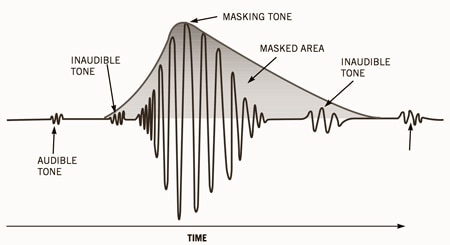
The most popular compression format today. The MP3 (MPEG Layer 3) format was developed, after several intermediate formats, by the Fraunhofer Institute in Germany. Actually, the .MP3 format relies on fooling the human ear. After some research, it turned out that human hearing tends to adapt to the appearance of new sounds, which is expressed in an increase in the hearing threshold. Therefore, some sounds are capable of masking (that is, making them subjectively inaudible) others. So in this format, some of the sounds that, according to the corresponding theory, are made inaudible, are simply removed from the general sound.

WAV AND MP3 COMPARISON | FEATURES AND WHICH IS BEST Part 2

WAV AND MP3 COMPARISON | FEATURES AND WHICH IS BEST Part 2

WAV vs. MP3

And now to the description of the formats. WAV music format The WAV music format was developed jointly by IBM and Microsoft engineers. The goal was to create a universal container format that would store uncompressed music and could be played on multiple devices.

WAV vs MP3


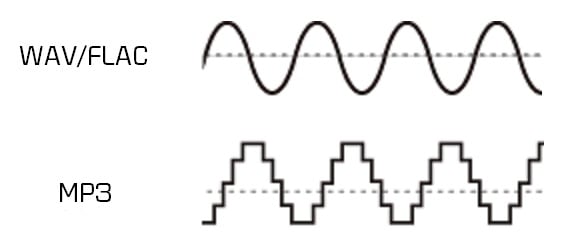
In fact, they succeeded. WAV is loved by both users (thanks in large part to native support for the Windows operating system) and music studios (minimal loss, fast encoding and decoding). It is true that WAV has not lost the main drawback of uncompressed formats: the huge file size. But the sound quality is as high as possible. In fact, it is a quasi-analog format in which the audio stream is recorded in waves. MP3 music format The MP3 music format was developed by the German company Fraunhofen IIS and was originally created to transfer audio into video files. Even its name stands for Moving Picture Expert Group Layer 3, that is, “the third layer in moving pictures”. But it turned out that the format is perfect for recording any sound and can be easily played without being packaged in an MPEG container. Since the task of the developers was to reduce the bit rate (“size”) of the audio track, otherwise it will weigh like a video track, they boldly mocked the audio stream. And, in addition to frame-splitting and spike-pasting compression, they also eliminated inaudible frequencies. That is, when encoding, everything below 20 Hz and above 15 kHz is removed from the audio stream. In theory, a person does not hear this, so he should not suffer. In practice, it turns out that frequencies below 20 Hz make the bass deeper, and above 15 kHz the voice is more detailed. But it doesn’t matter if headphones or speakers can’t reproduce frequencies below 20 Hz and above 15 kHz. And inexpensive audio equipment just can’t do that. But MP3 files are “heavy” a bit and provide enough quality for independent listening. And in the age of digital distribution, these two virtues have made MP3 very popular. Difference Between MP3 and WAV Actually, the main difference between WAV and MP3 is that the former is uncompressed and incredibly detailed, while the latter is compressed and not very verbose. But for the sake of music in the first format, you will have to buy an external hard drive, and in the second, a flash drive will suffice. The WAV format in 2019 is commonly used in the field of “professional audio”. Record musicians in studios. It’s where the songs mix. Only notorious audiophiles with excellent quality audio equipment listen to music on it. The MP3 format is now ubiquitous. It is suitable for listening at home, on the road (from a smartphone or player), in a car through a radio. A CD can fit about 50 songs in high quality or about 200 in low quality. The quality, of course, is not very high, but sufficient. And the “size” decides. In terms of numbers, the WAV bit rate is 1140 kbps, the MP3 bit rate is a maximum of 320 kbps. Which format is better, WAV or MP3? There is no definitive answer to this question. These formats are designed for different purposes. Comparison table, below: TECHNIQUE ON WHICH THEY WILL LISTEN TO MUSIC. PREFERRED FORMAT WHY HIGH DETAIL WAV HIGH-END EQUIPMENT, WITHOUT ELIMINATION OF INAUDIBLE FREQUENCIES ECONOMIC MP3 EQUIPMENT STILL CAN’T WAIT TO GET THE BEST SOUND QUALITY, CAN SAVE SPACE ON YOUR COMPUTER OR CUP PHONE PLAYER, MP3 PLAYER OF SPACE

WAV AND MP3 COMPARISON | FEATURES AND WHICH IS BEST

WAV AND MP3 COMPARISON | FEATURES AND WHICH IS BEST

WAV vs MP3

The development of digital audio distribution has led to the fact that there are now several dozen audio file formats on the market.

WAV vs. MP3

Each developer tried to come up with their own encoding method and encryption algorithms, and then make them popular. But now, in 2019, it has become clear that MP3 has won the battle of music formats.

And even if the developers no longer support it, that’s fine. Anyway, music in files of this type can be played on any phone, player, computer, radio, TV, and even some models of smart watches. However, when you buy high-quality audio equipment, such as headphones and a sound card for a total of 1.5 salaries, the disadvantages of MP3 start to show.

It seems that the technique is good, but still the music sounds somewhat “flat” and boring. This is because MP3 cuts parts of the audio stream. And then you want to choose a higher quality format. For example, a slightly less common WAV, which will help the technique to “open up”. But is this WAV really that good? Let’s compare two formats, WAV and MP3, and choose the one that suits you best! What is the difference between compressed and uncompressed music formats? Since WAV is a sample uncompressed music format and MP3 is a compressed format, it is worth understanding what compressed and uncompressed music formats are to understand the key difference between the two. We are not going to go deeper, we will also talk about sigma-delta modulation, just “let’s go over it.”

Uncompressed music formats were one of the first to emerge. They involve the sequential recording of every sound captured by the microphone in the studio, every note, every attempt by the vocalist to hit eight octaves in a single song. As a result, the file is incredibly detailed as all the sounds are listed. There are only a couple of problems. Due to the high level of detail of the audio file, it is huge. On average, a three-minute song in a WAV container “weighs” about 60 megabytes. As a result, it’s good for a gigabyte flash drive if it fits at least one artist’s album. And at a time when a 1GB hard drive was an unattainable luxury, it was at least unwise to waste precious hard drive space for songs.

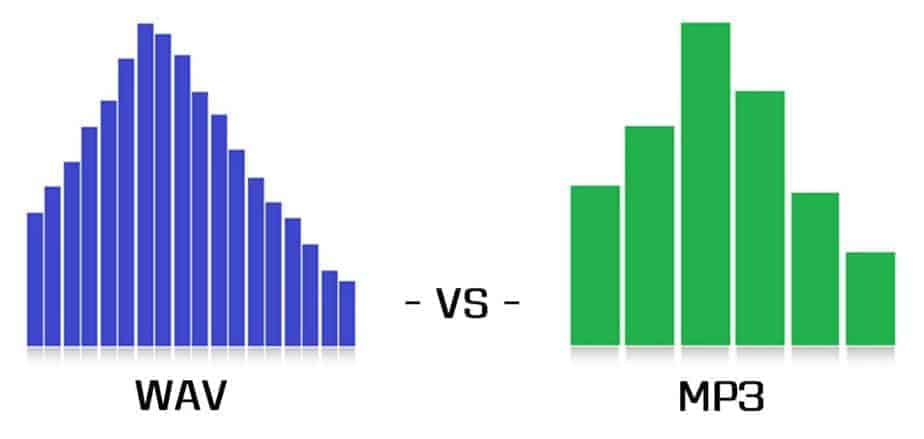
The second problem is that to decode this type of music you need a powerful and agile processor. That is, the chip has to constantly take a digital signal and convert it to analog that goes to the speakers. At the same time, there are many digital signals – we remind you of every sound. Therefore, the performance of the chip must also be high. Thus, engineers and programmers were faced with the task of ensuring that a Robbie Williams fan could keep his entire discography (14 albums, 3 collections, countless singles, 8 DVDs) without having to buy a server. This is how compressed formats appeared, of which MP3 is an example. Compressed formats involve additional music transcoding. The audio stream is divided into separate frames, then they are pasted, the details are partially lost (for example, two loudness peaks are pasted into one), perhaps, as in MP3, some frequency ranges are cut off …

As a result, the file is much smaller. On average, a three minute song in a high bit rate (320 kbps) MP3 file “weighs” about 10 megabytes. In other words, a full EP (mini-album) in MP3 will “fit” in the volume of a song in WAV! And if you reduce the bitrate, removing even more frame-parts from the audio stream and significantly degrading the quality, then the entire discography of the long-suffering Robbie Williams may be “cluttered.” On the other hand, the loss of quality cannot be said to be too significant for the listener. MP3 320 kbps provides enough quality for listening to music, watching movies, etc. The listener ignores “missing details” or “ponders” them to create a complete acoustic picture. In addition, the quality of the equipment also affects the quality of playback. On computers with a weak built-in sound card and Chinese speakers that MP3 64 kbps, that MP3 320 kbps, that WAV will sound just as bad. But just get a multichannel audio system, an amplifier, a discrete sound card with a 192KHz DAC, and the sound in WAV flourishes. But MP3 will seem too flat and with little detail.

Why is WAV not as popular as MP3 or FLAC?

Why is WAV not as popular as MP3 or FLAC?

WAV vs. MP3

WAVE or WAV is a short form of Wave Audio File Format (less commonly known as Audio for Windows). This format is the standard for storing audio streams on a PC. It is the domain of the RIFF format for storing audio in “strings”, very similar to the 8SVX and AIFF formats used by the Amiga and Macintosh computers respectively. It is also the main format on Windows systems for storing normal uncompressed audio. Typically this is done by linear pulse code modulation.

WAV vs MP3

Both WAV and AIFF are compatible with Windows, Macintosh or Linux operating systems. The format also takes into account some of the differences in Intel processors, such as endian byte order. The RIFF format acts as a wrapper for various audio compression codecs.

Although a WAV file can contain compressed audio, its most common use is to store uncompressed audio in linear PCM format. The standard audio CD format, for example, is LPCM audio, with 2 channels, 44-100 Hz sample rate, and 16 bits per sample. Since the LPCM format stores uncompressed audio that is exactly the same as the original, it allows professional users and audio experts to use it for maximum audio quality. The WAV audio file can also be modified in almost any audio editor. The Wav format works with compressed audio on Windows systems through the Audio Compression Manager (ACM). Any ACM codec can be used to compress a WAV file. The ACM user interface can be accessed through a variety of programs, including the standard audio recording program on some versions of Windows.

Starting with Windows 2000, the WAVE_FORMAT_EXTENSIBLE header appeared, which allowed storing multichannel audio data, taking into account the location of the speakers, eliminating ambiguities in terms of sample types and container sizes in the standard WAV format. It also supported arbitrary extensions for the snippet format.

There are also many inconsistencies in the WAV format: for example, 8-bit data is unsigned, while 16-bit data is signed.

WAV files can contain embedded IFF “lists”, which can contain multiple sub-changes.

Metadata
Derived from the Resource Interchange File Format (RIFF), WAV files can have metadata (tags) in an INFO chunk. Additionally, Extensible Metadata Platform (XMP) metadata can be embedded in WAV files.

Popularity
WAV files are large enough that this format is cumbersome to share over the Internet, and this greatly undermines its popularity. However, this format, as a general rule, is most often used to preserve the original appearance of high-quality files in cases where the amount of free disk space is not limited. It is also used in audio editing programs to save time when compressing and decompressing data.

More often, data is compressed using lossy formats such as Ogg Vorbis, MP3, ATRAC, AAC, Musepack, and WMA, which are used to store and share music (for example, between Internet users). The small file size and the ability to download them quickly are also a significant advantage, while this audio data takes up much less space. But lossy formats sacrifice quality for size, so their algorithms don’t preserve the original sound quality in every detail. But there are also lossless codecs like FLAC, Shorten, Monkey’s Audio, ATRAC Advanced Lossless, Apple Lossless, WMA Lossless, TTA, WavPack, but none of these codecs can be called generally accepted.

Wav and Mp3: comparison of these two formats.

Wav and Mp3: comparison of these two formats.

WAV vs MP3

The development of digital audio distribution has led to the fact that there are now several dozen audio file formats on the market. Each developer tried to create their own encoding method and encryption algorithms, and then make them popular. But now, in 2019, it has become clear: MP3 won the battle of music formats. And even if the developers don’t support it anymore, that’s fine. Anyway, music in files of this type can be played on any phone, player, computer, radio, TV, and even some models of smart watches.

MP3 VS WAV

However, when you buy high-quality audio equipment, for example, headphones and a sound card for a total of 1.5 salaries, the disadvantages of MP3 start to show. It seems that the technique is good, but anyway the music sounds a bit “flat” and boring. This is because MP3 cuts parts of the audio stream.

And then you want to choose a higher quality format. For example, a slightly less common WAV, which will help the technique to “open up”. But is this WAV good? Let’s compare two formats, WAV and MP3, and choose the correct one. How compressed and uncompressed music formats are different Since WAV is a sample of uncompressed music format and MP3 is a compressed format, it is worth understanding what compressed and uncompressed music formats are to understand the key difference. between the two.

We are not going to go deeper, we will also talk about sigma-delta modulation, just “let’s go over the top.” Uncompressed music formats were one of the first to emerge. They involve sequentially recording every sound captured by the microphone in the studio, every note, every attempt by the vocalist to hit eight octaves in a single song. As a result, the file is incredibly detailed as all the sounds are listed. There are only a couple of problems.

Due to the high level of detail of the audio file, it is huge. On average, a three-minute song in a WAV container “weighs” about 60 megabytes. As a result, it’s good for a gigabyte flash drive if it fits at least one artist’s album. And at a time when a 1GB hard drive was an unattainable luxury, it was at least unwise to waste precious hard drive space for songs. The second problem is that decoding such music requires a powerful and agile processor.

That is, the chip has to constantly take a digital signal and convert it to analog that goes to the speakers. At the same time, there are many digital signals; remember, every sound. Therefore, the performance of the chip must also be high. Thus, engineers and programmers were faced with the task of ensuring that a Robbie Williams fan could keep his entire discography (14 albums, 3 collections, countless singles, 8 DVDs) without having to buy a server. This is how compressed formats appeared, of which MP3 is an example. Compressed formats involve additional music transcoding. The audio stream is divided into separate frames, then they are pasted, the details are partially lost (for example, two loudness peaks are pasted into one), maybe, as in MP3, some frequency ranges are cut off … And as a result, the file is much smaller! On average, a three minute song in a high bit rate (320 kbps) MP3 file “weighs” around 10 megabytes.

In other words, a full EP (mini-album) in MP3 will fit the volume occupied by a song in WAV! And if you reduce the bitrate by removing even more frame-parts from the audio stream and significantly degrading the quality, then the entire discography of the long-suffering Robbie Williams may be “cluttered.” On the other hand, the loss of quality cannot be said to be too significant for the listener. MP3 320 kbps provides enough quality for listening to music, watching movies, etc. The listener ignores the “missing details” or “ponders” them to create a complete acoustic picture. In addition, the quality of the equipment also affects the quality of playback. On computers with a weak integrated sound card and Chinese speakers, MP3 64 kbps, MP3 320 kbps, WAV will sound equally bad. But just get a multi-channel audio system, an amplifier, a discrete sound card with a 192KHz DAC, and the sound in WAV flourishes. But MP3 will seem too flat and with little detail.