MP3 and FLAC Audio Formats – We Use It Wisely

MP3 and FLAC Audio Formats – We Use It Wisely

FLAC vs MP3

In this post, I want to talk about how to get the best results when compressing music in FLAC and MP3 formats. In the age of mass distribution of audio and video streaming services, this topic may seem of little relevance, however, as practice shows, this is not the case.

FLAC vs MP3

First, not everyone wants to depend on third-party resources, which can behave as they please at any time, from the introduction of various access restrictions to content to its complete removal. Second, there are many places in the world where the Internet is slow, dreary, and with lunch breaks. Third, the sound quality when listening online is usually quite acceptable for most users, but it can plunge sophisticated listeners with good equipment into depression. Considering all the above, we can assume

Basic concepts

PCM (pulse code modulation), also known as PCM (pulse code modulation) is a method of representing an analog signal in digital form. It works like this: electrical vibrations are fed into the input of a device called the ADC (analog to digital converter), which is an analog audio signal. The ADC measures the level of this signal with a certain frequency and transmits the obtained values ​​to the outside, where they are stored. Thus, a data matrix is ​​formed, which is a sequence of values ​​of the amplitude of the original signal. The process described is called “digitization”. The main problem with storing PCM data in “naked” form is its rather large volume, therefore, for a more rational use of space on the carrier, various digital audio compression algorithms are used.

Encoder (or “encoder” from English “encoder”) is a software designed to convert WAV to any other format in order to reduce the amount of stored data.

Decoder – Software or hardware used to play files compressed in the appropriate format or convert them to uncompressed format.

Lossy is the generic name for a family of audio formats that use lossy data compression. Typical members of the family are MP3, AAC, WMA, Ogg Vorbis. The main characteristic of lossy formats is that when the material is compressed in any of them, a significant part of the original audio information is irretrievably lost and cannot be restored later in any way. Because of this, a high degree of compression is achieved, while the loss is barely perceptible or generally invisible to the ear, as only data that is not critical to human perception is discarded.

Lossless is the generic name for a family of audio formats that use lossless data compression. Typical family members: FLAC, Monkey’s Audio (APE), ALAC, WavPack. Unlike lossy formats, here no information is lost during compression, everything happens in the same way as in normal filing cabinets. Paying for complete data security is significantly lower compression ratio compared to loss.

MP3 (MPEG-1 Layer 3) is historically the first and most widespread lossy compression format. Despite the fact that, due to the era of MP3, today it does not shine with the efficiency of compression, its popularity remains very high due to its versatility: any plate can reproduce this format. At the same time, if a suitable encoder and decoder are used, the MP3 sound quality is at a very decent level. The combination of these two factors justifies the use of the format today. The MP3 compression ratio while maintaining high sound quality is 6 to 9 times. The average bit rate of such an MP3 with 16-bit / 44.1 kHz stereo parameters is 150 to 240 kbps, the file size of a five-minute recording in this form is 6 to 9 MB.

FLAC (Free Lossless Audio Codec) is currently the most popular lossless audio compression format. If lossless support is claimed for any software or equipment, this software / equipment can almost certainly play FLAC. The format is the de facto standard among lovers of quality sound. The FLAC compression ratio is 1.3-2.8 times. FLAC bitrate with parameters 16 bit / 44.1 kHz / stereo – 500-1100 kbps, the file size of a five minute recording in this form is 18-40 MB.

FLAC or MP3: these are the differences

FLAC vs MP3

FLAC and MP3 are common audio formats. We explain their similarities and differences in this practical tip.

Similarities Between FLAC and MP3

At first glance, FLAC and MP3 have a lot in common:
FLAC and MP3 are audio formats. Detailed information on FLAC files can be found in this practical tip.

Mp3 vs Flac
The audio information is compressed in both formats.
With both, compression works in several steps. One of them can be lossless mid-side encoding for both.
Strictly speaking, both MP3 and FLAC are codecs, that is, pairs of an encoder to compress and a decoder to play the file.
Both formats allow the addition of metadata as tags.
Streaming is possible with both formats, that is, near real-time streaming.
WAV file in wave format

Differences between FLAC and MP3

Despite the similarities, there are essential differences between FLAC and MP3:
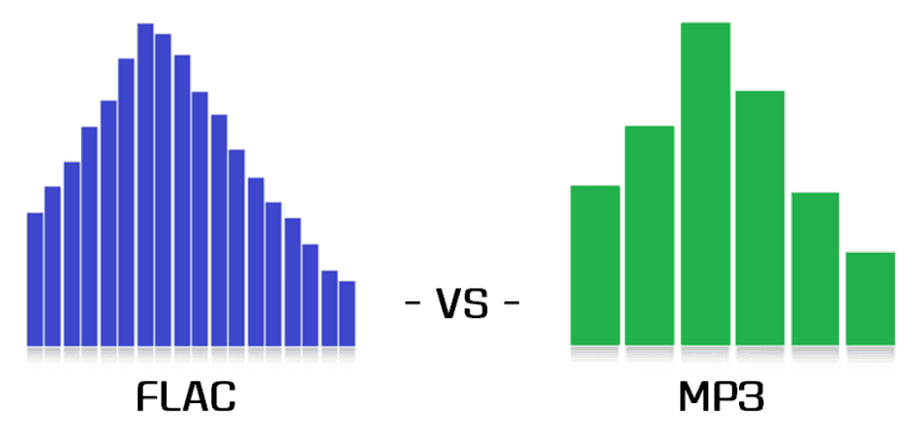
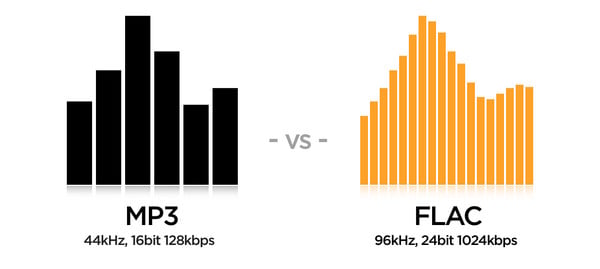
MP3 is a psychoacoustic compression process, which means it changes the signal as you can see in the image. FLAC just changes the way the data is presented so that the file can be saved more efficiently.
MP3 is leaky due to the way it works. This means that the information in the original file is lost and errors occur. On the other hand, FLAC files can be used to restore the original without errors.
MP3 achieves a file compression of approximately one-tenth the original size. FLAC reduces the size of the source file by approximately half.
PCM files, like WAV, store continuous fluctuations in sound pressure as discrete values ​​over time. With a high sampling frequency and depth, this process is virtually lossless. FLAC files store data from WAV files in a different way. However, the PCM file can be regenerated from it at any time.
MP3 files generate noise especially before the strong amplitude increases and reduces the dynamics of some frequencies and thus irreparably falsifies the output signal. However, if the encoding is good, the differences are subliminal
There is already a huge market for MP3 music, editing software and playback devices. Until now, FLAC has barely established itself in the area of ​​music downloading, audio processing software, and in terms of playback devices.

FLAC or MP3: which is better?

The differences between FLAC and MP3 in particular show which format is more suitable for which application:
MP3 has the immense advantage of being available, widespread, and compatible with common hardware and software. In addition, there is the huge compression rate, which is particularly suitable for fast streams and large music collections.
FLAC has a decisive force: it encodes lossless audio files and is much more flexible and more compressed than ZIP or RAR files. FLAC is particularly ideal in the recording studio, but also for highly dynamic music or simply for archiving lossless audio CDs.

Convert FLAC to MP3: what about bit rate?

If you’re the proud owner of a high-quality FLAC file music library, don’t worry about the bit rate (sample rate). But for lossy formats like MP3 or AAC, it is the bit rate that determines the sound quality. The previous default value was 128 kbps, today you just need to convert to 320 kbps. Almost any converter that converts from FLAC to MP3 should offer this setting.

flac

Opinions differ about the bit rate: some do not hear the difference between an MP3 with 128 kbps and an MP3 with 320 kbps, others do. But if you start with a FLAC file, you should get the most out of your file and convert more than a few kilobits per second (kbps).

mp3 quality

FLAC or MP3: do you hear the difference?

It’s a topic worth discussing, like in the hi-fi world: is there a difference between FLAC and MP3 files? The answer: yes, certainly!

If you don’t hear a difference, it’s not so much the file format, but the computer the song is playing on. If you listen to the same song in MP3 and FLAC format, you will notice a clear difference. A FLAC file simply contains more information. If you play this in a good installation, you will clearly hear the added value. Take the test yourself!

Hi-fi enthusiasts speak deeper. Music sounds fuller and more realistic. The best test is to switch between FLAC and MP3, because switching back to MP3 exposes gaps in the soundtrack. These frequencies are really beyond the audible range of people, or so they thought, but they still seem to be perceived.

However, the MP3 quality is sufficient for use in an MP3 player or smartphone. Although you can hear even finer nuances of the sound through the headphones, you can test it at home. Ambient volume also plays a role when traveling.

Lossless formats, such as the open source FLAC format, are the new standard. In terms of quality, they are comparable to a conventional CD, but take up much less storage space. This is made possible by a “smarter” compression process: while storing the same amount of digital information as on a CD, you save up to 30 percent more space. Therefore, if you want to digitize your CD collection, today it is important to use a lossless format like FLAC.

FLAC files not working? Make them compatible

However, there is also a small drawback to the FLAC format. Many playback devices, such as MP3 players, cannot play FLAC files, only MP3 files. However, it is not necessary to buy a new MP3 player with FLAC support. The audio converter (Mp4Gain), which converts FLAC files to MP3 files, can be found in this website

Once you download Mp4Gain, you can quickly convert your FLAC files to MP3. Then you can use them on a suitable MP3 player or similar device.

All about M4A files. What is M4A?

About M4A Format

M4A is a file extension of an audio file encoded with (advanced audio codingAAC) which is a lossy compression. M4A is generally thought of as the successor of MP3, which was not originally designed for audio only, but was the layer MPEG III or 2 video files. M4A stands for MPEG 4 Audio. The M4A file type is primarily associated with ‘MPEG-4 Audio Layer

m4a

‘.The files in. M4A are actually the audio layer (not video) MPEG 4 movies. M4A is destined to become the new audio file compression standard. This format is also known as Apple Lossless, Apple Lossless Encoder, or ALE. of a new codec designed to provide lossless coding in less storage space.

Both M4A and MP3 file extensions are used for audio-only files. MPEG-only audio 4 container files usually have an M4A file extension. They are unprotected. Protected files usually have an M4P.AAC or M4A file extension. File quality is better and the file size is smaller compared to MP3 files.
Programs that can open M4A files include iTunes, Quicktime, Windows Media Player, and Roxio Popcorn, toast and Creator. Some media players only play the format when renamed MP4.

. Mp4 vs. M4A

M4A means MPEG 4 Audio and is a file extension used to represent audio files.
The existence of two different file extensions. Mp4 and. M4A, to name only MP4 audio files has been a source of confusion between users and multimedia playback software. Some file managers, such as Windows Explorer, look for the type of media and associated applications of a file based on its extension But since MPEG-4 Part 14 is a container format, MPEG-4 files can contain any number of audio, video, and even subtitle streams, so it is impossible to determine the type of streams in an MPEG-4 file depending on of its file extension alone. In response, Apple Inc. began using and popularizing the. File extension m4a, which is used for MP4 containers with audio data in Advanced Audio Coding (AAC) or its own Apple Lossless (ALE, ALAC) format. Software capable of audio / video playback must recognize files with the extension. M4a or file extensions. Mp4, as expected, since there are no file format differences between the two. Most software capable of creating MPEG-4 audio allows the user to choose the file name extension of the created MPEG-4 files.

whats m4a

All about M4A files

The M4A (MPEG-4 Audio) file extension is used for compressed audio files, which were created in the MP4 or MPEG-4 container format. However, unlike these formats, M4A files only contain audio data. Depending on Apple’s QuickTime file format, these documents are often associated with Apple products, such as the iPod or iTunes multimedia software.

A higher compression rate allows smaller file sizes than the usual MP3 standard. At the same time, better reproduction quality is achieved. Files in the relatively new M4A format can be opened with many external media players, except iPod or iTunes. Depending on the operating system used, such as the current Windows Media Player, the latest versions of Winamp Media Player or Apple QuickTime Player to call.

All converters to or from M4A

MP3 to M4A
M4A to MP3
M4A to OGG
M4A to WMA
M4A to WAV
M4A to AAC
M4A to FLAC
OGG to M4A
WMA to M4A
WAV to M4A
AAC to M4A
FLAC to M4A
MP4 to M4A
AVI to M4A
3GPP to M4A
MOV to M4A
OPUS to M4A
AMR to M4A
MKV to M4A
WEBM to M4A
FLV to M4A
WMV to M4A
MPG to M4A
M4A to MP4
AIFF to M4A
MID to M4A
MP2 to M4A
OGV to M4A
GMO to M4A
OGA to M4A
OGX to M4A
M4P to M4A
MXF to M4A
MPEG to M4A
VOB to M4A
TS to M4A
M4V to M4A
ASF to M4A
M2V to M4A
RMVB to M4A
QT to M4A