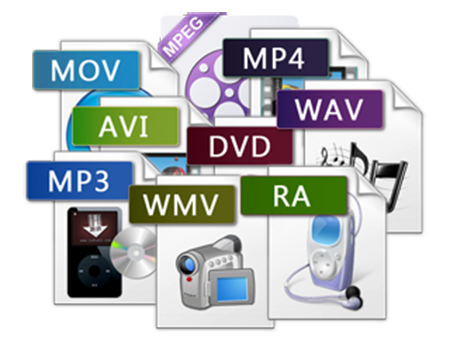
The MP4 file format
The MP4 file format has long been one of the most popular video formats on the web. Thanks to good compression coupled with good video file quality, excellent compromises can be achieved. The codecs used for MP4 are mainly H.264 or H.265.
Advantage
The format offers a good compromise between image quality and compression and is particularly compelling due to the simple ability to bundle multiple audio tracks and additional elements into a single format.
Disadvantages
MP4 files are often heavily compressed using standard codecs, making processing and creation difficult.
The AVI file format
The abbreviation AVI stands for Audio Video Interleave and means that in this format the video and audio tracks are directly linked to each other. The format is widespread, but technically obsolete.
Advantage
This format is mainly characterized by a very high level of acceptance. There is hardly any player and hardly any browser that does not support AVI files.
Disadvantages
The technical limitations of the file format and, above all, the lack of ability to use multiple audio tracks mean that fewer and fewer users are using the AVI file format.
The MKV file format
The MKV format is currently one of the most popular video formats on the net. It is a powerful container format that can integrate not only video files but also audio tracks, menus, and many other functions.
Advantage
The MKV format is particularly compelling due to the high quality of video files and the wide range of functions in which the format can be used. The format can only be used with the appropriate codec, but it is freely available on the net.
Disadvantages
The disadvantages of the format are mainly the low compression properties, so it is not possible to create very compact files.
The MOV file format
This video format was developed by Apple and is designed primarily for use with Quicktime. However, the format is no longer up to date and is therefore rarely used for network applications.
Advantage
The advantages of the format are mainly the ease of use in an Apple environment and the very high compression, which allows to obtain small files.
Disadvantages
Due to the very high compression of video files, there is a consequent loss of images and information. While relatively small and compact files can be created, in most cases the result is not as convincing.
The OGG file format
The OGG video file format was developed, among other things, to bring more flexibility to the market structure, which is often controlled by the rights holders. The OGG format was one of the first formats to be used in a widespread environment such as Linux, and thus it was able to establish itself in the market very quickly.
Advantage
The OGG file format has the advantage of being very widespread and not having authorization keys. Therefore, most browsers can extract it and use it natively. As a result, this video file format is often used to embed video files on your website.
Disadvantages
Despite the wide distribution, there are also downsides. Both the Safari browser and the older Internet Explorer only partially support the format, which can lead to display issues.
The VOB file format
The VOB video file format was established relatively early as the standard for DVD and was therefore developed primarily for these media. The format is not suitable for network use due to lack of licenses and low compression.
Advantage
The format can be easily read by any DVD player and also offers the advantage of low compression. It also allows you to merge different audio tracks.
Disadvantages
The VOB format is not suitable for network use as it cannot be uploaded on various platforms or on your own website. To play the format, you need your own codec, which is not freely available.
The WMV file format
The WMV format was developed by Microsoft and is still widely used today. Since this format supports digital rights management (DRM), it is generally used whenever the copyright of the video file is required.
Advantage
The format is recognized as reliable on all common devices with the Microsoft operating system and can be used without problems.
Disadvantages
As the format is older, very large video files are only partially supported. There are also limitations on file size and video quality.