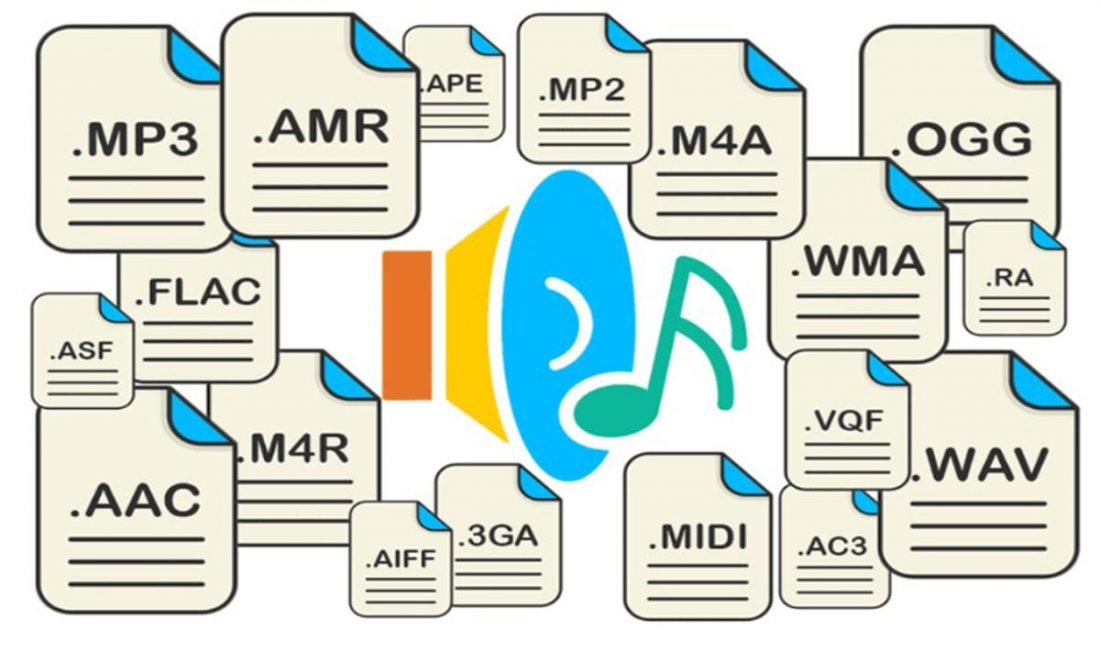
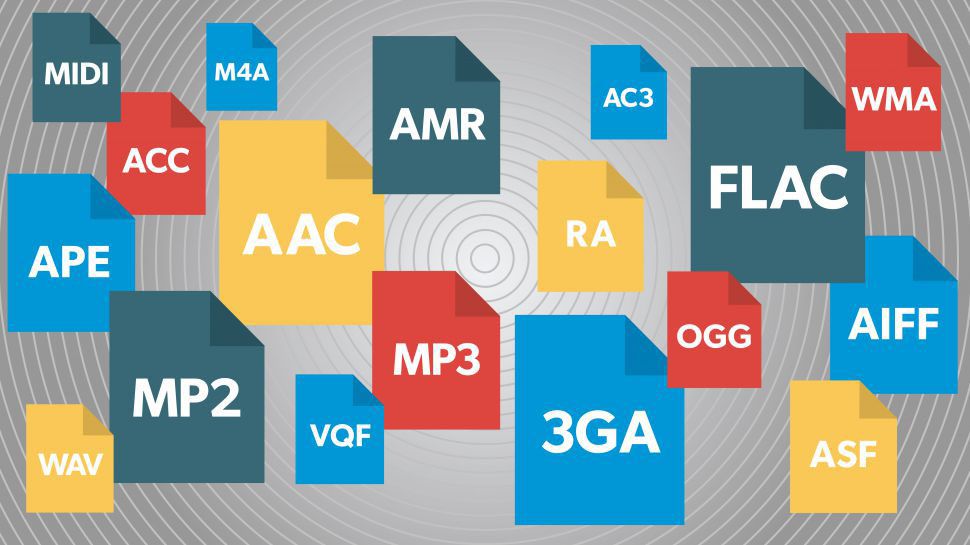
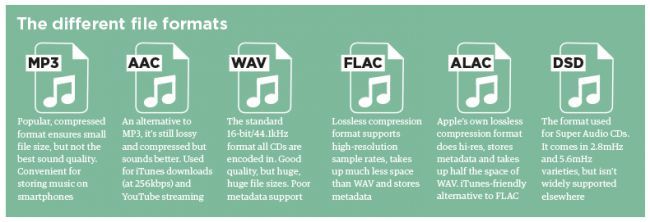
THE MOST COMMON FORMATS FOR MUSIC AND OTHER AUDIO FILES, AND HOW THEY ARE RELATED TO EACH OTHER


Free Download Mp4Gain
picture

THE MOST COMMON FORMATS FOR MUSIC AND OTHER AUDIO FILES, AND HOW THEY ARE RELATED TO EACH OTHER
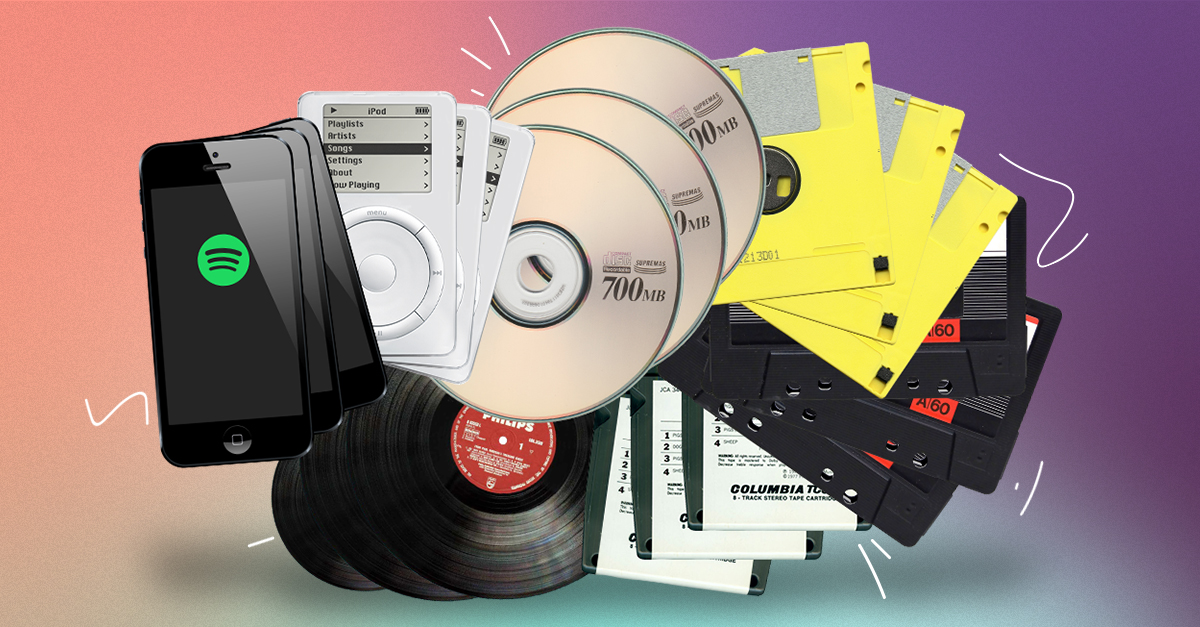
Music Formats


And for the direct competitors of the universal MP3 format, they can count on a lot today.

Music Formats

Due to continuing inconsistencies in home storage of the WAV format, it was eventually discontinued. But for professional studios, he says, the basics of the job. Especially when recording live vocals or instruments. Just convert the recorded material from WAV to MP3 at the final stage.

music format

However, music can be represented in some other popular formats nowadays. For example, many times (especially the Internet) they use these data types like OGG, AIFF, AMR, etc. But the real competitor of MP3 has become the newest and best audio FLAC etc. Of course, for MP3 you can convert all parameters to the maximum, but the playback quality of FLAC represents much higher. Also, it is a single file and the separation occurs directly on the track due to the player or startup software. In other words, listeners see each track individually, but can switch between playback tracks. For the MP3 format, this also seems possible to merge multiple tracks through it, thus creating a single file. But here it is in this version fast switching between tracks will not be possible (normal fast forward should be used, that’s all).

However, not everything is bad. The fact that music or audiobooks are all popular formats today allows them to be easily converted, even keeping the original parameters of the audio material. Based on this, and for sound processing and conversion and audio editors, almost all programs call converters. Any program of this type (MP3 editor or converter) detects the original and final type of audio files, is unambiguous and can produce direct and reverse transformations. Let’s explain this specific example.

WAVE THEORY AUDIO EDITOR FOR MP3 FILES
Many types of software are used in audio processing today. First, look at the narrow application of so-called audio editors. The most prominent representatives of these can be called giants Sony Audio Forge, Sintrillium Cool Editing Pro, which was later acquired by Adobe and renamed Audition, Acoustica Mixcraft, ACID Pro and many others.

mp3 editor

The principle on which they operate is that, for convenience, all MP3 audio programs have a typical waveform, as originally used for WAV files. This method determines the appearance and opportunity enough to edit any type of conventional audio material in WAV format. Other than that, the fact that you can do basic copy, cut, paste, etc. E., it’s just a matter of getting the frequency characteristics and bitrate changes, not to mention using a lot of extra effects that plug into VSTs via DirectX or a generic host bridge studio thing.

In its simplest form, the conversion can be done using the standard file menu, which contains the line “Save As…” (Save As…) or the export function present in MP3 format. Thus, all the process is reduced to just the final selection of the format (MP3 here as an example) and activation of the recording mode. In this case the conversion will be done automatically saving the current configuration parameters and the frequency characteristics. I don’t like the original version? ?Nothing is easier than changing the format to MP3, pre-specified with higher settings. However, one thing needs to be considered here: if the raw material is of such poor quality that special remediation or even professional tools will not work for audio it is necessary to use Repairs here, the intervention of various filters, etc. D. For the layman, it will cause great difficulties.

As is clear, there is absolutely no difference between the audiobooks we are dealing with: MP3, music or just recorded voice or noise. By the way, audiobooks are supposed to have a much lower sound quality by default. This is understandable, since the file has to take up minimal space and, in general, the perceived sound characteristics of speech are not that important. Finally, is this a professional recording of a particular set of albums?

However, if you use some standard operations, even without specific knowledge, it’s fine to achieve good results, especially since there are such built-in templates, based on any application for specific operations. Of course, it will be very difficult for the first time to achieve a perfect sound, but if you study the plan and understand how it works, it will work like clockwork, and as a result, it will take a lot of time.


Free Download Mp4Gain
picture


Mp4Gain Main Window
picture


Mp4Gain Features
picture


Free Download Mp4Gain
picture

Audio formats. Understanding the differences

Audio formats. Understanding the differences

Audio File Format

There are many different audio formats.

audio file formats

You can’t even imagine how many audio formats there are. Now we will consider only the most popular ones, and if you need complete information, you can find it on Wikipedia.

Audio formats
Sound is itself an analog phenomenon. In order for it to register on a computer, it must be digitized. Digitized audio takes up a lot of space. Therefore, they use special algorithms to encode and compress data: codecs. Codecs provide encoding / decoding of audio / video data, as well as compression / decompression of such data. Download a set of codecs for Windows:

The type of media file format (audio or video, no difference) is determined by its extension. For example, MP3 files have the extension .mp3. The codec for this format is always the same: MPEG Layer-Ç. But for the MP4 format, the codecs may be different.

Some formats, such as MP4 and FLV, can contain streaming audio and video. So, if you see a file with the extension .mp4, you can’t definitely tell that it contains only music or only video, or a movie – audio and video. After all, initially in such formats, the possibility of transmitting both audio and video was raised.

We all know that once information is compressed, it can be lost. Therefore, all codecs can be divided into two groups: with loss of quality and without loss of quality. Don’t be intimidated by the word “lossy”: As a general rule, codecs cut off “unnecessary” information that is invisible to our eyes and ears (almost invisible).

Lossless compression codecs include:

FLAC (Free Lossless Audio Codec);
APE (Monkey’s Audio);
ALAC (Apple Lossless Audio Codec).
And here are the lossy codecs:

If you are a fan of sound then it makes sense to look for music in FLAG format. For normal home listening, the most popular MP3 format is sufficient. Also, to experience the total difference between MP3 and FLAC formats, you need professional sound reproduction equipment; unfortunately, the tablet does not belong to said team. So I don’t see any reason to download FLAC music to a tablet.

Now let’s take a quick look at the audio formats themselves:

WAV is the first (or one of the first) audio formats. It is used to store uncompressed audio recordings. One minute of recording in WAV format requires 10MB. An audio CD is usually copied in this format and then the resulting WAV files are compressed with an MP3 codec to save space.
MP3 (MPEG Layer-3) is the most widely used audio format. It reduces the sound with a loss of quality, but only the sound that is not heard by the human ear is cut off. As a result, a person does not hear the difference and the sound takes up less space. The main characteristic of this format is the bit rate. The higher the bit rate, the better the sound quality. Uncompressed audio CD has a bit rate of 1411.2 Kbps. The highest sound quality in the case of MP3 format is achieved at a bit rate of 320 Kbps. Anything below 320 Kbps is of worse quality . The difference between 128 Kbps and 320 Kbps is already felt by ear, so if you can download recordings with a higher bit rate, go for it.
WMA (Windows Media Audio) is a format developed by Microsoft for the Windows operating system. Microsoft tried to create a replacement for MP3, but, as time has shown, it failed.
OGG is an open format that supports encoding of audio with various codecs. The most widely used OGG codec is Vorbis. In terms of compression quality, the format is comparable to MP3, but less common in terms of media player and audio player support. If you can download music in MP3 and OGG format, you should choose MP3 because your audio player may not support OGG format.
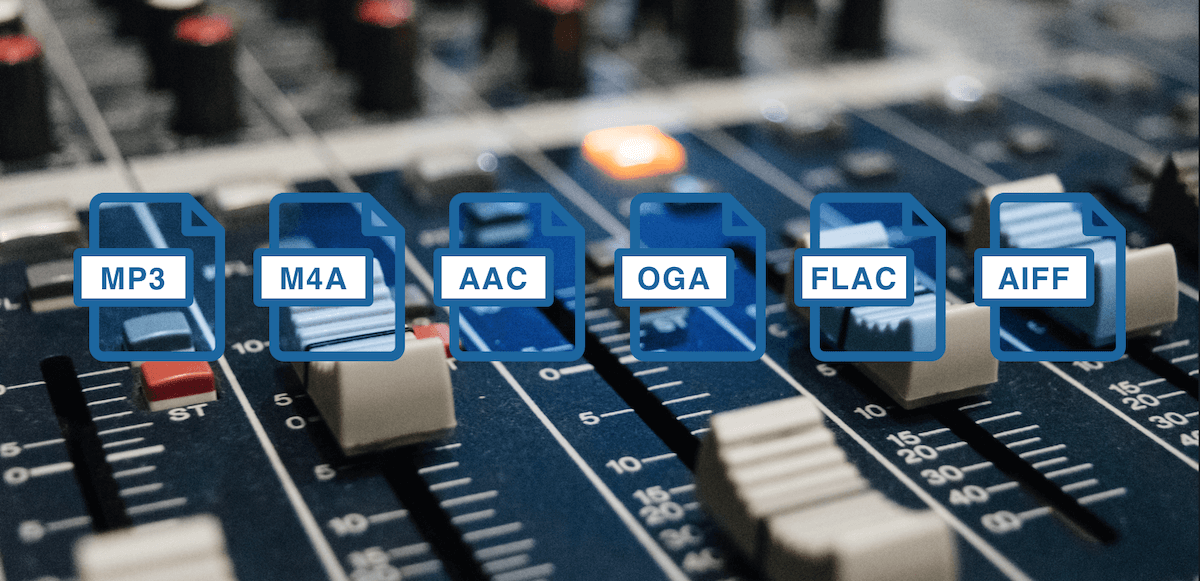
AAC is a proprietary audio format that provides better sound quality than MP3. It is currently the best lossy audio coding algorithm. A file of this format can have the extensions aac, mp4, m4a, m4b, t4p, t4g.
FLAC is a lossless compression format. It does not make any changes to the audio stream, so the sound encoded with it is identical to the original. Used for listening to sound in high-level sound systems.
Video formats
There are no fewer video content formats and standards than audio formats. Let’s start with the international standards that define the data storage and encoding format of multimedia files:

About audio formats

About audio formats

audio formats

Installations
Installation first. There is no perfect format. Different types of audio require different approaches.

Audio Formats

Second installation. It is impossible to do something good with poor quality.

Third installation. There are three approaches to comparing quality: the discriminating edge (heavyweights), the comforting edge (consumer audio), and the intelligibility edge.

Fourth installation. Disputes in a weight category are useless and are called “holivars”. The arguments in different weight classes are meaningless: “heavy is heavier than light” and “light is lighter than heavy.” Disputes (especially between heavyweights) can only take place with the support of the “blind method”.

A brief introduction
Bit rate is one of the most important metrics for measuring digital audio recordings. It is measured in kilobits per second (for short: kbps, just kilobits, kbps, kbps, kbps, etc.).

On the fingers: answer the question “how much memory occupies a second of audio”.

All kinds of transformations are already underway: there are eight bits in a byte, 1024 bits in a kilobit, 60 seconds in a minute, 60 minutes in an hour, and we arrive at the following empirical data:

bit rate 1400 = 1 hour takes 615 megabytes on disk
320 bitrate = 1 hour takes 141 megabytes on disk
bit rate 192 = 1 hour takes 84 megabytes on disk
bit rate 24 = 1 hour takes 11 megabytes on disk
Naturally, we all want to use disk space sparingly. This is where the format war begins. 11 MB is sixty times cheaper than 615 MB. Megabytes is the cost of storing audio recordings.

The price of storage can also be expressed in bills, dividing the cost of the disk by its capacity. For an archive of audio recordings, the storage price is far from being as critical as for an archive of video recordings.

Furthermore, the storage price can be conditionally expressed in man-hours, if the playback device has a much smaller capacity than your general archive of audio recordings. It takes time to regularly download new tracks to the device.

The storage price can also be expressed in square meters of work area. 500 audio CDs will take up a lot of space and require furniture solutions, but a small external hard drive fits in your pocket.

If there is a different price, then the question of quality arises: then we assume that the lowest bitrate has the lowest quality. So we come to the main question: where is the limit of reason, where is the ideal “price / quality” ratio.

The most approximate division of audio formats in descending order of average bitrate:

uncompressed audio
lossless compression
lossy compression

Uncompressed audio is the pure signal without conversion, “as is”, the equivalent of WAV or audio CD. Classic parameters: 1411 kbps, 44100 kHz sample rate, 16-bit audio.

Codec is an abbreviation of the words (KO der and DEC oder). An encoder is a program that packages a pure audio signal in the desired special format. A decoder is a program that converts a special format into a pure audio signal. In modern English, the two terms were transformed a bit: below code and below code, which corresponds to the direct Russian counterparts for coding and racing coding. And do not confuse encryption and encryption: these are two very different processes, although externally there is a lot of similarity.

For an ordinary person, only a player that can work with this format is required (that is, it has a decoder). The “encoder” itself is only required to “create” such files.

Lossless compression – Typically used for collectible audio material. It is generally believed that this format can be converted exactly to Audio CD.

Better is this compression:

Save disk space by about half
The file format assumes the storage of additional information (artist, album, track number, track name, etc.)
The compression formats themselves differ:

format openness and compression algorithms
player support
overhead encoding, decoding costs
compression ratio
The overhead costs are negligible for the average person and the compression ratio of the codecs differs slightly. Main actors: FLAC, APE, WAVPACK, ALAC.

Lossy Compression – Provides a much higher compression ratio by discarding unimportant audio details. The smaller the size of the file we are trying to compress, the more details we will need to discard. In addition to the disappearing details, technical artifacts also appear.

What audio formats are there and how are they different?

What audio formats are there and how are they different?

Audio formats

When recording sound, the question arises which audio format to choose for disk storage. Almost all of today’s recording programs offer a multitude of options here, from highly compressed MP3 to uncompressed WAV files.

However, it’s easy to lose track in the jungle of different formats. We clarify what audio formats are available and what are the differences between the formats. FROM MP3 TO WAV, EVERYTHING YOU NEED TO KNOW ABOUT AUDIO FORMATS When you save your audio recordings digitally, they are in a specific format.

Audio Formats

Describes the structure of the file and contains all the audio signals. A distinction is generally made between two variants: uncompressed audio formats, which contain all the data, and compressed. With these, certain information is cut from the file. Compressed music formats can also be divided into lossless and lossy.

Uncompressed formats include the following: PCM (Raw Data) AIFF (Audio Interchange File Format) WAV CDDA (Compact Disc Digital Audio) The main compressed formats are: MP3 WMA (Windows Media Audio) / Lossless WMA AAC (Advanced Audio Coding) FLAC (Free Lossless Audio Codec)

This is what defines lossless formats. Uncompressed audio formats store all data in an audio file, including what the human ear cannot or can barely hear. This takes up a lot of storage space on the data carrier, but the sound quality is excellent. Lossless files are compressed to a certain extent to reduce file size.

However, this is done in such a way that no noticeable loss of quality can be detected. All original data is preserved, only the layout of the data is changed. These are lossy formats. One of the most popular lossy formats is the MP3 music format. Parts of the original file are removed to reduce storage space. Ideally, only information from the file that is not perceptible to humans is removed.

The higher the compression level, the smaller the file, but the quality also suffers with each further reduction. PROCESS YOUR AUDIO FILES EVEN MORE – SAVE STORAGE SPACE AND COMPRESS The most common uncompressed music formats are WAV and AIFF. If you record audio files on a digital audio workstation, you typically export them in one of these two formats and then process them.

If you want to save the data without any loss, but the original data must be preserved, first compress the files with an appropriate audio program in a lossless format, for example as a FLAC file. This takes up less space on the data carrier, so you can save a lot on external media and transmit the data.

Since all the information is still contained in the file and is simply unzipped when you open it, you can process these music files optimally: cutting, adding additional effects or soundtracks, or splitting the file, and all without the quality of the sound is affected. If you want to share your music and audio files, upload them to the network, send them by e-mail or if you want to save many files on a data medium, compression is essential.

You can also do this by using a corresponding audio program, some of which you can download for free from the Internet. Compression reduces the file size to a greater or lesser extent depending on the degree. At the same time, the audio file information that cannot be restored is lost. Be careful when compressing. Bit rates – this is what determines the quality of an audio file

Bit rate describes the amount of data that is processed in the music file per second. The higher the value, the higher the quality of the file. Uncompressed files typically have a bit rate of 1411 kilobytes. For example, if you convert a WAV file to MP3 format, you can set the bit rate, for example, to 192 or 320 Kb per second. THE DIFFERENT AUDIO FORMATS AT A GLANCE

What music format is suitable for what purpose and what are the sound differences?

Here you can find out when you should ideally use which format. Uncompressed formats: PCM, WAV PCM describes the raw data of an audio file. The format allows very high bit rates and therefore very high quality. The data is in the original and the sound corresponds to that of an audio CD. However, the PCM format consumes a lot of memory and cannot be played with all common audio programs that are designed for the MP3 format, for example. Therefore, you need a special program to process the flat file.

Mp3, the winner

In the era of broadband connections, fiber optics and HD videos on YouTube, MP3 remains the reference format for audio files. We are now so used to listening to music in compressed formats, and often through poor quality playback systems, that it is difficult for us to remember what listening to music really means. The recent evolution from download to hit-and-run streaming has only made the situation worse by further devaluing the value of music. When was the last time you listened to a record from start to finish without interruption, spending those 30-40 minutes on “simple” listening activity?

Audio formats

Premise: This post is not a crusade against Spotify because I use it myself for new releases or to have some background music at work, it is not even an analog vs. digital (or vinyl vs. CD vs. MP3) post because on this topic en Much has already been said. My goal is to make you understand what you are missing, in qualitative terms, if you listen to music in compressed formats.

Audio formats

Sampling and theoretical aspects.

Audio recording on a computer or digital medium assumes that the signal passes through an analog> digital (AD) converter, so that the continuous electrical signal generated by microphones or musical instruments is transformed into a digital signal (series of 0 and 1) This process is called sampling. The final quality of the recording depends on several factors: converter quality, sample rate, and bit depth.

To make an easily understandable comparison: When shooting a movie, the “analog” reality perceived by our eye is stored in a movie that takes 24 frames per second. If we consider the standard of the audio CD (44.1 kHz, 16 bits), for every second of music 44100 pictures are taken from the computer to the continuous electrical signal. If with the sampling frequency we have simply established how many times in a second the waveform will be analyzed, with the bit depth we assign to each sample a numerical value: 2 ^ 16 = 65,536 possible values.

If you wonder how it got to 44,100, I refer you to the Nyquist-Shannon sampling theorem.

When we press the record button on our computer, through the PCM (pulse code modulation) sampling process described above, the files are saved in uncompressed WAV or AIFF format.

Lossless files and lossy files

PCM files take up a lot of space on our hard drives because, as we have seen, there is the data necessary to describe the analog waveform in as much detail as possible. Indicatively, a WAV or AIFF file as audio CD will occupy 10 MB for every minute of music.

To overcome this problem, remember that in the early 2000s storage space cost around $ 10 / GB, while today the price is around $ 0.03 / GB (source): Audio formats have been introduced that , through an algorithm encodes and decodes information, reduces the size of the file. These codecs fall into two categories: formats with lossless compression and formats with lossy compression.

As the name implies, lossless compression indicates a reduction in file weight (usually around 50%) without loss of information. Leaving the world of audio aside for a second, ZIP and RAR files are clear examples of this type of compression: at any time we can “unzip” such a file and have access to the original information again without this no way has changed.

The most common file formats are: FLAC (Free Lossless Audio Codec) and ALAC (Apple Lossless Audio Codec).

Lossy compression, on the other hand, implies that some of the original audio information is somehow removed to obtain a file that weighs even 90% less than the PCM.

By what criteria is information removed without “compromising” the original audio too much? Since our hearing is an imperfect instrument, codecs exploit two principles of psychoacoustics: the minimum threshold of audibility (the human ear does not perceive all frequencies in the range between 20Hz and 20kHZ equally) and masking (a weaker sound). is masked, making it inaudible, by a louder sound.)

Compression algorithms, however advanced, introduce a number of artifacts into audio files that, if played back in discrete quality audio systems, can be easily recognized or at least noticed even by an inexperienced ear. Several studies have shown that an untrained ear does not distinguish the difference between an uncompressed file and an MP3 with a bit rate equal to 256kb / s or more.

The most common lossy formats are: MP3, OGG Vorbis, AAC.

The victory of MP3

Since its introduction in the mid-1990s, MP3 has established itself as the industry-standard consumer format fueled by file-sharing through peer-to-peer channels, where, with slow connections, the heaviest file was the one it was downloaded, the longer it took to obtain it, and since the market introduction of MP3 players in which we tried to store as much music as possible and, therefore, we resorted to very compressed files.

In the transition from the era of downloading to that of small transmission files, they ensure smoother and smoother data transmission.

Despite, therefore, the evolution that has taken place in recent years in the speed of Internet connections and the reduction in the price of storage systems, only in recent years have services been created to buy files from High-quality online audio (HD tracks) or HD streaming services (Tidal).

Examples and audio files.

The main services we use to buy or listen to music use these compression levels (all information is taken from the official websites of each service at the time this publication was written).

Spotify: OGG Vorbis files at 96 kb / s (normal mobile quality), 160 kb / s (normal desktop and web player quality, high mobile quality), 320 kb / s (premium users: high desktop quality, very high quality mobile).
iTunes: By default, CDs are imported into 128 kb / s AAC files. Files in the iTunes Store are of this quality, except for “iTunes Plus” songs converted to AAC at 256 kb / s.
Pandora: 64kb / s AAC (free users), 192kb / s AAC (premium users).
YouTube: HD videos (720 or 1080p) have an audio quality equal to 384kb / s, SD videos (360, 480p) have an audio quality equal to 128kb / s.

Understanding digital audio formats

Understanding digital audio formats

When it comes to digitally distributing our music it is important that we understand what they are
the different formats, which are the most used and which are the best in terms of the
Relationship between size and quality.

PCM digital audio

WAVE

The name comes from the acronym waveform audio file format and is a used file
usually on computers with the Windows operating system.
WAV or WAVE files contain audio in LPCM format (Linear Pulse Code
Modulation) This is a way to encode an analog audio signal to the domain
digital by using equidistant samples over time of amplitude values
of the analog signal.
The quantity of samples is given by the sampling rate or sampling rate,
while the amount of possible amplitude values ​​is determined by the
Bit depth or bit rate.
The sampling frequency of the CDAUDIO for example is 44.1 kHz and 16 bits. exist
higher sampling rates such as 48 kHz, 88.2 kHz, 96 kHz up to 192 kHz at
this system.
On the other hand, WAV files are uncompressed audio and are generally used in
stages of recording, editing, mixing and mastering for being of high quality.
The higher the sample rate and the greater the number of bits, the file size will be
our hard drive
In general for professional uses at least a frequency of
44.1 kHz sampling and a depth of 24 bits preferably.
The standard extension for this type of file is: .wav

AIFF

The name comes from Audio Interchange File Format or audio file format
interchangeable, this format was developed by Apple computers and is used to save
and manipulate audio on computers.
It is like WAV a file type without compression or lossles therefore allows
Processing for professional applications such as recording, editing, mixing and
mastering as well as for professional video uses.
Another similarity with WAV files is that it is PCM audio (press code
modulation) that for practical purposes it is the same as the LPCM.
The standard extension for this type of files is .aiff

MP3

Also known as MPEG1 or MPEG2 audio layer, it is a form of coding
of digital audio in which psychoacoustic models discard information from
Audio that is presumed is not audible to most users.
As an example a file created with a resolution of 128 kbits / s is equivalent to 1/11
the size of a file on an audio CD.
The main purpose of using this type of coding is to reduce the size of the
files and be able to send / download faster, especially through
from Internet.
Being a file type reduced in quality IS NOT RECOMMENDED for
recordings, editing, mixing or mastering of professional audio.
For this reason we recommend NOT to use it to send us your clues to
mix / master