Audio formats. Understanding the differences


Free Download Mp4Gain
picture

Audio formats. Understanding the differences
Audio File Format

There are many different audio formats.
audio file formats

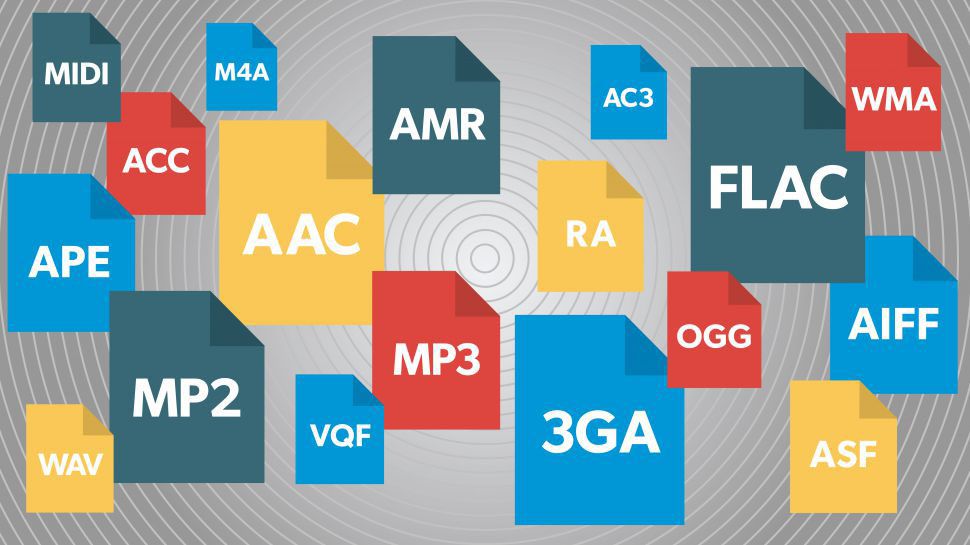
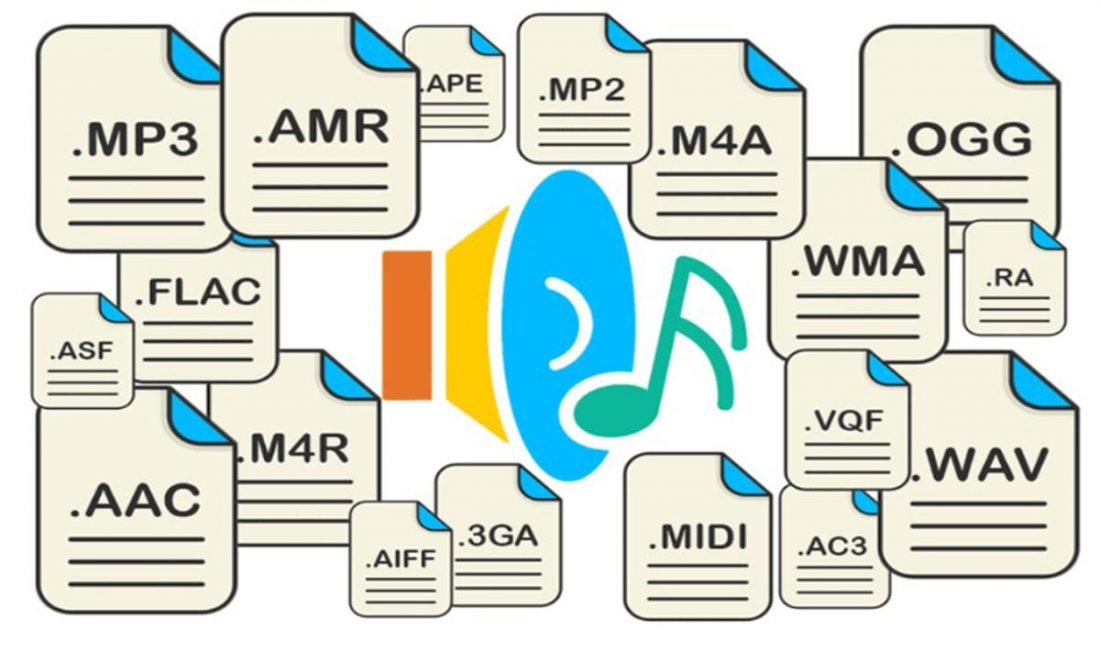
You can’t even imagine how many audio formats there are. Now we will consider only the most popular ones, and if you need complete information, you can find it on Wikipedia.

Audio formats
Sound is itself an analog phenomenon. In order for it to register on a computer, it must be digitized. Digitized audio takes up a lot of space. Therefore, they use special algorithms to encode and compress data: codecs. Codecs provide encoding / decoding of audio / video data, as well as compression / decompression of such data. Download a set of codecs for Windows:

The type of media file format (audio or video, no difference) is determined by its extension. For example, MP3 files have the extension .mp3. The codec for this format is always the same: MPEG Layer-Ç. But for the MP4 format, the codecs may be different.

Some formats, such as MP4 and FLV, can contain streaming audio and video. So, if you see a file with the extension .mp4, you can’t definitely tell that it contains only music or only video, or a movie – audio and video. After all, initially in such formats, the possibility of transmitting both audio and video was raised.

We all know that once information is compressed, it can be lost. Therefore, all codecs can be divided into two groups: with loss of quality and without loss of quality. Don’t be intimidated by the word “lossy”: As a general rule, codecs cut off “unnecessary” information that is invisible to our eyes and ears (almost invisible).

Lossless compression codecs include:

FLAC (Free Lossless Audio Codec);
APE (Monkey’s Audio);
ALAC (Apple Lossless Audio Codec).
And here are the lossy codecs:

If you are a fan of sound then it makes sense to look for music in FLAG format. For normal home listening, the most popular MP3 format is sufficient. Also, to experience the total difference between MP3 and FLAC formats, you need professional sound reproduction equipment; unfortunately, the tablet does not belong to said team. So I don’t see any reason to download FLAC music to a tablet.

Now let’s take a quick look at the audio formats themselves:

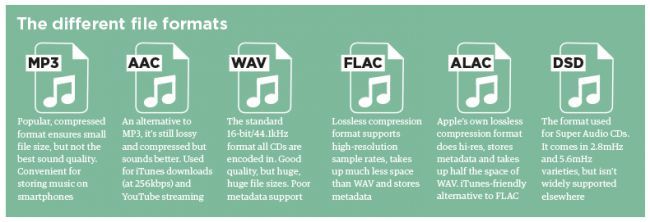
WAV is the first (or one of the first) audio formats. It is used to store uncompressed audio recordings. One minute of recording in WAV format requires 10MB. An audio CD is usually copied in this format and then the resulting WAV files are compressed with an MP3 codec to save space.
MP3 (MPEG Layer-3) is the most widely used audio format. It reduces the sound with a loss of quality, but only the sound that is not heard by the human ear is cut off. As a result, a person does not hear the difference and the sound takes up less space. The main characteristic of this format is the bit rate. The higher the bit rate, the better the sound quality. Uncompressed audio CD has a bit rate of 1411.2 Kbps. The highest sound quality in the case of MP3 format is achieved at a bit rate of 320 Kbps. Anything below 320 Kbps is of worse quality . The difference between 128 Kbps and 320 Kbps is already felt by ear, so if you can download recordings with a higher bit rate, go for it.
WMA (Windows Media Audio) is a format developed by Microsoft for the Windows operating system. Microsoft tried to create a replacement for MP3, but, as time has shown, it failed.
OGG is an open format that supports encoding of audio with various codecs. The most widely used OGG codec is Vorbis. In terms of compression quality, the format is comparable to MP3, but less common in terms of media player and audio player support. If you can download music in MP3 and OGG format, you should choose MP3 because your audio player may not support OGG format.
AAC is a proprietary audio format that provides better sound quality than MP3. It is currently the best lossy audio coding algorithm. A file of this format can have the extensions aac, mp4, m4a, m4b, t4p, t4g.
FLAC is a lossless compression format. It does not make any changes to the audio stream, so the sound encoded with it is identical to the original. Used for listening to sound in high-level sound systems.
Video formats
There are no fewer video content formats and standards than audio formats. Let’s start with the international standards that define the data storage and encoding format of multimedia files:


Free Download Mp4Gain
picture


Mp4Gain Main Window
picture


Mp4Gain Features
picture


Free Download Mp4Gain
picture

Comparison of audio formats

What is the best audio format for what purpose?

Comparison of audio formats

All radio and podcast producers are faced with the question: What audio format is best for my shows and contributions? There is usually no simple answer. Each file format and each codec has advantages and disadvantages.

Audio Formats Comparison

Before converting / converting, you need to be clear about what you plan to do with your audio file: Should it be published to the NRWision media library? Is the program designed to broadcast on the Internet or for the home audio system? Should the file be edited again if necessary? Only then can you weigh which audio format and which properties make the most sense.

Audio File Formats comparision

Compress without loss?

You must decide whether you want the best possible sound quality or the smallest possible file size. With some audio codecs, sound is retained at its full bandwidth and without loss. Other codecs compress the file so that it takes up less space or is faster to transfer online. At best, it can still be played on many different devices and players. Depending on the strength of the compression, the sound of music or voice recording may also be audibly affected.

In the case of audio files, information such as sample rate and bit rate always play a role.

The sample rate indicates how often the level is saved per second. CDs, for example, have a sample rate of 44,100 Hz. 44,100 values ​​are stored for one second of music.

Bit transfer rate

Bit rate defines the amount of data that is processed per second. It can be constant or variable and therefore also influences the sound quality.
Important: When converting audio files to other formats, the quality cannot be improved, it only deteriorates or is preserved. With each compression, some of the audio data is lost, although it is not necessarily audible.

Next we present the audio formats and their properties.

MP3

File extension: .mp3

MP3 is probably the most popular and widely used audio format in the world. It became the standard for music files on the Internet more than 20 years ago and has been freely available since 2017. By the way, MP3 was developed by the Fraunhofer Institute in Germany, among others. Raw audio is highly compressed when converted to MP3 files to save storage space. Only what humans can hear should be preserved. You can set the degree of compression, the so-called bit rate. 192 kBit / s (kilobits per second) roughly corresponds to CD quality. At higher bit rates, MP3 files sound lossless to most people. Lower bit rates are used, for example, in Internet radios.

Advantage:
widely used, compatible with many playback devices, high compression

Disadvantage:
possibly loss of audible quality, especially at low bit rates

Wav

File extension: .wav

WAV files are not compressed and therefore take up a lot of storage space. But they can be used well for audio editing and can be easily edited in almost any software.

WAV files were developed for Windows computers in 1991. However, they can also be reproduced and used on other operating systems.

Advantage:
no need to encode / decode when editing

Disadvantage:
very large files

WMA

File extension: .wma

Originally, the WMA (Windows Media Audio) format was supposed to compete with MP3, but it could not be established equally. Audio data is also compressed here, if possible without audible loss.

Some versions of WMA files may contain a certificate key to prevent piracy.

Advantage:
good compression with high sound quality

Disadvantages:
not very widespread, only supported by a few players

AAC (advanced audio coding)

File extension: .aac

This audio format is considered the successor to the MP3 format. With the AAC format, developers have managed to further reduce memory size while maintaining the best possible sound quality.

The AAC process is being used with increasing frequency on music websites, Internet radio stations, and as a soundtrack format for video files.

Advantage:
very good compression, small files with high audio quality

Disadvantage:
not yet compatible with all programs and devices

Ogg

File extension: .ogg

In Ogg files, there is actually a container format. In addition to compressed audio, it can also contain video and text data. Also, Ogg files can be used well as an online stream. Even so, the format never prevailed against MP3 among home users.

Advantage:
small file size with good sound quality, no license

Disadvantage:
not compatible with many programs, must be converted for audio processing

FLAC (Free Lossless Audio Codec)

File extension: .flac

The name already gives it away: the FLAC codec is freely available and compresses audio files without loss of quality. The format is mainly used for music that can be faithfully reproduced thanks to FLAC. More and more players support FLAC files, sometimes just with the help of a plugin.

The FLAC codec makes audio files 30 to 60 percent smaller. This makes them much larger than MP3 files. To do this, you can decode it and thus restore the original data without loss.

Advantage:
no loss, no license

Disadvantage:
relatively large files, not natively supported by all players

Opus

File extension: .opus

The latest file format from our overview should become the Internet audio standard. Opus is developed openly and has several advantages. The audio codec significantly reduces the bit rate again. The quality of music and language is preserved as best as possible. Additionally, Opus files can be streamed and contain metadata.

Opus plays practically no role (yet) in audio processing. We are curious to see if and how the format will prevail for years to come.

Mp3, the winner

In the era of broadband connections, fiber optics and HD videos on YouTube, MP3 remains the reference format for audio files. We are now so used to listening to music in compressed formats, and often through poor quality playback systems, that it is difficult for us to remember what listening to music really means. The recent evolution from download to hit-and-run streaming has only made the situation worse by further devaluing the value of music. When was the last time you listened to a record from start to finish without interruption, spending those 30-40 minutes on “simple” listening activity?

Audio formats

Premise: This post is not a crusade against Spotify because I use it myself for new releases or to have some background music at work, it is not even an analog vs. digital (or vinyl vs. CD vs. MP3) post because on this topic en Much has already been said. My goal is to make you understand what you are missing, in qualitative terms, if you listen to music in compressed formats.

Audio formats

Sampling and theoretical aspects.

Audio recording on a computer or digital medium assumes that the signal passes through an analog> digital (AD) converter, so that the continuous electrical signal generated by microphones or musical instruments is transformed into a digital signal (series of 0 and 1) This process is called sampling. The final quality of the recording depends on several factors: converter quality, sample rate, and bit depth.

To make an easily understandable comparison: When shooting a movie, the “analog” reality perceived by our eye is stored in a movie that takes 24 frames per second. If we consider the standard of the audio CD (44.1 kHz, 16 bits), for every second of music 44100 pictures are taken from the computer to the continuous electrical signal. If with the sampling frequency we have simply established how many times in a second the waveform will be analyzed, with the bit depth we assign to each sample a numerical value: 2 ^ 16 = 65,536 possible values.

If you wonder how it got to 44,100, I refer you to the Nyquist-Shannon sampling theorem.

When we press the record button on our computer, through the PCM (pulse code modulation) sampling process described above, the files are saved in uncompressed WAV or AIFF format.

Lossless files and lossy files

PCM files take up a lot of space on our hard drives because, as we have seen, there is the data necessary to describe the analog waveform in as much detail as possible. Indicatively, a WAV or AIFF file as audio CD will occupy 10 MB for every minute of music.

To overcome this problem, remember that in the early 2000s storage space cost around $ 10 / GB, while today the price is around $ 0.03 / GB (source): Audio formats have been introduced that , through an algorithm encodes and decodes information, reduces the size of the file. These codecs fall into two categories: formats with lossless compression and formats with lossy compression.

As the name implies, lossless compression indicates a reduction in file weight (usually around 50%) without loss of information. Leaving the world of audio aside for a second, ZIP and RAR files are clear examples of this type of compression: at any time we can “unzip” such a file and have access to the original information again without this no way has changed.

The most common file formats are: FLAC (Free Lossless Audio Codec) and ALAC (Apple Lossless Audio Codec).

Lossy compression, on the other hand, implies that some of the original audio information is somehow removed to obtain a file that weighs even 90% less than the PCM.

By what criteria is information removed without “compromising” the original audio too much? Since our hearing is an imperfect instrument, codecs exploit two principles of psychoacoustics: the minimum threshold of audibility (the human ear does not perceive all frequencies in the range between 20Hz and 20kHZ equally) and masking (a weaker sound). is masked, making it inaudible, by a louder sound.)

Compression algorithms, however advanced, introduce a number of artifacts into audio files that, if played back in discrete quality audio systems, can be easily recognized or at least noticed even by an inexperienced ear. Several studies have shown that an untrained ear does not distinguish the difference between an uncompressed file and an MP3 with a bit rate equal to 256kb / s or more.

The most common lossy formats are: MP3, OGG Vorbis, AAC.

The victory of MP3

Since its introduction in the mid-1990s, MP3 has established itself as the industry-standard consumer format fueled by file-sharing through peer-to-peer channels, where, with slow connections, the heaviest file was the one it was downloaded, the longer it took to obtain it, and since the market introduction of MP3 players in which we tried to store as much music as possible and, therefore, we resorted to very compressed files.

In the transition from the era of downloading to that of small transmission files, they ensure smoother and smoother data transmission.

Despite, therefore, the evolution that has taken place in recent years in the speed of Internet connections and the reduction in the price of storage systems, only in recent years have services been created to buy files from High-quality online audio (HD tracks) or HD streaming services (Tidal).

Examples and audio files.

The main services we use to buy or listen to music use these compression levels (all information is taken from the official websites of each service at the time this publication was written).

Spotify: OGG Vorbis files at 96 kb / s (normal mobile quality), 160 kb / s (normal desktop and web player quality, high mobile quality), 320 kb / s (premium users: high desktop quality, very high quality mobile).
iTunes: By default, CDs are imported into 128 kb / s AAC files. Files in the iTunes Store are of this quality, except for “iTunes Plus” songs converted to AAC at 256 kb / s.
Pandora: 64kb / s AAC (free users), 192kb / s AAC (premium users).
YouTube: HD videos (720 or 1080p) have an audio quality equal to 384kb / s, SD videos (360, 480p) have an audio quality equal to 128kb / s.

What are the most common video formats?

The choice of audio and video codecs and containers affects video quality and file size. Here we show you how to find the format that best suits your needs.

Decades and decades of developments in the audiovisual field have led to a result that can be seen as strange in a way. While in other sectors the continuous development has led to a very pronounced standardization (think of the DOC or PDF format), the situation in multimedia is at least worse.

audio file formats

One example is the world of audio formats, which is animated by strong “competition” and a variety of available options. Indeed, it is no less than that of video formats. In this case, we actually have to deal with a separation between codecs and containers (we’ll see what they are and what role they play) that will make things even more complicated. So when converting a movie, you need to be careful to choose the right codec and video format to avoid creating files that are too large or simply unreadable. In short, the mistake is just around the corner.

Differences between containers and codecs

Before analyzing the situation and determining the most commonly used video formats, some basic concepts need to be clarified: First: What is the difference between the codec and the container? In the audio world, if the codec used to digitize the audio track matches the “final” file format, the codecs used in the video differ from the file format that the video file will adopt at the end of the digitization process. The reason will be explained soon and is in the multimedia nature of a video.

audio format

A film actually contains video and audio data: the conversion or playback software must be able to analyze both multimedia transmissions and therefore requires different algorithms that work with one or the other type of data transmission. This is exactly what codecs do: Since the name, code and decoding of data (audio and video) consist of films, you can convert them to another video format or play them back with a media player. Even with regard to containers, it is enough to use the literal meaning of the word: These are files that contain both the video and audio sequences and “provide” codecs for reading and playback.

What are the most common codecs?

As already mentioned, a codec is responsible for compressing and decompressing the video files and determines how they are played on the screen of the PC or smart TV. Each operating system provides the user with dozens and dozens of different codecs, each useful for encoding and decoding a particular type of file, even if new ones can be installed by downloading special software or packages from the Internet. Among the most commonly used codecs we find FFmpeg, Divx, Xvid, H.264 and its development H.265, VP9 and VP 10 (also known as the name of the Google codec).

What are the most commonly used containers?

Containers, on the other hand, have the task of “bundling” the audio and video stream processed by the codecs and can therefore be used for the media player software. Containers are determined, among other things, by the “final” video file format. The most common are: Avi, Wmv, Mov, Flav and Mp4.

-Avi. The AVI video format (short for Audio Video Interleave), developed by Microsoft and introduced in 1992 as part of its video for Windows technology, is one of the oldest used today. It is so widespread and used that many consider it to be the de facto industry standard. Its simple infrastructure (elementary, one would almost say) makes it easy to use on different operating systems (Windows, MacOS, Linux, Android and the most popular browsers) and enables the “storage” of streams that are processed by different codecs
Flv. This is the video format that resulted from compression by Adobe Flash software and was developed almost exclusively for playing movies on the Internet. If it could be seen as the de facto standard for video file formats on the web until a few years ago, this is no longer the case today: The spread of HTML 5 and the discovery of some bugs in the software caused it to change a bit On the one hand, however, the FLV video file format remains a favorite for those who generally create video for the network: with its compression algorithms, you can indeed get good quality small videos