What music file format is recommended? Part 2


Free Download Mp4Gain
picture

What music file format is recommended? Part 2

AUDIO FORMATS

Opus is a new audio compression format developed by the IETF and standardized by RFC6716 in 2012. There is very little hardware and software supported, but at low bit rates of 128 kbps or less, it appears to be the strongest sound quality with compression with lost.

audio formats

Vorbis is a free audio file format developed by Xiph.org. It seems to be used on Youtube too. Since the standard bit rate is 112 kbps, the sound quality at a low bit rate appears to be good.

WMA is a standard Windows audio compression method developed by Microsoft. If the bit rate is 160 kbps or less, it exceeds the MP3 upper limit frequency. However, the size will be a little larger.

AAL (ATRAC Advanced Lossless) is a lossless compressed version of ATRAC mentioned above. According to Sony, it can be compressed to about half the size of the data without losing any music information on the CD, but it actually seems to vary considerably depending on the sound source.

As the name implies, Apple Lossless (ALAC) is Apple’s lossless compression audio codec. Used in iTunes, etc.

FLAC is an audio file format developed and distributed as free open source software. It seems to be the most popular in lossless compression.

Monkey’s Audio is an audio format that compresses PCM losslessly without degrading sound quality. It is so named because it is used in music playing software called Monkey’s Audio. The characteristic is that it does not fit the name and the compression rate is high.

TAK is a high-speed, high-compression, lossless compression audio encoder. It has the same level of compression as Monkey’s Audio, but it’s pretty crazy.

TTA is a free real-time lossless compression audio encoder / decoder. Like TAK, it’s too manic so I wouldn’t use it.

WMA Lossless is a lossless compressed version of WMA mentioned above.

Equalizer Image
AIFF is an uncompressed audio file format developed by Apple. It seems to be the Windows WAV. It seems to have been used on Macintosh (Mac) for a long time.

WAV (WAVE) is a format for describing audio data developed by Microsoft and IBM. This is what happens when you convert a CD (Linear PCM) into an uncompressed file in Windows.

Also, the sound quality of lossy compressed music file formats is almost the same at 192 kbps bit rates. If it is 160 kbps or less, I am wondering if other compression formats are slightly better than MP3. In this case, it is better to check the music player software. Sound quality is exactly the same for lossless and uncompressed music file formats. Lossless compression will have issues with compression ratio and playback load.

I want to read it together
What is free high-quality music player software for Windows?
After all, what music file format is recommended?
Image of listening to music with a portable music player
I’ve mentioned it so far, but I recommend MP3 or WAV (AIFF). The reason is as follows.

Due to the large capacity of hard drives and flash memory, lossy compressed music file formats do not need to have a bit rate lower than 192 kbps.
The compression ratio of the lossless music file format is currently 60 to 70% maximum, so taking into account the encoding time and effort and loading during playback, the file format of Uncompressed music is sufficient for lossless compression.
I don’t think I can distinguish between 192kbps MP3 and WAV, so I can’t help but worry about the compression format.
MP3 and WAV have many compatible hardware and software.


Free Download Mp4Gain
picture


Mp4Gain Main Window
picture


Mp4Gain Features
picture


Free Download Mp4Gain
picture

What music file format is recommended?

What music file format is recommended?

audio format

There are many types of music file formats, so it is difficult to know which one is recommended.

AUDIO FORMAT

I have only used MP3 and WAV due to their confusion, so I don’t really know about the new music file formats that are increasing year after year. So, I took a quick look at the existing music file formats based on the information from the internet. Let’s make a list of types and extensions so that you can easily understand them later.

* The target is a music file format that can be converted from a CD (linear PCM).


* The format can be replaced with the term codec and the extension can be replaced with the term file format. Simply put, a codec is a device or software that can encode (encode) and decode (decode) data in both directions using one encoding method. A file format is an information device like a computer. It is the storage format of the file used in.

* The bit rate for lossy compression is 192 kbps.

* The corresponding items indicate the amount of hardware and software that the music file format supports. ◎ Many, ○ Many, ▲ Normal, △ Less, × Very few.

Currently, lossless compression is emerging as a compression format in addition to lossy compression. Irreversible compression (lossy compression) is a data compression method in which the data before compression and the data after compression do not completely match, and reversible compression (lossless compression) is the data before and after compression. It is a data compression method that exactly matches the data.

In other words, lossy compression is a poor sound quality compression method because it adds a reduction in the amount of data, and lossless compression is a good sound quality compression method because it does not reduce the amount of data. . They are all the same in the sense that they aim for high sound quality with the smallest possible size.

Now, I’m sure there are music file formats that you already know, but let’s briefly explain each one.

Mixer Image
AAC is a music file format standardized in 1997 (approved in 1999). Standardized in order to obtain high sound quality and high compression that exceeds MP3. If the bit rate is 160 kbps or less, it exceeds the MP3 upper limit frequency.

ATRAC is a voice data compression technology developed by Sony since 1992. If the bit rate is less than 128 kbps, it is above the upper frequency limit of MP3.

HE-AAC is a music file format standardized in 2003. By incorporating SBR technology into the aforementioned AAC, the playback band has been expanded and the sound quality and compression efficiency at low bit rates (128 kbps or less) have been vastly improved.

* SBR (Spectral Band Replication) is a technology for audio compression and encoding, which aims to strengthen the conventional encoding method and increase the compression rate.

MP3 is the oldest music file format standardized in 1991 (approved in 1993). Since it is old, it has a high penetration rate and there is a large amount of supported hardware and software.

Audio formats.

Audio formats.

Audio Formats

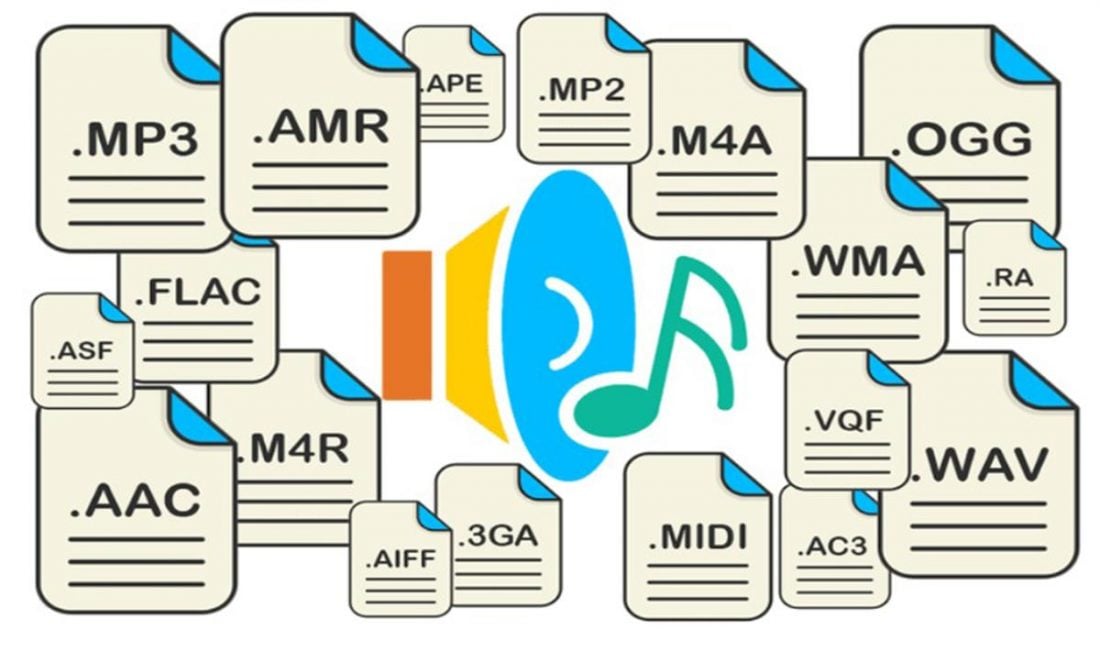
There are many types of voice file formats, as well as image file formats.

Audio Files

Since the digital audio files are easy to copy, the illegal copy and distribution of music files has become a problem these days.

As explained in what analog data is, the mechanism of digital audio files is that analog signals become digital data and are saved.

Explaining in detail the conversion method, to convert an analogue to digital waveform, it is necessary to perform a job called “sampling” that measures (record) the sound waveform at regular intervals, and is the sampling cycle. The sampling frequency is called (sampling frequency).

The sampling frequency represents the number of samples per second and is in Hz. In other words, it is a unit that expresses how many times the sound is measured and recorded per second, and the greater the value, the more faithful the original and greater sound becomes the quality of the sound. However, the amount of data will increase proportionally.

The sampling frequency of a typical music CD is 44.1 k Hz. However, even if the sampling frequency is increased, there are sounds and frequency bands that can not really be recorded, so some classical music enthusiasts love expensive analogue equipment.

In addition, it is not only the sampling frequency, which affects the quality of the sound, but also the “sampling bit” that indicates the strength (volume) of the sound (16 bits are 65,535, 24 bits are 16,777,215). (Express) and “Number of channels” (number of sound lines recorded as stereo, monaural and 5.1 channels) also have an effect. The higher the value, the greater the sound quality.

Another factor that greatly affects sound quality is the bit rate. The bit rate represents the amount of data to be recorded per second and the unit is “BPS”.

In other words, the higher the bit rate, the more information can be stored, which results in a higher sound quality. As will be described in detail below, in the MP3 file format, 128 K BPS is the minimum bit rate that can be heard.

However, there is “constant bit rate” and “variable bit rate” in the bit rate. The constant bit rate is the same bit rate that is fixed from the beginning to the end of the voice, and the variable bit rate increases or decreases the bit rate according to the amount of voice information.

In other words, the bit rate is high for clauses with multiple voices and the bit rate is low for simple low voice clauses. You can reduce the total size of the file by choosing a variable bit rate.

This is the information contained in the digitized data of analog audio signals.

However, digitized data can not be used as. Just converting this data into an arbitrary file format and saving them, it will be possible to use them with multimedia devices and application software that admit that format.

The storage format of said data

file format

Is named. A file format is a file format with an extension.

Then, to save the data in a file format, it is necessary to transform (encode: encoding) the data according to that format. (For coding, see What is a character code?)

A dedicated program is used to codify the data, but said coding program is

Codec (codec)
Is named. In other words, the gross data obtained by converting analog signals into digital data are processed by a codec to market them as a file format.

Therefore, there are many types of codecs and coding methods for each type of codec.

Most current codecs are programs that compress and encode data when creating a file and decompress (decompress) data by playing a file. In general terms, codecs are used to compress and decompress data. It refers to a compression method program of this type.

Audio formats. Understanding the differences

Audio formats. Understanding the differences

Audio File Format

There are many different audio formats.

audio file formats

You can’t even imagine how many audio formats there are. Now we will consider only the most popular ones, and if you need complete information, you can find it on Wikipedia.

Audio formats
Sound is itself an analog phenomenon. In order for it to register on a computer, it must be digitized. Digitized audio takes up a lot of space. Therefore, they use special algorithms to encode and compress data: codecs. Codecs provide encoding / decoding of audio / video data, as well as compression / decompression of such data. Download a set of codecs for Windows:

The type of media file format (audio or video, no difference) is determined by its extension. For example, MP3 files have the extension .mp3. The codec for this format is always the same: MPEG Layer-Ç. But for the MP4 format, the codecs may be different.

Some formats, such as MP4 and FLV, can contain streaming audio and video. So, if you see a file with the extension .mp4, you can’t definitely tell that it contains only music or only video, or a movie – audio and video. After all, initially in such formats, the possibility of transmitting both audio and video was raised.

We all know that once information is compressed, it can be lost. Therefore, all codecs can be divided into two groups: with loss of quality and without loss of quality. Don’t be intimidated by the word “lossy”: As a general rule, codecs cut off “unnecessary” information that is invisible to our eyes and ears (almost invisible).

Lossless compression codecs include:

FLAC (Free Lossless Audio Codec);
APE (Monkey’s Audio);
ALAC (Apple Lossless Audio Codec).
And here are the lossy codecs:

If you are a fan of sound then it makes sense to look for music in FLAG format. For normal home listening, the most popular MP3 format is sufficient. Also, to experience the total difference between MP3 and FLAC formats, you need professional sound reproduction equipment; unfortunately, the tablet does not belong to said team. So I don’t see any reason to download FLAC music to a tablet.

Now let’s take a quick look at the audio formats themselves:

WAV is the first (or one of the first) audio formats. It is used to store uncompressed audio recordings. One minute of recording in WAV format requires 10MB. An audio CD is usually copied in this format and then the resulting WAV files are compressed with an MP3 codec to save space.
MP3 (MPEG Layer-3) is the most widely used audio format. It reduces the sound with a loss of quality, but only the sound that is not heard by the human ear is cut off. As a result, a person does not hear the difference and the sound takes up less space. The main characteristic of this format is the bit rate. The higher the bit rate, the better the sound quality. Uncompressed audio CD has a bit rate of 1411.2 Kbps. The highest sound quality in the case of MP3 format is achieved at a bit rate of 320 Kbps. Anything below 320 Kbps is of worse quality . The difference between 128 Kbps and 320 Kbps is already felt by ear, so if you can download recordings with a higher bit rate, go for it.
WMA (Windows Media Audio) is a format developed by Microsoft for the Windows operating system. Microsoft tried to create a replacement for MP3, but, as time has shown, it failed.
OGG is an open format that supports encoding of audio with various codecs. The most widely used OGG codec is Vorbis. In terms of compression quality, the format is comparable to MP3, but less common in terms of media player and audio player support. If you can download music in MP3 and OGG format, you should choose MP3 because your audio player may not support OGG format.
AAC is a proprietary audio format that provides better sound quality than MP3. It is currently the best lossy audio coding algorithm. A file of this format can have the extensions aac, mp4, m4a, m4b, t4p, t4g.
FLAC is a lossless compression format. It does not make any changes to the audio stream, so the sound encoded with it is identical to the original. Used for listening to sound in high-level sound systems.
Video formats
There are no fewer video content formats and standards than audio formats. Let’s start with the international standards that define the data storage and encoding format of multimedia files:

Audio formats: rating and benefits

Audio formats: rating and benefits

Audio Formats

As actual field studies have shown, a good idea to rank the top ten audio formats turned out to be an impossible task at first.

Audio formats

Competition conditions too different for unequal participants. In addition, some corruption schemes or lobbyists of transnational companies in the field of audio recording interfere in our good cause to help people choose the best sound product.

The world’s most popular MP3 format reached the leaders of popular love solely due to multi-million dollar promotional investments. And if you take the sound quality, then regular. And even in terms of compression and disk space savings, it’s not the highest compression either.

Therefore, a compromise decision was made: divide the test subjects into three groups and compare and identify the leaders by groups.

Three types of audio formats
No compression.
Lossless compression.
Lossy compression.
Uncompressed audio recording formats show their best performance only on high-quality professional audio equipment.

If you have an inexpensive tablet or smartphone in your hands, then wonderful music will sound on your device, but you will not hear it simply because the hardware and software resource and the speakers or headphones cannot reproduce such high sound quality.

On the other hand, if you start MP3 sound recording through professional stereos and amplifiers, you will hear such noise and rattle from the speakers that, again, this type of use is completely meaningless.

Audio classification by type of sound reproduction equipment
For professional equipment, uncompressed audio formats.
For semi-professional teams, compressed audio formats. But without loss.
For inexpensive equipment: lossy and compressed audio formats.
In the first case, the hardware is so expensive that it is ridiculous to worry about saving money on media.

In the second case, the owner of an Apple device for a thousand dollars will obviously be able to call himself and spend a couple of hundred dollars on a bulky memory.

In the third case, since it has hardly been possible to raise money for a cheap smartphone, saving on the size of the stored music is very important. Well, no one is going to listen to a symphony orchestra in Hi-Fi on the phone anyway. Unless you can download a ringtone from the classics for fun to make it look like a fresh bell pepper to the eyes of tomatoes.

With this concludes the overture, we begin to present the subject.

Audio formats for high quality sound
This includes uncompressed formats.

PCM – Pulse Code Modulation. The original analog audio is sampled as is, without any modification.
PCM is the most common audio recording format used on CDs and DVDs. Dolby multi-channel, surround, subject to high-quality speakers, sounding almost one-on-one with a live performance.

If you like to sit in front of a home theater and immerse yourself in empathy for the main and supporting characters in the movie, this is it.

Wav
A fairly old format, developed as early as 1991. Well, the old masters always thought of high quality.

Many people consider WAV to be an uncompressed format. But it is actually a container and it can also contain compressed files.

In most cases, WAV contains uncompressed PCM audio. Therefore, the quality is high. But even for one minute of recording, approximately 32MB of memory is wasted.

Good enough compatibility with Windows and Mac.

AIFF
WAV analog from Apple developers. This is also a container and also usually contains sound in PCM format. Good compatibility with Windows.

Lossy compressed audio formats
Truly popular formats for everyone.

MP3
In accordance with the MPEG-1 Audio Layer 3 standard, it appeared in 1993 and instantly won universal love precisely because of its economy in memory consumption.

A CD can store the complete discography of your favorite band.
Throw some records in the glove compartment and you can enjoy music from Kaliningrad to Vladivostok.
During this time, you can listen to all the books by all the writers worth listening to.
The MP3 format is such a solid eunuch, from which they cut the most reluctant, but began to show the ability to store and save. So MP3 is a very inexpensive format.

The main advantage is that he leans on everything that he just plays and sings.

AAC
An advanced form of audio encoding. The younger but advanced brother of MP3. It has slightly improved sound characteristics and a higher compression ratio.

Applies to Android, iOS, iTunes, YouTube, Nintendo, and the latest versions of PlayStation.

Description of the main audio formats

Description of the main audio formats

audio formats

In the world of music there are a large number of music formats, their modifications and versions, created by the giants of the music industry and small companies that have received public recognition in the electronic world.

audio formats

Various physical methods have been developed to store audio data for these purposes, such as vinyl records, magnetic tape, CD, DAT, MD (minidisc), DVD, or converting music scores to music (MIDI), in the same way that they have many different computing methods emerged. audio data storage – digital: OGG, Mp3, Flac, Wav formats.

It is impossible to consider and discuss all audio formats, codecs, their advantages and disadvantages, so in my article I will try to tell you about the most popular audio file extensions that you find.

Why can’t we use any universal audio file encoding format? Because implementing multiple functions requires a different format. For example: to play CDs in a CD-ROM drive, to record music or sound effects in video games, to record a movie track or video clip, to play on mobile phones or to transfer files over the Internet, in addition, there are various operating systems that are the most widely used in the world … These include: Amiga, Macintosh, NEXT, and Windows PC.

Also, the work of a dj, sound engineer, cj, video engineer, or a simple music lover is quite different in nature. This may require that your audio data be saved in your own way. For example, the audio of a CD must be saved using 16 bits and a sampling frequency of 44.1 kHz. However, to download sound over the Internet, we’d better use a different bit depth and sample rate, as each minute of 16-bit, 44-kilohertz audio takes up about 10MB, i.e. an average track of 5 minutes will be 50 meters, too much data for the average user. This article provides an overview of the most popular music formats.

AA (Audible Audio Book File) is a proprietary format developed by Audible. It is used to record audiobooks sold through the Audible and iTunes services. It is possible to reduce or accelerate the speed of listening to files: digital tone, the ability to leave bookmarks when listening to audio books, file protection, when delivering sound recordings over the Internet.

AAC (Advanced Audio Coding) is an audio file format with less quality loss when encoding than MP3 in the same sizes. Lossless music encoding of original quality using the ALAC profile. AAC is a family of MPEG4 audio coding algorithms. Unlike the hybrid mp3 filter bank, AAC uses MDST (Modified Cosine Transform) technology, which means that the listener gets better sound quality than MP3 encoding with the same or lower bit rate. Possible AAC file extensions: [.m4a], [.m4b], [.m4p].

Additionally, AAC is a wideband audio coding algorithm that uses two basic coding principles to dramatically reduce the amount of data required to transmit high-quality digital audio. This format is one of the highest quality, uses lossy compression, compatible with most modern equipment, including notebooks.

For 2009, it is much less common than MP3 and other workarounds. AAC (Advanced Audio Coding) was originally created as a successor to MP3 with improved encoding quality. The AAC format, officially known as ISO / IEC 13818-7, was released in 1997 as the new seventh part of the MPEG-2 family. There is also the AAC format known as MPEG-4 Part 3.

Benefits of AAC over MP3:

– up to 48 audio channels;

– high coding efficiency with constant and variable bit rate;

– sampling frequencies from 8 Hz to 96 kHz (MP3: 8 Hz – 48 kHz);

– More flexible set stereo mode.

ADX is a proprietary ADICM-based lossy compression and storage format developed by CRI Middleware specifically for use in video games. The most characteristic feature is the ability to repeat the sound recording, which makes using the format convenient to use as background music in various games that support this media container. It is compatible with many SEGA Dreamcast games, some PlayStation 2 games and GameCube.

Unlike MP3, it does not use the psychoacoustic model of reducing the volume of sound data (reducing its complexity). Instead, the ADPCM model uses a prediction function relative error data record to store samples.

What are the most common video formats?

The choice of audio and video codecs and containers affects video quality and file size. Here we show you how to find the format that best suits your needs.

Decades and decades of developments in the audiovisual field have led to a result that can be seen as strange in a way. While in other sectors the continuous development has led to a very pronounced standardization (think of the DOC or PDF format), the situation in multimedia is at least worse.

audio file formats

One example is the world of audio formats, which is animated by strong “competition” and a variety of available options. Indeed, it is no less than that of video formats. In this case, we actually have to deal with a separation between codecs and containers (we’ll see what they are and what role they play) that will make things even more complicated. So when converting a movie, you need to be careful to choose the right codec and video format to avoid creating files that are too large or simply unreadable. In short, the mistake is just around the corner.

Differences between containers and codecs

Before analyzing the situation and determining the most commonly used video formats, some basic concepts need to be clarified: First: What is the difference between the codec and the container? In the audio world, if the codec used to digitize the audio track matches the “final” file format, the codecs used in the video differ from the file format that the video file will adopt at the end of the digitization process. The reason will be explained soon and is in the multimedia nature of a video.

audio format

A film actually contains video and audio data: the conversion or playback software must be able to analyze both multimedia transmissions and therefore requires different algorithms that work with one or the other type of data transmission. This is exactly what codecs do: Since the name, code and decoding of data (audio and video) consist of films, you can convert them to another video format or play them back with a media player. Even with regard to containers, it is enough to use the literal meaning of the word: These are files that contain both the video and audio sequences and “provide” codecs for reading and playback.

What are the most common codecs?

As already mentioned, a codec is responsible for compressing and decompressing the video files and determines how they are played on the screen of the PC or smart TV. Each operating system provides the user with dozens and dozens of different codecs, each useful for encoding and decoding a particular type of file, even if new ones can be installed by downloading special software or packages from the Internet. Among the most commonly used codecs we find FFmpeg, Divx, Xvid, H.264 and its development H.265, VP9 and VP 10 (also known as the name of the Google codec).

What are the most commonly used containers?

Containers, on the other hand, have the task of “bundling” the audio and video stream processed by the codecs and can therefore be used for the media player software. Containers are determined, among other things, by the “final” video file format. The most common are: Avi, Wmv, Mov, Flav and Mp4.

-Avi. The AVI video format (short for Audio Video Interleave), developed by Microsoft and introduced in 1992 as part of its video for Windows technology, is one of the oldest used today. It is so widespread and used that many consider it to be the de facto industry standard. Its simple infrastructure (elementary, one would almost say) makes it easy to use on different operating systems (Windows, MacOS, Linux, Android and the most popular browsers) and enables the “storage” of streams that are processed by different codecs
Flv. This is the video format that resulted from compression by Adobe Flash software and was developed almost exclusively for playing movies on the Internet. If it could be seen as the de facto standard for video file formats on the web until a few years ago, this is no longer the case today: The spread of HTML 5 and the discovery of some bugs in the software caused it to change a bit On the one hand, however, the FLV video file format remains a favorite for those who generally create video for the network: with its compression algorithms, you can indeed get good quality small videos