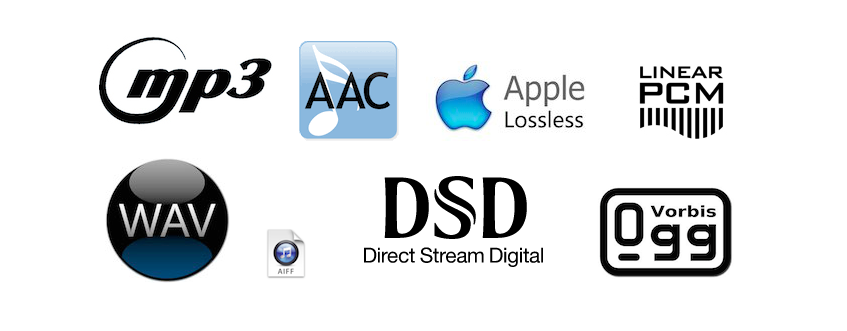
THE MOST COMMON FORMATS FOR MUSIC AND OTHER AUDIO FILES, AND HOW THEY ARE RELATED TO EACH OTHER


Free Download Mp4Gain
picture

THE MOST COMMON FORMATS FOR MUSIC AND OTHER AUDIO FILES, AND HOW THEY ARE RELATED TO EACH OTHER
Music Formats


And for the direct competitors of the universal MP3 format, they can count on a lot today.

Music Formats

Due to continuing inconsistencies in home storage of the WAV format, it was eventually discontinued. But for professional studios, he says, the basics of the job. Especially when recording live vocals or instruments. Just convert the recorded material from WAV to MP3 at the final stage.

music format

However, music can be represented in some other popular formats nowadays. For example, many times (especially the Internet) they use these data types like OGG, AIFF, AMR, etc. But the real competitor of MP3 has become the newest and best audio FLAC etc. Of course, for MP3 you can convert all parameters to the maximum, but the playback quality of FLAC represents much higher. Also, it is a single file and the separation occurs directly on the track due to the player or startup software. In other words, listeners see each track individually, but can switch between playback tracks. For the MP3 format, this also seems possible to merge multiple tracks through it, thus creating a single file. But here it is in this version fast switching between tracks will not be possible (normal fast forward should be used, that’s all).

However, not everything is bad. The fact that music or audiobooks are all popular formats today allows them to be easily converted, even keeping the original parameters of the audio material. Based on this, and for sound processing and conversion and audio editors, almost all programs call converters. Any program of this type (MP3 editor or converter) detects the original and final type of audio files, is unambiguous and can produce direct and reverse transformations. Let’s explain this specific example.

WAVE THEORY AUDIO EDITOR FOR MP3 FILES
Many types of software are used in audio processing today. First, look at the narrow application of so-called audio editors. The most prominent representatives of these can be called giants Sony Audio Forge, Sintrillium Cool Editing Pro, which was later acquired by Adobe and renamed Audition, Acoustica Mixcraft, ACID Pro and many others.

mp3 editor

The principle on which they operate is that, for convenience, all MP3 audio programs have a typical waveform, as originally used for WAV files. This method determines the appearance and opportunity enough to edit any type of conventional audio material in WAV format. Other than that, the fact that you can do basic copy, cut, paste, etc. E., it’s just a matter of getting the frequency characteristics and bitrate changes, not to mention using a lot of extra effects that plug into VSTs via DirectX or a generic host bridge studio thing.

In its simplest form, the conversion can be done using the standard file menu, which contains the line “Save As…” (Save As…) or the export function present in MP3 format. Thus, all the process is reduced to just the final selection of the format (MP3 here as an example) and activation of the recording mode. In this case the conversion will be done automatically saving the current configuration parameters and the frequency characteristics. I don’t like the original version? ?Nothing is easier than changing the format to MP3, pre-specified with higher settings. However, one thing needs to be considered here: if the raw material is of such poor quality that special remediation or even professional tools will not work for audio it is necessary to use Repairs here, the intervention of various filters, etc. D. For the layman, it will cause great difficulties.

As is clear, there is absolutely no difference between the audiobooks we are dealing with: MP3, music or just recorded voice or noise. By the way, audiobooks are supposed to have a much lower sound quality by default. This is understandable, since the file has to take up minimal space and, in general, the perceived sound characteristics of speech are not that important. Finally, is this a professional recording of a particular set of albums?

However, if you use some standard operations, even without specific knowledge, it’s fine to achieve good results, especially since there are such built-in templates, based on any application for specific operations. Of course, it will be very difficult for the first time to achieve a perfect sound, but if you study the plan and understand how it works, it will work like clockwork, and as a result, it will take a lot of time.


Free Download Mp4Gain
picture


Mp4Gain Main Window
picture


Mp4Gain Features
picture


Free Download Mp4Gain
picture

The best popular audio formats

The best popular audio formats

Audio Formats

I looked around the forest of audio formats for normal use and chose the 5 most important ones. It is true that, in part, a bit simplified, a bit rough in presentation. I refrain from differentiating the exact settings of the respective codecs, that would be too complex.

I also don’t want to get into the nasty topic of DRM. The most important one I dropped is probably Vorbis. . Of course, I assume that the correct settings are used when encoding and that a high quality level is selected.

Audio formats

1st place:
MP3 (MPEG-1 Audio Layer 3)

The most widespread digital format, with good encoding (for example, with LAME) in high bit rates, a format of the highest quality and transparency.

Quality (4.5 / 5 points)
Popularity (5/5 points)
Compression (4/5 points)
Total: 13.5

2nd place:
AAC (advanced audio coding)

It became famous especially for its use in the Apple iPod, a codec that has small advantages over MP3 at low bit rates due to technical developments.

Quality (4/5 points)
Popularity (4.5 / 5 points)
Compression (4.5 / 5 points)
Total: 13

3rd place:
WMA (Windows Media Audio)

Windows proprietary format. Of course, Microsoft has the reins here, so variable format doesn’t run on all playback devices. Otherwise, no major strengths and weaknesses and, for example, the standard format with Napster.

Quality (4/5 points)
Popularity (4/5 points)
Compression (4/5 points)

Total: 12

4th place:
FLAC (Free Lossless Audio Codec) !!

As the only lossless codec on this list. FLAC works in something like a ZIP program: the original can be restored from the compressed file by approximately 50% without restrictions. In times of low hard disk space, a real alternative, especially since many playback devices can play this format. My winner of hearts, the popularity will certainly increase in the future.

Quality (5/5 points)
Popularity (3.5 / 5 points)
Compression (3/5 points)

Total: 11.5

5th place:
Wav

The original format of the normal audio CD data. Impeccable quality and still widespread thanks to the well-known compact disc. It actually started out of the competition because it’s completely unzipped.

Quality (5/5 points)
Popularity (5/5 points)
Compression (0/5 points)
Total: 10

Better audio formats

audio formats

You have decided to digitize the music tracks in your audio CD collection by transferring everything to your computer, and in doing so you have begun to evaluate the possibility of converting them to a more pleasant format for you. However, having little experience in this regard, you would like to receive some advice on the subject so that you can make the best decision. How to say Things are exactly this way and would you like to know if I can help you by indicating what are the best audio formats? Of course yes, that was exactly what he intended to do.

If you allow me a few minutes of your free time, I can actually tell you, by thread and by sign, what are the most popular audio formats in circulation, their strengths and weaknesses and for what uses they may be more or less convenient to contact . condition to opt for those that you think may actually be right for you. To complete the information and to give you an even more complete description of the matter, at the end of the article it will also be my concern to indicate what tools you can use to perform various conversion operations. You will see that after reading this guide, you will no longer have any doubts about what to do.

So? How about putting the talk aside and finally getting to the heart of the matter? You? Brilliant! Therefore, I suggest not wasting any more time and immediately start focusing on the topic. Get comfortable in front of your trusted computer and read everything below. I am sure you can say that you are happy and satisfied with what you have learned. I wish you, as always, happy reading.

What is the best audio format?

What is the best audio format?

Many are known, but there is always the question of which is the best audio format. The main and most recognized for listening to music are MP3, Wav, FLAC and Ogg.

But, to choose the best audio format, you must first know that they have multiple conformations, and you can always choose the best one. Music always goes everywhere, at home in front of the computer, in a living room with a hi-fi system, with headphones on public transport or when playing sports. Music that gives a special meaning to each moment and that encourages when heard.

There are many ways to enjoy it, but it is usually always done in digital format. Within the audio files, there is a great variety and normally many still use MP3 for convenience. But there are alternatives that are less popular and that seek to offer a different and higher quality experience. For those who do not know it, there are a number of main sound systems.

The best audio format

Beyond that the MP3 format is the most popular of all available audio formats, it is not the only one. Some others like “FLAC”, “WMA”, “OGG” have certain characteristics that, depending on what you want, can be very useful on certain occasions.

In technology, audio formats can generally be classified into 2 categories. There are those that retain all the quality and those that lead to quality losses in sound or information.

Those that preserve the quality of the audio are those that come from pure sources such as CDs. This is how those who lose quality and sacrifice this information are to save space.

Formats that preserve audio quality

“FLAC” is Free Lossless Audio Codec or “FLAC”. It is one of the formats that best preserves the audio quality and its compression algorithm is excellent. It is open source, does not generate quality losses and the size of the file because it is compressed, is much smaller.

Apple Lossless is known as “ALAC” and is very similar to “FLAC”. The difference is that it is not as efficient, so these files are larger, although they still have the unconditional support of iOS, something that “FLAC” does not have.

“APE” is another and although the problem with this format is that it is not compatible with the vast majority of players, it is considered similar to the “FLAC” or “ALAC” format in terms of audio quality. As it is highly compressed, it makes the computer’s processor work faster and therefore it is not recommended to use it in low-power computing equipment.

“WAV” and “AIFF” are not compression formats, but rather exact copies of the original content and differ in the way they save data. “AIFF” was created by Apple and “WAV” is more universal, but both have too much disk space.

Formats with loss of audio quality

MP3, MPEG Audio Layer III or MP3, as many already know them, is the most common format that can be found. “ACC” is very popular on iTunes and is considered more efficient than MP3 since files in this format are smaller.

OGG Vorbis is one of the free and open source alternatives to MP3 and ACC. It is not restricted by patents, but it is also not supported by many players. WMA is Microsoft’s proprietary format and is very similar to MP3, but without great advantages over the others.

Which audio format to choose?

The one that is most recommended to choose is the “MP3” or “AAC”, since many players support them. Furthermore, if they are encoded with a high bitrate, they can hardly be distinguished from the original source. However, if what you want is to burn the music, formats such as “FLAC” are recommended, because then you can convert everything to other formats, without losing the audio quality.

Once the audio formats are known, when choosing, the differences between each one must be taken into account. In general, what experts recommend is to use “MP3” or “AAC” since they are compatible with most players and the quality of both is very similar to that of the original source, especially if it is encoded with a high bit rate. Unless you have a specific need, “MP3” and “AAC” are the most advisable options.

However, one thing to know is that to store music in lossless formats, there is no such thing as “FLAC”. You probably won’t notice a higher quality, but it’s good for storing music if you plan to convert it to other formats later. In these cases, “FLAC” is always recommended, and it is also possible to choose the format without loss or degradation of file quality.

As a final conclusion, it can be said that you should not be obsessed with the subject, but you just have to be sure of what you want and choose.

Understanding digital audio formats

Understanding digital audio formats

When it comes to digitally distributing our music it is important that we understand what they are
the different formats, which are the most used and which are the best in terms of the
Relationship between size and quality.

PCM digital audio

WAVE

The name comes from the acronym waveform audio file format and is a used file
usually on computers with the Windows operating system.
WAV or WAVE files contain audio in LPCM format (Linear Pulse Code
Modulation) This is a way to encode an analog audio signal to the domain
digital by using equidistant samples over time of amplitude values
of the analog signal.
The quantity of samples is given by the sampling rate or sampling rate,
while the amount of possible amplitude values ​​is determined by the
Bit depth or bit rate.
The sampling frequency of the CDAUDIO for example is 44.1 kHz and 16 bits. exist
higher sampling rates such as 48 kHz, 88.2 kHz, 96 kHz up to 192 kHz at
this system.
On the other hand, WAV files are uncompressed audio and are generally used in
stages of recording, editing, mixing and mastering for being of high quality.
The higher the sample rate and the greater the number of bits, the file size will be
our hard drive
In general for professional uses at least a frequency of
44.1 kHz sampling and a depth of 24 bits preferably.
The standard extension for this type of file is: .wav

AIFF

The name comes from Audio Interchange File Format or audio file format
interchangeable, this format was developed by Apple computers and is used to save
and manipulate audio on computers.
It is like WAV a file type without compression or lossles therefore allows
Processing for professional applications such as recording, editing, mixing and
mastering as well as for professional video uses.
Another similarity with WAV files is that it is PCM audio (press code
modulation) that for practical purposes it is the same as the LPCM.
The standard extension for this type of files is .aiff

MP3

Also known as MPEG1 or MPEG2 audio layer, it is a form of coding
of digital audio in which psychoacoustic models discard information from
Audio that is presumed is not audible to most users.
As an example a file created with a resolution of 128 kbits / s is equivalent to 1/11
the size of a file on an audio CD.
The main purpose of using this type of coding is to reduce the size of the
files and be able to send / download faster, especially through
from Internet.
Being a file type reduced in quality IS NOT RECOMMENDED for
recordings, editing, mixing or mastering of professional audio.
For this reason we recommend NOT to use it to send us your clues to
mix / master

What is the best audio format for listening to music?

What is the best audio format for listening to music?

Although the MP3 format is the most popular of all available audio formats, it is not the only one, some such as FLAC, WMA, OGG and others, have features that, depending on what you want, can be very useful in certain occasions

Here I show you a summary of what to expect when you are looking for the best audio format to listen to music.

As a general rule, we can classify audio formats into two categories: those that retain all quality and those that lead to loss of quality in sound or information.

Those who retain all audio quality come from pure sources such as CDs, while those who lose quality sacrifice this information to save space.

Formats that preserve audio quality:

FLAC: Free Lossless Audio Codec or FLAC, for its acronym in English, is one of the formats that best preserves audio quality. Its compression algorithm is excellent and does not generate quality losses, it is open source and the file size when compressed is much smaller
Apple Lossless: known as ALAC is very similar to FLAC, but not as efficient as this, so these files are larger, although they have the unconditional support of iOS, which FLAC does not have

APE: The problem with this format is that it is not very compatible with the vast majority of players, but it is similar to the FLAC or ALAC format in terms of audio quality. Being very compressed makes the computer’s processor work faster so it is not recommended in low power computing equipment
WAV and AIFF: they are not compression formats, but exact copies of the original content, differing in the way they save the data. While AIFF was created by Apple, WAV is more universal, but both take too much disk space.

Formats with loss of audio quality:

MP3: MPEG Audio Layer III or MP3, as we all know them, is the most common format you can find
ACC: is more efficient than MP3, files in this format are smaller and is very popular on iTunes
OGG Vorbis: it is a free and open source alternative to MP3 and ACC, it is not restricted by patents but not supported by many players
WMA: this is the proprietary format of Microsoft very similar to MP3, without great advantages over the others
Which audio format to choose
You may be interested: «It’s proven: classical music modifies your genes and makes you smarter»
It is more recommended to choose MP3 or AAC, since many players support them, in addition, if they are encoded with a high bitrate they are almost indistinguishable from the original source. However, if what you want is to burn your music, I recommend formats like FLAC, then you can convert everything to other formats without losing audio quality.