Are your ears worthy of your headphones?


Free Download Mp4Gain
picture

Are your ears worthy of your headphones?…

Audio Quality
Audio Quality

The process of human hearing sound is very complicated.
Audio Quality
Audio Quality

But compared to the metaphysics of headphones and audio, the complexity of the human ear is basically not worth mentioning. But before we get into whether Beats is shallow, whether Sony is good, and whether headphone noise reduction is good for your ears, let’s take a look at what we’re talking about when it comes to sound quality. It may be that when you feel that the sound quality of a certain headset is not good, the problem is in your ears or in the sound file itself.

01 What is sound quality?

The essence of music and sound is the vibration of air, and sound quality is generally attributed to three aspects: volume, pitch, and timbre.

Everyone knows the volume and the tone is Do Re Mi Fa Sol La Ti. And what is the tone?

The American National Standards Institute defines timbre as “…a sensory attribute by which a listener can judge that two tones of the same volume and pitch are not the same.” We can tell the difference between a guitar playing a 440Hz tone and a piano playing a 440Hz tone.

The sound reproduced by different headphones is different, and the timbre is also different. However, in terms of volume, different headphones will also have a certain volume difference due to different internal circuitry; as for the tone, there is no obvious change without accident.

02Digital recording and analog recording

There is no doubt that pre-CD audio carriers: magnetic tapes, vinyl records, etc., are all analog recording products. The word “analog” is also translated as “analog”, in short, it restores and reproduces the vibration in the air at that moment in a physical way. Whether it’s vinyl or tape, physical features such as bumps, depressions, or magnetic dust splits on tape or disc are used to restore the vibrance detail of the audio.

But in the age of CDs and computers, all audio vibrations are converted to 0 or 1 on the surface of the disc and go into the so-called binary algorithm. After decoding, it is restored to physical vibration.

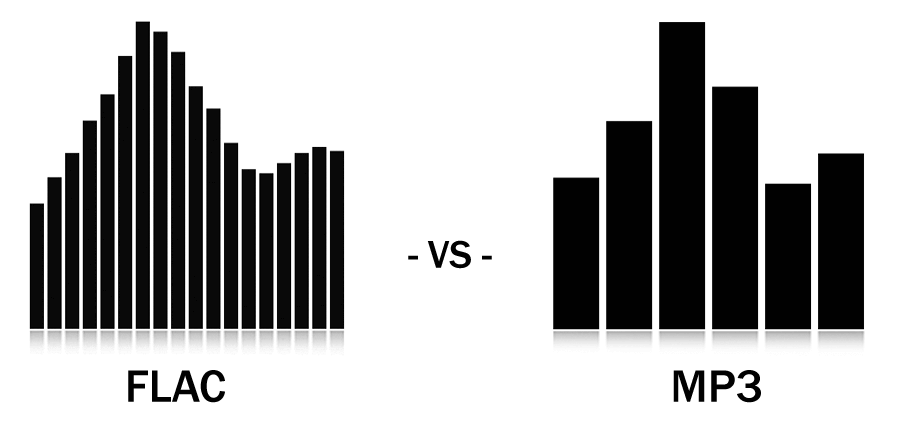
In popular music recordings, there are probably three most common formats:

44.1 kHz, 16-bit waveform

320kb mp3

128kb mp3


Free Download Mp4Gain
picture


Mp4Gain Main Window
picture


Mp4Gain Features
picture


Free Download Mp4Gain
picture

Mp3, is it the best format for music and sound?

Mp3, is it the best format for music and sound?

best format for music and sound

People are looking for the best audio and video quality in 2022, what is it?

best format for music and sound

If you are seriously looking for high-quality audio and video, we advise you to stay away from the data-throwing fundamentalists and adopt a more practical attitude.

First of all you must ask yourself, on which devices will you listen to the audio or see the videos.

We have listened to dozens of fundamentalists who use numbers and certain statements as dogmas and have turned even this discussion of quality into a dogma.

And that is diametrically different from the simple my real aspiration to really enjoy the best audio and video quality that your equipment can deliver and that your eyes and ears are capable of detecting.

Mathematical statements are useless if you do not have an HD computer to listen to your audios and watch your videos.

Nor if the extreme is reached where the difference is already indistinguishable for 99.99% of the population.

It is fully demonstrated that for 99.99% of the population, even for those who have auditory training, an mp3 with 320 kbps and 48000 as sample rate is indistinguishable from a WAV or FLAC.

You can improve your audio with Mp4Gain regardless if you decide to continue using mp3s or prefer to switch to FLAC (Mp4Gain can convert and use these and other formats like ogg, m4a, etc)

In short, the discussion of sound quality should be based more on actually hearing the best possible audio and not a fundamentalist discussion about numbers.

The audio formats with the best sound quality

The audio formats with the best sound quality

audio formats


In addition, when editing, because some details have been compressed and sacrificed, the editing space is relatively small.

audio formats

It should be noted that the sound quality will be compromised every time these formats are output. After too many output programs, the quality can be terrible, so the number of times of recompression and conversion should be reduced.

Pros: small file size, maximum device compatibility

Disadvantages: destructive compression leads to loss of sound quality, less spatial flexibility for reissue


Resume
When it comes to sound files for editing, it’s ideal to work with uncompressed formats like .WAV or .AIFF. Such a format allows users to get the greatest degree of tolerance and freedom when editing, and most of these file formats are still supported, regardless of software or equipment. Also, when the video is output at the end of the project, the music file will still be compressed, so it’s ideal to use a file format with higher sound quality from the start, which is ideal for a project that needs to go through post-edit layers. But if it is based on the premise of convenient, fast and easy-to-use transmission, .MP3 can still meet your needs without sacrificing sound quality.

Mp4Gain is a program that allows you not only to normalize the audio of your sound or cvideo files, but also to improve the quality and offers you to perform a whole series of modifications so that you have better audio quality used.

The audio formats with the best sound quality

The audio formats with the best sound quality

audio formats
audio formats

First of all, divide all types of music files into three parts as follows:

audio formats
audio formats


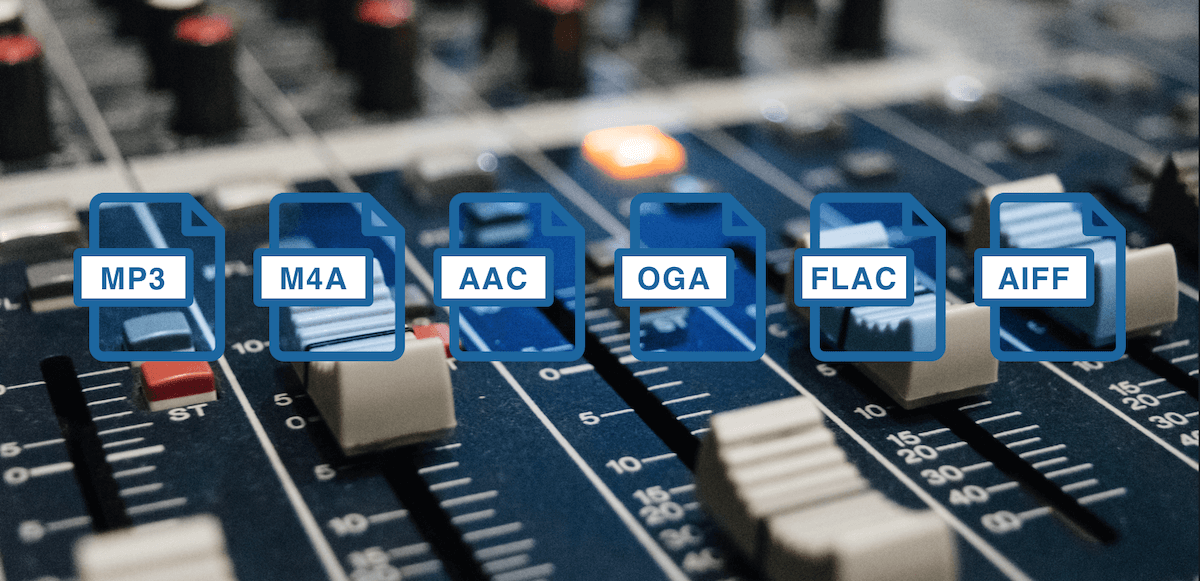
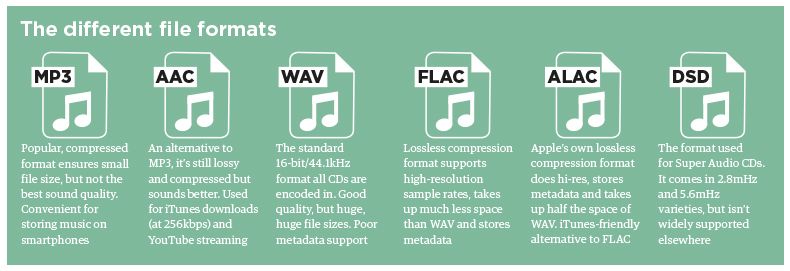
Uncompressed file formats: .WAV, .AIFF

Lossless compression formats: .FLAC, .ALAC (Apple Lossless)

Destructive compression formats: .MP3, .AAC, .WMA, .OGG

Below are their respective advantages and disadvantages.


1. Uncompressed file format
Uncompressed music files are just like the concept of Raw files. Essentially no compression will of course have the best sound quality. (The sample rate and bit rate of the original recording are also very important. If the compressed music file is converted to an uncompressed file, the music won’t magically improve the sound quality.)

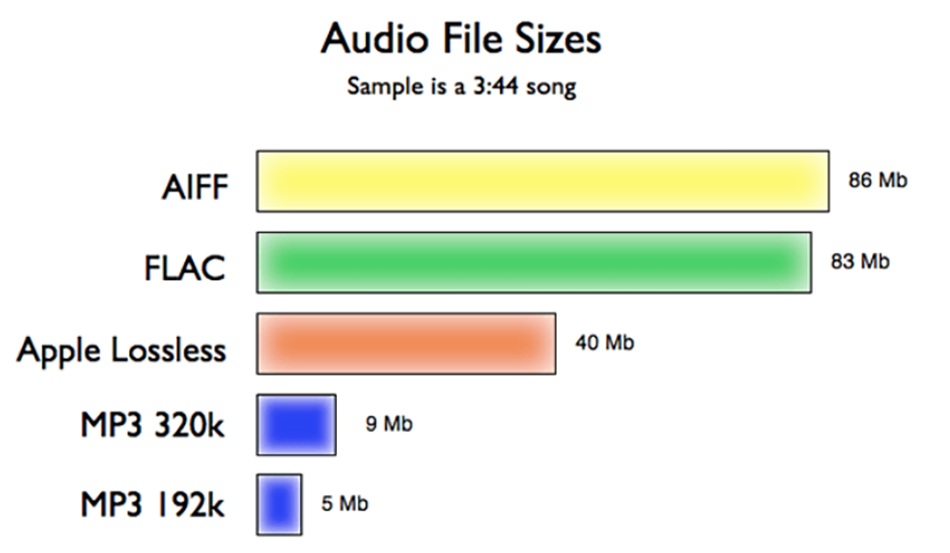
The most common disadvantage of uncompressed files is the file size. Generally, the file size of a song is around 25 ~ 40 MB. While that capacity is no longer an issue for cloud hard drives, it is still an issue for email. Also big (25MB max for Gmail attachments). Also, some portable music players or devices may not be able to play such music files.

Advantages: original sound reproduction, no compression, lossless, easier to use in post production

Disadvantages: large file format, fewer supported devices


2. Lossless compression format
The term “compressed and lossless” seems contradictory, but compression does not necessarily affect sound quality. More precisely, it’s more like “compressed to save space”. It’s like compressing a high quality file into a .ZIP and decompressing it when you want to use it, the quality of the file will not be affected.

Therefore, this type of file has a compressed capacity, but the file will be decompressed during playback to restore sound quality. Although the concept of reducing capacity without affecting sound quality is great, the downside is that support for this format is extremely low and in order to decompress the file during playback, an additional codec is required to use it, and it will. also take some performance.

Advantages: small file capacity (about 1/2 ~ 1/3 lossless files), good sound quality

Disadvantages: Decompression can eat performance when used, and support from hardware or software is extremely low


3. Destructive compression format
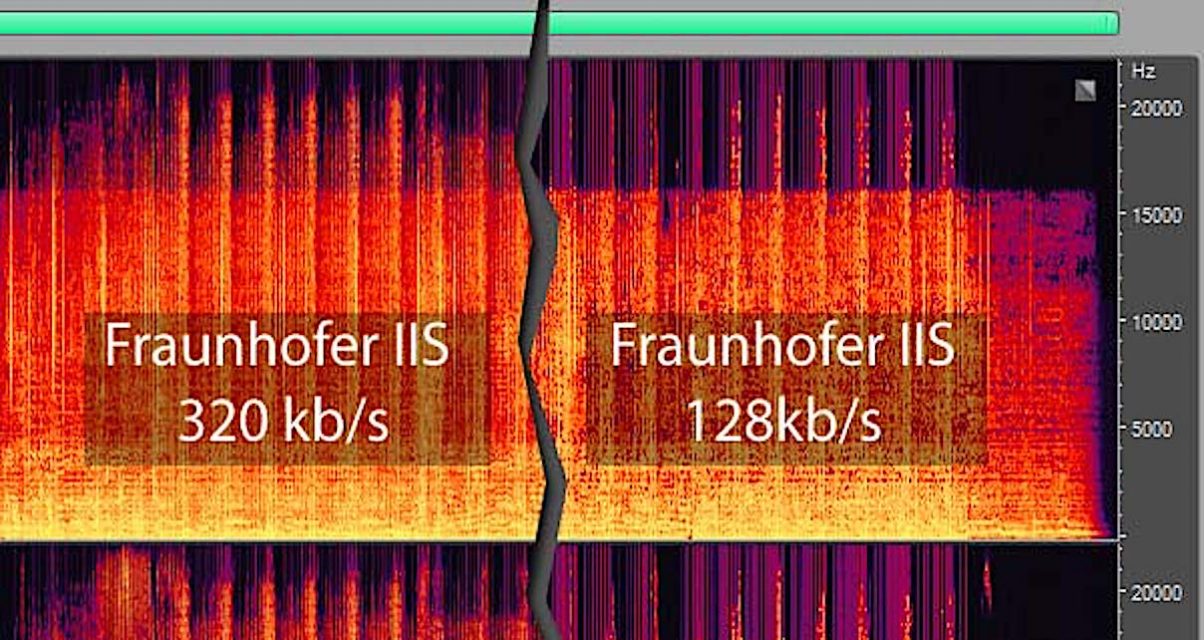
The destructive compression format is currently the most common music file format, the main reason is that it has the greatest compatibility with portable devices (mobile phones, MP3 players, etc.), and the files are small and have a space of limited storage. , users can store more music (compressed capacity is about one-tenth of lossless sound quality), and most of the music provided by today’s streaming media is files in this format. There is always a price to pay for smaller files. Compared to lossless formats, this destructive compression will affect the audio range that the original sound can present and will cause some distortion. So, to be safe, keep the compression rate above 320 kbps as much as possible.

The higher the kbps value of the mp3 file, the better the sound quality? Part 2

The higher the kbps value of the mp3 file, the better the sound quality? Part 2

Mp3 quality

MPEG audio encoding has a high compression ratio, MP1 and MP2 have a compression ratio of 4:1 and 6:1-8:1 respectively, while MP3 has a compression ratio of up to 10:1-12: 1, which means that one minute Uncompressed CD-quality music requires 10 MB of storage space, but only about 1 MB after MP3 compression encoding, and its sound quality is basically distortion-free.

mp3 128kbps To 320kbps

Although it is a distorted compression, its biggest advantage is a higher compression ratio in exchange for very little sound distortion. Usually a CD can only store a dozen CDs, but it can store hundreds of MP3 songs, which is why MP3 is popular all over the world. Currently, MP3 is the most common music format on the Internet. Music files of the same length are stored in the MP3 format, usually only 1/10 of the WAV format. Due to their small file size and good sound quality, they can achieve a sound effect that is closer to the original sound source. Therefore, until now, the status of MP3 format as the mainstream audio format is still hard to shake. Simply put, WMA is smaller than MP3 and MP3 has better sound quality than WMA. Currently, the music format with the best sound quality is APE, which is equivalent to the sound quality of a CD, but relatively large. A song weighs about 20 MB! 1 or so, another advantage of WMA is that content providers can add copy protection through DRM (Digital Rights Management) solutions, such as Windows Media Rights Manager 7. This copyright protection technology built-in author can limit the playback time and number of playback, and even the playback machine, etc., which is a boon for music companies that have been defeated by piracy. MP3 format: MP3 technology originated From MPEG technology, MPEG is short for Moving Picture Experts Group. MPEG audio encoding has a high compression ratio, MP1 and MP2 have a compression ratio of 4:1 and 6:1-8:1 respectively, while MP3 has a compression ratio of up to 10:1-12: 1, which means that one minute Uncompressed CD-quality music requires 10 MB of storage space, but only about 1 MB after MP3 compression encoding, and its sound quality is basically distortion-free.

The higher the kbps value of the mp3 file, the better the sound quality?

The higher the kbps value of the mp3 file, the better the sound quality?

kbps mp3

Kbps refers to the number of bits (bit rate) of mp3, and bit rate refers to the amount of information that can be transmitted per second in a data stream.

mp3 kbps

Kbps means “kilobytes per second,” so a higher value means more data, a higher bit rate, more information, and better sound quality, but it also means more processing to decode the information. the more space the file should take up. (But this is nothing compared to today’s hardware, and many people put ape directly on the hard drive!) For mp3, 128kbps is a qualified quality! As for the bit rate you use, it depends on your own needs. If the requirements are high, use CBR320kbps, CBR192kbps or VBR variable bit rate. If the file size is required to be small for network streaming or online playback, please use CBR128kbps or lower bit rate can be. Sound quality is closely tied to its compression ratio. In fact, WMA is slightly worse than MP3 at a rate of 192 kb/s or higher, but it is quite close to the effect of the original WAVE file. The difference is that the treble component of WMA in the same ratio is greater than that. of MP3 in the ratio of 96K and 64K. Simply saying that WMA is more advanced than MP3 is untenable. In fact, their principles are the same, and they are similar in the case of high ratios. Also, there is a problem with the compression software: if you use Hero Jieba to compress high-quality MP3, it will definitely be worse than WMA. Now LAME has grown considerably and is stronger than WMA at ratios above 128K. Comparing 96K WMA with 128K MP3, MP3 is definitely better. So it depends on your needs, if you need low baud, MP3 PRO or WMA is recommended (MP3 PRO is much better than WMA at 64K ratio), and if it’s high quality MP3, it doesn’t matter, but it’s still recommended. MP3, because after all it is a fairly open format, unlike WMA, which is monopolized by the Microsoft family, and can only be played with WMP. For that, I only use MP3. WMA format: WMA sound quality is stronger than MP3 format, its “body” is thinner than MP3, and it supports data transmission technology (Stream), which can be downloaded and listened to on the Internet. The characteristic of WMA is that when a song is compressed to a very small size, it can still maintain good sound quality, which is much better than RA format. It is the same as the VQF format developed by YAMAHA in Japan. Reduces data stream but maintains sound quality method to achieve higher compression ratio than MP3. The compression ratio of WMA can generally reach around 18:1. Another advantage of WMA is that content providers can add copy protection through DRM (Digital Rights Management) solutions, such as Windows Media Rights Manager 7. This built-in copyright protection technology can limit the playing time and the number of plays, and even the playing machine, etc., which is a blessing for music companies that have been defeated by piracy .MP3 Format: MP3 technology originated from MPEG technology, MPEG is short for Moving Picture Experts Group. MPEG audio encoding has a high compression ratio, MP1 and MP2 have a compression ratio of 4:1 and 6:1-8:1 respectively, while MP3 has a compression ratio of up to 10:1-12: 1, which means that one minute Uncompressed CD-quality music requires 10 MB of storage space, but only about 1 MB after MP3 compression encoding, and its sound quality is basically distortion-free. Although it is a distorted compression, its biggest advantage is a higher compression ratio in exchange for very little sound distortion. Usually a CD can only store a dozen CDs, but it can store hundreds of MP3 songs, which is why MP3 is popular all over the world. Currently, MP3 is the most common music format on the Internet. Music files of the same length are stored in the MP3 format, usually only 1/10 of the WAV format. Due to their small file size and good sound quality, they can achieve a sound effect that is closer to the original sound source. Therefore, until now, the status of MP3 format as the mainstream audio format is still hard to shake. Simply put, WMA is smaller than MP3 and MP3 has better sound quality than WMA. Currently, the music format with the best

What is bit rate, bit rate and KBPS?

What is bit rate, bit rate and KBPS?

Kbps

People often use Kbps to describe the hearing effect and audio quality.

Mbps- Mbps

On Windows systems and some players, kbps is called “bit rate” and “bit rate”.
16Kbps=phone sound quality
24Kbps=Increased telephone sound quality, short wave transmission, long wave transmission, European standard medium wave transmission
40Kbps=US standard medium wave transmission
56Kbps=Voice
64Kbps=Voice boost, mobile phone ringtones the best bit rate (Kbps) setting value, mobile phone The best setting for mono MP3 players is
112 Kbps = FM FM stereo transmission 128 Kbps =
best setup for cassettes, mobile phone stereo MP3 players, best setup for low-end MP3 players
192 Kbps = the best setting for mid-range MP3 players The fixed value of
320 Kbps = the best setting for high-end MP3 players (the highest bit rate on the
MP3 format) The highest quality of the MP3 format is 320 Kbps

2. How to distinguish true and false KBPS
The maximum quality in MP3 format, the bitrate is 320Kbps, but it is not ruled out that some unscrupulous merchants convert low quality audio (such as: 40, 64, 128 kbps) to the maximum quality (320kbps);
for a long time, many people Judgment on sound quality depends entirely on the bitrate of the dance music, i.e. whether the audio file is 192k, 256k or 320k (the bitrate in the file mp3-properties-detailed information), but in fact, this parameter does not really reflect a song. The sound quality of music is data that can be falsified and cannot fully represent the actual sound quality of a song. For example, using software such as QianqianjingTing, you can convert a 64Kbps music to 320Kbps, but before conversion and conversion After the sound quality is the same, the sound quality has not really improved.

What does kbps mean? Part 2

What does kbps mean? Part 2

Kilobits Per Second (Kbps)

With the proliferation of digital storage and streaming, few people listen to music with physical objects.

kbps

Earlier I asked a high school student that he didn’t use the tape and that he didn’t know what it was. It was really shocking!

That’s the tape thank you!

Now almost all the music we listen to comes from the internet, be it Youtube or Soundcloud, Spotify or songs downloaded from iTunes or Beatport. Most of the time we don’t think that the sound transmitted by these different platforms is different, but there are times when we suddenly feel that the “sound quality” is not very good, but often we don’t know what the sound is. quality is What is the meaning?

Today we will introduce you to what this “sound quality” really means and the principle behind it.

First of all, everything we hear from the Internet are digital files, that is, the real (continuous) sound is saved by sampling (slicing) and then restored by decoding. So generally the quality of the sound we hear has two levels: one is how finely the song itself is sampled, and the other is how realistic our playback system is when playing it.

If you take a video as an example, you can see the fineness of 480p, 1080p, 4K video in the image below.

And this is similar to the finesse of the song itself: the finer the sample, the better the sound quality. But we actually see the image through the screen, so even though I have 4K HD video, I still see it on a traditional VCR. It may be the same as 480p, because your player can’t play it. Good quality. It’s like buying a CD and listening to it with the 39 yuan headphones Daiso bought.

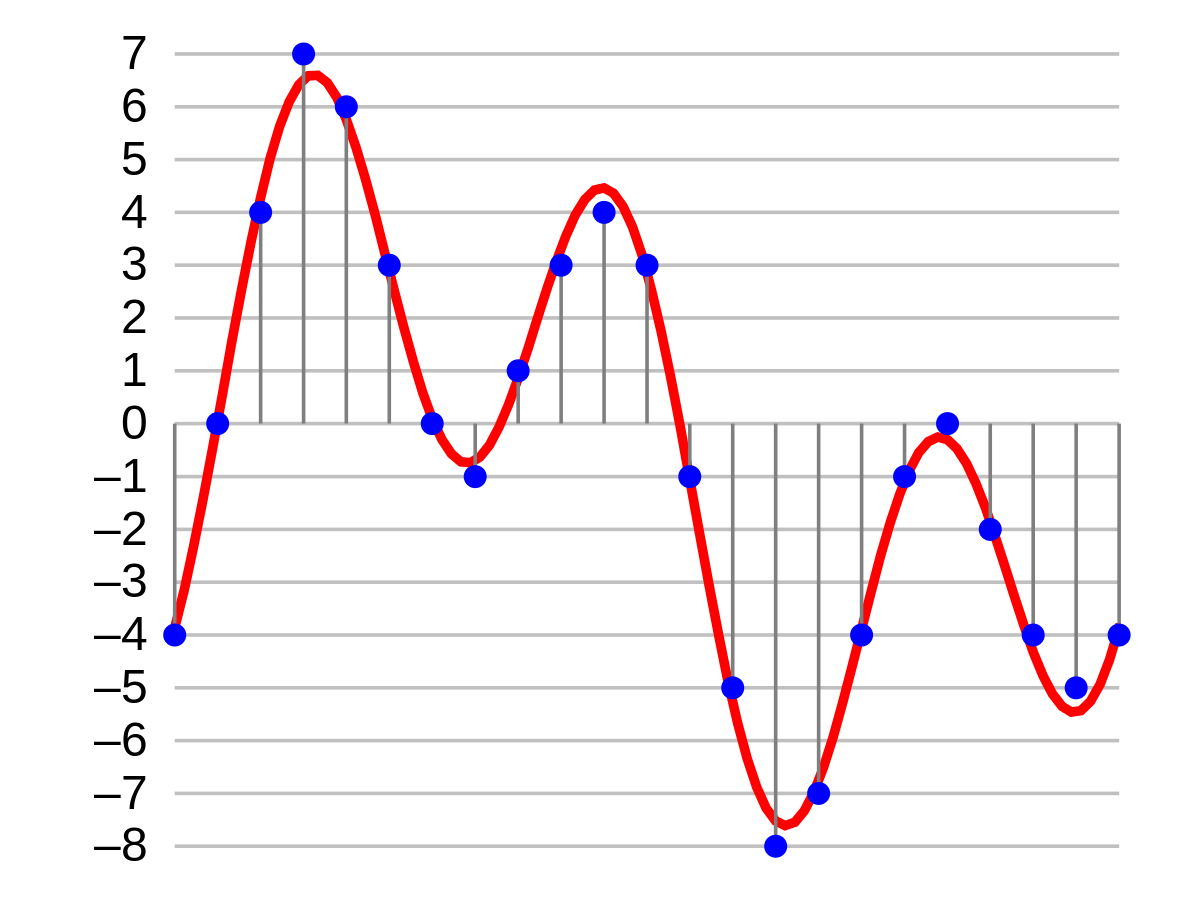
But today we are more focused on the level of sophistication of the original song. The two most important elements that affect the sound quality of digital music are the sample rate (Hz) and the bit depth (bits), which are the horizontal and vertical axes in the figure below.

The so-called sample rate is the number of points we want to take in 1 second to sample (horizontal axis), and the bit depth is the density of the scale we want to set on the vertical axis.

The following image shows the difference between the sample rate of 100 Hz and 33 Hz, respectively. The black line is the original waveform.

Connect the sampled lines and compare them to the original waveform to learn the effect of the sample rate on the sound. 100 Hz is significantly closer to reality than 33 Hz.

At this time, someone will ask, so you can get 100 million Hz, and it is guaranteed to be the same as the real thing. Basically yes, but there will be a big problem with this, the file will be very big and it can take a year to upload a song. And the numbers are generated to speed up the transmission speed, so this is not acceptable!

To achieve a perfect balance, you need to set a suitable sample rate, which makes people sound good, but the file is not too big, and the bottom line is that it should be at least 44.1kHz. Because according to the sampling theory, the sampling frequency should be greater than twice the bandwidth of the sampled signal, and people can hear the sound up to 20,000 Hz, so we take a little more than 2 times as the standard minimum.

The object of comparison is that the general local dialect is 8000Hz. You can listen to the CD and compare the microphones.

Of course, there are 48,000 Hz and 96,000 Hz or even more, but 96,000 Hz is enough by industry standards.

The following is the common bit depth of 16 bits, 24 bits, which is the 16th power of 2 and the 24th power. What it affects is the part of the vertical axis that we just mentioned, as shown in the figure.

It can be seen that the dynamic range that 24-bit can record is larger than that of 16-bit, in other words, the sound you hear can be more vivid, in other words, it can accommodate a larger dynamic range.

What does kbps mean?

What does kbps mean?

KBPS

What does cbr320kbps mean?

kbps

When downloading music, we often see these options: lossless sound quality and normal sound quality, lossless sound quality requires members to download, otherwise only normal sound quality can be downloaded. Since it is a fee, the lossless sound quality must be higher than the normal sound quality, so what are the differences between them?

What does kbps mean?
Different compression encoding methods

Commonly seen MP3, WMA, OGG are called lossy compression. As the name suggests, lossy compression is to reduce the audio sample rate and bit rate, and the output audio file will be smaller than the original file, which is normal sound quality. we often see.

Another audio compression is called lossless compression, which can compress the volume of the audio file to a smaller size on the premise of saving 100% of all the data in the original file. Same size, same bitrate. Lossless compression formats include APE, FLAC, WAV, WavPack, LPAC, WMALossless, AppleLossless, TTA, Tak, TAC, La, OptimFROG, Shorten, while common and conventional lossless compression formats today include APE, FLAC, TTA, TAK, WAV, Generally CDs are lossless music.

What does kbps mean?
different file sizes

Common MP3, WMA and other formats occupy about 1M-5M space for single-handed songs, while for music in lossless formats such as ape and flac, the space occupied by a single song can generally reach tens of megabytes, or even more than 100M.

different bit rates

Bit rate (Kbps) refers to the transmission rate of digital signals, that is, how many thousands of bits of information are transmitted per second (K means thousands of bits, Kb means how many thousands of bits). For music, theoretically this The higher the value, the better the sound quality. Ordinary music, such as WMA, is generally 128kbps music, MP3 is mostly 128 or 192 or 320kbps/, while the bit rate of lossless music generally reaches 800-900kbps, and traditional CD even reaches 1411 Kbps. Using lossless compression, the sound quality is the most perfect.

What does kbps mean?
different sound

The feature of lossless music is that regardless of whether there is sound between the beats, its data always flows smoothly, so the fast magnetic vibration in your headphones is stable, and the sound is natural and real; while lossy formats such as MP3 are due to the loss of people The ear can not hear part of the data, so the magnetic block in the earphone vibrates unnaturally, causing it to vibrate when there is sound, and do not vibrate when there is no sound, so the magnet block vibrates excessively and unstable, which will produce burr noise. If professional equipment is used, it is easy to hear right and wrong.

Best digital quality audio formats

Best digital quality audio formats

WAV vs MP3

It is often a measure of the quality of a track. There is a lot of debate about which is the best music format. So I recently witnessed a similar dispute. Not virtual, but real. In general, I decided to write an article on audio formats and try to explain in human language which is the best audio format. I’ll try to avoid abstruse terms and feature descriptions, so as not to hurt the brains of readers again.

High quality audio formats

I immediately admit that I am not going to sing praises in honor of any particular audio format, just as I am not going to “disappoint” anyone. Let everyone decide for themselves. I will not go into the “jungle” and review the most famous formats of high quality music.

I believe that these disputes are conducted by people, to put it mildly, not well versed in this matter. Because professionals (that is, people who know what they are doing and why they are doing it) will not do it. With today’s abundance of audio formats, anyone who needs it will find what they need. Agree, a dispute between a tractor driver and a driver about which is better – a tractor or a car will look silly. For some purposes a tractor, for others a machine. Here it is the same.

WAV is rightly considered the highest quality music format. This audio format is not compressed or lossy. Used for recording and processing sound, this is the highest quality sound, as the WAV recording is not compressed. Encoded to any other audio format. Well, as a result, it “weighs” a lot, so it is mainly used for sound recording.

Lossy audio compression

I’ll start with the well-known and widely used (though not always loved) MP3 format. This audio format is actively used everywhere and everywhere, where it is needed and where it is not needed. But this does not mean that it is not worthy of the place it occupies in its niche. Very worthy. Although he has been “sitting” in his niche for about two decades, no one has “kicked” him out of there yet. And there were many who wanted to say it. And the main favorite of them is WMA (Windows Media), which was conceived by Microsoft as an alternative to MP3. As a result, it is an alternative and it is, despite the best efforts of the developers. The next character is OGG. Despite the broader possibilities than MP3, for example, it never received widespread acceptance. Although it is compatible with many operating systems. Perhaps the AAC audio format is worth mentioning, which was supposed to change on the relay. Encoding quality has been improved and compression loss reduced. But Ay.

The main advantage of these formats is their small size. The downside is the loss of quality.

Lossless audio compression
FLAC is perhaps the most popular lossless audio format and encoding codec. Music lovers are gradually switching to this format. WavPack competes with it, but it is not that popular. It’s the same story with Apple Lossless, which reduces the size to 60%.

Here the story is exactly the opposite: the quality is better and the size is greater.

Skeptics say that it is almost impossible to distinguish MP3 (320 kbps) from Losless by ear. “And if there is no difference, why pay more?” In fact, on ordinary equipment, it is quite difficult to feel the difference in audio formats, even for music lovers. But there are those who immediately feel this difference (they personally attended the experiment). But when listening to a good device, the difference is huge. The problem is that not everyone can afford a good device.

Compressed using special lossless audio codecs, it can be restored with absolute precision if desired.

If you take a normal audio CD with analog sound, record it in WAV format for uncompressed sound, then compress WAV using lossless codec, then decompress the resulting sound file into WAV and burn the result to a blank CD, you can get two completely identical audio files COMPACT DISCS.

The advantage of lossless for storing an audio collection is that the quality of the recordings is much higher than that of lossy codecs and they take up less space than uncompressed audio. It is true that lossy files are smaller than lossless music files. Most modern playback programs understand the lossless format. Programs that cannot play it can easily learn it using the lossless plugin. What are lossless audio formats?