The audio formats with the best sound quality


Free Download Mp4Gain
picture

The audio formats with the best sound quality
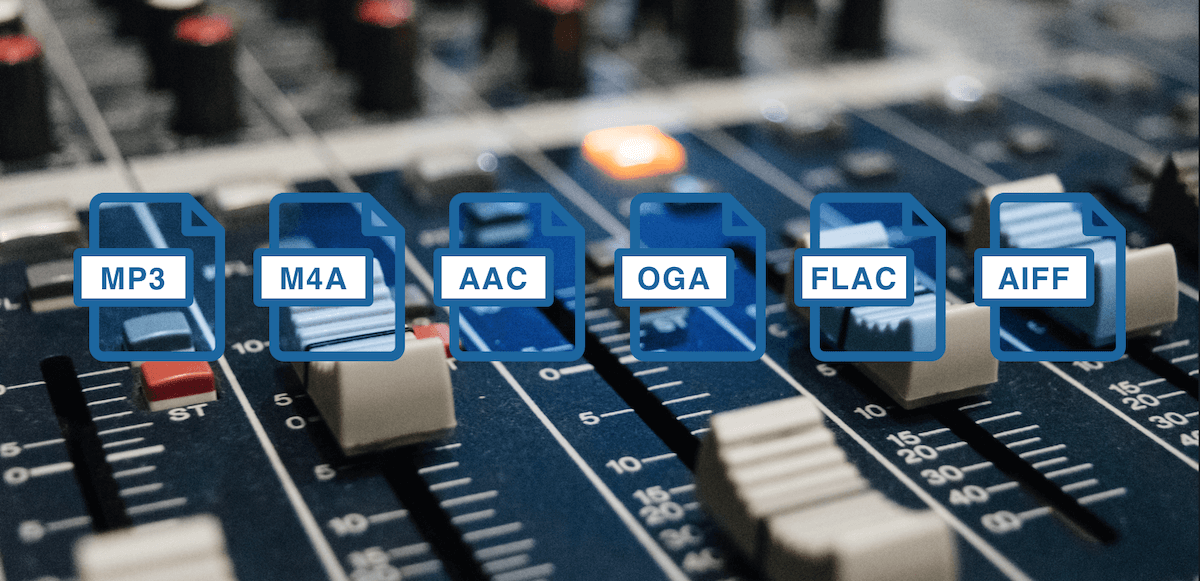
audio formats
audio formats

First of all, divide all types of music files into three parts as follows:

audio formats
audio formats


Uncompressed file formats: .WAV, .AIFF

Lossless compression formats: .FLAC, .ALAC (Apple Lossless)

Destructive compression formats: .MP3, .AAC, .WMA, .OGG

Below are their respective advantages and disadvantages.


1. Uncompressed file format
Uncompressed music files are just like the concept of Raw files. Essentially no compression will of course have the best sound quality. (The sample rate and bit rate of the original recording are also very important. If the compressed music file is converted to an uncompressed file, the music won’t magically improve the sound quality.)

The most common disadvantage of uncompressed files is the file size. Generally, the file size of a song is around 25 ~ 40 MB. While that capacity is no longer an issue for cloud hard drives, it is still an issue for email. Also big (25MB max for Gmail attachments). Also, some portable music players or devices may not be able to play such music files.

Advantages: original sound reproduction, no compression, lossless, easier to use in post production

Disadvantages: large file format, fewer supported devices


2. Lossless compression format
The term “compressed and lossless” seems contradictory, but compression does not necessarily affect sound quality. More precisely, it’s more like “compressed to save space”. It’s like compressing a high quality file into a .ZIP and decompressing it when you want to use it, the quality of the file will not be affected.

Therefore, this type of file has a compressed capacity, but the file will be decompressed during playback to restore sound quality. Although the concept of reducing capacity without affecting sound quality is great, the downside is that support for this format is extremely low and in order to decompress the file during playback, an additional codec is required to use it, and it will. also take some performance.

Advantages: small file capacity (about 1/2 ~ 1/3 lossless files), good sound quality

Disadvantages: Decompression can eat performance when used, and support from hardware or software is extremely low


3. Destructive compression format
The destructive compression format is currently the most common music file format, the main reason is that it has the greatest compatibility with portable devices (mobile phones, MP3 players, etc.), and the files are small and have a space of limited storage. , users can store more music (compressed capacity is about one-tenth of lossless sound quality), and most of the music provided by today’s streaming media is files in this format. There is always a price to pay for smaller files. Compared to lossless formats, this destructive compression will affect the audio range that the original sound can present and will cause some distortion. So, to be safe, keep the compression rate above 320 kbps as much as possible.


Free Download Mp4Gain
picture


Mp4Gain Main Window
picture


Mp4Gain Features
picture


Free Download Mp4Gain
picture

What audio format should I choose?

What audio format should I choose?

Best Audio Format
Everybody loves music. Some listen to it on the way to work, and others can’t go a minute without their favorite songs. Listening to music comfortably depends not only on the mood, the time, the moon phase and good headphones, but also on the audio format in which it is stored on our devices.

Best Audio formats

In the 21st century, streaming services are becoming popular, but most people still store music offline and listen to it from their phones, players, audio systems, etc. But this post is not a discussion “Which headphones are better?”, “Why listen to music?” or “Why vinyl, not CD?”, but a brief summary of today’s most popular digital audio formats, their pros and cons. I will not analyze them all, and I will not compare different encodings, the differences “this AAC from this AAC”, but I will try to count in an accessible way the differences of some popular audio formats from each other.

So what is the best way to store your music collection? Today, there are many digital audio formats, and if you want, you can see a list of them on Wikipedia. But we will focus only on MP3, AAC, WMA and FLAC.

MP3

The most popular audio format and nobody can argue with that. Why is it so popular? It’s simple, because Mp3 was the first audio format with the best ratio (at the time) of file size and quality when compressed. Therefore, most of the songs were translated into MP3, which served as the undisputed primacy of the audio format on the market.

The advantages are clear from the previous paragraph: small size, tolerable compression loss, ubiquity, compatibility with all devices, and also, due to the small size, you can store a large collection of songs on a medium with little memory capacity, which it is also an advantage for some.

But Mp3 also has some disadvantages. Even though compression losses are not visible to ordinary people, knowledgeable people will notice them immediately. This is a low sound quality compared to other audio formats, as well as a “cut” of frequencies above 17 kHz, which is felt by ear with good headphones.

AAC

The young audio format AAC, mainly promoted by Apple, can be considered the successor to Mp3. AAC seems much more advantageous because Compared to MP3, AAC file compression is more efficient. At a bit rate of 128 kbps, an AAC composition is comparable in sound quality to the same MP3 composition at a 192 kbps bit rate.

Better compression quality is a major advantage of AAC. The disadvantage is not the same prevalence as in the same mp3. Some devices do not yet support this format. And also the compositions in AAC take up more space than in MP3. Not as much as FLAC, but still, for some it is a critical factor.

WMA

The WMA format was created by Microsoft as an alternative to Mp3 for Windows users. It was believed that with half the bit rate of MP3, WMA produces similar quality. But, in fact, the composition in WMA at 128 kbps is noticeably lower than that of Mp3. The advantages include full Windows support, but the disadvantage is extremely low quality at a low bit rate. By personal observation, I will say that I have not seen people storing their music in this audio format for a long time.

FLAC

One of the most common audio formats for music lovers in good quality. FLAC compresses the data, leaving it in the output identical to the original, without losing any data, which is the main lossless compression algorithm. Furthermore, decoding the FLAC format does not require as much processor resources, allowing you to listen to music on portable devices.

The advantages of music in FLAC are excellent quality and fast decoding, but a disadvantage, as a result, is the large file size.

So in what audio format should you keep your music collection? If you are not so critical of losses after compression, if you want to make a mistake with the support, so that your collection does not become a bunch of useless files in 5 years, you have a limited amount of memory for your music, then choose Mp3. If free space allows you to store larger files, switch to AAC. I personally don’t recommend WMA. I think this audio format is dead, although most people will not agree with me. And if quality is important to you, you have a good audio system or headphones, and even minimal compression loss is inexcusable for you, then FLAC definitely is. But be prepared for the fact that you must have plenty of room for music.