What is the best digital audio format?


Free Download Mp4Gain
picture

What is the best digital audio format?
What is the best digital audio format?


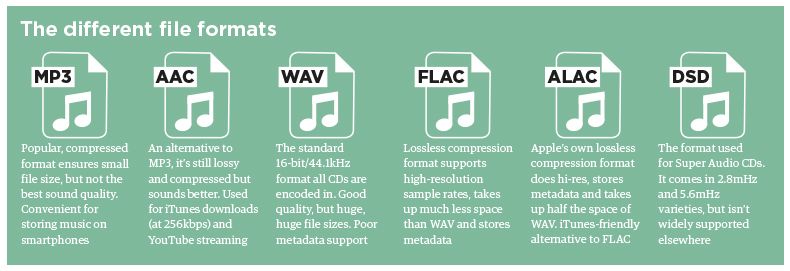
When choosing the best digital audio format, several factors must be taken into account. The most popular digital audio formats are MP3, AAC and WAV.
What is the best digital audio format?

MP3

MP3 is the most commonly used digital audio format. It is a compression format that allows audio information to be compressed without a great loss of quality. It is compatible with most audio players and is very easy to play on most devices.

AAC

AAC is a digital audio format developed by Apple. It offers better sound quality than older digital audio formats like MP3, but with a much smaller file size. This means more songs can be stored on a device without affecting performance.

WAV

WAV is the lossless digital audio format. This means that the original audio file is saved exactly as it was recorded. This means that WAV files are much larger than MP3 or AAC files, which means that more storage space is needed to store the files.

In conclusion, the best digital audio format depends on your needs and preferences. If you need a small file size, MP3 or AAC are good options. If you need the best sound possible, then WAV is the best choice.

What is the digital audio format with the best sound quality?

Currently there are several digital audio formats, each with its own qualities. The most popular formats are FLAC, MP3, AAC, OGG and WMA. But which of these offers the best sound quality?

FLAC (Free Lossless Audio Codec)

FLAC is a lossless audio format that preserves all the characteristics of the original audio without any compression. This means that the audio is reproduced with the highest sound quality, without any loss of quality. Also, FLAC is an open format, so it is compatible with most audio players.

MP3 (Moving Picture Experts Group Layer 3)

MP3 is a compressed audio format used to reduce file sizes. This allows more audio files to be stored and streamed, but also causes a loss of quality. However, if a high bit rate is used, the sound quality of MP3 files can still be very good.

AAC (Advanced Audio Coding)

AAC is a compressed audio format developed by Apple as an alternative to MP3. It has a better compression ratio than MP3, which means smaller audio files with equal or better sound quality. However, as with MP3, the sound quality depends on the bit rate.

OGG (Ogg Vorbis)

OGG is a lossless audio format developed by Xiph.Org. Like FLAC, it does not compress audio, so audio files are played at highest sound quality. Unlike FLAC, however, OGG is a closed format, so it is not supported by all audio players.

WMA (Windows Media Audio)

WMA is a compressed audio format developed by Microsoft. It is compatible with most audio players, but offers lower sound quality than other formats. Also, like MP3 and AAC, the sound quality depends on the bit rate.

Conclusion

Of the five popular digital audio formats, FLAC and OGG offer the best sound quality because they don’t compress the audio. However, MP3, AAC and WMA offer good sound quality if a high bit rate is used. Finally, FLAC is the most widely supported digital audio format, while OGG is the least widely supported.


Free Download Mp4Gain
picture


Mp4Gain Main Window
picture


Mp4Gain Features
picture


Free Download Mp4Gain
picture

Best digital quality audio formats

Best digital quality audio formats

WAV vs MP3

It is often a measure of the quality of a track. There is a lot of debate about which is the best music format. So I recently witnessed a similar dispute. Not virtual, but real. In general, I decided to write an article on audio formats and try to explain in human language which is the best audio format. I’ll try to avoid abstruse terms and feature descriptions, so as not to hurt the brains of readers again.

High quality audio formats

I immediately admit that I am not going to sing praises in honor of any particular audio format, just as I am not going to “disappoint” anyone. Let everyone decide for themselves. I will not go into the “jungle” and review the most famous formats of high quality music.

I believe that these disputes are conducted by people, to put it mildly, not well versed in this matter. Because professionals (that is, people who know what they are doing and why they are doing it) will not do it. With today’s abundance of audio formats, anyone who needs it will find what they need. Agree, a dispute between a tractor driver and a driver about which is better – a tractor or a car will look silly. For some purposes a tractor, for others a machine. Here it is the same.

WAV is rightly considered the highest quality music format. This audio format is not compressed or lossy. Used for recording and processing sound, this is the highest quality sound, as the WAV recording is not compressed. Encoded to any other audio format. Well, as a result, it “weighs” a lot, so it is mainly used for sound recording.

Lossy audio compression

I’ll start with the well-known and widely used (though not always loved) MP3 format. This audio format is actively used everywhere and everywhere, where it is needed and where it is not needed. But this does not mean that it is not worthy of the place it occupies in its niche. Very worthy. Although he has been “sitting” in his niche for about two decades, no one has “kicked” him out of there yet. And there were many who wanted to say it. And the main favorite of them is WMA (Windows Media), which was conceived by Microsoft as an alternative to MP3. As a result, it is an alternative and it is, despite the best efforts of the developers. The next character is OGG. Despite the broader possibilities than MP3, for example, it never received widespread acceptance. Although it is compatible with many operating systems. Perhaps the AAC audio format is worth mentioning, which was supposed to change on the relay. Encoding quality has been improved and compression loss reduced. But Ay.

The main advantage of these formats is their small size. The downside is the loss of quality.

Lossless audio compression
FLAC is perhaps the most popular lossless audio format and encoding codec. Music lovers are gradually switching to this format. WavPack competes with it, but it is not that popular. It’s the same story with Apple Lossless, which reduces the size to 60%.

Here the story is exactly the opposite: the quality is better and the size is greater.

Skeptics say that it is almost impossible to distinguish MP3 (320 kbps) from Losless by ear. “And if there is no difference, why pay more?” In fact, on ordinary equipment, it is quite difficult to feel the difference in audio formats, even for music lovers. But there are those who immediately feel this difference (they personally attended the experiment). But when listening to a good device, the difference is huge. The problem is that not everyone can afford a good device.

Compressed using special lossless audio codecs, it can be restored with absolute precision if desired.

If you take a normal audio CD with analog sound, record it in WAV format for uncompressed sound, then compress WAV using lossless codec, then decompress the resulting sound file into WAV and burn the result to a blank CD, you can get two completely identical audio files COMPACT DISCS.

The advantage of lossless for storing an audio collection is that the quality of the recordings is much higher than that of lossy codecs and they take up less space than uncompressed audio. It is true that lossy files are smaller than lossless music files. Most modern playback programs understand the lossless format. Programs that cannot play it can easily learn it using the lossless plugin. What are lossless audio formats?

About modern audio encoding formats

About modern audio encoding formats

Digital Audio Quality

While MP3 is still the de facto format for compressing music on the computer, there are many other lesser known compression standards. Some of them are outdated and practically unused, some have appeared recently and have not had time to occupy their niche yet. Here I will focus only on formats that use lossy compression, as they allow you to achieve the highest degree of compression of audio data.

Digital audio qualty
What is lossy compression? Only the file encoded in this way and then again decoded into a wave file will be binary different from the original file (i.e. the content of the files will be different), although the difference may be subtle or completely invisible to the ear. How do you manage to achieve such a result? These questions are answered by psychoacoustics (see, for example, a selection of articles from the journal “Sound Engineer” for 1999-2000), a relatively new science that deals with the study of how the human brain perceives sound. The fact is that we do not perceive all the solid information. For example, we can hear footsteps on an asphalt road quite clearly in the absence of strange sounds, but the footsteps themselves are completely inaudible if a passenger car passes. This is the so-called masking effect: a quiet sound becomes completely inaudible if there is a strong sound source nearby. This effect, along with some others, is used in psychoacoustic models of modern codecs. The combination of conventional data compression methods and knowing what information is perceived by our brain and what is not, allows you to achieve a music compression ratio of 1:10 with an acceptable sound quality.

Below I have provided a brief overview of the most common and well-known music file compression formats that could be used to create a home music collection.

Wave file with ADPCM compression

The Microsoft ADPCM (Adaptive Differential Pulse Code Modulation) codec, once popular with hackers who didn’t want to waste time encoding MP3 music, is far from a quality standard. To reduce the file size, it was necessary to create wave files of eight or even four bits with a sample rate of 22 KHz, which gave a very weak result. And if an MP3 file with a fixed 128 Kb / s bit rate sounds more or less bearable (and ideal for some listeners), then a wave file of the same size compressed with the ADPCM codec sounds just awful.

ADPCM uses a very simple compression algorithm that provides high encoding speed on slower computers, but is completely inapplicable for storing music. The extremely low sound quality with an acceptable compression ratio led to the fact that at this time this codec is hardly ever used to compress music. The exception is computer games, whose creators often use ADPCM WAV files to store soundtracks.

MP3

MPEG (from the Motion Picture Expert Group) 1 Layer III (less often MPEG 2 Layer III), also known as incompetent people MPEG 3 (there is no such format) has for many years been the only association with the phrase “computer music” . Developed in the late 1980s, without requiring resources (playing MP3 files is possible even on computers with 486 processors), the format that allowed music to be compressed up to 10 times without catastrophic loss of quality quickly took root in computers. domestic. Although until recently most encoders were paid, it is now easy to find players and encoders distributed under the free software license. After a while, it became clear that “CD quality” at 128 Kb / s bit rate is impossible,
how equipping computers with more sophisticated sound cards and acoustic systems made it possible to identify the shortcomings of such encoding. Increasing the bitrate and improving the codecs became quite natural: VBR and Joint Stereo (combined stereo) technologies made it possible to significantly reduce file size while increasing quality. Modern encoders allow you to achieve sound quality, audibly indistinguishable from a CD at bit rates in the 192-256 Kb / s range, even on high-quality equipment. However, in some rare cases (in the presence of good hearing and equipment) even the 320 Kb / s bit rate is not enough.