What are lossless file formats


Free Download Mp4Gain
picture

Whether it is image, music or video files, it is important to understand the difference between different types of formats and when to use them. Using the wrong format can ruin the quality of a file or make the file size unnecessarily large.
file audio differenze

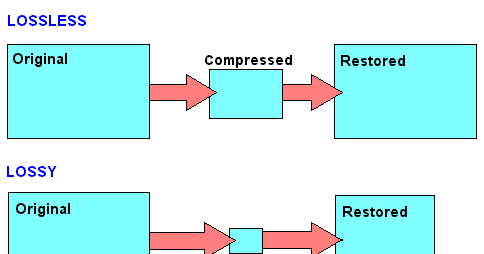
Some types of media file formats are “lossy” and some types “lossless”. We will explain what these terms mean for the benefits of each type of file format and why you should never convert lossy to lossless formats.

Compression explained.

We use compression to make files smaller so they can retrieve faster and take up less storage space. For example, when you take a photo, your camera captures all the light you can get and collects an image. If you save the image in RAW format, which retains all the clear data that the camera sensor receives, the image can reach 25 MB. (Depending on image resolution: A multi-megapixel camera provides a larger image.)

comprimere i-grandi-audio

If we upload these files to a social network or put them on a website, we don’t want these image files to take up so much space. A photo gallery with RAW images could take hundreds of megabytes of space. RAW formats can be used by professional photographers to maintain high image quality during the editing process, but they are not intended for the average person.

Instead, our camera or smartphone converts the image into a JPEG file. JPEG files are much, much smaller than RAW images. When you convert RAW to JPEG, some of the image data is “discarded”, which produces a much smaller file. The conversion process uses a compression algorithm that works well for photos, so they can look pretty good despite compression. You can still see compression elements, depending on the quality settings.

Note that lost formats generally have a setting that controls their loss. For example, JPEG has a variable quality setting. Low quality produces a smaller JPEG image file, but the image quality is significantly poorer. Below is a close-up example of a lost JPEG: various “compression artifacts” can be seen.

We call RAW a “lossless” format because it retains all the original data in the file, while we call JPEG a “lost” format because some data is lost when we convert an image to JPEG. However, these are not the only design and loss-free formats.

Images: RAW, BMP and PNG are all image formats without data loss. JPEG and WebP are lost image formats.
Audio: WAV is a container file that is often used to contain lossless audio, although it is also capable of containing lost sound. FLAC is a lossless audio format, while MP3 is a lossless audio format.
Video: Consumers use few lossless video formats as they involve video files taking up a large amount of space. Common formats like H.264 and H.265 are all lost. H.264 and H.265 can deliver smaller files with higher quality than previous generations of video codecs because it has a “smarter” algorithm that is better at choosing which data to discard.
Some of these lossless formats also provide compression. For example, a WAV file generally contains uncompressed audio and takes up little space. A FLAC file may contain the same lossless sound as a WAV file, but it uses compression to continue creating a smaller file. Formats like FLAC provide no data: they store all data and compress them intelligently, just like ZIP archives. However, they are still much larger in size than MP3s that throw a lot of data.

A conversion can be a loss, even between formats without data loss. For a conversion to be effectively lossless, the data in the original file must fit within the destination file. For example, loss without FLAC files only supports 24-bit audio. If you converted a WAV file containing 32-bit PCM audio to FLAC, the conversion process must generate some data. The conversion process between a WAV file containing 24-bit PCM audio in FLAC would be lossless.


Free Download Mp4Gain
picture


Mp4Gain Main Window
picture


Mp4Gain Features
picture


Free Download Mp4Gain
picture

Lossless audio formatsĀ 

WAV (.wav) The WAV format is nothing more than a digital recording of real sounds, sounds that come from a source outside the PC. With WAV music, drums, piano, guitar, bass or vocals are heard the same, no matter what computer the file is played on (with the same acoustic quality of hardware components, of course).

wav

DSD (DFF, .Dsf) are used in digital media such as Super Audio CDs. Sampling quality is very high (variable sampling rate is approximately 64 times higher than for audio CDs), although according to several operators in this sector, it must be absolutely determined whether the final quality is higher than the sampling quality. PCM (used in high quality Blu-Ray and DVD Audio). I can reproduce free readers like Foobar 2000 or AIMP on our computer.

AIFF (.aif). It’s the Apple audio format used by Apple for Mac. It’s basically the WAV equivalent used by Windows.

APE (Mono Audio; .ape): Ordinary with a loss that allows us to reduce by about 50% the space occupied by our music (in some cases even more), without losing quality. In this way, an album that takes up about 600 MB in wav format averages 300 MB (much more than about 100 MB of high-speed mpc and 60 mp3 mp3, but the quality is the same as the original); On average, I speak because there are certain types of music where the level of compression is even higher. You can use WinAmp plug-ins to listen to songs in this format, or better yet, a player that uses it natively as Foobar 2000. Right now, it’s probably the best lossless codec, considering the balance between speed and compression (Click here for a lossless comparison table) format.)

Apple Lossless Audio Codec – ALAC (.m4a) This is a lossless audio codec created by Apple a few years ago and available as an open source from Apple since October 2011. Some programs support it in Windows (encoded). , including DbPowerAmp.

FLAC (.flac): a very popular open source format. It used to be very popular (among music purists), but some space has been lost with the MonkeyAudio bee format, which allows for better compression in the same quality. Compared to others, it always came in .ape format (but also after WavPack).


LA (Lossless Audio: .la): The lossless format that compresses the most. Conversion to this format is very slow, but achieves the best compression in history (for example, MonkeyAudio, this album would take up about 290 MB compared to 300 MB in APE). This is not widespread, as some MB obtained on a bee is not worth the long wait (and less support from third-party programs), but it is the winner of my lossless format comparison.flac

OPTIM FROG (.ofr) – Excellent lossless codec, best after LA as compressibility. Compression, when set to slightly high levels, is about 3 times slower than Monkey Audio and the gain in MB is about 2%. Like all other formats on this site, you can listen without the addition of Foobar 2000.

WAVPACK (.wv, wvc) – is a valid open source compression format that allows lossless, lossy and hybrid results. The compression rate is high and the compression is good. Another interesting hybrid format is that the lossy file is merged with another file, which allows you to completely restore the original file without loss in case we want to restore it.

What are the most popular audio formats?

What are the most popular audio formats?

There are dozens of audio files that we can use to convert a song, but the really useful ones can be counted on the fingers of one hand.

losseless

When we think of an audio file, most of us immediately think of MP3. Without a doubt, it’s one of the most popular audio formats, but it’s not the only one. Let’s see what are the most popular audio formats and what are the differences in use. And we have to choose that according to our needs.

There are different categories of audio files. First we defined the formats as uncompressed. The word itself defines this section of the file. In this case, the recorded sound waves are actually converted into a digital format without further processing. What does it all mean? In files that are very difficult to save and take up a lot of space. In order to simplify the storage of audio files and to reduce the load, formats with lossy data compression were created. These sacrifice some quality in favor of the small storage space required.

losseless

To fix this error, which represents the loss of quality in favor of file size, compressed audio formats were created without loss of data. Obviously, they’re not small files like lossy compression, but they’re still smaller than uncompressed. However, it must be said that these types of formats are only widespread in certain cases.

PCM

PCM is the most common and widely used audio format on CDs and DVDs that we have at home. It is the faithful conversion of analog audio into a digital file. It is no coincidence that it is an uncompressed audio format. Remember that analog sounds exist as waveforms. In order to convert a sound wave into digital bits, the sound must be sampled and recorded at certain intervals.

WAV

WAV stands for Waveform Audio File Format (previously it was also called Audio for Windows, now it is no longer). It is a standard developed by Microsoft and IBM in 1991. WAV files can contain compressed and uncompressed audio formats. In most cases, however, they are used for uncompressed people. Although it was developed for Windows, it can also be safely opened on a Mac.

MP3

This is without a doubt the most popular audio format. It was released in 1993 and over the years its success has increased thanks to the combination with the pieces of music. Why are they used so often? Quite simply, these are lossy compressed files, and the generated files are so small that users can create a music library without taking up too much space. And the quality? It is much lower than other formats, but the human ear doesn’t always manage to notice the difference significantly. MP3 is also a universal file. It can be found on smartphones, computers, smart TVs, tablets and many other electronic devices.

WMA

WMA stands for Windows Media Audio. It was first published in 1999 and has gone through several developments since then, always keeping the same name. As you can easily guess, it is an audio format created by Microsoft. It was developed to replace MP3s. Unfortunately, there are very few platforms that support this, so the MP3 mastery has never been compromised.

OGG

OGG is not a real compression audio format. We can define it as a multi-purpose multimedia container. It can contain all types of audio formats, but is often used to contain Vorbis files. It is one of the best performing files to reduce size without losing quality.

FLAC

FLAC stands for Free Codec Lossless Audio. It is a lossless, compressed format that was created in 2001. A FLAC file can be compressed to 60% of its original size without minimal loss of sound quality. It is also an open source format. Because of this, it is compatible with most programs and devices. It is the best quality alternative to MP3.

Better audio formats

audio formats

You have decided to digitize the music tracks in your audio CD collection by transferring everything to your computer, and in doing so you have begun to evaluate the possibility of converting them to a more pleasant format for you. However, having little experience in this regard, you would like to receive some advice on the subject so that you can make the best decision. How to say Things are exactly this way and would you like to know if I can help you by indicating what are the best audio formats? Of course yes, that was exactly what he intended to do.

If you allow me a few minutes of your free time, I can actually tell you, by thread and by sign, what are the most popular audio formats in circulation, their strengths and weaknesses and for what uses they may be more or less convenient to contact . condition to opt for those that you think may actually be right for you. To complete the information and to give you an even more complete description of the matter, at the end of the article it will also be my concern to indicate what tools you can use to perform various conversion operations. You will see that after reading this guide, you will no longer have any doubts about what to do.

So? How about putting the talk aside and finally getting to the heart of the matter? You? Brilliant! Therefore, I suggest not wasting any more time and immediately start focusing on the topic. Get comfortable in front of your trusted computer and read everything below. I am sure you can say that you are happy and satisfied with what you have learned. I wish you, as always, happy reading.

What is the best audio format?

What is the best audio format?

Many are known, but there is always the question of what is the best audio format. The main and most recognized for listening to music are MP3, Wav, FLAC and Ogg.

But, to choose the best audio format, you must first know that they have several conformations, and you can always choose the best. Music always goes everywhere, at home in front of the computer, in a living room with a hi-fi system, with headphones on public transport or when playing a sport. Music that gives a special meaning at all times and that encourages listening.

best audio format

There are many ways to take advantage of it, but this is usually done in digital format. In audio files, there is a wide variety and normally many still use MP3 for convenience. But there are less popular alternatives that seek to provide a different, better experience. For those who do not know it, there are a number of main sound systems.

The best audio format

Beyond the fact that the MP3 format is the most popular of all the audio formats available, it is not the only one. Some others like “FLAC”, “WMA”, “OGG” have certain characteristics which, depending on what you want, can be very useful on certain occasions.

In technology, audio formats can generally be classified into 2 categories. There are those which preserve all the quality and those which involve losses of quality of the sound or information.

Those that preserve the quality of the audio are those that come from pure sources such as CDs. This is how those who lose quality and sacrifice this information must save space.

Audio quality formats

“FLAC” is a lossless audio codec or “FLAC”. It is one of the formats that best preserves audio quality and its compression algorithm is excellent. It is open source, does not generate quality losses and the file size because it is compressed, is much smaller.

best audio format
lossless

Apple Lossless is known as “ALAC” and is very similar to “FLAC”. The difference is that it is not as efficient, so these files are larger, although they still have unconditional support for iOS, which “FLAC” does not.

“APE” is another and although the problem with this format is that it is not compatible with the vast majority of players, it is considered to be similar to the “FLAC” or “ALAC” format in terms of audio quality. . As it is highly compressed, it accelerates the functioning of the computer’s processor and it is therefore not recommended to use it in low-consumption computer equipment.

“WAV” and “AIFF” are not compression formats, but rather exact copies of the original content and differ in the way they record the data. “AIFF” was created by Apple and “WAV” is more universal, but both have too much disk space.

Formats with loss of audio quality

MP3, MPEG Audio Layer III or MP3, as many people already know, is the most common format that can be found. “ACC” is very popular on iTunes and is considered more efficient than MP3 because files in this format are smaller.

OGG Vorbis is one of the free and open source alternatives to MP3 and ACC. It is not limited by patents, but it is also not supported by many players. WMA is Microsoft’s proprietary format and is very similar to MP3, but without much advantage over the others.

best audio formats

Which audio format to choose?

The most recommended is “MP3” or “AAC” because many players support it. In addition, if they are encoded with a high bit rate, they can hardly be distinguished from the original source. However, if you want to burn music, formats like “FLAC” are recommended, because you can then convert everything to other formats without losing audio quality.

Once the audio formats are known, when choosing, the differences between each must be taken into account. In general, what the experts recommend is to use “MP3” or “AAC” as they are compatible with most players and the quality of both is very similar to that of the original source, especially if it is encoded with a high bit rate. Unless you have a specific need, “MP3” and “AAC” are the most recommended options.

However, one thing to know is that to store music in lossless formats, there is no “FLAC”. You probably won’t notice any higher quality, but it’s good for storing music if you plan to convert it to other formats later. In these cases, “FLAC” is always recommended, and it is also possible to choose the format without loss or degradation of quality

What is the best audio format?

What is the best audio format?

Many are known, but there is always the question of which is the best audio format. The main and most recognized for listening to music are MP3, Wav, FLAC and Ogg.

But, to choose the best audio format, you must first know that they have multiple conformations, and you can always choose the best one. Music always goes everywhere, at home in front of the computer, in a living room with a hi-fi system, with headphones on public transport or when playing sports. Music that gives a special meaning to each moment and that encourages when heard.

There are many ways to enjoy it, but it is usually always done in digital format. Within the audio files, there is a great variety and normally many still use MP3 for convenience. But there are alternatives that are less popular and that seek to offer a different and higher quality experience. For those who do not know it, there are a number of main sound systems.

The best audio format

Beyond that the MP3 format is the most popular of all available audio formats, it is not the only one. Some others like “FLAC”, “WMA”, “OGG” have certain characteristics that, depending on what you want, can be very useful on certain occasions.

In technology, audio formats can generally be classified into 2 categories. There are those that retain all the quality and those that lead to quality losses in sound or information.

Those that preserve the quality of the audio are those that come from pure sources such as CDs. This is how those who lose quality and sacrifice this information are to save space.

Formats that preserve audio quality

“FLAC” is Free Lossless Audio Codec or “FLAC”. It is one of the formats that best preserves the audio quality and its compression algorithm is excellent. It is open source, does not generate quality losses and the size of the file because it is compressed, is much smaller.

Apple Lossless is known as “ALAC” and is very similar to “FLAC”. The difference is that it is not as efficient, so these files are larger, although they still have the unconditional support of iOS, something that ā€œFLACā€ does not have.

“APE” is another and although the problem with this format is that it is not compatible with the vast majority of players, it is considered similar to the “FLAC” or “ALAC” format in terms of audio quality. As it is highly compressed, it makes the computer’s processor work faster and therefore it is not recommended to use it in low-power computing equipment.

“WAV” and “AIFF” are not compression formats, but rather exact copies of the original content and differ in the way they save data. “AIFF” was created by Apple and “WAV” is more universal, but both have too much disk space.

Formats with loss of audio quality

MP3, MPEG Audio Layer III or MP3, as many already know them, is the most common format that can be found. “ACC” is very popular on iTunes and is considered more efficient than MP3 since files in this format are smaller.

OGG Vorbis is one of the free and open source alternatives to MP3 and ACC. It is not restricted by patents, but it is also not supported by many players. WMA is Microsoft’s proprietary format and is very similar to MP3, but without great advantages over the others.

Which audio format to choose?

The one that is most recommended to choose is the “MP3” or “AAC”, since many players support them. Furthermore, if they are encoded with a high bitrate, they can hardly be distinguished from the original source. However, if what you want is to burn the music, formats such as “FLAC” are recommended, because then you can convert everything to other formats, without losing the audio quality.

Once the audio formats are known, when choosing, the differences between each one must be taken into account. In general, what experts recommend is to use “MP3” or “AAC” since they are compatible with most players and the quality of both is very similar to that of the original source, especially if it is encoded with a high bit rate. Unless you have a specific need, “MP3” and “AAC” are the most advisable options.

However, one thing to know is that to store music in lossless formats, there is no such thing as ā€œFLACā€. You probably won’t notice a higher quality, but it’s good for storing music if you plan to convert it to other formats later. In these cases, ā€œFLACā€ is always recommended, and it is also possible to choose the format without loss or degradation of file quality.

As a final conclusion, it can be said that you should not be obsessed with the subject, but you just have to be sure of what you want and choose.

What is the best audio format for listening to music?

What is the best audio format for listening to music?

Although the MP3 format is the most popular of all available audio formats, it is not the only one, some such as FLAC, WMA, OGG and others, have features that, depending on what you want, can be very useful in certain occasions

Here I show you a summary of what to expect when you are looking for the best audio format to listen to music.

As a general rule, we can classify audio formats into two categories: those that retain all quality and those that lead to loss of quality in sound or information.

Those who retain all audio quality come from pure sources such as CDs, while those who lose quality sacrifice this information to save space.

Formats that preserve audio quality:

FLAC: Free Lossless Audio Codec or FLAC, for its acronym in English, is one of the formats that best preserves audio quality. Its compression algorithm is excellent and does not generate quality losses, it is open source and the file size when compressed is much smaller
Apple Lossless: known as ALAC is very similar to FLAC, but not as efficient as this, so these files are larger, although they have the unconditional support of iOS, which FLAC does not have

APE: The problem with this format is that it is not very compatible with the vast majority of players, but it is similar to the FLAC or ALAC format in terms of audio quality. Being very compressed makes the computer’s processor work faster so it is not recommended in low power computing equipment
WAV and AIFF: they are not compression formats, but exact copies of the original content, differing in the way they save the data. While AIFF was created by Apple, WAV is more universal, but both take too much disk space.

Formats with loss of audio quality:

MP3: MPEG Audio Layer III or MP3, as we all know them, is the most common format you can find
ACC: is more efficient than MP3, files in this format are smaller and is very popular on iTunes
OGG Vorbis: it is a free and open source alternative to MP3 and ACC, it is not restricted by patents but not supported by many players
WMA: this is the proprietary format of Microsoft very similar to MP3, without great advantages over the others
Which audio format to choose
You may be interested: Ā«It’s proven: classical music modifies your genes and makes you smarterĀ»
It is more recommended to choose MP3 or AAC, since many players support them, in addition, if they are encoded with a high bitrate they are almost indistinguishable from the original source. However, if what you want is to burn your music, I recommend formats like FLAC, then you can convert everything to other formats without losing audio quality.

Encoding digital audio with a loseless format?

Compressing a digital audio with loss is to reduce the size of an audio file.

Codecs are used to reduce the size of the files. Some of the operations that codecs can perform to reduce file sizes are as follows:

Reduce the bit rate of the original sound so that the audio takes up less space.
Remove sounds at frequencies that are not noticeable by the human ear.
Elimination of redundancies of the audio signal.
They can reduce the number of existing channels by transforming a surround sound to Stereo.
Reduce the number of bits per sample.
Etc.
Note: The compression process of an audio is extremely complex. In addition, each codec applies different methodologies to compress the size of an audio.

Obviously during the compression process there will be a loss in audio quality. The higher the weight reduction of the compressed file, the higher the loss of quality.

UTILITIES THAT YOU HAVE TO COMPRESS AN AUDIO

Obviously compressing an audio has certain utilities. Some of them are as detailed below:

The space needed to store the songs on our hard drive will be much smaller. Although hard drives are cheap and their storage capacity is large, it is not feasible and / or practical to store all of our songs without loss.
We can pass the audio files to third parties in a much more convenient and fast way. After compressing a music song we can pass it by email or other means without any problem.
It seems that the trend in the very near future will be to consume video and audio via streaming. Therefore the compression of video and audio is very important. If we offer a web service in which we provide streaming audio, it is essential to compress the audio to save bandwidth and so that customers can play it at home without problems.

Select the compressed audio file format

There are numerous types of compressed file format with loss. Some of the most popular are the following:

.mp3
.ogg
.wma
.m4a
.aac
Depending on the needs, it may be useful to select one format or another.

However in my case I recommend using the mp3 or ogg file format. The reasons are as follows:

The .mp3 files do not stand out for providing the best audio quality. However, the .mp3 format is the most universally extended.
Any music player is capable of playing the .mp3 file format. You cannot say the same of the other file formats.
Everyone is able to play audio in .mp3 format. Even people with little knowledge technologically speaking.
If someone does not want to use the .mp3 format because they think the quality is not enough, or because it is a proprietary format, I recommend using .ogg. In the following link you can find the advantages and disadvantages of the .ogg files with respect to the .mp3 files.
Select the audio compression codec (encoder)

Once the file format is selected we must be aware of the codec that we will use to perform the audio compression.

In the case that we want to compress in the .mp3 file format there are the following codecs:

FHC: It’s the first codec that existed. At present this codec has become obsolete. Its compression time is very high and does not support variable bit rate.

Xing: It is the fastest encoder and allows you to obtain files with a variable bit rate (VBR). However, the quality level offered by this type of encoder is lower than Blade and Lame.

Blade: Until Lame’s appearance was the best option. It is slightly slower than Xing, but the quality levels obtained are much better. Currently this host has a problem and it does not support variable bit rates.

Lame: It is available under the GNU license and is also the best host available today. It supports variable bit rates, is fast and the quality obtained is better than in the rest of the encoders.