Principles of Quality Audio


Free Download Mp4Gain
picture

Principles of Quality Audio

Quality Audio
Quality Audio
Quality Audio
Quality Audio

Introduction

Audio is an important part of our lives. We listen to music, watch movies, and play games with audio. Good quality audio can make these experiences more enjoyable. In this article, we will discuss the principles of quality audio.

What is quality audio?

Quality audio is audio that is clear, natural, and engaging. It has a wide frequency range, good dynamic range, and low noise levels. Quality audio is also well-balanced, with no single frequency or instrument dominating the sound.

How to achieve quality audio

There are a number of factors that contribute to quality audio. These include:

  • The quality of the recording equipment.
  • The skill of the recording engineer.
  • The quality of the playback equipment.
  • The listening environment.

Recording equipment

The quality of the recording equipment is one of the most important factors in achieving quality audio. Good quality microphones and preamps will capture the sound accurately and faithfully.

Recording engineer

The skill of the recording engineer is also important. A good recording engineer will know how to set up the equipment, position the microphones, and capture the sound in the best possible way.

Playback equipment

The quality of the playback equipment is also important. Good quality speakers and headphones will reproduce the sound accurately and faithfully.

Listening environment

The listening environment can also affect the quality of the audio. A good listening environment is quiet and free from distractions. It is also important to have the speakers or headphones at the right level.

Conclusion

Quality audio is important for a number of reasons. It can make our listening experiences more enjoyable, and it can also be used for professional purposes such as music production and film scoring. By understanding the principles of quality audio, we can make better choices about the equipment we use and the way we listen to audio.

8 Subtitles

Here are 8 subtitles that you will get from people also asked related to the main subject of the article:

  1. What is quality audio?
  2. How to achieve quality audio?
  3. What are the benefits of quality audio?
  4. What are the most important factors in achieving quality audio?
  5. What are some tips for recording quality audio?
  6. What are some tips for listening to quality audio?
  7. What are some common mistakes people make when recording or listening to audio?
  8. How can I improve the quality of my audio recordings?

Benefits of quality audio

There are a number of benefits to quality audio. These include:

  • Improved clarity and naturalness of sound.
  • Increased realism and engagement.
  • Enhanced emotional impact.
  • Improved productivity and focus.
  • Reduced stress and fatigue.
  • Increased enjoyment.

Most important factors in achieving quality audio

The most important factors in achieving quality audio are:

  • The quality of the recording equipment.
  • The skill of the recording engineer.
  • The quality of the playback equipment.
  • The listening environment.

Tips for recording quality audio

Here are some tips for recording quality audio:

  • Use good quality microphones and preamps.
  • Position the microphones correctly.
  • Capture the sound in the best possible environment.
  • Avoid noise.
  • Use the right recording software.
  • Edit the audio carefully.

Tips for listening to quality audio

Here are some tips for listening to quality audio:

  • Use good quality speakers or headphones.
  • Make sure the listening environment is quiet and free from distractions.
  • Set the volume to the right level.
  • Listen actively and pay attention to the details of the sound.

Common mistakes people make when recording or listening to audio

Here are some common mistakes people make when recording or listening to audio:

  • Using poor quality equipment.
  • Not positioning the microphones correctly.
  • Recording in a noisy environment.
  • Not editing the audio carefully.
  • Listening to audio on poor quality speakers or headphones.
  • Not paying attention to the details of the sound.

How to improve the quality of your audio recordings

Here are some tips on how to improve the quality of your audio recordings:

  • Invest in good quality equipment.
  • Learn how to use the equipment correctly.
  • Practice recording in different environments.
  • Edit your audio carefully.
  • Get feedback from others.

Free Download Mp4Gain
picture


Mp4Gain Main Window
picture


Mp4Gain Features
picture


Free Download Mp4Gain
picture

The Quality of MP4 Audio

The Quality of MP4 Audio

The Quality of MP4 Audio

Videos are a fun way to share your memories and special moments. However, in order for your videos to sound good, it is important to pay attention to the quality of the audio. Have you ever listened to a video with poor and distorted audio? That’s no fun for anyone.

The Quality of MP4 Audio

In this article, we will explain in a simple and fun way how to make sure that the audio quality in your MP4 videos is the best.

What is MP4 audio?

MP4 audio is simply the sound you hear in an MP4 video. Like video, audio is compressed and saved as an MP4 file.

Audio Quality

Audio quality is measured in bits and samples. The higher the number of bits and samples, the better the audio quality. For example, an audio file with 128 bits and 44.1 samples per second will have better quality than an audio file with 64 bits and 22.05 samples per second.

Improving Audio Quality

There are several ways to improve the audio quality in your MP4 videos. One of the best is to use a program called Mp4Gain. This program allows you to adjust the audio quality in your MP4 videos to make them sound better.

Another way to improve the audio quality in your MP4 videos is to make sure you use a good microphone. A quality microphone will help you record crisp, clear audio in your videos.

Conclusion

In conclusion, to make sure that the audio quality in your MP4 videos is the best, it is important to pay attention to the audio quality and use a program like Mp4Gain. With these simple tips, your MP4 videos will sound better than ever.

What are the advantages of the lossless audio format?

What are the advantages of the lossless audio format?

Lossless and Lossy Audio Files

The advantage of lossless for storing an audio collection is that the quality of the recordings is much higher than that of lossy codecs and they take up less space than uncompressed audio. It is true that lossy files are smaller than lossless music files. Most modern playback programs understand the lossless format. Programs that cannot play it can easily learn it using the lossless plugin. What are lossless audio formats?

Lossless audio

Lossless audio formats
A true music lover is unlikely to be satisfied with the sound of music recorded in Ogg Vorbis or MP3 compression formats. Of course, if you listen to audio recordings on home audio equipment, sound defects cannot be heard with your ear, but if you try to play a compressed file on high-quality Hi-Fi equipment, you will immediately find the sound defects. . Of course, creating a collection of quality music on CD or vinyl is not easy. There is a reasonable alternative to this path for lovers of high-quality sound – lossless music. It can be stored on a PC in a way that allows you to keep your music’s original settings unchanged, even if compression is applied. In this way it simultaneously solves the problems of high-quality music and its compact storage, since audio equipment for listening (headphones, speakers, amplifiers) is quite affordable.

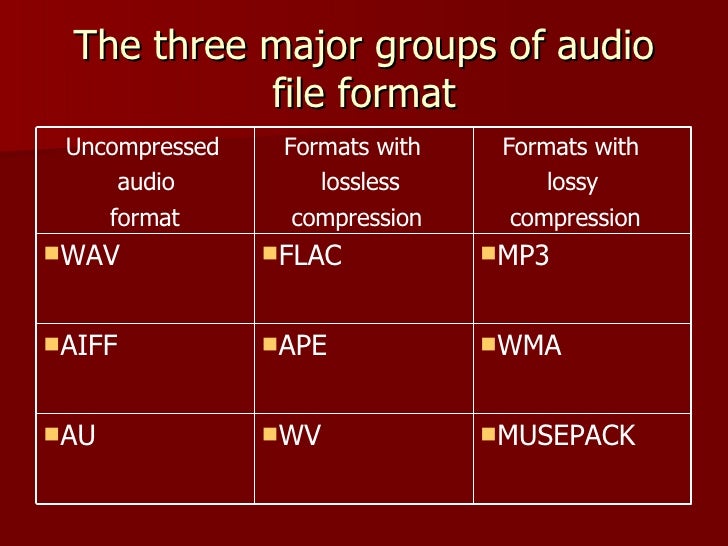
Uncompressed lossless audio formats:

CDDA is an audio CD standard;
WAV: Microsoft Wave;
IFF-8SVX;
IFF-16SV;
AIFF;
Compressed formats:

FLAC;
APE – Monkey’s Audio;
M4A – Apple Lossless – Apple’s high-quality music format;
WV – WavPack;
WMA: Windows Media Audio 9;
TTA – True Audio.

FLAC format
The most common format is the. It differs from lossy audio codecs in that no data is removed from the audio stream when it is used. This makes it possible to use it successfully to play music on Hi-Fi and Hi-End equipment, as well as to create an archive from a collection of audio recordings.

The great advantage of the format is its free distribution. This is important for musicians who record music on their own. The format has gained a lot of popularity recently, thanks to which its support is included in the vast majority of multimedia players.

APE format
Unlike FLAC, for the APE format there are only codecs and plugins for the Windows platform. For other platforms, there are expensive third-party software solutions. The algorithm is capable of achieving lossless compression of audio information between 1.5 and 2 times. It includes three main stages of encoding, of which only one is based on the use of inherent properties of sound for compression. The rest are similar to conventional filing cabinets. Even though the compression algorithm is distributed free of charge, the licensing restrictions are such that it is practically inaccessible to amateur musicians.

Apple Lossless Format
You can listen to high-quality lossless music using the audio compression codec without sacrificing Apple quality. This format was developed by Apple for use on its own devices. The format is compatible with iPods with special dock connectors and the latest firmware. The format does not use specific rights management (DRM) tools, but the container format contains such capabilities. It also supports QuickTime and is included as a feature in iTunes.

The format is part of the free access libraries, which allows you to organize listening to files in Windows applications. In 2011, Apple released the source codes for the format, opening up broad prospects for the codec. In the future, it can seriously compete with other formats. The tests yielded good results. Compressed files vary in size between 40-60% of the originals. The decoding speed is also impressive, which justifies its use for mobile devices, whose performance is not high.

One of the disadvantages of the codec is that the extension of the audio files matches the audio codec, leading to confusion because AAC is not a high-quality music format. Therefore, it was decided to store the data in an MP4 container with the extension .m4a.

Lossless audio formats

Lossless audio formats

Lossless audio

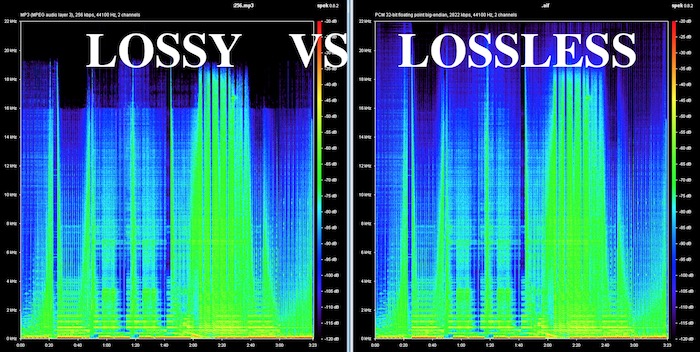
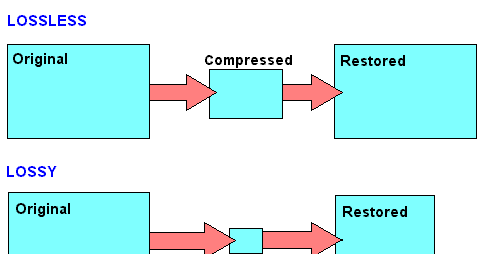
Audio files can be converted in a more or less space saving way using lossless or lossy codecs. While the data reduction is absolutely true to the original with lossless codecs, a difference can be heard from the original material, especially with heavy compression with lossy codecs.

Lossless compressed audio files lose approximately 25% to 50% of their original file size. Typical representatives are Monkey’s Audio, FLAC, or WavPack. Modern lossy codecs like AAC, Ogg Vorbis, or MP3, on the other hand, reduce source material by 90% without sounding noticeably worse.

Lossless audio compression

Unlike documents or images, for example, audio files are very difficult to compress, since identical repetitions are very rare in music. But it is precisely on such occurrences that the Huffmann or Lempel-Ziv algorithms depend, which are used in ZIP or RAR, for example. Therefore, most non-clustered compressors employ predictive coding. The signal is divided into a music component and a noise component. Depending on how well this prediction has been made, the noise component should ideally be Gaussian white noise that can be easily compressed using conventional methods.
In the ideal case, the result is 50% compression, which is highly dependent on the piece of music.

Monkey’s Audio, FLAC and WavPack are popular formats for lossless compression of WAV (PCM) files, for example digitized original recordings from the recording studio (for archiving or later processing) or archiving copies of music CDs. The sound quality is always the same as the original and the checksums reveal corrupted files. Increasing hard drive capacity at affordable prices makes “Lossless Codecs” interesting for everyday use.

Uncompressed: WAV (PCM)

WAV is the largest common denominator of Windows audio formats. The Macintosh equivalent is called AIFF. WAV is actually the collective term for various subformats, of which PCM is the most common and is generally equated with WAV.

WAV (PCM) is an uncompressed recording of sound samples: the time signal of a noise is sampled, quantized, digitized, and saved at discrete points in time. The more often and finer you record these values, the better the sound. With CD quality music, this instantaneous value is recorded 44,100 times per second and recorded with 16-bit “precision”, that is, 2 ^ 16 = 65536 possible values.

With the help of special programs (eg CDex, EAC, Audiograbber), Audio CDs can be transferred to the hard disk as WAV (PCM) files. Viewed in this way, WAV (PCM) files are copies of the original, provided the CD-ROM drive is not read incorrectly or the CD is damaged. One minute at CD quality requires roughly 10MB of storage space, which is not as happy to give away even in the age of ever-larger hard drives.

On the PC, WAV (PCM) and CD-quality (44.1 kHz, 16-bit, stereo) audio files are often the starting material for creating space-saving audio files in formats such as MP3. However, for sound processing on the home PC, WAV (PCM) is the first choice.

Monkey’s Audio

Monkey’s Audio is a lossless audio codec for PCM wave files. Monkey’s Audio comes with a convenient program interface (in English), over which files can be compressed, decompressed, verified or tagged. PCM wave files (any sample rate, 8/16/24 bit, mono or stereo) or corresponding Shorten or WavPack files are accepted as source files. Monkey’s Audio does not support multiple channels.

The APE tags that are used to store the title information can be supplemented with their own fields and are therefore very flexible. They are now used in conjunction with other audio formats as well.

The included command line encoder allows integration into other programs. Various audio players support the format through plugins. A plug-in for Winamp can be installed at the same time as installation. Monkey’s Audio is a Windows program by default. However, there is a platform independent version of Java.

FLAC

FLAC stands for “Free Lossless Audio Codec”. There are several lossless audio codecs available. FLAC is suitable here for several reasons: FLAC follows the open source philosophy (free open source code, available for many operating systems), works very fast, has a good and secure framework structure.

What are the most popular audio formats?

What are the most popular audio formats?

There are dozens of audio files that we can use to convert a song, but the really useful ones can be counted on the fingers of one hand.

losseless

When we think of an audio file, most of us immediately think of MP3. Without a doubt, it’s one of the most popular audio formats, but it’s not the only one. Let’s see what are the most popular audio formats and what are the differences in use. And we have to choose that according to our needs.

There are different categories of audio files. First we defined the formats as uncompressed. The word itself defines this section of the file. In this case, the recorded sound waves are actually converted into a digital format without further processing. What does it all mean? In files that are very difficult to save and take up a lot of space. In order to simplify the storage of audio files and to reduce the load, formats with lossy data compression were created. These sacrifice some quality in favor of the small storage space required.

losseless

To fix this error, which represents the loss of quality in favor of file size, compressed audio formats were created without loss of data. Obviously, they’re not small files like lossy compression, but they’re still smaller than uncompressed. However, it must be said that these types of formats are only widespread in certain cases.

PCM

PCM is the most common and widely used audio format on CDs and DVDs that we have at home. It is the faithful conversion of analog audio into a digital file. It is no coincidence that it is an uncompressed audio format. Remember that analog sounds exist as waveforms. In order to convert a sound wave into digital bits, the sound must be sampled and recorded at certain intervals.

WAV

WAV stands for Waveform Audio File Format (previously it was also called Audio for Windows, now it is no longer). It is a standard developed by Microsoft and IBM in 1991. WAV files can contain compressed and uncompressed audio formats. In most cases, however, they are used for uncompressed people. Although it was developed for Windows, it can also be safely opened on a Mac.

MP3

This is without a doubt the most popular audio format. It was released in 1993 and over the years its success has increased thanks to the combination with the pieces of music. Why are they used so often? Quite simply, these are lossy compressed files, and the generated files are so small that users can create a music library without taking up too much space. And the quality? It is much lower than other formats, but the human ear doesn’t always manage to notice the difference significantly. MP3 is also a universal file. It can be found on smartphones, computers, smart TVs, tablets and many other electronic devices.

WMA

WMA stands for Windows Media Audio. It was first published in 1999 and has gone through several developments since then, always keeping the same name. As you can easily guess, it is an audio format created by Microsoft. It was developed to replace MP3s. Unfortunately, there are very few platforms that support this, so the MP3 mastery has never been compromised.

OGG

OGG is not a real compression audio format. We can define it as a multi-purpose multimedia container. It can contain all types of audio formats, but is often used to contain Vorbis files. It is one of the best performing files to reduce size without losing quality.

FLAC

FLAC stands for Free Codec Lossless Audio. It is a lossless, compressed format that was created in 2001. A FLAC file can be compressed to 60% of its original size without minimal loss of sound quality. It is also an open source format. Because of this, it is compatible with most programs and devices. It is the best quality alternative to MP3.