Explore 4 main audio formats


Free Download Mp4Gain
picture

Explore 4 main audio formats
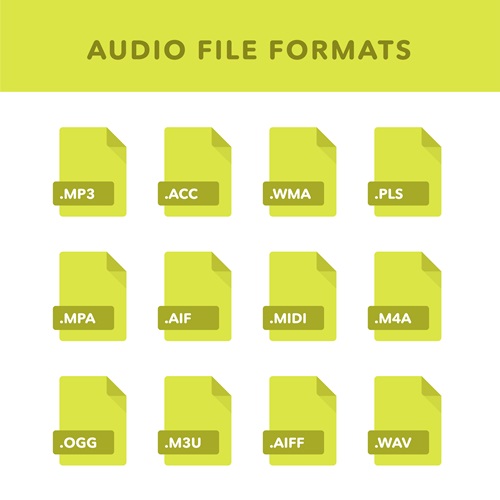
audio file formats
audio file formats

Let’s take a look at the main audio formats and the differences between them.
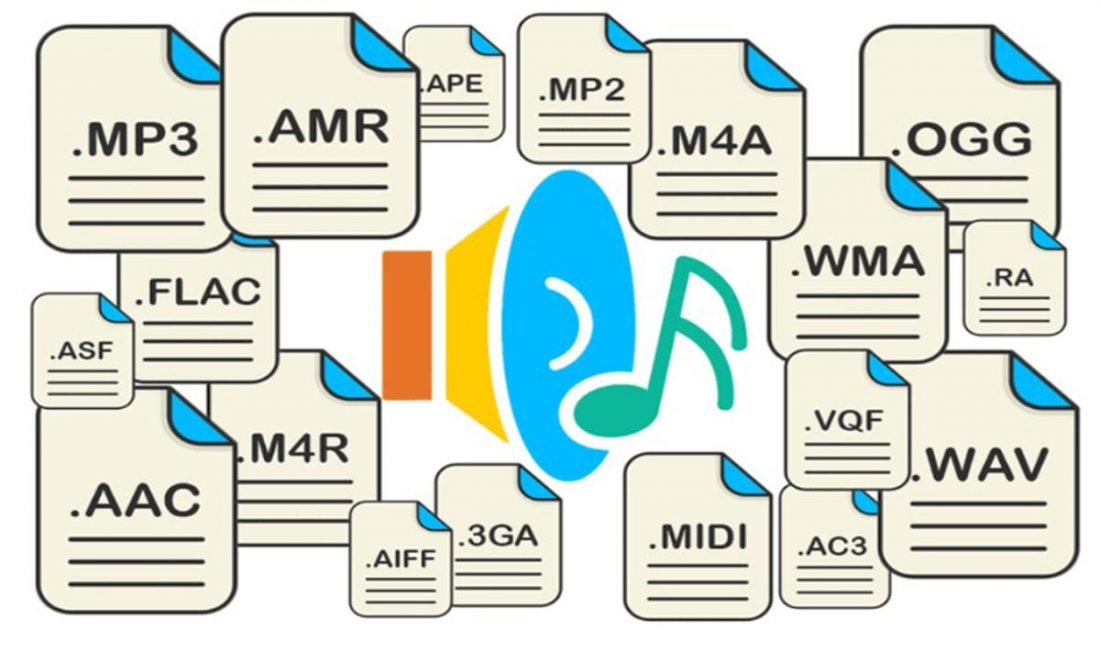
audio file formats
audio file formats

The audio format is directly related to the quality and purpose of the audio track, i.e. where and on what device it will be played and what its purpose is.

However, before discovering the difference between them and choosing the best audio format for your music, you should know what categories they fall under. Let’s go ahead!

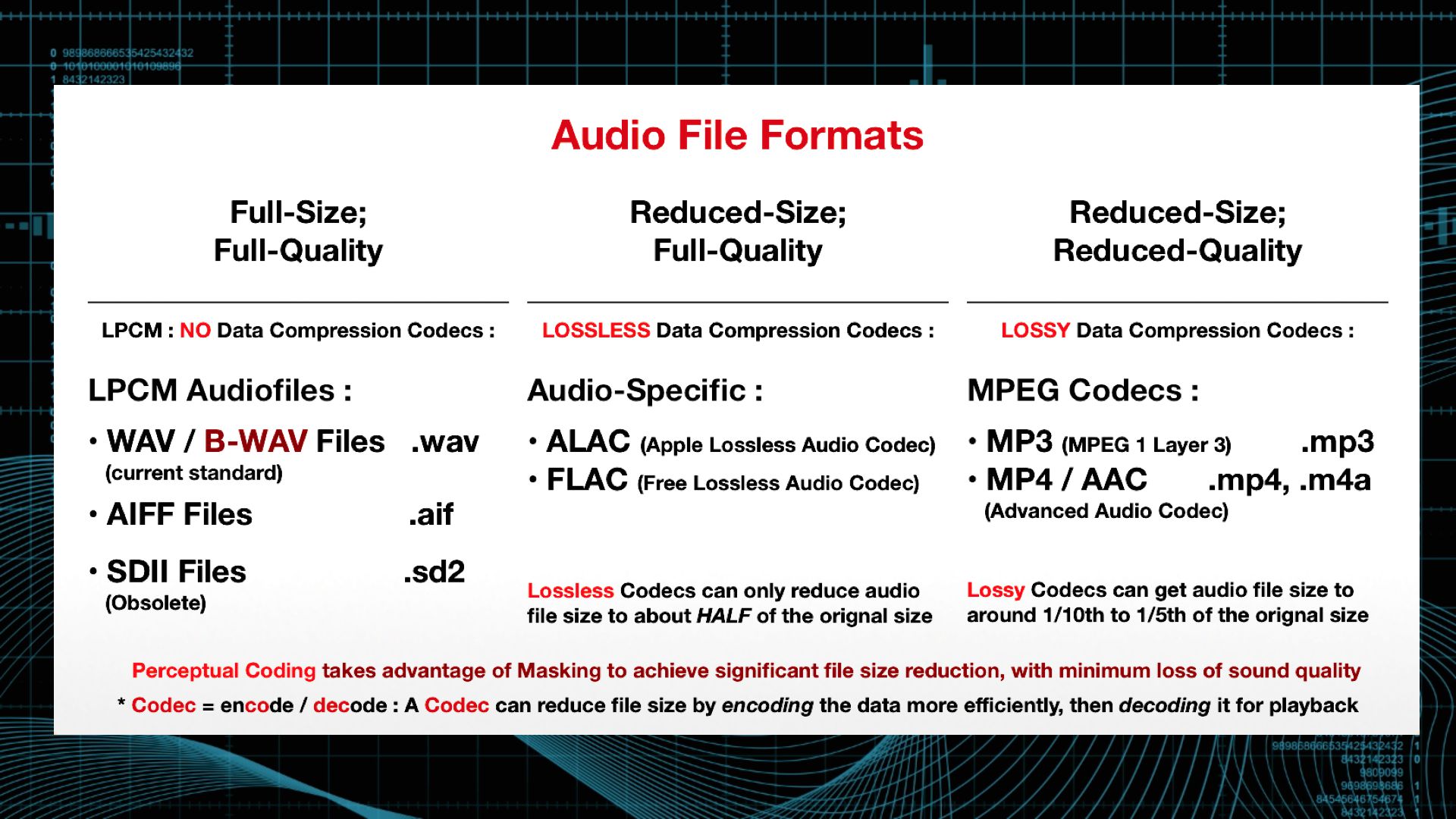
Uncompressed audio is like a picture, uncompressed audio is better quality, larger in file size and safer to copy, with nearly the same detail as the original sound.

WAV is the most widely used audio format of this type and reproduces music with precision similar to that of a recording.

compressed audio
When music is compressed, the file is smaller and can be easily stored on your device. Because of this advantage, compressed audio is often more of an option for users.

However, it should be remembered that some audio formats in this category may lose quality depending on the option selected, just like MP3 and AAC .

What is the best audio format?
As we said before, the first step in deciding on an audio format is to know the final objective of the track. Whether it’s for music lessons, performances, karaoke, auditions, or recording versions, you need to understand the pros and cons of each option.

WAV
WAV (Waveform Audio File Format) is an uncompressed format, therefore sufficient storage space is required. This is for those who already work with music, such as experts in the field or users who want to edit audio.

At high fidelity, WAV faithfully reproduces the elements and character of the original soundtrack. Furthermore, this format allows the selection of different bit and sample rates, and can be used on multiple platforms.

FLAC
FLAC (Free Lossless Audio Codec) is one of the most widely used compression formats by music lovers today.

Digital audio encoding allows you to preserve its quality, but the resulting file will be smaller. Over the years, this format has become more widely used and is compatible with different devices and platforms.

FLAC is free and open source, ready to use and can be easily played on smartphones and other devices.

MP3
Before deciding on the best audio format, it is worth taking a look at the most famous format in the music world: MP3.

MP3 is one of the main audio compression formats, and has become synonymous with the convenience and efficiency of generating files quickly, with smaller files and a certain level of quality.

Many devices and programs can play this format. But MP3 is difficult to use in professional audio processing and advanced audio editing.

As is known, this format exists on almost all platforms and is ideal for sharing audio.

Another interesting factor is its bit rate, although it is a compressed format, it can vary depending on the user’s goals and improvements in quality.

AAC Like MP3, Advanced Audio Coding (AAC) is a more efficient audio format than its predecessor.

To create smaller files with less storage space, AAC is a great option for users to reduce file size and keep high-quality audio tracks.


Free Download Mp4Gain
picture


Mp4Gain Main Window
picture


Mp4Gain Features
picture


Free Download Mp4Gain
picture

Compressed audio formats

Compressed audio formats

Compressed Audio File Formats

Understanding compressed audio formats
The digital age dictates its own laws, according to which, in particular, audio and video information is more convenient to store and transmit in compressed form. Let’s briefly discuss the principle of sound compression.

Compressed Audio file formats

As you know, the music we listen to consists of a set of signals, each of which has its own characteristics, including loudness. The human auditory system is designed so that we do not distinguish or misdirect a weak (low) signal from the background of a strong (strong) signal. This principle forms the basis of modern means of compression (compression) of audio data.

If we imagine that a signal of a certain length is divided into many parts, and each part is processed in such a way that a weaker signal, which is difficult to distinguish from a strong one, falls under the knife and a stronger signal remains, then this will be a rough model of audio signal compression. … Consequently, the level of data compression will depend on how many parts (samples) the original file will be divided into and how many weak signals from each individual sample will be removed (what the bit rate will be: the number of bits in a sample of a specified duration).

The first versions of codecs for data compression acted quite crudely: they just cut off a weak signal and did not take into account the type of music, therefore, rather energetic music, without special nuances, in a compressed form does not it sounded worse than the original, whereas more complex classical and acoustic music simply lost all color and depth.

As a result of this, a transition to a more intelligent compression algorithm, with a variable bit rate, was made. Depending on the musical texture, that is, the ratio of weak and strong signals, the codec changes the amount of weak signals cut, so that we hear a more believable sound.

Obviously, with a higher sample rate (sampling) of 44.1-48.0 KHz and a higher bit rate (160-192 Kbps), we will get a sound more consistent with the original than with a sample rate 22 KHz and 64 Kbps bit rate. However, the size of the final compressed file is directly proportional to the selected sample rate and bit rate, and this is what people who distribute music in the form of compressed (compressed).

It should also be remembered that most algorithms cut the upper part of the audible range as well, starting at around 15 kHz.

There are currently several original compression algorithms, most of which are compatible with Linux.

Ogg Vorbis
Ogg Vorbis is a completely open audio format that allows you to store and transmit audio information with high sound quality (44.1-48.0 kHz sample rate, 16+ bits, polyphony (multi-channel audio)) and bit rates ranging from 16 to 512 kbps per channel. The number of channels processed can be as high as 255. This allows Vorbis to be on par with MPEG-4 (AAC and TwinVQ), WMA and PAC audio, and clearly superior to MPEG-1 Layer 3 (MP3) audio. .

Ogg Vorbis is also a streaming format, allowing it to be used, for example, for Internet broadcasts, especially since this format is compatible with Icecast. The characteristics of the codec algorithm allow you to get the final file smaller than MP3 files of similar quality.

For the reproduction the console program ogg123 is used, to encode – oggenc; both have graphic housings. More details on both are in the following sections.

MP3
MP3 or MPEG-1 audio layer 3 is by far the most popular format for storing and transmitting compressed data. This format was developed by the Frauenhofer Institut, Germany. However, despite the ubiquity of the format, it should not be forgotten that the patent for MP3 encoding and decoding algorithms belongs to a single company, so the end user at any time may find themselves in a very disadvantageous environment, such as It has already happened with the developers of free MP3 data compression tools …. You can get details about the license conditions on the developers website.

WMA
The WMA format is a proprietary product of Microsoft. It failed to occupy a market segment comparable to MP3, but it has some popularity despite serious security concerns identified. At the moment, only the universal MPlayer player can play WMA files. There are no free data compression tools for this algorithm and its appearance is unlikely.