All the Audio Format Differences: Which One Should You Use?
All the Audio Format
Three classifications of audio formats
All the Audio Format
Characteristics and differences of different audio formats
Which audio format is right for you?
You already know MP3, but what about AAC, FLAC, OGG or WMA? Why are there so many audio file formats and is there any best audio format?
Comparison of audio formats
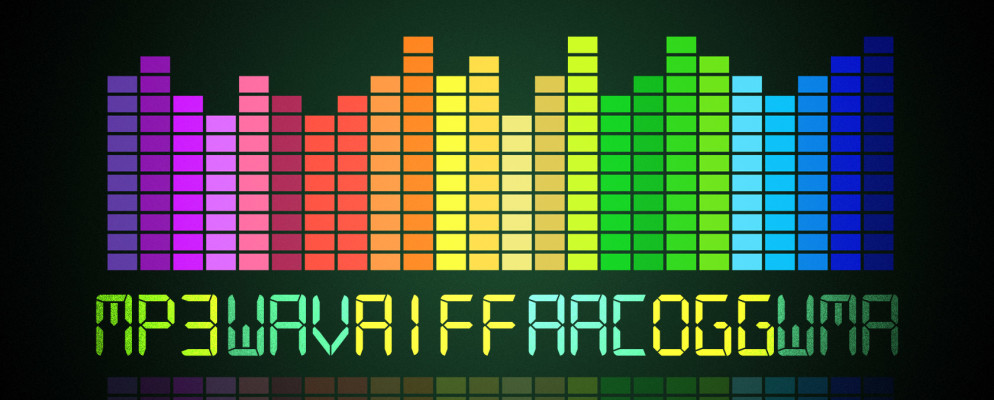
Audio files come in various types and sizes. While we’re all probably familiar with MP3, what about AAC, FLAC, OGG, or WMA? Why are there so many audio standards? Is there a better audio format? Which ones are important and which ones can be ignored?
All audio formats are divided into three main categories, and once you know what the categories mean, you can choose the format within the categories that best suits your needs.
uncompressed audio format
Uncompressed audio consists of actual sound waves that have been captured and converted to digital format without any additional processing. So uncompressed audio files tend to be the most accurate, but take up a lot of disk space: about 34MB per minute for 24-bit 96KHz stereo.
Audio file format: PCM
PCM stands for Pulse Code Modulation, a digital representation of the original analog audio signal. Analog sounds exist as waveforms. To convert a waveform into digital bits, the sound must be sampled and recorded at specific intervals (or pulses).
This digital audio format has a “sample rate” (how often the samples are made) and a “bit depth” (how many bits are used to represent each sample). There is no compression involved. Digital recordings are almost accurate representations of analog sounds.
Let’s take a look at the main audio formats and the differences between them.
audio file formats
The audio format is directly related to the quality and purpose of the audio track, i.e. where and on what device it will be played and what its purpose is.
However, before discovering the difference between them and choosing the best audio format for your music, you should know what categories they fall under. Let’s go ahead!
Uncompressed audio is like a picture, uncompressed audio is better quality, larger in file size and safer to copy, with nearly the same detail as the original sound.
WAV is the most widely used audio format of this type and reproduces music with precision similar to that of a recording.
compressed audio
When music is compressed, the file is smaller and can be easily stored on your device. Because of this advantage, compressed audio is often more of an option for users.
However, it should be remembered that some audio formats in this category may lose quality depending on the option selected, just like MP3 and AAC .
What is the best audio format?
As we said before, the first step in deciding on an audio format is to know the final objective of the track. Whether it’s for music lessons, performances, karaoke, auditions, or recording versions, you need to understand the pros and cons of each option.
WAV
WAV (Waveform Audio File Format) is an uncompressed format, therefore sufficient storage space is required. This is for those who already work with music, such as experts in the field or users who want to edit audio.
At high fidelity, WAV faithfully reproduces the elements and character of the original soundtrack. Furthermore, this format allows the selection of different bit and sample rates, and can be used on multiple platforms.
FLAC
FLAC (Free Lossless Audio Codec) is one of the most widely used compression formats by music lovers today.
Digital audio encoding allows you to preserve its quality, but the resulting file will be smaller. Over the years, this format has become more widely used and is compatible with different devices and platforms.
FLAC is free and open source, ready to use and can be easily played on smartphones and other devices.
MP3
Before deciding on the best audio format, it is worth taking a look at the most famous format in the music world: MP3.
MP3 is one of the main audio compression formats, and has become synonymous with the convenience and efficiency of generating files quickly, with smaller files and a certain level of quality.
Many devices and programs can play this format. But MP3 is difficult to use in professional audio processing and advanced audio editing.
As is known, this format exists on almost all platforms and is ideal for sharing audio.
Another interesting factor is its bit rate, although it is a compressed format, it can vary depending on the user’s goals and improvements in quality.
AAC Like MP3, Advanced Audio Coding (AAC) is a more efficient audio format than its predecessor.
To create smaller files with less storage space, AAC is a great option for users to reduce file size and keep high-quality audio tracks.
THE MOST COMMON FORMATS FOR MUSIC AND OTHER AUDIO FILES, AND HOW THEY ARE RELATED TO EACH OTHER
And for the direct competitors of the universal MP3 format, they can count on a lot today.
Due to continuing inconsistencies in home storage of the WAV format, it was eventually discontinued. But for professional studios, he says, the basics of the job. Especially when recording live vocals or instruments. Just convert the recorded material from WAV to MP3 at the final stage.
music format
However, music can be represented in some other popular formats nowadays. For example, many times (especially the Internet) they use these data types like OGG, AIFF, AMR, etc. But the real competitor of MP3 has become the newest and best audio FLAC etc. Of course, for MP3 you can convert all parameters to the maximum, but the playback quality of FLAC represents much higher. Also, it is a single file and the separation occurs directly on the track due to the player or startup software. In other words, listeners see each track individually, but can switch between playback tracks. For the MP3 format, this also seems possible to merge multiple tracks through it, thus creating a single file. But here it is in this version fast switching between tracks will not be possible (normal fast forward should be used, that’s all).
However, not everything is bad. The fact that music or audiobooks are all popular formats today allows them to be easily converted, even keeping the original parameters of the audio material. Based on this, and for sound processing and conversion and audio editors, almost all programs call converters. Any program of this type (MP3 editor or converter) detects the original and final type of audio files, is unambiguous and can produce direct and reverse transformations. Let’s explain this specific example.
WAVE THEORY AUDIO EDITOR FOR MP3 FILES
Many types of software are used in audio processing today. First, look at the narrow application of so-called audio editors. The most prominent representatives of these can be called giants Sony Audio Forge, Sintrillium Cool Editing Pro, which was later acquired by Adobe and renamed Audition, Acoustica Mixcraft, ACID Pro and many others.
mp3 editor
The principle on which they operate is that, for convenience, all MP3 audio programs have a typical waveform, as originally used for WAV files. This method determines the appearance and opportunity enough to edit any type of conventional audio material in WAV format. Other than that, the fact that you can do basic copy, cut, paste, etc. E., it’s just a matter of getting the frequency characteristics and bitrate changes, not to mention using a lot of extra effects that plug into VSTs via DirectX or a generic host bridge studio thing.
In its simplest form, the conversion can be done using the standard file menu, which contains the line “Save As…” (Save As…) or the export function present in MP3 format. Thus, all the process is reduced to just the final selection of the format (MP3 here as an example) and activation of the recording mode. In this case the conversion will be done automatically saving the current configuration parameters and the frequency characteristics. I don’t like the original version? ?Nothing is easier than changing the format to MP3, pre-specified with higher settings. However, one thing needs to be considered here: if the raw material is of such poor quality that special remediation or even professional tools will not work for audio it is necessary to use Repairs here, the intervention of various filters, etc. D. For the layman, it will cause great difficulties.
As is clear, there is absolutely no difference between the audiobooks we are dealing with: MP3, music or just recorded voice or noise. By the way, audiobooks are supposed to have a much lower sound quality by default. This is understandable, since the file has to take up minimal space and, in general, the perceived sound characteristics of speech are not that important. Finally, is this a professional recording of a particular set of albums?
However, if you use some standard operations, even without specific knowledge, it’s fine to achieve good results, especially since there are such built-in templates, based on any application for specific operations. Of course, it will be very difficult for the first time to achieve a perfect sound, but if you study the plan and understand how it works, it will work like clockwork, and as a result, it will take a lot of time.
Dematerialized music has evolved considerably for almost 15 years and has played an important role in the daily life of every individual. We’ve all heard more or less about FLAC, MP3, WAV, etc.! Few people really know the difference between each size, its pros and cons …
This article is intended to enlighten you to make the best possible choice for extracting and compressing your audio files.
There are different types of layouts that can be grouped into several large families:
– uncompressed files
-lossless compressed files
– Lossy compressed files
-Uncompressed files
WAV: WAV (Waveform Audio File Format) is an audio file format created by Microsoft for Windows. This format is usually an uncompressed container. Therefore, an audio CD with a duration of about 80 minutes in WAV weighs plus or minus 800 MB
Advantages: the file remains in its original form, no loss of information (no loss)
Disadvantages: The WAV file is an uncompressed format that gives it a large size and therefore takes up more space in the storage space.
AIFF – Audio Interchange File Format (AIFF) is the Mac OS equivalent of the WAV format. Therefore, it has the same characteristics as this. The pros and cons of this format are the same as for WAV.
– Lossless compressed files
FLAC: The FLAC (Free Lossless Audio Codec) format is without doubt the most beneficial file for the user. Firstly, in terms of WAV and AIFF, this format is a lossless format, ie the digitization of the file does not imply any loss of information from the audio spectrum. The file is scanned and returned as is. The second advantage of this format is the size it occupies in the storage space. Nondestructive compression is applied to this type of format as a ZIP file, making the scanned file about 2 times less space than a WAV file. Therefore, for 80 minutes of music on CD, the occupied space will be approximately 400 MB. Finally, this format is universal, compatible with most multimedia players, it is compatible with all operating systems except iOS,
Advantages: file size, identical reproduction of the original file during scanning, free and compatible with almost all media players and operating systems
– Disadvantages: none
ALAC: The ALAC (Apple Lossless Audio Codec) format is simply the Apple equivalent of the FLAC file.
– Lossy compressed files
MP3: The MP3 format (Mpeg Layer 3) is a well-known format. It is a format with destructive compression, that is, a recording from which musical information has been removed thanks to the so-called psychoacoustic compression algorithm (taking into account the peculiarities of the human ear), so that less scanning is needed to create a lighter file to obtain . This format is most commonly used for dematerialized music, as it allows a significant space saving in the storage space with a size of about 150 MB for an 80 minute CD. Compression can be more or less destructive depending on the speed used, which can range from 4: 1 (320 Kbits / sec) to 12: 1 (128 Kbits / sec).
-Advantages: it takes up little space on the hard disk and does not affect the quality of the songs with a dynamic range and a limited variety of timbres
– Disadvantages: paid MP3 license, destructive compression for “richer” songs.
AAC: The AAC (Advanced Audio Coding) format is a format close to the MP3 format, but provides additional definition with an identical compression rate. Apple uses this specific format in the iTunes Store, but also on YouTube. the extension can be written in various forms, such as .AAC, .M4A or MP4
AAC, MP3, MP3 Pro, Ogg Vorbis, WMA. In the digital age, choosing one or the other of these standards is not easy. Especially since their properties lend them to one use instead of another. Detailed review
Which format for digital music should you choose?
MP3 is far from alone in the world. Feeling that compressed digital music is likely to change the record market, many developers have begun designing formats designed to offer the best compromise between the amount of data used and the sound quality. Thus, AAC for Apple, WMA from Microsoft and other OGG Vorbis communities were born. So many standards that have their advantages and disadvantages and that it is advisable to know them well before choosing the most appropriate coding software for your needs.
First, remember that an audio CD uses uncompressed data. Music is digitized on its surface at a rate of 44,100 samples per minute. Second, each of these samples is encoded in 16 bits (2 bytes) and in stereo. This gives a total of 176 KB per Second music, or about 10 MB per second. Minute. Even if an increasing number of Internet users use broadband, websites that sell music for download cannot afford to offer 40-minute four-minute songs. Compression formats allow this amount of data to be shared by a factor ranging from 8 to 15, with little or no loss of quality.
All of these compression algorithms work on the same principle: eliminate frequencies that the human ear does not perceive at all, or very little, and level the frequencies close to each other for identical values to increase compression. These are the so-called “destructive” algorithms. In other words, when converting a compressed audio file from an audio CD to an audio CD format, the resulting data will not be the same as the original file. Depending on the formats and needs, compression may be more or less important. It is defined by what is called bitrate, that is, the flow of information per. Second of music. It can range from 32 kbps (kilobits per second) to 320 kbps. Detailed review of the different formats.
MP3
Commonly designed by the Fraunhofer Institute and Thomson and standardized in 1992, it is a derivative of audio compression used for MPEG-1 format videos (MP3 also stands for MPEG-1 Audio Layer 3).
This is the format offered by the main configuration panel. In fact, we can define a bit rate (“bit rate” in jargon) that ranges from 32 to 320 kbps. From 128 Kbps the sound quality becomes enough to encode songs. At 192 Kbps, the quality is similar to an audio CD. At this compression rate, one minute of music equals 1.4 MB of data. But it is also possible to choose a variable bit rate called VBR (variable bit rate). In this case, the encoder increases the compression ratio in less complex music regions, reducing the size of the final file slightly. The benefit depends largely on the type of song: 5 to 10% with an extract from classical or jazz music, not much with rock or rap.
The great advantage of MP3 remains its compatibility with all portable audio players, but also certain hi-fi systems, car radios and DVD players in the living room. Almost universal, it appears on all free download sites such as Kazaa or eDonkey. On the other hand, this format sinks slightly at the level of high frequency recovery and is therefore less suitable for e.g. Classical music.
Free MP3 encoding software includes WinAmp and MusicMatch JukeBox. Lastly, note that there are several MP3 coding algorithms, with “Fraunhofer” being the most widely used, and “Lame” being the most effective, with the latter being especially compatible with Pinnacle’s CDex.
WMA
Launched in 1999 by Microsoft, WMA (Windows Media Audio) was only intended to counter the rise of MP3. With compelling arguments. By utilizing the features of the human ear more effectively in the audible spectrum, WMA is able to eliminate frequencies that are truly useless while maintaining certain high frequencies that affect sound quality. The relatively efficient compression algorithm maintains a quality that corresponds to an audio CD with a 128 kbps bit rate, or 1 MB per second. Minute of a song.
Completely free of charge, WMA also has the advantage of having an encoder built into Windows Media Player. An effective way to ensure the spread of this support. Especially since this format is linked to precise copyright management (DRM or Digital Right Management) that allows, for example, to define a limited useful life of files or prohibit recording options. That’s why some music download sites use it. Many digital audio players also support WMA and reputable shareware such as WinAmp allows encoding in this format.
AAC
Contrary to belief, AAC (Advanced Audio Coding) is not a format developed by Apple, but by a consortium that includes the Fraunhofer Institute (father of MP3), Sony and even Dolby. Prestigious names that grow well. In fact, AAC is arguably the most efficient compression algorithm. Unlike MP3 and WMA, it is not based on MPEG-1 but on MPEG-4 (the format behind DivX). This choice seems to have paid off as it allows you to get a better compromise between compression ratio and sound quality. That’s why at AAC we get the equivalent of audio CD quality with a bit rate of only 96 kbps. In addition, as with WMA, the DRM (copyright management) features and the ability to control sounds on 48 different channels,
We found AAC on the Apple iTunes online music site and on your iPod player. But it is also integrated into software like WinAmp.
OGG Vorbis
OGG Vorbis is in audio compression format, as Linux is in operating systems. In fact, it is an “open” format whose source codes are public and can be customized and changed by anyone. It’s still a pretty effective format. At 128 kbps, we reach the quality level of an audio CD (1 MB in 1 minute). The compression structure of OGG format is also significantly different from MP3, WMA and other AACs. Segmenting audio sources into successive packets, the compression algorithm works first on each packet independently of the others. This allows you to not really have weakness at certain frequencies and to maintain the same quality regardless of the type of music.
In addition, polyphony features allow playback of up to 255 audio channels (sic). The package structure also makes it very suitable for streaming on the Internet, especially for online radios. Open, OGG Vorbis needed to evolve quickly and maybe move closer to AAC in terms of performance.
Digitizing music involves compressing the original sound that may distort the work. AAC, MP3, WMA or Wav: which of these formats offers the best representation?
If we are not aware of or no longer aware of the quality of today’s music in its digital form, it is often because our audio rendering tools are so poor. This is due to the speakers that come with desktops or built-in laptops, but also to the headphones / earphones that come with MP3 players, which are mostly entry-level products. On the other hand, for those with high performance equipment, listening to poorly recorded or poorly coded songs quickly becomes unpleasant.
Therefore, choosing the best audio format for the same recording is best for fun. Today, there are 5 main audio file formats: AAC (promoted by Apple, iPod and iPhone in mind), WMA (promoted by Microsoft), MP3, Wav and Ogg (the last three are neutral).
In addition to the file format, there is another criterion called the compression ratio. The more a file is compressed, the more it removes the frequency bands in the music and therefore potentially small nuances that enrich the listening. The compression ratio is expressed in the number of bits, the basic computing unit. Values range from 56 Kbits / s (56,000 bits per second, minimum quality for radio or podcasts) to 320 Kbits / s. The lower the number, the more compressed and small the file will be, but the less comfortable it is to listen to.
The sampling frequency is also important. This value is expressed in Hz and must be as large as possible to preserve the shape of the original audio signal and therefore the accuracy of the recording. In general, we prefer a file with a sampling rate for CD quality (44,100 Hz), but we also found lower quality files (22,000 Hz).
The study from the Musiclassics studio.
This online digital music sales site dedicated exclusively to classical music launched a modernization of its interface during 2009. On this occasion, the question arose about the best audio formats that its customers could offer. To make it right, the site invited 15 people (bloggers, musicians, fans, audiophiles) to a listening session in a professional studio. They had to judge from 1 to 5 the quality of 4 different musical excerpts representative of the diversity of classical music (voice, violin, piano, orchestra and heart), coded in 6 different ways: MP3 320 Kbps, Wav, WMA 192 Kbps and 320 Kbps, AAC 192 Kbps and 320 Kbps. Here are the results of this study:
Since formats compressed at 128 Kbps or less have not been studied, the difference in ratings is relatively small. However, the MP3 format, even compressed at 320 Kbps, is the worst with a significant difference. More surprisingly, the CD (Wav file) is located behind the WMA and AAC formats. These files seem to change the rendering slightly. It is observed that the difference in notation between the 192 and 320 Kbps compression is not significant.
But too bad MusiClassics did not want to integrate the free and open OGG file format into these results. However, we noticed that as a consumer it would be better to choose 192 Kbps AAC or WMA files instead of 320 Kbps MP3 and 192 192 Kbps MP3. 128 Kbps files would score less than 3/5, which is not satisfactory.
Many are known, but there is always the question of what is the best audio format. The main and most recognized for listening to music are MP3, Wav, FLAC and Ogg.
But, to choose the best audio format, you must first know that they have several conformations, and you can always choose the best. Music always goes everywhere, at home in front of the computer, in a living room with a hi-fi system, with headphones on public transport or when playing a sport. Music that gives a special meaning at all times and that encourages listening.
There are many ways to take advantage of it, but this is usually done in digital format. In audio files, there is a wide variety and normally many still use MP3 for convenience. But there are less popular alternatives that seek to provide a different, better experience. For those who do not know it, there are a number of main sound systems.
The best audio format
Beyond the fact that the MP3 format is the most popular of all the audio formats available, it is not the only one. Some others like “FLAC”, “WMA”, “OGG” have certain characteristics which, depending on what you want, can be very useful on certain occasions.
In technology, audio formats can generally be classified into 2 categories. There are those which preserve all the quality and those which involve losses of quality of the sound or information.
Those that preserve the quality of the audio are those that come from pure sources such as CDs. This is how those who lose quality and sacrifice this information must save space.
Audio quality formats
“FLAC” is a lossless audio codec or “FLAC”. It is one of the formats that best preserves audio quality and its compression algorithm is excellent. It is open source, does not generate quality losses and the file size because it is compressed, is much smaller.
lossless
Apple Lossless is known as “ALAC” and is very similar to “FLAC”. The difference is that it is not as efficient, so these files are larger, although they still have unconditional support for iOS, which “FLAC” does not.
“APE” is another and although the problem with this format is that it is not compatible with the vast majority of players, it is considered to be similar to the “FLAC” or “ALAC” format in terms of audio quality. . As it is highly compressed, it accelerates the functioning of the computer’s processor and it is therefore not recommended to use it in low-consumption computer equipment.
“WAV” and “AIFF” are not compression formats, but rather exact copies of the original content and differ in the way they record the data. “AIFF” was created by Apple and “WAV” is more universal, but both have too much disk space.
Formats with loss of audio quality
MP3, MPEG Audio Layer III or MP3, as many people already know, is the most common format that can be found. “ACC” is very popular on iTunes and is considered more efficient than MP3 because files in this format are smaller.
OGG Vorbis is one of the free and open source alternatives to MP3 and ACC. It is not limited by patents, but it is also not supported by many players. WMA is Microsoft’s proprietary format and is very similar to MP3, but without much advantage over the others.
Which audio format to choose?
The most recommended is “MP3” or “AAC” because many players support it. In addition, if they are encoded with a high bit rate, they can hardly be distinguished from the original source. However, if you want to burn music, formats like “FLAC” are recommended, because you can then convert everything to other formats without losing audio quality.
Once the audio formats are known, when choosing, the differences between each must be taken into account. In general, what the experts recommend is to use “MP3” or “AAC” as they are compatible with most players and the quality of both is very similar to that of the original source, especially if it is encoded with a high bit rate. Unless you have a specific need, “MP3” and “AAC” are the most recommended options.
However, one thing to know is that to store music in lossless formats, there is no “FLAC”. You probably won’t notice any higher quality, but it’s good for storing music if you plan to convert it to other formats later. In these cases, “FLAC” is always recommended, and it is also possible to choose the format without loss or degradation of quality