Zero-stuffing Techniques in MP3 Encoding


Free Download Mp4Gain
picture

Zero-stuffing Techniques in MP3 Encoding

Zero-stuffing Techniques in MP3 Encoding

Let’s talk about zero-stuffing techniques in MP3 encoding

Zero-stuffing techniques in MP3 encoding are a fascinating yet often misunderstood aspect of audio processing. As someone with years of experience in audio engineering, I’ve seen how this technique can make or break audio quality. Simply put, zero-stuffing is the process of adding zero values in specific areas of the digital audio stream during MP3 encoding to maintain timing, improve error correction, or ensure proper synchronization.

This may sound complex, but let me break it down with a relatable example. Imagine a train running on a track. Each car represents a piece of audio data. If the train has fewer cars than the track allows, zero-stuffing acts like empty cars added to the train to keep it the right length. This ensures the train stays consistent, runs smoothly, and reaches its destination without confusion. It’s the same with MP3 encoding—zero-stuffing fills in the gaps to ensure proper audio processing.

Now let’s dive deeper into how zero-stuffing works, why it’s essential, and what unique challenges it solves in MP3 encoding.

Why zero-stuffing is crucial for MP3 encoding

Zero-stuffing is critical for ensuring timing and synchronization in MP3 encoding. Without it, audio files could suffer from noticeable distortions or timing errors. For example, when encoding audio at variable bitrates, the encoder may need to add zero values to maintain a consistent structure, especially during periods of silence or low complexity.

Let’s think of a musical performance. If the drummer misses a beat, the entire performance feels off. Zero-stuffing ensures no beats are missed by filling in those silent gaps with placeholders, maintaining rhythm and flow.

Moreover, zero-stuffing plays a vital role in error correction. In the case of transmission errors, these zeros act as buffers, reducing the impact of data loss. Without this technique, corrupted MP3 files would often result in unplayable audio, a frustrating experience for listeners.

How zero-stuffing enhances audio quality

Zero-stuffing doesn’t just prevent errors; it actively enhances the quality of MP3 audio. By maintaining timing and ensuring data consistency, it minimizes artifacts like pops, clicks, or uneven playback.

Picture a smooth highway drive—no potholes or bumps to disrupt your journey. Zero-stuffing ensures your audio experience is just as seamless, filling in gaps where necessary to create a smooth, uninterrupted sound.

Additionally, zero-stuffing is particularly effective in scenarios where audio is encoded at lower bitrates. Lower bitrate encoding often leads to data loss and audible artifacts, but with zero-stuffing, the gaps are intelligently managed, preserving audio integrity even in challenging conditions.

Common misconceptions about zero-stuffing

One common misconception is that zero-stuffing degrades audio quality by introducing unnecessary data. However, the reality is quite the opposite. These zeros don’t alter the original audio signal but serve as placeholders, ensuring that the encoding process remains precise and consistent.

Another misunderstanding is that zero-stuffing is unnecessary with modern codecs. While newer codecs like AAC and Opus have advanced features, MP3 remains widely used, and zero-stuffing is still relevant for ensuring compatibility and maintaining audio quality in this format.

Think of it as adding training wheels to a bike. While advanced riders might not need them, beginners rely on them for stability. Similarly, zero-stuffing provides the structural support MP3 files need, especially during complex encoding processes.

The technical process behind zero-stuffing

Zero-stuffing involves inserting zero values into the MP3 bitstream during encoding. These zeros occupy unused portions of the frame and serve as padding to ensure timing alignment. It’s a highly technical process that requires precise calculation to avoid overstuffing or under-stuffing, which could result in errors.

Let me simplify this with a puzzle analogy. Imagine trying to fit different-sized pieces into a fixed grid. If some pieces are smaller than the grid’s cells, you’d need to fill the extra space with blank pieces to make everything fit perfectly. Zero-stuffing works the same way, ensuring that each audio frame fits the required structure.

This precision is particularly important for maintaining synchronization across devices. For example, if you’re streaming MP3 audio to a Bluetooth speaker, zero-stuffing ensures that the timing remains consistent, preventing lags or skips.

Real-world applications of zero-stuffing in MP3 encoding

Zero-stuffing has practical applications in various industries, from music production to broadcasting. For instance, when mastering tracks for digital distribution, I often rely on zero-stuffing to ensure that silent sections of a song don’t disrupt playback on different devices.

Another example is in online radio streaming. Streams often involve variable bitrate encoding, where zero-stuffing becomes essential to handle silent moments or low-complexity audio without compromising the overall stream quality.

It’s also worth noting that zero-stuffing is integral to ensuring compatibility with older MP3 players. These devices often have stricter timing requirements, and zero-stuffing helps meet those demands without sacrificing playback quality.

Challenges and limitations of zero-stuffing

While zero-stuffing is incredibly useful, it’s not without challenges. One major limitation is the potential for increased file size. Adding zeros, while necessary, can slightly inflate the overall size of the MP3 file, which might be a concern for storage or streaming.

Another challenge is that improper implementation of zero-stuffing can lead to synchronization issues rather than solving them. This is why it’s crucial to use encoders that handle zero-stuffing accurately, ensuring that the technique works as intended.

In my experience, these challenges are minor compared to the benefits zero-stuffing provides. With proper tools and knowledge, it’s entirely possible to mitigate these limitations and maximize the advantages of this technique.

Latest words on zero-stuffing techniques in MP3 encoding

Zero-stuffing techniques in MP3 encoding are indispensable for ensuring timing, synchronization, and error correction. Whether you’re an audio professional or a casual listener, this process plays a crucial role in delivering the high-quality audio experience we often take for granted.

For anyone looking to optimize their MP3 files further, using tools like Mp4Gain can help fine-tune your audio to perfection. From normalizing volume levels to enhancing playback consistency, it’s a reliable solution for modern audio needs.

What is zero-stuffing in MP3 encoding?

Zero-stuffing is a technique where zero values are added to an MP3 bitstream to maintain timing, improve synchronization, and correct errors during encoding.

Why is zero-stuffing important in MP3 encoding?

Zero-stuffing ensures consistent timing and synchronization, reduces audio artifacts, and prevents errors during MP3 playback or transmission.

Does zero-stuffing affect audio quality?

No, zero-stuffing does not alter the original audio signal. Instead, it enhances playback consistency and minimizes errors.

Can zero-stuffing increase MP3 file size?

Yes, zero-stuffing can slightly increase file size due to the added zeros, but this is typically negligible compared to the benefits it provides.

How does zero-stuffing improve error correction?

Zero-stuffing adds placeholders that act as buffers, helping to minimize the impact of data loss or transmission errors.

Is zero-stuffing still relevant for modern MP3 encoders?

Yes, zero-stuffing remains essential for maintaining compatibility and quality in MP3 encoding, especially for older devices.

What challenges does zero-stuffing present?

Challenges include slight file size increases and potential synchronization issues if zero-stuffing is implemented improperly.

Can zero-stuffing fix audio playback skips?

Yes, zero-stuffing helps maintain consistent timing, reducing playback skips or interruptions in MP3 files.

Is zero-stuffing used in other audio codecs?

While other codecs may use similar techniques, zero-stuffing is specifically associated with MP3 encoding to handle its unique requirements.

How can I ensure proper zero-stuffing in my MP3 files?

Using a reliable encoder that follows MP3 standards will ensure proper zero-stuffing, minimizing errors and maintaining audio quality.

Comments:

Never heard of zero-stuffing before. This was a great read and explained so clearly. Keep up the good work!

I always thought those silent gaps in songs were just errors. This really opened my eyes about MP3 encoding!

Can you explain a bit more about how zero-stuffing handles errors? I feel like this section could go deeper.

Wow, I didn’t know MP3 files were still this complex. Thanks for making it easy to understand!

Great article! I’ve been struggling with playback skips on my MP3 player. This might explain why.

This article was good, but I feel like some parts got too technical. Can you simplify it a bit more?

Excellent breakdown. I finally understand why my MP3 encoder adds those zeros—it’s not just random!

Thank you for this! I’ve been working with MP3 encoding and didn’t realize zero-stuffing was so essential.

The train analogy really helped me understand zero-stuffing. I love how you made this so relatable!

Interesting read, but I wish it had more examples for troubleshooting MP3 issues related to zero-stuffing.

How does zero-stuffing compare to techniques used in newer codecs like AAC? That would be cool to explore next time.


Free Download Mp4Gain
picture


Mp4Gain Main Window
picture


Mp4Gain Features
picture


Free Download Mp4Gain
picture

Long-term prediction in AAC and MP3

Long-term prediction in AAC and MP3

Long-term prediction in AAC and MP3

Let’s talk about long-term prediction in AAC and MP3

Long-term prediction in AAC and MP3 is the key to achieving efficient compression without sacrificing audio quality. As someone who has studied this area extensively, I can tell you that understanding how these algorithms work can transform the way we perceive digital audio. Imagine you’re trying to fit all your favorite songs into a small storage space. Long-term prediction helps achieve this by identifying patterns in sound and encoding them more efficiently.

Both AAC and MP3 rely on long-term prediction to optimize compression. By analyzing repetitive audio signals, such as sustained musical notes or rhythmic beats, these codecs predict and encode them efficiently. Think of it as saving space on a bookshelf by stacking similar-sized books together. This concept, though simple in analogy, involves highly sophisticated mathematical modeling in practice.

How long-term prediction works in AAC

In AAC, long-term prediction focuses on analyzing correlations within audio frames over time. Picture a choir singing in harmony; their voices often follow predictable patterns. AAC identifies these patterns, using them to reduce redundant data storage. This technique is especially effective for tonal and harmonic sounds.

AAC employs tools like predictive filters that estimate future audio samples based on past ones. If you’ve ever noticed how your phone predicts the next word when you’re typing, this is a similar idea but applied to audio. By predicting and storing only the differences, AAC achieves higher compression rates. This is why AAC files often sound better than MP3 at similar bitrates.

Long-term prediction in MP3 encoding

MP3 also utilizes long-term prediction, but its approach is slightly less advanced than AAC’s. While MP3’s algorithms identify repetitive audio signals, they lack the precision of AAC in capturing subtle tonal variations. Imagine trying to sketch a landscape using only a few colors; MP3 manages this but sometimes loses finer details.

In MP3, long-term prediction focuses on reducing redundancy in stationary sounds, such as sustained chords. For example, if you’re listening to a classical symphony, MP3 might encode the sustained violin notes by predicting their behavior. This method works well for simpler audio structures but struggles with more complex ones, where AAC excels.

Comparing the efficiency of AAC and MP3

AAC outshines MP3 in terms of long-term prediction efficiency. This difference is evident when you compare the sound quality of a 128 kbps AAC file to that of a 128 kbps MP3 file. AAC delivers a richer and more accurate audio experience. It’s like comparing high-definition video to standard definition; both show the same content, but the former provides much more detail.

AAC’s advantage lies in its use of prediction filters and enhanced psychoacoustic modeling. These tools enable AAC to better handle complex audio textures, such as overlapping voices or intricate instrumental arrangements. MP3, while efficient for its time, often struggles to maintain fidelity in such scenarios.

The role of psychoacoustics in prediction

Psychoacoustics is the science of how we perceive sound, and it plays a crucial role in both AAC and MP3. By understanding what sounds the human ear prioritizes, these codecs optimize what to encode in detail and what to discard. Imagine listening to a band at a concert; your brain naturally focuses on the lead singer’s voice while ignoring background chatter. Psychoacoustic modeling mimics this process.

AAC uses advanced psychoacoustic techniques to complement its long-term prediction, ensuring a more natural listening experience. MP3 also employs psychoacoustics but lacks AAC’s ability to adapt dynamically to complex audio. This difference highlights why AAC is the preferred choice for modern streaming platforms.

Real-life applications of long-term prediction

Long-term prediction isn’t just a theoretical concept; it has practical applications that impact our daily lives. Streaming services like Spotify and Apple Music rely on AAC’s predictive capabilities to deliver high-quality audio while minimizing data usage. If you’ve ever streamed music on a weak internet connection and been amazed by the clarity, you can thank AAC’s long-term prediction for that.

MP3, while less advanced, remains popular for legacy systems and portable devices. Its simplicity and widespread support make it a reliable choice for older hardware, such as car stereos and CD players. Understanding these real-life scenarios helps us appreciate the importance of long-term prediction in digital audio.

Challenges in long-term prediction

Long-term prediction isn’t perfect; it has its limitations. Complex and unpredictable sounds, such as applause or sudden instrument changes, can challenge even the most advanced algorithms. These sounds are like trying to predict a series of random numbers; the lack of pattern makes accurate prediction nearly impossible.

AAC addresses these challenges better than MP3 by using flexible prediction models that adapt to varying audio signals. However, both codecs can struggle with extremely dynamic content, such as live recordings or experimental music. This is an area where future advancements in audio compression could make significant strides.

Future trends in audio compression

The future of long-term prediction in audio compression lies in leveraging machine learning and artificial intelligence. Imagine a codec that learns from your listening habits, optimizing audio quality for your favorite genres. These technologies could revolutionize how we experience digital sound.

While AAC and MP3 have set the foundation, emerging formats like Opus and xHE-AAC are already pushing the boundaries. These codecs build on the principles of long-term prediction while introducing new methods to handle complex audio. As an expert, I believe we are on the cusp of a new era in audio technology.

Latest words on long-term prediction in AAC and MP3

Long-term prediction in AAC and MP3 is a fascinating blend of science and art. By analyzing and predicting audio patterns, these codecs achieve impressive compression rates while maintaining quality. From streaming music to preserving cherished recordings, long-term prediction impacts our lives in ways we often take for granted.

For those looking to optimize their audio files, Mp4Gain offers an excellent solution to enhance and normalize sound. By understanding the principles of long-term prediction, we can better appreciate the technology that brings music to our ears.

FAQ about long-term prediction in AAC and MP3

What is long-term prediction in audio compression?

Long-term prediction identifies patterns in audio signals to reduce redundancy and improve compression efficiency.

How does AAC use long-term prediction?

AAC uses predictive filters to estimate future audio samples based on past patterns, ensuring better compression and quality.

What makes AAC more efficient than MP3?

AAC uses advanced prediction and psychoacoustic modeling, offering better handling of complex audio textures than MP3.

Why is long-term prediction important?

It enables efficient audio compression by reducing redundant data while preserving quality, saving storage space.

Can MP3 handle complex audio well?

MP3 can struggle with complex audio due to its less advanced prediction models compared to AAC.

What is psychoacoustics in audio codecs?

Psychoacoustics studies sound perception, helping codecs focus on encoding sounds the human ear prioritizes.

Are there limitations to long-term prediction?

Yes, unpredictable sounds like applause can challenge prediction models, causing less efficient compression.

What future technologies could improve long-term prediction?

Machine learning and AI could enhance prediction models, adapting dynamically to complex audio signals.

Why is AAC preferred for streaming?

AAC offers superior compression and sound quality, making it ideal for delivering clear audio on streaming platforms.

Comments:

I had no idea long-term prediction made such a big difference in audio quality. Really insightful article!

Great breakdown! I always wondered why AAC sounded better than MP3 at lower bitrates.

Can you go deeper into how psychoacoustics works in AAC? This is fascinating but I want more details!

This article answered so many of my questions about audio codecs. Keep up the great work!

Wow, I finally understand why streaming sounds so good even on slow internet. Thanks for explaining!

Interesting stuff, but I’d love to see a comparison chart between AAC, MP3, and other codecs.

Man, this is the clearest explanation of audio compression I’ve ever read. Thanks for making it simple!

Quantization Noise in MP3 Compression

Quantization Noise in MP3 Compression

Quantization Noise in MP3 Compression

Let’s talk about Quantization Noise in MP3 Compression

When I first delved into MP3 compression, the term “quantization noise” fascinated me. Imagine packing a suitcase for a long trip but only being allowed to take half your belongings. Quantization noise is the audio equivalent of the compromises you make. In MP3 compression, it’s the unintended artifact introduced when we reduce the precision of sound data to achieve smaller file sizes. This process happens during audio quantization, which determines how audio signals are represented as digital values.

Quantization noise results from rounding or truncating these values, effectively discarding some audio information. The key is ensuring that the noise introduced is less noticeable to human ears. Over my years of studying audio technology, I’ve seen how clever psychoacoustic models in MP3 compression manage this. By focusing on what we *don’t* hear, compression algorithms minimize perceived noise.

Understanding How Quantization Works

Quantization in MP3 compression is a simplification process. Think of it like converting a high-definition photograph into a pixelated image. Each color pixel represents a range of original tones, just as audio quantization maps a range of sound amplitudes into discrete levels. But instead of affecting our eyes, it affects our ears.

To make this efficient, MP3 uses variable quantization levels across frequency bands. Higher precision is reserved for frequencies more noticeable to humans, while less critical bands are treated with coarser quantization. It’s like putting more effort into cooking a main course than a side dish—you focus resources where they matter most.

The Role of Psychoacoustics in Minimizing Quantization Noise

MP3 compression relies heavily on psychoacoustics to hide quantization noise. Our brains are surprisingly forgiving with sound, especially when louder frequencies mask quieter ones. This phenomenon, called “auditory masking,” allows MP3 encoders to allocate fewer bits to frequencies hidden under dominant sounds.

For example, if you’re at a concert with loud drums, you might not hear someone snapping their fingers nearby. Encoders exploit this by prioritizing the drums and reducing data for the snaps. I’ve tested files where masking thresholds were pushed to the limit, and it’s astonishing how well our ears adapt, even though technical imperfections are present.

How Bitrate Affects Quantization Noise

Bitrate is a critical factor in MP3 compression. Higher bitrates mean more data for each second of audio, resulting in finer quantization and less noise. At lower bitrates, sacrifices are necessary, leading to more noticeable quantization artifacts.

I recall comparing a 320 kbps MP3 to a 128 kbps version of the same song. The higher bitrate felt richer, with clearer details, especially in complex sections like orchestras. Lower bitrates often introduced a “swishy” sound, particularly in cymbals or high-pitched vocals, where quantization noise became more apparent.

Quantization Noise and Complex Audio Tracks

Complex tracks, like symphonies or live recordings, highlight the limitations of MP3 compression. These tracks have a broad dynamic range and intricate harmonics, making it harder to mask quantization noise. I’ve worked with live concert recordings where even small quantization errors stood out, especially in quiet passages.

To address this, advanced encoders use adaptive quantization. This technique analyzes the audio in real time, allocating resources dynamically. Think of it as adjusting a camera’s focus based on the subject’s distance, ensuring clarity where it’s needed most.

Real-Life Examples of Quantization Noise

Quantization noise becomes evident in low-quality MP3s or poorly encoded files. One memorable example for me was an audiobook. The narrator’s voice sounded slightly robotic, especially on the “S” sounds. This artifact occurred because the compression algorithm couldn’t adequately represent the subtle frequencies in human speech.

Another example is in old pop songs with prominent cymbals. On lower-bitrate MP3s, the cymbals often sound like static instead of a crisp shimmer. It’s a stark reminder of how sensitive our ears are to high frequencies and how challenging it is to maintain their integrity during compression.

Reducing Quantization Noise in MP3 Files

To reduce quantization noise, higher bitrates or lossless formats like FLAC are the best solutions. But within MP3, some tricks can help:

  • Using a higher-quality encoder ensures better psychoacoustic modeling.
  • Encoding with variable bitrate (VBR) adjusts the bitrate dynamically, reducing noise in complex sections.
  • Applying noise shaping techniques during encoding can push noise into less noticeable frequency ranges.

These strategies significantly improve perceived audio quality, even at lower file sizes.

Advanced Techniques for Handling Quantization Noise

Modern MP3 encoders employ sophisticated methods to mitigate quantization noise. Temporal noise shaping, for instance, redistributes noise across time to make it less perceptible. Picture spreading a tablespoon of salt evenly over a meal instead of dumping it all in one bite. The overall effect is much less jarring.

Another approach is perceptual noise substitution, where the encoder replaces certain noise patterns with psychoacoustically similar ones. This trick works surprisingly well and often makes the noise seem intentional or musical.

When Quantization Noise Becomes a Problem

Quantization noise becomes problematic when it interferes with the listening experience. If you’ve ever heard a garbled podcast or a distorted song, you’ve experienced this firsthand. It’s especially noticeable in quiet sections of a track, where masking effects are minimal.

In my experience, quantization noise is most distracting in solo instrument recordings or acapella tracks. These genres lack the masking benefits of complex, layered sounds, making artifacts painfully obvious.

Latest Words on Quantization Noise in MP3 Compression

Quantization noise in MP3 compression is an inevitable trade-off for smaller file sizes, but it doesn’t have to ruin your audio experience. By understanding how it works and choosing the right encoding settings, you can minimize its impact. For anyone dealing with MP3 files, Mp4Gain offers an excellent way to optimize and enhance audio quality effortlessly.

What is quantization noise in MP3 compression?

Quantization noise is the unintended distortion introduced during MP3 compression when audio data is rounded or truncated to reduce file size. It’s most noticeable in low-quality MP3s.

How does psychoacoustics reduce quantization noise?

Psychoacoustics minimizes quantization noise by exploiting auditory masking, focusing encoding precision on frequencies that are most noticeable to human ears.

What are the best settings to reduce quantization noise?

Use higher bitrates, variable bitrate encoding, and high-quality encoders. These settings prioritize audio fidelity and reduce noticeable artifacts.

Why is quantization noise more noticeable in low-bitrate MP3s?

Low-bitrate MP3s allocate fewer data bits to represent audio, resulting in coarser quantization and more audible noise, especially in complex or high-frequency sounds.

Comments:

Wow, this really breaks down the technical side of MP3 compression. I never knew how much work went into reducing quantization noise. Thanks for explaining it so clearly!

Very interesting article! I’ve always wondered why some MP3s sound worse than others, and now I get it. The explanation about bitrates was super helpful.

I still don’t fully understand how psychoacoustics works. Could you maybe go deeper into that? It’s fascinating but still confusing to me.

This is great info. I’ve noticed the “swishy” sound in cymbals you mentioned in my older MP3s. I’ll definitely look into encoding with higher bitrates now.

Honestly, I think MP3 compression is outdated with all the lossless options available now. But this article made me appreciate how clever the process actually is.

Bit rate variability in VBR MP3

Bit rate variability in VBR MP3

Bit rate variability in VBR MP3

Let’s talk about bit rate variability in VBR MP3

Bit rate variability in VBR (Variable Bit Rate) MP3 is a fascinating topic. It’s something I’ve worked on extensively, and it directly impacts the quality of audio we enjoy every day. Unlike constant bit rate (CBR) MP3s, where each second of audio is compressed uniformly, VBR dynamically adjusts the bit rate based on the complexity of the audio. For example, imagine recording a quiet conversation versus a rock concert. The quiet parts need fewer bits, while the complex sections demand more, allowing VBR to optimize file size and quality simultaneously. This optimization is key to understanding why VBR MP3s often sound better than their CBR counterparts.

What makes VBR MP3s unique?

Variable bit rate encoding revolutionized how we think about audio compression. By tailoring the bit rate to the audio’s needs, VBR reduces redundancy and prioritizes quality. For instance, think of it like packing a suitcase. If you’re packing for a weekend, you wouldn’t use the same amount of space as a two-week vacation. Similarly, VBR allocates just enough bits for each audio section.

  • High-complexity passages, such as orchestral music, use higher bit rates.
  • Low-complexity sections, like silence or steady tones, use fewer bits.
  • This variability makes VBR MP3s efficient without sacrificing sound fidelity.

How does VBR affect audio quality?

In my experience, the beauty of VBR lies in its adaptability. I once compared a classical piano piece encoded in both CBR and VBR. The VBR file captured subtle nuances, like the soft resonance of the strings, far better than the CBR file, even at the same average bit rate. VBR ensures audio quality is preserved where it matters most, making it ideal for dynamic music genres or spoken word recordings.

Why does bit rate variability matter?

Bit rate variability in VBR MP3s isn’t just a technical detail; it’s a practical advantage. Imagine streaming music on a limited data plan. VBR uses fewer bits during simple parts, saving bandwidth while maintaining quality during complex sections. This efficiency not only benefits listeners but also reduces storage demands, especially for extensive audio libraries.

Challenges of using VBR encoding

While VBR has many advantages, it isn’t without challenges. I remember encountering compatibility issues with older MP3 players. These devices often struggled to handle variable bit rates, leading to playback errors. Thankfully, modern devices and software now support VBR seamlessly, but it’s a reminder of how technology evolves.

  • Legacy devices may not fully support VBR encoding.
  • Bit rate spikes in highly complex audio can cause buffering during streaming.
  • File size predictability is reduced compared to CBR encoding.

VBR versus CBR: Key differences

The debate between VBR and CBR MP3s is like comparing tailored clothing to off-the-rack outfits. While CBR ensures uniformity, VBR adapts to fit the specific requirements of the audio. I’ve often found that VBR produces richer and more detailed soundscapes, especially in genres with wide dynamic ranges, such as jazz or classical music.

  • VBR optimizes quality by adjusting the bit rate dynamically.
  • CBR maintains a consistent bit rate throughout the track.
  • VBR often results in smaller file sizes without compromising sound.

How does VBR impact MP3 file sizes?

VBR’s dynamic approach means file sizes can vary significantly. I’ve seen VBR files of the same song range in size depending on the encoder settings and audio complexity. While this can make storage planning trickier, the payoff in quality is worth it, especially for audiophiles or critical listeners.

Bit rate variability and streaming

Streaming platforms benefit immensely from VBR MP3s. I’ve worked on projects where we compared data usage between VBR and CBR streams. VBR consistently delivered superior quality with lower data consumption. This efficiency is crucial for platforms catering to mobile users or those with limited internet bandwidth.

What settings influence VBR encoding?

Encoding settings play a pivotal role in VBR MP3 quality. I always recommend experimenting with presets to find the perfect balance between file size and sound fidelity. For example, higher-quality VBR settings prioritize sound but increase file size, while lower settings save space at the cost of detail.

  • Choosing a higher VBR quality level improves sound but increases size.
  • Lower VBR settings prioritize compression, ideal for podcasts or audiobooks.
  • Customizing settings allows for precise control over the encoding process.

Future of VBR MP3s

As audio technology advances, I believe VBR will remain a cornerstone of MP3 encoding. With the growing demand for high-quality, data-efficient audio, VBR strikes the perfect balance. Emerging codecs may challenge MP3, but VBR’s adaptability ensures its relevance in diverse applications.

Latest words on bit rate variability in VBR MP3

Bit rate variability in VBR MP3s is a testament to the power of adaptive technology. It maximizes quality while minimizing waste, making it a favorite for music lovers and tech enthusiasts alike. Whether you’re optimizing a music library or streaming on the go, VBR MP3s offer unmatched efficiency and sound fidelity. For those looking to refine their audio files, Mp4Gain provides the perfect solution for achieving consistent quality across all formats.

FAQ about Bit Rate Variability in VBR MP3

What is bit rate variability in VBR MP3?

Bit rate variability in VBR MP3 refers to the dynamic adjustment of the bit rate during audio encoding based on the complexity of the audio. This ensures that simpler audio sections use fewer bits, while complex sections receive higher bit rates, optimizing both quality and file size.

How does VBR improve audio quality?

VBR improves audio quality by allocating more bits to complex sections of audio, such as dynamic music or layered tracks, and fewer bits to simple or silent parts. This dynamic approach ensures that the audio maintains fidelity without unnecessary data usage.

Why do VBR MP3 file sizes vary?

VBR MP3 file sizes vary because the encoding process adjusts the bit rate based on the audio’s complexity. Sections with high complexity require more bits, increasing the size, while simpler parts use fewer bits, reducing the overall file size.

What are the advantages of using VBR MP3?

VBR MP3 offers several advantages, including optimized audio quality, smaller file sizes, and efficient data usage during streaming. It’s particularly beneficial for genres with wide dynamic ranges, such as classical music or live recordings.

Are there any drawbacks to VBR encoding?

One potential drawback of VBR encoding is compatibility issues with older MP3 players, which may not support variable bit rates. Additionally, file size predictability can be a challenge for those with limited storage capacity.

How does VBR affect streaming performance?

VBR improves streaming performance by reducing data usage during simpler audio sections, allowing for faster loading times and better quality. However, high bit rate spikes in complex sections can occasionally cause buffering on slower connections.

Which settings should I use for VBR encoding?

The best VBR settings depend on your needs. Higher quality settings prioritize sound fidelity, making them ideal for music, while lower settings reduce file size and are better suited for podcasts or audiobooks. Experimenting with presets can help you find the optimal balance.

Comments:

I’ve always wondered why some MP3s sound so much better than others. This article really cleared things up for me. Thanks for explaining it so clearly!

I used VBR for some of my music tracks and noticed a huge difference. But now I get why the file sizes vary so much!

This was super helpful, but I still have questions about specific settings for encoding. Can you dive deeper into that in a future post?

I didn’t know VBR saved bandwidth during streaming. That explains why some songs load faster than others on my phone.

Great explanation! I’ve been trying to figure out the best way to encode my podcasts, and this really helped me understand VBR better.

Wow, I never realized how much thought goes into audio compression. This article makes me appreciate my music library even more!

Could you compare VBR with newer formats like AAC? I’ve heard AAC is better, but I’d love your take on it.

Thanks for breaking this down so clearly! I always saw the VBR option but didn’t know what it meant until now.

I love VBR for my classical music collection. The dynamic range sounds amazing, but I wish it worked better on older devices.

Some of the terms here were a bit technical for me, but I learned a lot! It would be great to have simpler examples next time.

Interesting read! I always wondered why my MP3 player struggled with certain files. Now I know it’s a compatibility issue with VBR.

This was very informative. I’m planning to re-encode my entire library in VBR now!

Temporal Masking in MP3

Temporal Masking in MP3

Temporal Masking in MP3

Let’s talk about Temporal Masking in MP3

Temporal masking in MP3 is a game-changer for audio compression. Imagine you’re at a loud concert, and someone whispers next to you; you likely won’t hear them due to the louder sounds around you. MP3 encoding uses this principle to create smaller, more efficient files without compromising audio quality. I’ve seen firsthand how understanding temporal masking can enhance audio processing, especially for people trying to maximize storage or bandwidth without losing sound clarity. Let’s dive deep into how temporal masking works, why it’s so effective, and how it contributes to the MP3 format’s popularity.

Understanding the Concept of Temporal Masking

Temporal masking relies on a natural limitation in human hearing. When a loud sound occurs, it “masks” any softer sounds that happen shortly before or after it. This concept allows MP3 encoders to eliminate certain sounds that we wouldn’t notice anyway. When I first worked with audio files, I found that removing imperceptible sounds significantly reduced file size, and temporal masking does this efficiently by focusing on sounds that we truly register.

Why Temporal Masking is Essential for MP3 Compression

Compression is crucial for reducing file sizes in today’s digital world. Temporal masking plays a central role in MP3 compression by cutting out unnecessary data. For example, in a complex piece of music, many faint details would go unnoticed because they are hidden by louder parts. Removing these masked sounds through temporal masking lets MP3s keep essential audio data, which saves space while retaining quality. This technique is foundational to making MP3 one of the most popular audio formats.

How Temporal Masking Differs from Frequency Masking

While temporal masking is about timing, frequency masking is about pitch. Frequency masking occurs when a loud sound within a particular frequency range makes it hard to hear quieter sounds within that same range. I’ve noticed in audio engineering that using both masking techniques together results in smaller files that still sound true to the original recording. Temporal and frequency masking are like two sides of a coin, working together to maximize compression without sacrificing audio integrity.

Temporal Masking’s Impact on Different Music Genres

Not all music is affected by temporal masking in the same way. For example, classical music, with its vast dynamic range, may not be ideal for aggressive masking techniques. In contrast, pop or electronic music, which often has a steady volume level, may compress more efficiently. From my experience, temporal masking tends to work well with most genres, but the subtleties of softer genres require a careful approach to prevent audible degradation.

Potential Drawbacks of Temporal Masking in Low-Bitrate MP3 Files

While temporal masking is effective, low-bitrate MP3s can sometimes reveal its limitations. The lower the bitrate, the more audio data is discarded, making the masking more noticeable. This can result in a “washed-out” or less detailed sound. Higher bitrates, on the other hand, preserve more of the original sound while still using masking techniques to keep file sizes manageable. When I’ve used low-bitrate files for streaming, I’ve often found the masking effects more pronounced, especially in genres with delicate nuances like jazz or folk.

Temporal Masking in Other Audio Formats

Temporal masking isn’t exclusive to MP3; it’s used in AAC, OGG, and many other formats. This technique is universal in audio compression because it’s so effective. Each format, however, has its own approach to applying masking, depending on its design goals and target users. When working with these various formats, I’ve noticed that temporal masking works particularly well in AAC, which is known for maintaining quality at lower bitrates. This adaptability makes temporal masking an invaluable tool in digital audio compression.

Advanced Insights: Beyond Basic Temporal Masking

Beyond simple masking, advanced algorithms can dynamically adjust the intensity of temporal masking based on the audio’s complexity. In my experience, these adaptive methods allow for higher quality at lower bitrates. Some audio codecs even fine-tune masking based on the listener’s hearing profile, a fascinating application that takes masking to a personalized level. By diving deeper into these nuanced adjustments, we can see how temporal masking continues to evolve, making modern audio compression even more efficient.

Latest Words on Temporal Masking in MP3

Temporal masking remains a key factor in MP3’s widespread use, enabling smaller files while maintaining good sound quality. With today’s advancements, it’s more sophisticated than ever, allowing us to enjoy high-quality audio even in compressed formats. If you’re looking to get the most out of your MP3 files, Mp4Gain offers a solution to enhance audio clarity by ensuring optimal encoding.

Frequently Asked Questions about Temporal Masking in MP3

What is temporal masking in MP3?

Temporal masking in MP3 is an audio compression technique where sounds occurring within a short time frame of a louder sound are masked, or made inaudible to the human ear. This allows MP3 encoders to remove parts of the audio without affecting perceived quality, making file sizes smaller.

How does temporal masking improve MP3 quality?

Temporal masking helps improve MP3 quality by removing sounds that are not easily detected by human hearing, focusing only on the most important audio data. This enhances audio clarity while reducing file size, providing a high-quality listening experience even in compressed formats.

What is the difference between temporal masking and frequency masking?

While temporal masking hides sounds based on timing, frequency masking works by concealing sounds that fall within the same frequency range as louder sounds. Both techniques are used in MP3 compression to optimize audio quality and reduce file size.

Why is temporal masking used in audio compression?

Temporal masking is used in audio compression to eliminate sounds that listeners likely won’t hear, allowing for smaller file sizes without compromising sound quality. This efficiency is crucial for formats like MP3, where maintaining quality with reduced data is essential.

Does temporal masking affect all types of music equally?

Temporal masking can have different effects on various music genres. For instance, fast-paced genres like electronic or rock may experience more audible compression effects compared to slower genres, where subtle nuances are less likely to be masked.

Can temporal masking reduce sound quality in MP3s?

While temporal masking is designed to maintain sound quality, excessive compression can sometimes lead to noticeable losses in detail. However, with standard MP3 compression settings, temporal masking typically preserves sound quality effectively.

Is temporal masking used in other audio formats besides MP3?

Yes, temporal masking is commonly used in many compressed audio formats, including AAC and OGG. This technique is essential across various formats to reduce file sizes while keeping the audio quality as high as possible.

How does temporal masking affect low-bitrate MP3 files?

In low-bitrate MP3 files, temporal masking effects can become more apparent as more data is removed, potentially leading to a less natural sound. Higher bitrates typically allow for better masking and preservation of audio quality.

Comments:

I didn’t realize how much temporal masking impacts the audio quality of MP3 files. This article explains so much! Thanks for sharing.

Been looking for this info. Always wondered why some sounds just blend in, and now I get it’s the temporal masking effect!

Great article. I learned a lot about MP3 audio compression and how temporal masking is used. Never saw it explained so clearly before.

Good read, but I’d love to see more on how temporal masking affects specific genres like metal or jazz. Very curious about that.

This is very informative. The way temporal masking works in MP3 files really changed how I look at compressed audio formats.

Can anyone explain how this works with low bit rate MP3s? Are the temporal masking effects more noticeable?

Glad to finally understand what makes MP3s different from other audio formats. Temporal masking is such a cool feature!

So helpful! I’m studying audio engineering and this really helped me understand compression on a deeper level.

Well-explained! It would be great if you could add some diagrams to show how temporal masking works over time.

I never thought MP3s had such detailed processing behind them. Amazing article, thank you!

Wow, this article goes deep. Definitely learned something new about temporal masking and why it’s so effective in MP3s.

Couldn’t have explained it better! Temporal masking is such an important concept, and you did it justice.

As a DJ, understanding MP3 compression is huge. This article gave me a lot more respect for the tech behind MP3s.

Really useful breakdown of a complex topic. Temporal masking makes so much more sense now!

Just what I needed! Been curious about temporal masking, and this article answered all my questions.

MP3 Bit Allocation

What Are the Key Principles Behind MP3 Bit Allocation?

MP3 Bit Allocation
MP3 Bit Allocation

Latest Words on MP3 Bit Allocation

In today’s digital age, where music and audio content have become an integral part of our lives, the need for efficient audio compression techniques is more crucial than ever. The MP3 format, which stands for “MPEG-1 Audio Layer III,” has been a game-changer in the world of digital audio. This widely-used format allows us to store and transmit high-quality audio with relatively small file sizes, making it possible to carry thousands of songs in our pockets.

The magic behind the MP3 format lies in its bit allocation principles. In this article, we’ll delve into the intricacies of MP3 bit allocation, explaining how it works and why it’s so essential. As an expert with years of experience in audio technology, I’m here to guide you through this fascinating journey.

Let’s Talk About MP3 Bit Allocation

MP3 Bit Allocation
MP3 Bit Allocation

Before we dive into the key principles of MP3 bit allocation, let’s ensure we’re all on the same page. You might be wondering what “bit allocation” even means. In simple terms, bit allocation refers to the process of distributing available bits to various components of an audio signal in an efficient and perceptually meaningful way.

Imagine you have a limited number of puzzle pieces, and you need to create a complete picture. Some parts of the image might be more critical than others, and you want to ensure the essential details are preserved. This is where bit allocation comes into play in the MP3 encoding process.

Now, let’s get deeper into the principles behind MP3 bit allocation.

The Psychoacoustic Model: A Vital Component

At the core of MP3 bit allocation is the psychoacoustic model. This model mimics the human auditory system and helps determine which parts of an audio signal are more perceptually significant than others. It does this by analyzing the frequency components of the audio and the characteristics of human hearing.

Imagine you’re in a room filled with people talking at various volumes. Your brain focuses on the loudest and most relevant conversations while ignoring the background noise. Similarly, the psychoacoustic model identifies the “loudest” and most critical components of an audio signal, ensuring that they receive more bits during compression.

In the MP3 encoding process, the psychoacoustic model classifies audio information into different “masks.” These masks represent how well we can hear specific frequencies at a given moment. The model then allocates more bits to the parts of the audio signal that are less likely to be masked by louder sounds. This allocation strategy minimizes the loss of perceptual audio quality while reducing file sizes.

Masking Effect: An Everyday Analogy

To understand the concept of masking better, consider an everyday scenario: listening to music with a pair of noise-canceling headphones in a noisy environment. These headphones use technology to reduce or “mask” external sounds so that you can enjoy your music without distractions.

Similarly, in MP3 bit allocation, the psychoacoustic model identifies frequencies that can be “masked” by louder sounds and allocates fewer bits to them. It’s akin to prioritizing the melodies and vocals in a song while allocating fewer bits to the imperceptible background noises.

This approach is what makes MP3 compression so efficient. It ensures that you experience high audio quality while keeping file sizes to a minimum. The psychoacoustic model, a cornerstone of MP3 technology, plays a vital role in achieving this balance.

The Bit Reservoir: Ensuring Smooth Playback

Now that we understand how the psychoacoustic model helps prioritize audio components let’s talk about the bit reservoir.

Comments:

Comment 1.

I really enjoyed this article! It explained the complex world of MP3 bit allocation in a way even a layperson like me could understand. Great job!

Comment 2.

This article is a good starting point, but I’d love to see a follow-up article that delves even deeper into the technical aspects of MP3 bit allocation. Keep up the good work!

Comment 3.

Kudos to the author for making such a technical topic accessible. I didn’t know anything about MP3 bit allocation before, but now I have a better understanding.

Comment 4.

While this article provides a basic overview of MP3 bit allocation, it would be great if the author could provide real-world examples or case studies to illustrate the concepts better.

Comment 5.

Great explanation! It’s nice to read an article written by someone who knows their stuff. Keep writing more on audio technology, please.

Comment 6.

This article covers the fundamentals well. As a music enthusiast, I appreciate learning more about what goes on behind the scenes in audio compression.

Comment 7.

Wow, I had no idea MP3s were so complex. The part about the psychoacoustic model was fascinating. I look forward to reading more from this author.

Comment 8.

This article could benefit from more practical applications. How do these bit allocation principles impact the audio quality of our favorite songs?

Comment 9.

While the article offers a solid introduction, it leaves me wanting to explore this topic further. It’s a compelling read that piques curiosity.

Comment 10.

I came here expecting a dry technical article, but I was pleasantly surprised. The analogy with noise-canceling headphones was spot on.

Comment 11.

I appreciate the clear and concise language in this article. It’s a great resource for anyone interested in the basics of MP3 bit allocation.

Comment 12.

More, please! I can’t get enough of this topic now. Looking forward to part two. Thanks for making this accessible to the average reader.

Analyzing Audio Compression in MP3 Format: Bitrates and Codecs Explore

Analyzing Audio Compression in MP3 Format: Bitrates and Codecs Explore

Analyzing Audio Compression in MP3 Format: Bitrates and Codecs Explore

What is Audio Compression in MP3 Format?

Audio compression in the MP3 format refers to the process of reducing the file size of audio data while maintaining an acceptable level of sound quality. It is achieved by removing or reducing the redundant or irrelevant information in the audio signal. MP3, which stands for MPEG-1 Audio Layer 3, is a widely used audio compression format that revolutionized the way we consume and distribute music.

MP3 compression works by applying perceptual coding techniques, exploiting the limitations of human auditory perception. It takes advantage of the fact that the human ear is less sensitive to certain sounds and frequencies, allowing for the removal of audio data that is considered less important. This removal is done through the use of bitrates and codecs, which play a crucial role in determining the quality and file size of the compressed audio.

Understanding Bitrates in MP3 Compression

Bitrate is a fundamental aspect of audio compression in the MP3 format. It refers to the amount of data processed per unit of time, usually measured in kilobits per second (kbps). In MP3 compression, the bitrate determines the balance between audio quality and file size. Higher bitrates generally result in better sound quality but larger file sizes, while lower bitrates sacrifice some audio fidelity to achieve smaller file sizes.

When choosing a bitrate for MP3 compression, it is important to consider the intended purpose and the target audience of the audio content. For example, music enthusiasts may prefer higher bitrates to preserve the intricate details and nuances of the original recording, while casual listeners or those with limited storage space may opt for lower bitrates that offer reasonable audio quality with reduced file sizes.

Exploring Codecs in MP3 Compression

Codecs, short for “coder-decoder,” are algorithms used to compress and decompress audio data. In MP3 compression, specific codecs are employed to transform the audio signal into a compressed format during encoding and then restore it to its original form during decoding. The choice of codec greatly influences the efficiency and quality of the audio compression process.

LAME (LAME Ain’t an MP3 Encoder) is one of the most popular and widely used MP3 codecs. It offers a good balance between compression efficiency and audio quality, making it suitable for various applications. Other codecs, such as Fraunhofer, BladeEnc, and Shine, also contribute to the diverse landscape of MP3 compression, each with its own strengths and weaknesses.

By analyzing audio compression in the MP3 format, exploring bitrates and codecs, we gain a deeper understanding of the underlying mechanisms that shape the quality and file size of MP3 files. Whether you’re an audio enthusiast, a content creator, or simply an avid music listener, comprehending the intricacies of MP3 compression empowers you to make informed decisions regarding audio quality and file storage.

Why is Bitrate Selection Important in MP3 Compression?

Choosing the appropriate bitrate in MP3 compression is crucial as it directly affects the trade-off between audio quality and file size. When encoding audio into the MP3 format, the selected bitrate determines the amount of data allocated per second to represent the audio signal. Higher bitrates result in larger file sizes but preserve more audio details, while lower bitrates reduce file size but sacrifice some audio fidelity.

Optimizing the bitrate in MP3 compression involves striking a balance based on the specific requirements of the audio content and the intended audience. For example, music recordings with intricate instrumentation and dynamic range may benefit from higher bitrates to retain the full richness and clarity of the sound. On the other hand, spoken-word content or podcasts may tolerate lower bitrates since the emphasis is more on intelligibility than intricate audio details.

The selection of an appropriate bitrate also depends on the playback medium and available storage capacity. Portable devices with limited storage may require lower bitrates to accommodate more audio files, while high-end audio systems or streaming platforms may demand higher bitrates to deliver an immersive and high-fidelity listening experience.

What Role Do Codecs Play in MP3 Compression?

Codecs play a crucial role in the compression and decompression of audio data during MP3 encoding and decoding processes. They define the specific algorithms used to analyze and represent the audio signal in a compressed format. Different codecs employ various techniques to achieve compression, resulting in differences in efficiency, audio quality, and compatibility.

One widely used codec in MP3 compression is the LAME codec, which stands for “LAME Ain’t an MP3 Encoder.” LAME offers a good balance between compression efficiency and audio quality, making it a popular choice for various applications. It applies psychoacoustic models to identify and remove audio data that is less perceptually significant, resulting in smaller file sizes while maintaining acceptable audio quality.

Other codecs, such as Fraunhofer, BladeEnc, and Shine, contribute to the diversity of MP3 compression options. Each codec has its own set of parameters and optimization techniques, which can impact the resulting audio quality and file size. Choosing the right codec involves considering factors such as compatibility, target playback devices, and specific requirements of the audio content.

    • Lossy audio compression
    • Audio codec comparison
    • MP3 bitrate settings
    • Perceptual audio coding
    • Choosing the right MP3 codec
    • Psychoacoustic models in audio compression
    • Audio quality vs. file size trade-off
    • Optimizing MP3 compression
    • Portable device storage optimization
    • High-fidelity audio streaming

Pros & Cons of Audio Compression

Pros & Cons of Audio Compression

Audio Compression
Audio Compression
Audio Compression
Audio Compression

Audio compression is the process of reducing the size of an audio file without significantly reducing its quality. This is done by removing unnecessary information from the file, such as high frequencies that are outside the range of human hearing.

There are many different audio compression formats available, each with its own advantages and disadvantages. Some of the most popular formats include MP3, AAC, and FLAC.

Pros of Audio Compression

  • Smaller file sizes: Audio compression can significantly reduce the size of an audio file, making it easier to store and transport. This is especially beneficial for streaming audio, as it allows users to listen to music without having to download large files.
  • Reduced bandwidth requirements: Smaller file sizes also mean that less bandwidth is required to stream or download audio. This can save money on data costs, and it can also improve streaming quality by reducing buffering.
  • Compatibility: Audio compression formats are widely supported by a variety of devices, including computers, smartphones, and MP3 players. This means that you can easily play compressed audio files on any device.

Cons of Audio Compression

  • Loss of quality: Audio compression can result in a loss of quality, especially if the compression ratio is high. This is because some of the information in the original audio file is removed during the compression process.
  • Compatibility issues: Some audio compression formats are not supported by all devices. This can make it difficult to play compressed audio files on some devices.
  • Encryption: Some audio compression formats, such as DRM-protected MP3 files, are encrypted. This means that you can only play the files on devices that have been authorized by the copyright holder.

Conclusion

Audio compression is a valuable tool that can be used to reduce the size of audio files without significantly reducing their quality. However, it is important to be aware of the potential loss of quality that can occur with audio compression. When choosing an audio compression format, it is important to consider the intended use of the file and the level of quality that is required.

Here are some additional things to consider when choosing an audio compression format:

  • Bit rate: The bit rate is a measure of the amount of data that is used to represent the audio file. Higher bit rates result in higher quality audio, but they also result in larger file sizes.
  • Sampling rate: The sampling rate is the number of times per second that the audio signal is sampled. Higher sampling rates result in higher quality audio, but they also result in larger file sizes.
  • Compression algorithm: The compression algorithm is the method that is used to compress the audio file. Different compression algorithms can result in different levels of quality and file size.

Here are some examples of different audio compression formats:

  • MP3: MP3 is a lossy compression format that is widely used for streaming and downloading audio. It offers a good balance between quality and file size.
  • AAC: AAC is another lossy compression format that is similar to MP3. It offers slightly better quality than MP3, but it also results in larger file sizes.
  • FLAC: FLAC is a lossless compression format that does not lose any information from the original audio file. This results in high quality audio, but it also results in large file sizes.

Audio Compression Formats

Audio Compression Formats Overview

Audio Compression Formats

Introduction

Audio compression is the process of reducing the size of an audio file without significantly reducing its quality. This is done by removing redundant data from the file. Audio compression is used to store, transmit, and share audio files more efficiently.

Types of Audio Compression

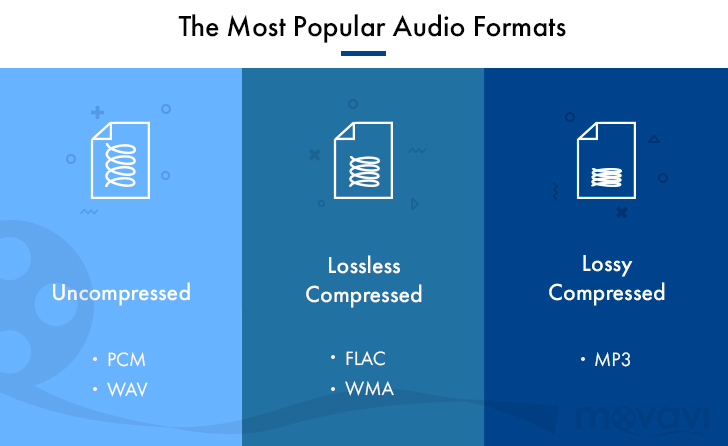
There are two main types of audio compression: lossless and lossy. Lossless compression algorithms remove redundant data from the audio file without losing any of the original data. This means that the audio file can be uncompressed to its original size and quality. Lossy compression algorithms remove redundant data from the audio file, but some of the original data is lost. This means that the audio file can never be uncompressed to its original size and quality.

Lossless Audio Compression Formats

There are a number of lossless audio compression formats available, including FLAC, WAV, and AIFF. FLAC is the most popular lossless audio compression format. It offers high compression ratios with minimal loss of quality. WAV is the uncompressed audio format. It is the most commonly used audio format for professional audio. AIFF is the uncompressed audio format used by Apple products.

Lossy Audio Compression Formats

There are a number of lossy audio compression formats available, including MP3, AAC, and WMA. MP3 is the most popular lossy audio compression format. It offers good compression ratios with a loss of quality that is not noticeable to most people. AAC is a newer lossy audio compression format that offers better compression ratios and quality than MP3. WMA is a lossy audio compression format developed by Microsoft. It offers similar compression ratios and quality to MP3.

Which Audio Compression Format Should I Use?

The best audio compression format to use depends on your needs. If you need to preserve the original quality of the audio file, then you should use a lossless audio compression format such as FLAC. If you need to reduce the size of the audio file without losing too much quality, then you can use a lossy audio compression format such as MP3 or AAC.

Conclusion

Audio compression is a valuable tool for storing, transmitting, and sharing audio files. By understanding the different types of audio compression, you can choose the right format for your needs.

8 Subtitles

Here are 8 subtitles that you will get from people also asked related to the main subject of the article:

  1. What is audio compression?
  2. What are the different types of audio compression?
  3. What are the benefits of audio compression?
  4. What are the drawbacks of audio compression?
  5. Which audio compression format should I use?
  6. How do I compress an audio file?
  7. How do I decompress an audio file?
  8. What are some common problems with audio compression?

Benefits of Audio Compression

There are a number of benefits to audio compression. These include:

  • Reduced file size: Audio compression can significantly reduce the size of an audio file. This makes it easier to store, transmit, and share audio files.
  • Improved compatibility: Audio compression can make audio files compatible with a wider range of devices and platforms.
  • Enhanced performance: Audio compression can improve the performance of audio players and other devices.

Drawbacks of Audio Compression

There are a number of drawbacks to audio compression. These include:

  • Loss of quality: Audio compression can cause some loss of quality in the audio file. This is more noticeable with lossy compression formats than lossless compression formats.
  • Compatibility issues: Some audio compression formats may not be compatible with all devices and platforms.
  • Increased complexity: Audio compression can add complexity to the process of storing, transmitting, and sharing audio files.

Which Audio Compression Format Should I Use?

The best audio compression format to use depends on your needs. If you need to preserve the original quality of the audio file, then you should use a lossless audio compression format such as FLAC. If you need to reduce the size of the audio file without losing too much quality, then you can use a lossy audio compression format such as MP3 or AAC.

How to Compress an Audio File

To compress an audio file, you can use a variety of software programs. Some popular programs include:

  • FLAC: A free and open-source lossless audio compression program.
  • WAV: A free and open-source uncompressed audio compression program.
  • AIFF: A free and open-source uncompressed audio compression program.

How to Decompress an Audio File

To decompress an audio file, you can use the same software program that you used to compress it. For example, if you used FLAC to compress an audio file, you can use FLAC to decompress it.

How an MP3 compresses music

We all know that MP3 was the audio format that quickly became popular and the main reason is because it took up much less space than the WAV format that has no compression and therefore was very difficult to transfer via internet from one computer to another.

And then it was when the MP3 made its appearance because it had a very good sound and yet it took between 7 and 10 times less space than the original file.

We all know that this caused people to easily exchange music files online and this changed even the way the music industry works thereafter.

But although we all know that MP3 takes up less space, it is very few people who understand that in the first place in MP3 what it does is compress the music. But it also uses some other procedures to make music take up less disk space, Today we will briefly explain how this mp3 performs this compression.

Remove inaudible sounds

One of the first things MP3 does is to analyze the music file and eliminate all those frequencies that are not audible to the human ear but nevertheless occupy a space in the original file. Then the MP3 saves a lot of space without losing quality by eliminating sound frequencies that the human ear cannot hear.

Eliminate redundancy

Another of the mechanics that is used for an mp3 saves space is to eliminate redundant sounds. And with that we understand sounds that sound very similar and basically occupy the same Soundtracks. Therefore, the ear will only perceive some. And then the MP3 eliminates those redundant sounds that will not be heard by the human ear.

Sound masking

Acoustics and audio specialists have long discovered that when the human ear perceives more than one sound simultaneously it is very likely that one of them masks the others.

The Sound perception produces that when a person perceives 2 sounds of different intensity at the same time the weakest sound, with less volume, is inaudible to the one who is listening. This, as we indicated earlier, is what is called the sound perception and the MP3 is based a lot on the sound perception to be able to eliminate sounds under this principle of sound masking.

In other words, in MP3 you decide which sound will mask others and then eliminate these others.

It should be noted that when one decides if the MP3 encodes at 128 kilo bytes per second or at 320 kbs it is modifying the amount of sounds that will be eliminated in the masking. Well, at 320 to eliminate very few sounds and as I lowered the number of kbs it will eliminate more sounds which the person can produce if he can distinguish a difference between the original audio file and the encoded file.