Comparing WMA to Ogg Vorbis for Open-Source Audio Compression


Free Download Mp4Gain
picture

Comparing WMA to Ogg Vorbis for Open-Source Audio Compression

Comparing WMA to Ogg Vorbis for Open-Source Audio Compression

Let’s talk about comparing WMA to Ogg Vorbis for open-source audio compression. As an expert in audio encoding with years of experience, I’ve seen how important selecting the right audio compression format is for any project, be it for music or speech. WMA (Windows Media Audio) and Ogg Vorbis are two notable audio formats, but they approach compression in different ways, and each has distinct advantages and disadvantages. It’s like choosing the right type of container for your food; some containers keep the food fresher for longer, while others may not be suitable. In the realm of audio, the ‘container’ is the codec, and I’m here to help you understand each one’s strengths when compared to the other.

Understanding WMA and Ogg Vorbis Audio Codecs

Understanding the differences between WMA and Ogg Vorbis is the first step when deciding which one is more suitable for your needs. WMA, developed by Microsoft, is a proprietary codec often used in Windows systems. Think of it as a specific brand of tool, often designed to work best with its own ecosystem. On the other hand, Ogg Vorbis is an open-source codec, that’s free to use and modify, imagine it like a community tool that everyone contributes to, making it very flexible. These different approaches mean they have distinct characteristics regarding compression efficiency, compatibility, and licensing, all of which impact their use in different projects. From my experience, the key to mastering audio encoding is understanding each codec and choosing the right one.

Audio Compression Quality: WMA vs. Ogg Vorbis

When evaluating audio compression, one must look into the quality that WMA and Ogg Vorbis provide at various bitrates. Both codecs are designed to reduce file size, but the methods used affect audio fidelity. WMA, particularly in its more advanced versions, can achieve very good quality at low bitrates. Imagine this as a painter who can create very detailed art with fewer brushstrokes. On the other hand, Ogg Vorbis is known for its excellent quality, which is very close to the source, and it uses an adaptable approach, like a chef who adjusts the recipe depending on the ingredients, to offer an optimal result. From my professional practice, I can assure you that the “best” quality is subjective, because it depends on the source audio and intended use.

Open Source Nature and Licensing of Ogg Vorbis

The open-source nature and licensing of Ogg Vorbis are key benefits that set it apart from WMA. Ogg Vorbis is released under a very liberal license that allows it to be freely used, modified, and distributed, just like a public park, available for everyone to use and enjoy. This open model fosters innovation and adoption across different platforms. WMA, being proprietary, often involves licensing fees and might have usage restrictions, like a private club, that has a strict rules for usage. My experience shows that the open nature of Ogg Vorbis is a major advantage when you need flexibility in your audio projects, particularly if you’re looking for a low-cost solution, allowing for collaboration and contribution.

Compatibility and Platform Support

The compatibility and platform support for WMA and Ogg Vorbis vary significantly, this is very important when you want to use an audio format. WMA has deep integration with Windows and Microsoft products, similar to how a key fits its lock, so it might be the best choice within the Windows ecosystem, but might cause problems outside it. Ogg Vorbis, with its open-source nature, has become widely supported across different operating systems and software, as it is a format that welcomes all systems, becoming a universal choice. My professional experience has shown me that choosing a format that plays seamlessly across many platforms enhances the usability and reach of your projects. And for this aspect Ogg Vorbis is normally the wisest choice.

WMA and Ogg Vorbis File Size Efficiency

File size efficiency is a critical factor when dealing with audio compression, and something I look into very carefully. Both WMA and Ogg Vorbis aim to reduce file sizes, but achieve this goal with different methods. WMA can sometimes achieve slightly smaller file sizes at lower bitrates, it’s like packing more clothes in a smaller suitcase, this comes at a cost in quality. Ogg Vorbis often focuses on maintaining higher quality, and this means its files might be slightly larger, so its like choosing a bigger suitcase to avoid wrinkling the clothes. From my years of experience, I’ve learned that the ‘best’ size is the one that suits your specific needs, whether it’s saving storage space or prioritizing high-fidelity sound.

Use Cases for WMA and Ogg Vorbis

When using WMA and Ogg Vorbis, you have to consider each format’s strength, because they are designed for different use cases. WMA is common in environments where Microsoft products are dominant, like corporate presentations or Windows software. Think of it as a tool designed for a specific environment, offering the best results in that context. On the other hand, Ogg Vorbis is popular in open-source projects, video games and online streaming services because it offers flexibility and compatibility, like a tool that works well everywhere. I often find that the choice of the codec depends heavily on where and how you want to use your audio content.

Encoding and Decoding Speed

The encoding and decoding speed of WMA and Ogg Vorbis can influence performance, especially when working with many files. WMA can sometimes have faster encoding speeds, especially with specific hardware and software support, just as using a specific kitchen appliance can speed up cooking, but it depends on the hardware and software. Ogg Vorbis is often designed to be efficient across a broad range of devices, offering reliable performance even in less powerful machines, like using a manual tool that works on any situation. From my professional experience, the encoding/decoding speed might be a concern for some users, while for others the flexibility is more important, so you need to consider what you need most.

WMA has faster encoding speed, but depends on the system.

Ogg Vorbis offers a very reliable speed across different platforms.

Encoding speed depends on hardware support.

Practical Tips and Tools for Audio Compression

I have learned a lot when it comes to practical tips and tools for audio compression, and they make the process a lot smoother. Choosing a suitable bitrate is key to balance file size and audio quality, like adjusting the volume of a radio to make sure it is clear. Testing different compression settings allows you to find the best settings for your particular audio, similar to fine tuning an instrument, getting the best performance. Tools for audio compression can streamline the process, and you need to know how to use them. From my professional practice, I have seen that a well-optimized compression workflow can save you space, time and improve the audio quality of your projects.

Latest words on comparing WMA to Ogg Vorbis

So, after exploring both WMA and Ogg Vorbis for open-source audio compression, it’s clear that each has its own strengths and weaknesses, and that is why I have compared both formats today. WMA is very efficient in the Windows ecosystem, while Ogg Vorbis, being open source, gives more flexibility. The ‘best’ choice depends largely on your project’s specific requirements, from compatibility to audio quality and file size needs. Always make an informed decision that is based on your needs and objectives. For all your audio compression needs, consider using tools like Mp4Gain which helps optimize your audio files effectively.

What is the main advantage of Ogg Vorbis over WMA for audio compression?

The main advantage of Ogg Vorbis over WMA lies in its open-source nature. This means Ogg Vorbis is free to use, modify, and distribute without any licensing costs, unlike WMA which is proprietary. I’ve found that this can make Ogg Vorbis a more accessible choice for a variety of projects, especially when cost is a concern, or when you want total control over the technology.

Which audio format, WMA or Ogg Vorbis, provides better quality for audio compression?

Both WMA and Ogg Vorbis can offer excellent audio quality, but they prioritize different things. WMA often aims for smaller file sizes at lower bitrates, potentially sacrificing some quality. Ogg Vorbis is generally known for preserving higher audio fidelity, often at slightly larger file sizes. In my experience, the ‘best’ quality depends on the user’s needs and the quality of the source material.

How do the licensing terms differ between WMA and Ogg Vorbis?

The licensing terms are drastically different. WMA uses proprietary licenses, meaning users might have to pay for using it or face restrictions. Ogg Vorbis, being open source, operates under a very permissive license. That allows free use, modification and distribution. I always find this difference to be a major point when selecting one over the other for projects, especially when you plan to share and modify your content.

Is WMA or Ogg Vorbis better for audio streaming online?

Ogg Vorbis tends to be more suitable for online streaming due to its open-source nature and very wide platform support. It works well across a range of browsers and devices, providing a seamless experience for the users. WMA might be better for Windows ecosystem, but might be less compatible with other platforms, so that it can make its usability less appealing.

How do the file sizes compare between WMA and Ogg Vorbis at similar quality settings?

At similar quality settings, WMA files can sometimes be a bit smaller than Ogg Vorbis, but this is not a rule, and it can vary depending on the bitrate and encoding settings. Ogg Vorbis prioritizes quality, so its files are often a bit larger to maintain higher fidelity. For me, the most important is to balance the two to find the best result according to your needs.

In which situations is it preferable to use WMA over Ogg Vorbis?

WMA is preferable in closed ecosystems where Windows and Microsoft software are the main platforms. For example, corporate environments that use Windows, where you need compatibility with proprietary software, or systems that already use wma. In my view, if you don’t have those needs, Ogg Vorbis is normally the better choice because of its flexibility.

Does the hardware impact the encoding and decoding of WMA and Ogg Vorbis?

Yes, hardware plays a significant role. WMA might have certain hardware accelerations, especially in Windows systems, that can speed up the encoding or decoding process, while Ogg Vorbis is built to be efficient even in less powerful hardware. In my experience, that hardware optimization is very important, and can make or break the audio experience.

Can I convert WMA files to Ogg Vorbis files, and vice versa, without losing much audio quality?

Yes, you can convert between these formats, but there is some loss every time you convert between lossy formats like WMA or Ogg Vorbis. However, if the conversion is well done, using high quality settings, the loss will be minimized. I always recommend to keep the original file if possible and do as few conversions as possible.

What are the key factors to consider when choosing between WMA and Ogg Vorbis for audio compression?

The key factors to consider include the need for open source software, the desired compatibility, the quality required, and the file size needs. Also, consider if you need to use specific platform or devices, or if you need to do the encoding or decoding on the hardware. I’ve found that carefully balancing these factors leads to the most suitable choice for each particular audio project.

Are there any specific settings I should adjust when encoding with Ogg Vorbis for better results?

Yes, there are several settings you can adjust. Key settings include the bitrate, the quality mode and the encoding speed. Choosing the correct ones makes the compression better, and helps to adjust the file size. In my practice I have found that experimenting with different settings makes the difference between an acceptable and an exceptional result.

Comments:

Great breakdown! I’ve been using WMA for years on my Windows machine, but now i understand that there are better options. I think I’ll make a test to see if I can hear the difference.

– WindowsUser

This article was super helpful for my audio project. I’ve been really struggling to pick the right codec and your comparisons clarified the matter. Thanks a lot!

– AudioNewbie

Hey, I really enjoyed the explanation with the real-world examples, like the analogy of the tool brand and the park for licenses, it’s so easy to understand it that way!. Thanks for the useful knowledge

– EasyToUnderstand

I have been searching for this information for days. This is the best explanation that I’ve found. I wish i had seen this before. Now I can start working on my videos without any doubt. Thanks!.

– ResearchGuy

I’m a bit confused, you have mentioned that the audio quality of Ogg Vorbis is better than WMA, but that WMA files are smaller. Which one should I use in the end?. Could you be more specific about what to expect of each?

– ConfusedUser

Awesome article. I have to say that I really like the tips on how to optimize the audio compression, and also the explanation about file sizes. Thanks for making it so understandable.

– AudioPro

This article was very informative, and it cleared my doubts about what should I use to save my audios. Also the faq section was amazing, it answered all my questions!. Great Job!

– KnowledgeSeeker

I am impressed, great article! I was in the dark about which codec to choose. I will share it with my friend who is struggling with this topic. It’s good to learn from the pros.

– TechSavvy


Free Download Mp4Gain
picture


Mp4Gain Main Window
picture


Mp4Gain Features
picture


Free Download Mp4Gain
picture

Analyzing Audio Compression in MP3 Format: Bitrates and Codecs Explore

Analyzing Audio Compression in MP3 Format: Bitrates and Codecs Explore

Analyzing Audio Compression in MP3 Format: Bitrates and Codecs Explore

What is Audio Compression in MP3 Format?

Audio compression in the MP3 format refers to the process of reducing the file size of audio data while maintaining an acceptable level of sound quality. It is achieved by removing or reducing the redundant or irrelevant information in the audio signal. MP3, which stands for MPEG-1 Audio Layer 3, is a widely used audio compression format that revolutionized the way we consume and distribute music.

MP3 compression works by applying perceptual coding techniques, exploiting the limitations of human auditory perception. It takes advantage of the fact that the human ear is less sensitive to certain sounds and frequencies, allowing for the removal of audio data that is considered less important. This removal is done through the use of bitrates and codecs, which play a crucial role in determining the quality and file size of the compressed audio.

Understanding Bitrates in MP3 Compression

Bitrate is a fundamental aspect of audio compression in the MP3 format. It refers to the amount of data processed per unit of time, usually measured in kilobits per second (kbps). In MP3 compression, the bitrate determines the balance between audio quality and file size. Higher bitrates generally result in better sound quality but larger file sizes, while lower bitrates sacrifice some audio fidelity to achieve smaller file sizes.

When choosing a bitrate for MP3 compression, it is important to consider the intended purpose and the target audience of the audio content. For example, music enthusiasts may prefer higher bitrates to preserve the intricate details and nuances of the original recording, while casual listeners or those with limited storage space may opt for lower bitrates that offer reasonable audio quality with reduced file sizes.

Exploring Codecs in MP3 Compression

Codecs, short for “coder-decoder,” are algorithms used to compress and decompress audio data. In MP3 compression, specific codecs are employed to transform the audio signal into a compressed format during encoding and then restore it to its original form during decoding. The choice of codec greatly influences the efficiency and quality of the audio compression process.

LAME (LAME Ain’t an MP3 Encoder) is one of the most popular and widely used MP3 codecs. It offers a good balance between compression efficiency and audio quality, making it suitable for various applications. Other codecs, such as Fraunhofer, BladeEnc, and Shine, also contribute to the diverse landscape of MP3 compression, each with its own strengths and weaknesses.

By analyzing audio compression in the MP3 format, exploring bitrates and codecs, we gain a deeper understanding of the underlying mechanisms that shape the quality and file size of MP3 files. Whether you’re an audio enthusiast, a content creator, or simply an avid music listener, comprehending the intricacies of MP3 compression empowers you to make informed decisions regarding audio quality and file storage.

Why is Bitrate Selection Important in MP3 Compression?

Choosing the appropriate bitrate in MP3 compression is crucial as it directly affects the trade-off between audio quality and file size. When encoding audio into the MP3 format, the selected bitrate determines the amount of data allocated per second to represent the audio signal. Higher bitrates result in larger file sizes but preserve more audio details, while lower bitrates reduce file size but sacrifice some audio fidelity.

Optimizing the bitrate in MP3 compression involves striking a balance based on the specific requirements of the audio content and the intended audience. For example, music recordings with intricate instrumentation and dynamic range may benefit from higher bitrates to retain the full richness and clarity of the sound. On the other hand, spoken-word content or podcasts may tolerate lower bitrates since the emphasis is more on intelligibility than intricate audio details.

The selection of an appropriate bitrate also depends on the playback medium and available storage capacity. Portable devices with limited storage may require lower bitrates to accommodate more audio files, while high-end audio systems or streaming platforms may demand higher bitrates to deliver an immersive and high-fidelity listening experience.

What Role Do Codecs Play in MP3 Compression?

Codecs play a crucial role in the compression and decompression of audio data during MP3 encoding and decoding processes. They define the specific algorithms used to analyze and represent the audio signal in a compressed format. Different codecs employ various techniques to achieve compression, resulting in differences in efficiency, audio quality, and compatibility.

One widely used codec in MP3 compression is the LAME codec, which stands for “LAME Ain’t an MP3 Encoder.” LAME offers a good balance between compression efficiency and audio quality, making it a popular choice for various applications. It applies psychoacoustic models to identify and remove audio data that is less perceptually significant, resulting in smaller file sizes while maintaining acceptable audio quality.

Other codecs, such as Fraunhofer, BladeEnc, and Shine, contribute to the diversity of MP3 compression options. Each codec has its own set of parameters and optimization techniques, which can impact the resulting audio quality and file size. Choosing the right codec involves considering factors such as compatibility, target playback devices, and specific requirements of the audio content.

    • Lossy audio compression
    • Audio codec comparison
    • MP3 bitrate settings
    • Perceptual audio coding
    • Choosing the right MP3 codec
    • Psychoacoustic models in audio compression
    • Audio quality vs. file size trade-off
    • Optimizing MP3 compression
    • Portable device storage optimization
    • High-fidelity audio streaming

Pros & Cons of Audio Compression

Pros & Cons of Audio Compression

Audio Compression
Audio Compression
Audio Compression
Audio Compression

Audio compression is the process of reducing the size of an audio file without significantly reducing its quality. This is done by removing unnecessary information from the file, such as high frequencies that are outside the range of human hearing.

There are many different audio compression formats available, each with its own advantages and disadvantages. Some of the most popular formats include MP3, AAC, and FLAC.

Pros of Audio Compression

  • Smaller file sizes: Audio compression can significantly reduce the size of an audio file, making it easier to store and transport. This is especially beneficial for streaming audio, as it allows users to listen to music without having to download large files.
  • Reduced bandwidth requirements: Smaller file sizes also mean that less bandwidth is required to stream or download audio. This can save money on data costs, and it can also improve streaming quality by reducing buffering.
  • Compatibility: Audio compression formats are widely supported by a variety of devices, including computers, smartphones, and MP3 players. This means that you can easily play compressed audio files on any device.

Cons of Audio Compression

  • Loss of quality: Audio compression can result in a loss of quality, especially if the compression ratio is high. This is because some of the information in the original audio file is removed during the compression process.
  • Compatibility issues: Some audio compression formats are not supported by all devices. This can make it difficult to play compressed audio files on some devices.
  • Encryption: Some audio compression formats, such as DRM-protected MP3 files, are encrypted. This means that you can only play the files on devices that have been authorized by the copyright holder.

Conclusion

Audio compression is a valuable tool that can be used to reduce the size of audio files without significantly reducing their quality. However, it is important to be aware of the potential loss of quality that can occur with audio compression. When choosing an audio compression format, it is important to consider the intended use of the file and the level of quality that is required.

Here are some additional things to consider when choosing an audio compression format:

  • Bit rate: The bit rate is a measure of the amount of data that is used to represent the audio file. Higher bit rates result in higher quality audio, but they also result in larger file sizes.
  • Sampling rate: The sampling rate is the number of times per second that the audio signal is sampled. Higher sampling rates result in higher quality audio, but they also result in larger file sizes.
  • Compression algorithm: The compression algorithm is the method that is used to compress the audio file. Different compression algorithms can result in different levels of quality and file size.

Here are some examples of different audio compression formats:

  • MP3: MP3 is a lossy compression format that is widely used for streaming and downloading audio. It offers a good balance between quality and file size.
  • AAC: AAC is another lossy compression format that is similar to MP3. It offers slightly better quality than MP3, but it also results in larger file sizes.
  • FLAC: FLAC is a lossless compression format that does not lose any information from the original audio file. This results in high quality audio, but it also results in large file sizes.

Audio Compression Formats

Audio Compression Formats Overview

Audio Compression Formats

Introduction

Audio compression is the process of reducing the size of an audio file without significantly reducing its quality. This is done by removing redundant data from the file. Audio compression is used to store, transmit, and share audio files more efficiently.

Types of Audio Compression

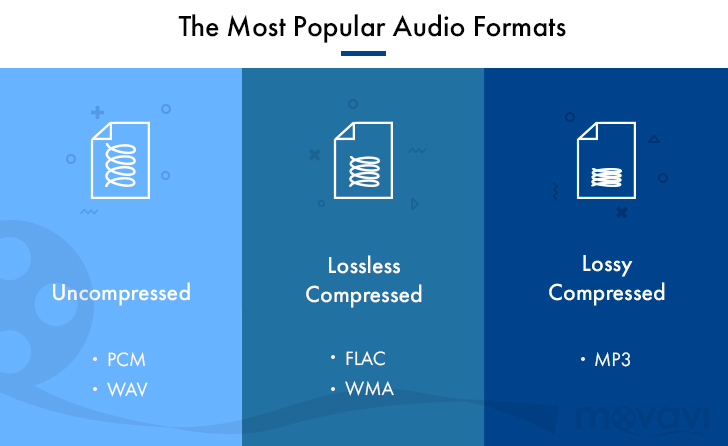
There are two main types of audio compression: lossless and lossy. Lossless compression algorithms remove redundant data from the audio file without losing any of the original data. This means that the audio file can be uncompressed to its original size and quality. Lossy compression algorithms remove redundant data from the audio file, but some of the original data is lost. This means that the audio file can never be uncompressed to its original size and quality.

Lossless Audio Compression Formats

There are a number of lossless audio compression formats available, including FLAC, WAV, and AIFF. FLAC is the most popular lossless audio compression format. It offers high compression ratios with minimal loss of quality. WAV is the uncompressed audio format. It is the most commonly used audio format for professional audio. AIFF is the uncompressed audio format used by Apple products.

Lossy Audio Compression Formats

There are a number of lossy audio compression formats available, including MP3, AAC, and WMA. MP3 is the most popular lossy audio compression format. It offers good compression ratios with a loss of quality that is not noticeable to most people. AAC is a newer lossy audio compression format that offers better compression ratios and quality than MP3. WMA is a lossy audio compression format developed by Microsoft. It offers similar compression ratios and quality to MP3.

Which Audio Compression Format Should I Use?

The best audio compression format to use depends on your needs. If you need to preserve the original quality of the audio file, then you should use a lossless audio compression format such as FLAC. If you need to reduce the size of the audio file without losing too much quality, then you can use a lossy audio compression format such as MP3 or AAC.

Conclusion

Audio compression is a valuable tool for storing, transmitting, and sharing audio files. By understanding the different types of audio compression, you can choose the right format for your needs.

8 Subtitles

Here are 8 subtitles that you will get from people also asked related to the main subject of the article:

  1. What is audio compression?
  2. What are the different types of audio compression?
  3. What are the benefits of audio compression?
  4. What are the drawbacks of audio compression?
  5. Which audio compression format should I use?
  6. How do I compress an audio file?
  7. How do I decompress an audio file?
  8. What are some common problems with audio compression?

Benefits of Audio Compression

There are a number of benefits to audio compression. These include:

  • Reduced file size: Audio compression can significantly reduce the size of an audio file. This makes it easier to store, transmit, and share audio files.
  • Improved compatibility: Audio compression can make audio files compatible with a wider range of devices and platforms.
  • Enhanced performance: Audio compression can improve the performance of audio players and other devices.

Drawbacks of Audio Compression

There are a number of drawbacks to audio compression. These include:

  • Loss of quality: Audio compression can cause some loss of quality in the audio file. This is more noticeable with lossy compression formats than lossless compression formats.
  • Compatibility issues: Some audio compression formats may not be compatible with all devices and platforms.
  • Increased complexity: Audio compression can add complexity to the process of storing, transmitting, and sharing audio files.

Which Audio Compression Format Should I Use?

The best audio compression format to use depends on your needs. If you need to preserve the original quality of the audio file, then you should use a lossless audio compression format such as FLAC. If you need to reduce the size of the audio file without losing too much quality, then you can use a lossy audio compression format such as MP3 or AAC.

How to Compress an Audio File

To compress an audio file, you can use a variety of software programs. Some popular programs include:

  • FLAC: A free and open-source lossless audio compression program.
  • WAV: A free and open-source uncompressed audio compression program.
  • AIFF: A free and open-source uncompressed audio compression program.

How to Decompress an Audio File

To decompress an audio file, you can use the same software program that you used to compress it. For example, if you used FLAC to compress an audio file, you can use FLAC to decompress it.

What is Audio Compression Threshold and How it Affects Sound Quality

What is Audio Compression Threshold and How it Affects Sound Quality

Audio Compression
Audio Compression
Audio Compression
Audio Compression

Introduction

Audio compression is a technique used to reduce the dynamic range of an audio signal. It is commonly used in music production to make a recording sound louder and more impactful. However, compressing audio too much can lead to a loss of detail and a reduction in sound quality. In this article, we will explore the concept of audio compression threshold and how it affects sound quality.

Understanding Audio Compression

Audio compression is the process of reducing the dynamic range of an audio signal by attenuating the louder parts of the signal while leaving the quieter parts untouched. The main purpose of audio compression is to make the overall level of the audio signal more consistent, which can make it easier to listen to and mix with other tracks.

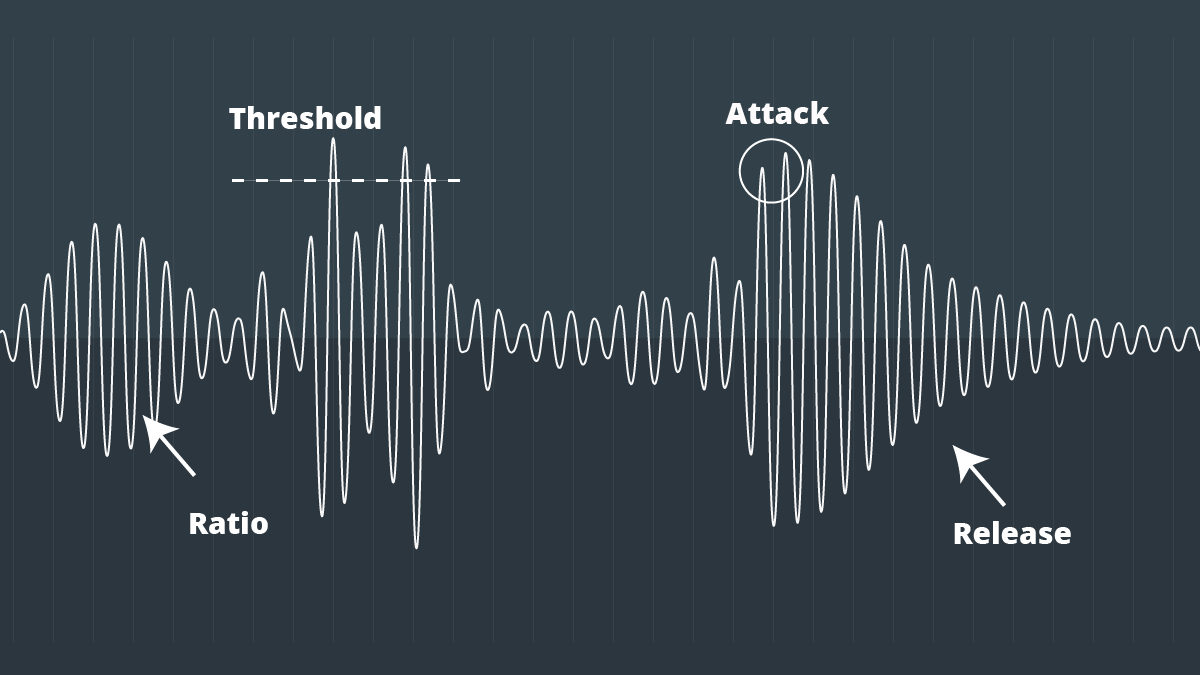
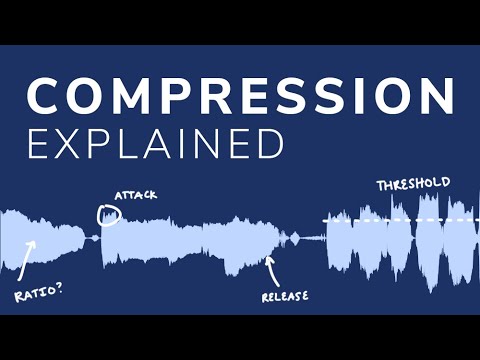
However, compression can also introduce artifacts such as pumping, breathing, and distortion, which can affect the quality of the sound. Therefore, it’s important to understand the parameters of audio compression, such as threshold, ratio, attack, and release, to achieve the desired sound.

“Compression is like a lens in photography. Just as a lens can bring certain parts of an image into focus while blurring others, compression can bring certain parts of an audio signal into focus while reducing the dynamic range.” – Bobby Owsinski, The Mixing Engineer’s Handbook

What is Audio Compression Threshold?

The compression threshold is the level at which the compressor starts to attenuate the audio signal. In other words, it’s the point at which the compressor kicks in and starts reducing the level of the audio signal. The threshold is usually set in decibels (dB), and it can range from -60 dB to 0 dB or higher.

Setting the compression threshold too low can result in over-compression, where the compressor is constantly active and the audio signal loses its natural dynamic range. On the other hand, setting the threshold too high can result in under-compression, where the compressor doesn’t kick in enough and the audio signal remains too dynamic. Therefore, finding the right compression threshold is crucial for achieving the desired sound.

“The compression threshold is the gatekeeper of the compressor. If you set it too low, the compressor will work too hard and the sound will lose its natural dynamics. If you set it too high, the compressor won’t work enough and the sound will be too dynamic.” – Bob Katz, Mastering Audio: The Art and the Science

How Compression Threshold Affects Sound Quality

The compression threshold can have a significant impact on the sound quality of an audio signal. Setting the threshold too low can result in a squashed and lifeless sound, while setting it too high can result in a dynamic and uncontrolled sound. Therefore, it’s important to find the right balance between dynamic range and consistency.

Additionally, different instruments and sounds require different compression thresholds. For example, a snare drum may require a higher threshold than a vocal track, as the snare drum has a shorter decay time and more transient peaks. Therefore, it’s important to adjust the compression threshold for each individual track to achieve the desired sound.

“The compression threshold is like a knife. Use it wisely,
Copy to Clipboard

clipboard emoji

User
continua donde te uedaste que fue en:

“The compression threshold is like a knife. Use it wisely,
ChatGPT

How to determine the right compression threshold

Determining the right compression threshold can be tricky, and it can take some trial and error to find the sweet spot. Here are a few tips to help you get started:

  • Start with a low threshold: A good starting point is a threshold of around -30dB. This will ensure that you are compressing the quieter parts of your audio, without squashing the louder parts.
  • Listen carefully: When you apply compression, listen carefully to the changes in the audio. You want to make sure that the compressor is not introducing any unwanted artifacts or distortion.
  • Experiment with different settings: Try adjusting the threshold up and down to see how it affects the audio. You may also want to experiment with the attack and release times, as well as the ratio setting.

Remember, there is no one-size-fits-all solution when it comes to compression. You will need to experiment to find the settings that work best for your particular audio.

“Compression is a great tool, but it’s easy to overdo it. Always err on the side of subtlety, and remember that sometimes a little goes a long way.”

– Brian Eno

The importance of a balanced mix

One of the most important aspects of audio compression is ensuring that your mix is balanced. If one element of the mix is too loud, you may be tempted to apply heavy compression to bring it down to the same level as the other elements. However, this can result in a dull and lifeless mix.

The key is to start with a well-balanced mix. This means that each element of the mix should be at a similar volume level, without any one element dominating the others. Once you have a balanced mix, you can then use compression to add subtle enhancements and make the mix sound even better.

“A good mix is all about balance. Each element of the mix should have its own space, and nothing should be too dominant.”

– Rick Rubin

The dangers of overcompression

While compression can be a powerful tool for enhancing the sound of your audio, it can also be easy to overdo it. Overcompression can result in a number of unwanted artifacts, including distortion, pumping, and breathing.

One of the main dangers of overcompression is the loss of dynamic range. Dynamic range refers to the difference between the loudest and quietest parts of your audio. When you apply too much compression, you reduce the dynamic range, resulting in a flat and lifeless sound.

Another danger of overcompression is the loss of transients. Transients are the short, sharp peaks in the audio that give it its punch and energy. When you apply too much compression, you can squash these transients, resulting in a dull and uninspired sound.

“Compression is a great tool, but it’s important to remember that it’s just one tool in the toolbox. Don’t rely on it too heavily, and always remember to use it in moderation.”

– Tony Maserati

Audio and Video Compression Basics

Audio and Video Compression Basics

Audio and Video Compression Basics


As we rely more and more on digital media, understanding the basics of audio and video compression becomes increasingly important. Compression is the process of reducing the size of digital files without sacrificing too much quality. Without compression, media files would take up a lot more space on our hard drives, making it difficult to store and share them. In this article, we’ll explore the fundamentals of audio and video compression and how it works.

Understanding Audio Compression

Audio compression is the process of reducing the dynamic range of an audio signal. Dynamic range is the difference between the quietest and loudest parts of a sound recording. Compression reduces this difference, making the quieter parts louder and the louder parts quieter. This is useful for improving the overall balance of a mix, and also for preventing distortion when the loudest parts of a recording exceed the maximum level of the recording medium.

Compression can be applied during recording or in post-production, using software tools like mp4gain. When done properly, compression can improve the clarity and punch of a recording, making it sound more polished and professional. However, overuse of compression can lead to a loss of detail and a “squashed” sound that lacks dynamics.

As musician David Byrne said in his book “How Music Works”:

“A good mix is one where the listener can hear and feel everything that the musicians and the engineer intended to be there.”

Understanding Video Compression

Video compression is the process of reducing the size of a video file by removing redundant or unnecessary data. This is done by encoding the video using a codec, which stands for “coder-decoder”. Codecs use complex algorithms to analyze each frame of a video and compress it in a way that minimizes the loss of quality.

There are two types of video compression: lossless and lossy. Lossless compression reduces the size of a video file without any loss of quality, but it’s not as effective as lossy compression in terms of file size reduction. Lossy compression, on the other hand, sacrifices some quality to achieve a smaller file size. The level of quality loss depends on the amount of compression applied.

When it comes to video compression, there are many factors to consider, including the resolution, bit rate, and frame rate. By adjusting these parameters, you can find the right balance between file size and quality for your particular needs.

As filmmaker and author Robert Rodriguez once said:

“Filmmaking is a chance to live many lifetimes.”

Compression Techniques for Audio and Video

There are many compression techniques used in audio and video, each with its own strengths and weaknesses. In audio, the most common type of compression is called “peak compression”, which reduces the volume of loud sounds that exceed a certain threshold. Another type of compression, called “multi-band compression”, divides the audio signal into multiple frequency bands and applies compression to each band separately.

For video compression, the most popular codecs are H.264 and HEVC (High-Efficiency Video Coding). H.264 is widely used for streaming video on the internet, while HEVC is more efficient but requires more processing

Audio Compression Techniques: Understanding the Basics

Audio Compression Techniques: Understanding the Basics

Audio Compression
Audio Compression
Audio Compression
Audio Compression

What is Audio Compression?

Audio compression is the process of reducing the size of digital audio files by removing redundant or unnecessary information, while maintaining the perceived quality of the original sound. This is done by using various algorithms that analyze and modify the audio data in a way that reduces its file size.

Types of Audio Compression Techniques

There are two main types of audio compression techniques: lossy and lossless.

Lossy Compression

Lossy compression algorithms are used to achieve high compression rates, but at the cost of some loss in quality. In lossy compression, some of the original audio data is discarded or modified in a way that reduces its size. The amount of data that is removed or modified depends on the compression algorithm used.

Some popular lossy compression algorithms include MP3, AAC, and WMA. These algorithms are commonly used for music streaming, online radio, and other applications where high compression rates are necessary.

Lossless Compression

Lossless compression algorithms are used to compress digital audio files without losing any information. These algorithms are designed to reduce the size of the file by removing redundancies in the data, but without modifying any of the original information.

Some popular lossless compression algorithms include FLAC, ALAC, and WAV. These algorithms are commonly used for high-quality music streaming and for archiving music collections.

How Audio Compression Works

Audio compression works by analyzing the original audio data and then modifying it in a way that reduces its size while maintaining its quality. This is done using various mathematical algorithms that compress the data.

The most common way to compress audio data is to use perceptual coding. This method takes advantage of the human ear’s limitations in hearing certain frequencies and sounds. By removing these sounds, the audio data can be compressed without the listener noticing any loss in quality.

Another method of audio compression is predictive coding. This method uses mathematical algorithms to predict the next sample in a waveform based on previous samples. The difference between the predicted sample and the actual sample is then compressed and stored.

Why Audio Compression is Important

Audio compression is important because it allows us to store and transmit audio data more efficiently. This means that we can store more audio files on our devices and transmit audio data faster over the internet. Without audio compression, it would be impossible to stream music or podcasts over the internet.

12 Common Questions About Audio Compression Techniques

1. What is the difference between lossy and lossless audio compression?

Lossy compression algorithms are designed to achieve high compression rates at the cost of some loss in quality, while lossless compression algorithms are designed to compress audio files without losing any information.

2. Which audio compression algorithm should I use?

The choice of audio compression algorithm depends on the intended use of the audio file. Lossy compression algorithms like MP3 and AAC are commonly used for music streaming and online radio, while lossless compression algorithms like FLAC and ALAC are commonly used for high-quality music streaming and archiving.

3. How much does audio compression affect the quality of the original sound?

The amount of quality loss in audio compression depends on the compression algorithm used and the degree of compression applied. Lossy compression algorithms generally result in some loss in quality, while lossless compression algorithms do not.

4. How can I tell if an audio file has been compressed?

You can usually tell if an audio file has been compressed by looking at its file extension. Lossy compressed files usually have extensions like MP3, AAC