What is Audio Compression Ratio and Why Does it Matter?


Free Download Mp4Gain
picture

What is Audio Compression Ratio and Why Does it Matter?

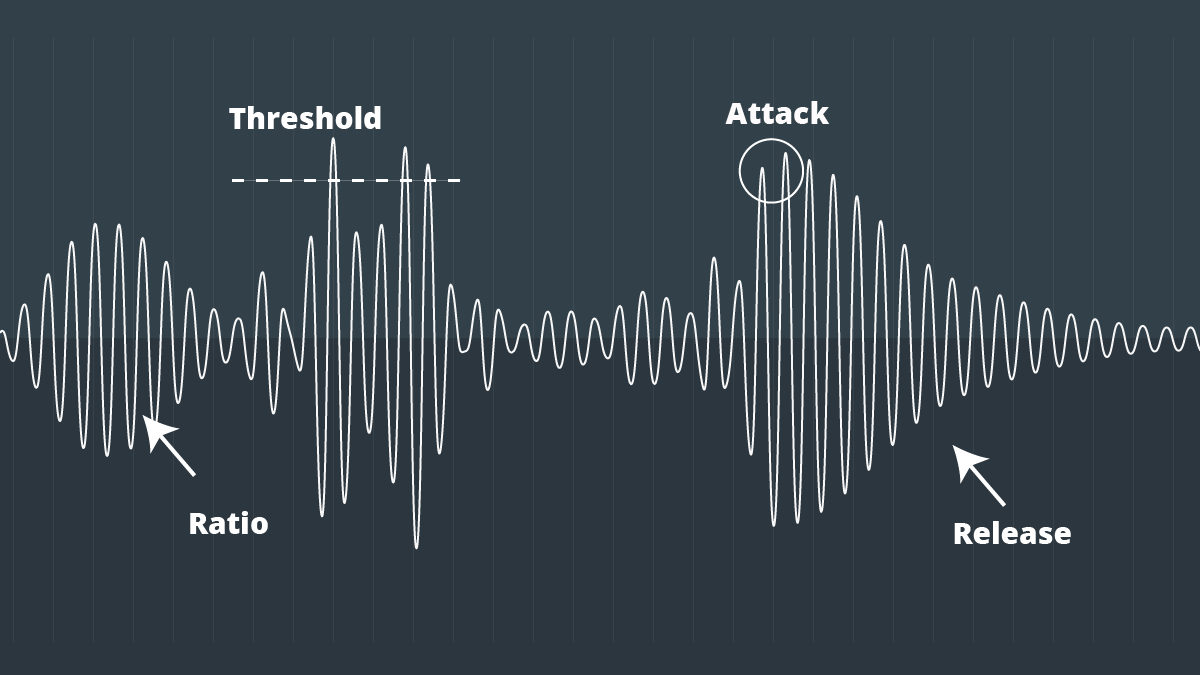
Audio Compression Ratio

Understanding Audio Compression Ratio

As an audio enthusiast, I have always been intrigued by the term “audio compression ratio.” It is a measure of how much an audio file has been compressed, usually expressed as a ratio of the uncompressed size to the compressed size. The higher the ratio, the more compressed the file is. But why does it matter? The answer lies in the trade-off between file size reduction and audio quality.
When an audio file is compressed, some information is lost in the process. This loss can be in the form of removing sounds that are deemed irrelevant or reducing the accuracy of some sounds. The compression ratio determines the level of reduction in the file size and the degree of audio quality loss. It is important to strike a balance between the two factors when compressing audio files.

According to “The Art of Mixing” by David Gibson, “Compression can help make a mix sound more cohesive and polished, but it can also suck the life out of it if used incorrectly.” Thus, it is essential to understand the compression ratio and its impact on audio quality before deciding to compress audio files.

Lossless Audio Compression

Lossless audio compression is a method of compressing audio files without losing any information. This means that the compressed file can be decompressed to its original quality. Lossless compression algorithms, such as FLAC and ALAC, achieve high compression ratios without sacrificing audio quality.
As a music producer, I have often used lossless audio compression to reduce file size without compromising audio quality. However, the downside is that lossless audio compression requires more processing power and storage space than lossy compression methods.

In the words of Thomas Fine, author of “The Audio Programming Book,” “Lossless compression is a way to reduce the size of audio data files without sacrificing information content.” Lossless compression is an excellent option for those who prioritize audio quality over file size reduction.

Audio Normalization and Compression

Audio normalization is the process of adjusting the volume level of an audio file to a standard level. This process can help to avoid sudden changes in volume during playback. Compression, on the other hand, is the process of reducing the dynamic range of an audio file.
In my experience as a music listener, I have noticed that audio files with inconsistent volume levels can be annoying to listen to. Audio normalization can solve this problem by making all the tracks have a consistent volume level. Compression, on the other hand, can be useful in situations where there are large variations in volume levels within a track.

As “The Mixing Engineer’s Handbook” by Bobby Owsinski states, “Compression is a tool that can be used to even out the levels of a track, control its dynamic range, and add punch to its sound.” Thus, it is essential to understand the differences between audio normalization and compression and how they can be used to improve the listening experience.

Conclusion

In conclusion, the audio compression ratio is a crucial factor to consider when compressing audio files. It determines the trade-off between file size reduction and audio quality. Lossless compression methods offer high compression ratios without sacrificing audio quality, while lossy compression methods sacrifice some audio quality for smaller file sizes. Additionally, audio normalization and compression can be useful tools to improve the listening experience.
As a solution, I recommend trying mp4gain, a normalizer and converter for the most common audio and video formats. It also has an integrated equalizer for further audio adjustment.

Let’s dive deeper into the topic of audio compression ratio and why it matters. Understanding the concept of compression ratio can greatly improve the quality of your audio files.

What is audio compression ratio?

Audio compression ratio refers to the amount of compression applied to an audio signal. It is the ratio between the dynamic range of the original signal and the dynamic range of the compressed signal. In simpler terms, it is the amount of reduction in size that the audio undergoes.

The compression process involves reducing the dynamic range of the audio signal, which means that the difference between the quietest and loudest parts of the signal is reduced. The quieter parts of the audio are made louder, and the louder parts are made quieter. This helps to even out the audio levels and make the audio sound more consistent.

Why does audio compression ratio matter?

Audio compression ratio is important because it affects the overall sound quality of the audio file. Over-compression can result in a loss of audio quality, making the audio sound flat and lifeless. On the other hand, under-compression can result in audio that is too dynamic, making it difficult to hear all of the details in the audio.

Compression ratio also affects the file size of the audio file. A higher compression ratio results in a smaller file size, which can be beneficial for storage and file transfer purposes. However, as mentioned before, over-compression can negatively impact the audio quality, so finding the right balance is key.

My experience with audio compression ratio

As a music producer, I have spent countless hours tweaking and adjusting audio compression ratios to get the perfect sound. It can be a tedious process, but the results are worth it. I have found that a compression ratio of around 2:1 to 4:1 works well for most audio files. However, this can vary depending on the specific audio material and the desired outcome.

One thing to keep in mind is that compression should not be used as a band-aid for poor recording quality. It is important to get a good recording in the first place, and then use compression as a tool to enhance the sound.

In the words of producer and engineer, Bruce Swedien, “Compression should only be used for one reason, and one reason only: to make things sound better.”

Conclusion

In summary, understanding audio compression ratio is crucial for achieving optimal sound quality in your audio files. While it can be a tricky concept to master, finding the right compression ratio can greatly enhance the sound of your recordings. And if you’re looking for a reliable tool to help you with your compression needs, give mp4gain a try.


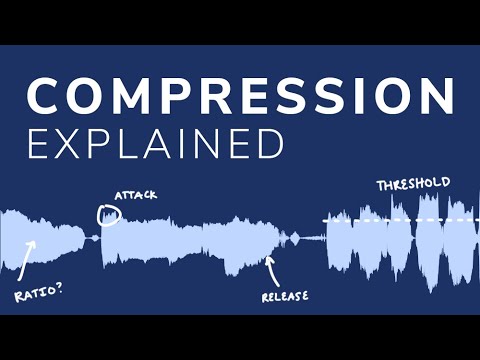
Free Download Mp4Gain
picture


Mp4Gain Main Window
picture


Mp4Gain Features
picture


Free Download Mp4Gain
picture

Audio and Video Compression Basics

Audio and Video Compression Basics

Audio and Video Compression Basics


As we rely more and more on digital media, understanding the basics of audio and video compression becomes increasingly important. Compression is the process of reducing the size of digital files without sacrificing too much quality. Without compression, media files would take up a lot more space on our hard drives, making it difficult to store and share them. In this article, we’ll explore the fundamentals of audio and video compression and how it works.

Understanding Audio Compression

Audio compression is the process of reducing the dynamic range of an audio signal. Dynamic range is the difference between the quietest and loudest parts of a sound recording. Compression reduces this difference, making the quieter parts louder and the louder parts quieter. This is useful for improving the overall balance of a mix, and also for preventing distortion when the loudest parts of a recording exceed the maximum level of the recording medium.

Compression can be applied during recording or in post-production, using software tools like mp4gain. When done properly, compression can improve the clarity and punch of a recording, making it sound more polished and professional. However, overuse of compression can lead to a loss of detail and a “squashed” sound that lacks dynamics.

As musician David Byrne said in his book “How Music Works”:

“A good mix is one where the listener can hear and feel everything that the musicians and the engineer intended to be there.”

Understanding Video Compression

Video compression is the process of reducing the size of a video file by removing redundant or unnecessary data. This is done by encoding the video using a codec, which stands for “coder-decoder”. Codecs use complex algorithms to analyze each frame of a video and compress it in a way that minimizes the loss of quality.

There are two types of video compression: lossless and lossy. Lossless compression reduces the size of a video file without any loss of quality, but it’s not as effective as lossy compression in terms of file size reduction. Lossy compression, on the other hand, sacrifices some quality to achieve a smaller file size. The level of quality loss depends on the amount of compression applied.

When it comes to video compression, there are many factors to consider, including the resolution, bit rate, and frame rate. By adjusting these parameters, you can find the right balance between file size and quality for your particular needs.

As filmmaker and author Robert Rodriguez once said:

“Filmmaking is a chance to live many lifetimes.”

Compression Techniques for Audio and Video

There are many compression techniques used in audio and video, each with its own strengths and weaknesses. In audio, the most common type of compression is called “peak compression”, which reduces the volume of loud sounds that exceed a certain threshold. Another type of compression, called “multi-band compression”, divides the audio signal into multiple frequency bands and applies compression to each band separately.

For video compression, the most popular codecs are H.264 and HEVC (High-Efficiency Video Coding). H.264 is widely used for streaming video on the internet, while HEVC is more efficient but requires more processing

Audio Compression Techniques: Understanding the Basics

Audio Compression Techniques: Understanding the Basics

Audio Compression
Audio Compression
Audio Compression
Audio Compression

What is Audio Compression?

Audio compression is the process of reducing the size of digital audio files by removing redundant or unnecessary information, while maintaining the perceived quality of the original sound. This is done by using various algorithms that analyze and modify the audio data in a way that reduces its file size.

Types of Audio Compression Techniques

There are two main types of audio compression techniques: lossy and lossless.

Lossy Compression

Lossy compression algorithms are used to achieve high compression rates, but at the cost of some loss in quality. In lossy compression, some of the original audio data is discarded or modified in a way that reduces its size. The amount of data that is removed or modified depends on the compression algorithm used.

Some popular lossy compression algorithms include MP3, AAC, and WMA. These algorithms are commonly used for music streaming, online radio, and other applications where high compression rates are necessary.

Lossless Compression

Lossless compression algorithms are used to compress digital audio files without losing any information. These algorithms are designed to reduce the size of the file by removing redundancies in the data, but without modifying any of the original information.

Some popular lossless compression algorithms include FLAC, ALAC, and WAV. These algorithms are commonly used for high-quality music streaming and for archiving music collections.

How Audio Compression Works

Audio compression works by analyzing the original audio data and then modifying it in a way that reduces its size while maintaining its quality. This is done using various mathematical algorithms that compress the data.

The most common way to compress audio data is to use perceptual coding. This method takes advantage of the human ear’s limitations in hearing certain frequencies and sounds. By removing these sounds, the audio data can be compressed without the listener noticing any loss in quality.

Another method of audio compression is predictive coding. This method uses mathematical algorithms to predict the next sample in a waveform based on previous samples. The difference between the predicted sample and the actual sample is then compressed and stored.

Why Audio Compression is Important

Audio compression is important because it allows us to store and transmit audio data more efficiently. This means that we can store more audio files on our devices and transmit audio data faster over the internet. Without audio compression, it would be impossible to stream music or podcasts over the internet.

12 Common Questions About Audio Compression Techniques

1. What is the difference between lossy and lossless audio compression?

Lossy compression algorithms are designed to achieve high compression rates at the cost of some loss in quality, while lossless compression algorithms are designed to compress audio files without losing any information.

2. Which audio compression algorithm should I use?

The choice of audio compression algorithm depends on the intended use of the audio file. Lossy compression algorithms like MP3 and AAC are commonly used for music streaming and online radio, while lossless compression algorithms like FLAC and ALAC are commonly used for high-quality music streaming and archiving.

3. How much does audio compression affect the quality of the original sound?

The amount of quality loss in audio compression depends on the compression algorithm used and the degree of compression applied. Lossy compression algorithms generally result in some loss in quality, while lossless compression algorithms do not.

4. How can I tell if an audio file has been compressed?

You can usually tell if an audio file has been compressed by looking at its file extension. Lossy compressed files usually have extensions like MP3, AAC

Mp3: Audio Compression.

Audio Digitization.

Sound is a continuous wave that propagates through air or other media, formed by
pressure differences, so that it can be detected by measuring the pressure level in a
point. Sound waves have the proper and measurable characteristics of waves in general,
such as reflection, refraction and diffraction. As it is a continuous wave, a
digitization process to represent it as a series of numbers. Currently, most of
the operations carried out on sound signals are digital, since both storage and
processing and transmission of the signal in digital form offers very significant advantages over
analog methods. Digital technology is more advanced and offers greater possibilities, less
sensitivity to transmission noise and ability to include error protection codes,
as well as encryption. With the appropriate decoding mechanisms, moreover, they can be treated
simultaneously signals of different types transmitted on the same channel. The disadvantage
main aspect of the digital signal is that it requires a much greater bandwidth than that of the signal
analog, hence an exhaustive study is carried out regarding data compression,
some of whose techniques will be the center of our study.
The digitization process consists of two phases: sampling and quantization. In the sampling,
Divide the time axis into discrete segments: the sampling frequency will be the inverse of time
that mediates between one measurement and the next. At this time the quantization is performed, which, in its
In the simplest way, it is simply to measure the signal value in amplitude and save it.

Nyquist’s theorem guarantees that the frequency necessary to sample a signal that has its
Higher components at a given frequency f is at least 2f. Therefore, the range being
higher than human hearing around 20 Khz., the frequency that guarantees a sampling
suitable for any audible sound will be about 40 Khz. Specifically, to get sound
High-quality frequencies of 44.1 Khz are used, in the case of CD, for example, and up to 48 Khz.
in the case of the DAT. Other typical values ​​are submultiples of the first, 22 and 11 Khz. According to
nature of the application of course the appropriate frequencies can be much lower
such that the voice process is usually carried out at a frequency of between 6 and 20 Khz. or
even less. Regarding quantization, it is evident that the more bits used for the
axis division of amplitude, the “finer” the partition will be and therefore the less error in attributing
a concrete amplitude to the sound at every moment. For example, 8 bits offer 256 levels of
quantization and 16, 65536. The dynamic range of human hearing is about 100 dB. The
axis division can be performed at equal intervals or according to a certain density function,
looking for more resolution in certain sections if the signal in question has more components in a certain
intensity zone, as we will see in the coding techniques.
The complete process is usually called PCM (Pulse Code Modulation) and so we
We will refer to it hereinafter. It has been described in a very simplistic way, mainly
because it is widely discussed and is well known, being the field of study of
this work. However, we will go into detail at any time that is necessary for the
development of the exhibition.
1.2 Coding and Compression.
Before describing compression and encoding systems, we must pause briefly.
analysis of human auditory perception, to understand why a quantity
Significant information that the PCM provides can be discarded. The heart of the matter,
as far as we are concerned, it is based on a phenomenon known as masking.
The human ear perceives a frequency range between 20 Hz. And 20 Khz. First of all, the
sensitivity is higher in the area around 2-4 Khz., so that the sound is more
hardly audible the closer to the ends of the scale. Second is the
masking, whose properties exhaustively use the most interesting algorithms:
when the component at a certain frequency of a signal has high energy, the ear cannot
perceive lower energy components at close frequencies, both lower and higher. TO
a certain distance from the masking frequency, the effect is reduced so much that
negligible; the range of frequencies in which the phenomenon occurs is called the critical band
(critical band). Components belonging to the same critical band influence each other and
they do not affect nor are affected by those that appear outside it