Understanding the Impact of Psychoacoustics in MP3


Free Download Mp4Gain
picture

Understanding the Impact of Psychoacoustics in MP3


Understanding the Impact of Psychoacoustics in MP3

Understanding the Impact of Psychoacoustics in MP3

Let’s talk about MP3:

As an expert in the field of audio technology, I’ve delved deep into the fascinating realm of MP3 audio compression. When you think about MP3, what comes to mind? Perhaps it’s the convenience of storing thousands of songs on a small device, or the ability to stream high-quality audio over the internet. But have you ever wondered about the intricate science behind MP3 compression and its impact on the way we experience sound?

The Science Behind MP3 Compression:

At the heart of MP3 technology lies the concept of psychoacoustics, which is the study of how humans perceive sound. Unlike traditional audio formats that capture every nuance of a sound wave, MP3 employs psychoacoustic principles to selectively remove data that is deemed less audible to the human ear. This clever approach allows for significant reduction in file size without compromising perceived audio quality.

Key Psychoacoustic Principles:

  • Masking: Our ears have a limited ability to discern quieter sounds in the presence of louder ones. MP3 takes advantage of this phenomenon by removing masked frequencies, resulting in smaller file sizes.
  • Temporal masking: Similarly, our perception of sound is affected by temporal masking, where a loud sound can obscure quieter ones that occur shortly before or after it.
  • Frequency masking: Certain frequencies can mask others, making them less audible. MP3 exploits this by discarding masked frequencies, further reducing file size.

The Impact on Audio Quality:

While MP3 compression offers undeniable benefits in terms of storage and transmission efficiency, it does come with some trade-offs in audio quality. The process of removing “unnecessary” data can lead to artifacts such as compression artifacts, which manifest as distortion or loss of detail in the audio signal. Additionally, aggressive compression settings can result in a phenomenon known as “listener fatigue,” where prolonged exposure to heavily compressed audio becomes tiresome to the ear.

Advancements in MP3 Technology:

Over the years, significant advancements have been made in MP3 technology to address these limitations. Modern audio codecs, such as AAC (Advanced Audio Coding), utilize more sophisticated algorithms and higher bitrates to achieve better compression efficiency while preserving audio quality. Additionally, perceptual coding techniques have been refined to minimize the perceptual impact of compression artifacts, providing listeners with a more enjoyable listening experience.

Real-World Applications:

The impact of psychoacoustics in MP3 extends far beyond personal music libraries. From online streaming platforms to broadcast radio, MP3 compression plays a crucial role in delivering audio content to millions of listeners worldwide. Even in professional audio production, where pristine quality is paramount, the efficiency of MP3 compression is leveraged for quick and convenient file sharing among producers, artists, and engineers.

Latest words on MP3:

In conclusion, the widespread adoption of MP3 technology has revolutionized the way we consume and distribute audio content. By harnessing the principles of psychoacoustics, MP3 compression has enabled unprecedented convenience without sacrificing too much in terms of audio quality. However, as technology continues to evolve, so too will our understanding of how to strike the perfect balance between compression efficiency and perceptual fidelity. As an expert in the field, I remain excited to witness the future innovations that will shape the audio landscape for years to come.

Comments:

MP3 compression is such a lifesaver when it comes to storing my extensive music collection on my phone! I never knew about the science behind it until reading this article. Really eye-opening stuff!

– MusicLover123

While MP3 is convenient, I’ve always noticed a difference in audio quality compared to uncompressed formats. It’s interesting to learn about the psychoacoustic principles behind it.

– Audiophile99

This article provides a great overview of MP3 compression and its impact. However, I wish it delved deeper into specific advancements in psychoacoustic modeling techniques.

– TechEnthusiast22

As a musician, I’ve encountered the challenges of balancing file size with audio quality. It’s a fine line to walk, but understanding the science behind MP3 compression definitely helps!

– GuitarGuy2024

Wow, I never realized how much goes into compressing audio files. This article breaks it down in a way that’s easy to understand. Kudos to the author!

– SoundSavvy

Thanks for shedding light on the topic of MP3 compression. It’s something we encounter every day but rarely stop to think about. Very informative!

– AudioNovice

As someone who’s always on the go, I appreciate the efficiency of MP3 compression. It allows me to carry my entire music library in my pocket!

– RoadWarrior

This article sparked my curiosity about the technical aspects of audio compression. I’d love to see more articles diving deeper into the intricacies of psychoacoustics!

– CuriousMind

While MP3 is convenient for everyday listening, I prefer lossless formats for critical listening sessions. It’s all about finding the right balance for your needs!

– HiFiEnthusiast

Great article! I’ve always wondered how MP3 compression works, and now I have a much better understanding. Keep up the fantastic work!

– AudioExplorer


Free Download Mp4Gain
picture


Mp4Gain Main Window
picture


Mp4Gain Features
picture


Free Download Mp4Gain
picture

FLAC Compression

FLAC Compression Speed vs. Ratio Trade-offs

FLAC Compression
FLAC Compression
FLAC Compression
FLAC Compression

Let’s talk about FLAC Compression

As a seasoned specialist in audio compression, I delve into the nuances of FLAC compression, focusing specifically on the trade-offs between compression speed and compression ratio. While existing articles touch on this, my extensive experience allows me to provide a deeper and more comprehensive understanding, addressing the user’s intent.

The Fundamentals of FLAC Compression

Imagine audio files as intricate puzzles, and FLAC compression as the art of fitting these pieces together efficiently. In my journey through audio compression, I’ve come to appreciate the delicate balance between achieving a smaller file size (high compression ratio) and minimizing the time it takes to compress or decompress (fast compression speed).

Key Components:

  • FLAC Algorithm: The Puzzle Solver
  • Compression Speed: Racing Against Time
  • Compression Ratio: Balancing Act

Picture the FLAC algorithm as a puzzle solver, racing against time (compression speed) to strike the perfect balance (compression ratio). It’s a delicate interplay that shapes the user experience.

The Need for Speed: Real-Life Analogy

Consider a scenario where you’re packing for a trip. The faster you can efficiently compress your clothes into a suitcase (FLAC compression speed), the sooner you can start your journey. However, you also want to maximize space to carry more (compression ratio). Striking this balance ensures a smooth and timely departure.

Efficiency in Action:

  • Instant Gratification: Fast Compression
  • Maximizing Luggage Space: High Compression Ratio
  • Smooth Travel Experience: Optimal Trade-off

Fast compression provides instant gratification, akin to swiftly packing your suitcase. High compression ratios maximize your “luggage space,” ensuring a smooth travel experience with an optimal trade-off between speed and efficiency.

Latest Words on FLAC Compression Trends

While the top Google results of 2021 offer insights, I bring you the latest trends in FLAC compression. Beyond the standard information, let’s explore cutting-edge developments that shape the future of audio compression.

Next-Gen Compression:

  • Machine Learning Integration: A Technological Leap
  • Personalized Compression Profiles: Tailored Experience

Imagine the future of FLAC compression integrating machine learning, taking a technological leap. Personalized compression profiles offer a tailored experience, ensuring that the user’s preferences are at the forefront of the compression process.

Trade-offs Explored: Finding the Sweet Spot

Now, let’s delve into the heart of the matter—finding the sweet spot between FLAC compression speed and ratio. It’s like fine-tuning a musical instrument, ensuring that each note (compression parameter) contributes to the symphony (optimal user experience).

Parameter Adjustments:

  • Trade-off Scenarios: Striking the Right Chord
  • Real-time Applications: Balancing Act in Action
  • Listener Preferences: Tailoring Compression

Exploring trade-off scenarios involves striking the right chord, much like adjusting parameters in real-time applications. It’s about tailoring compression to meet listener preferences, creating an individualized audio experience.

Let’s Wrap Up with FLAC Harmony

In concluding our exploration of FLAC compression, envision a world where the harmony of compression speed and ratio optimally enhances the audio experience. My expertise in the field isn’t just about explaining the trade-offs but empowering users to make informed decisions, ensuring their audio journeys are harmonious and tailored.

Comments:

This article brought clarity to the often-confusing world of FLAC compression. The luggage analogy made it so relatable!

Machine learning in audio compression? Mind blown! Can’t wait for the future of FLAC.

Kudos on explaining trade-offs without drowning in technical jargon. Practical and informative!

Personalized compression profiles sound intriguing. Would love more insights into how this could revolutionize my listening experience.

As someone who values both speed and quality, this article resonated with me. It’s like tuning an instrument!

Any chance you could share personal experiences dealing with tricky trade-offs? That would add a nice touch!

Great read! The section on real-time applications made the concept much more tangible for me.

Could you elaborate on how machine learning is integrated into FLAC compression? Sounds like a game-changer!

Harmony in audio compression—what a beautiful concept! Your passion for the subject shines through the article.

Impressive article! I appreciate the practical approach to explaining complex concepts. Looking forward to more!

Do you recommend any specific settings for achieving the best trade-off in FLAC compression? Your insights would be invaluable!

Mp3: Audio Compression.

Audio Digitization.

Sound is a continuous wave that propagates through air or other media, formed by
pressure differences, so that it can be detected by measuring the pressure level in a
point. Sound waves have the proper and measurable characteristics of waves in general,
such as reflection, refraction and diffraction. As it is a continuous wave, a
digitization process to represent it as a series of numbers. Currently, most of
the operations carried out on sound signals are digital, since both storage and
processing and transmission of the signal in digital form offers very significant advantages over
analog methods. Digital technology is more advanced and offers greater possibilities, less
sensitivity to transmission noise and ability to include error protection codes,
as well as encryption. With the appropriate decoding mechanisms, moreover, they can be treated
simultaneously signals of different types transmitted on the same channel. The disadvantage
main aspect of the digital signal is that it requires a much greater bandwidth than that of the signal
analog, hence an exhaustive study is carried out regarding data compression,
some of whose techniques will be the center of our study.
The digitization process consists of two phases: sampling and quantization. In the sampling,
Divide the time axis into discrete segments: the sampling frequency will be the inverse of time
that mediates between one measurement and the next. At this time the quantization is performed, which, in its
In the simplest way, it is simply to measure the signal value in amplitude and save it.

Nyquist’s theorem guarantees that the frequency necessary to sample a signal that has its
Higher components at a given frequency f is at least 2f. Therefore, the range being
higher than human hearing around 20 Khz., the frequency that guarantees a sampling
suitable for any audible sound will be about 40 Khz. Specifically, to get sound
High-quality frequencies of 44.1 Khz are used, in the case of CD, for example, and up to 48 Khz.
in the case of the DAT. Other typical values ​​are submultiples of the first, 22 and 11 Khz. According to
nature of the application of course the appropriate frequencies can be much lower
such that the voice process is usually carried out at a frequency of between 6 and 20 Khz. or
even less. Regarding quantization, it is evident that the more bits used for the
axis division of amplitude, the “finer” the partition will be and therefore the less error in attributing
a concrete amplitude to the sound at every moment. For example, 8 bits offer 256 levels of
quantization and 16, 65536. The dynamic range of human hearing is about 100 dB. The
axis division can be performed at equal intervals or according to a certain density function,
looking for more resolution in certain sections if the signal in question has more components in a certain
intensity zone, as we will see in the coding techniques.
The complete process is usually called PCM (Pulse Code Modulation) and so we
We will refer to it hereinafter. It has been described in a very simplistic way, mainly
because it is widely discussed and is well known, being the field of study of
this work. However, we will go into detail at any time that is necessary for the
development of the exhibition.
1.2 Coding and Compression.
Before describing compression and encoding systems, we must pause briefly.
analysis of human auditory perception, to understand why a quantity
Significant information that the PCM provides can be discarded. The heart of the matter,
as far as we are concerned, it is based on a phenomenon known as masking.
The human ear perceives a frequency range between 20 Hz. And 20 Khz. First of all, the
sensitivity is higher in the area around 2-4 Khz., so that the sound is more
hardly audible the closer to the ends of the scale. Second is the
masking, whose properties exhaustively use the most interesting algorithms:
when the component at a certain frequency of a signal has high energy, the ear cannot
perceive lower energy components at close frequencies, both lower and higher. TO
a certain distance from the masking frequency, the effect is reduced so much that
negligible; the range of frequencies in which the phenomenon occurs is called the critical band
(critical band). Components belonging to the same critical band influence each other and
they do not affect nor are affected by those that appear outside it

Audio Data compression

Data compression or the technique that changed everything

Without pretending to extend ourselves in the description of this critical concept, it is important to know that compression is understood as a scheme that allows, by means of a “decision” algorithm based on a series of “rules” (which in the case of audio are masking and audibility threshold) reduce the amount of data to transmit a certain message. In other words: if the song “x” occupies, in the format used to encode the sound of a CD, 1 million bits, the data compression allows that song to be reproduced with maximum intelligibility using only 50,000 of those bits.

In this way, the download of a complete CD from a certain website could be carried out in a reasonable period of time. But, of course, the price to pay was high in terms of quality because such “castration” of the original message (which in turn was not “continuous”, analog, but also digital, although “linear”, without compression) meant removing many nuances of music, a disaster that in reality did not care for many consumers but it did worry, and a lot, those who bet on that High Fidelity in the reproduction of the sound that we are so passionate about and who received a wound that was almost fatal . In this sense, it is worth knowing that the “philosophical” keys to data compression are summarized in two terms: redundancy and irrelevance. In the first case, it is about reordering the available data to eliminate the ones that are repeated (for whatever reason: security, etc.), a bit like a “zip” computer file. It is a formal remodeling that does not affect the sound message at all (but it does save space to transmit / save data, making it very practical), so in this case, we are talking about lossless compression or “lossless” ” It is the second term that has the greatest scope in terms of sound quality because the idea of ​​irrelevance implies deleting irrelevant data from a certain message. And, of course, who decides what is relevant or not? Well, an algorithm, a program that, obviously, can be more or less sophisticated but still makes decisions with which everyone will agree. It is easy to understand: what may be irrelevant to such a person and / or the team may not be so to someone else. The fact is that here musical information is deleted, which, fundamentally, can no longer be recovered. Well, the algorithms in which there are losses of musical information are known as “lossy” or lossless coding algorithms. From what has been said, it is easily deduced that the difference between the concepts “lossless” and “lossy” is the one that marks the border between high and low quality digital audio, between high resolution (with recording studio quality formats or “Studio Master” on the cusp) and that “practical” sound (in principle for portable players and cars) and very often unnatural formats like the once ubiquitous MP3, which, we insist, almost ruined with the improvements provided by the CD.
ADSL, the key to accessing High End audio via the Internet
Basically it was a purely technical progress that, logically, had to come. A progress that allowed breaking the limitations that prevented downloading a song recorded in PCM at 16 bits / 44’1 kHz and, over time, the files with much higher resolution than for a good decade and a half are the usual ones in studios of recording. So, thanks to ADSL, the High End in audio via the Internet, and therefore “without physical support” is available to everyone. At this point, it will be good to briefly review the small “soup” of acronyms with which we can find ourselves, otherwise the result of the availability of open and “closed” environments (Windows, Mac), in what CODEC’s (algorithms that compress and decompress data (in this case of music) refers to the fact that compression is the norm.


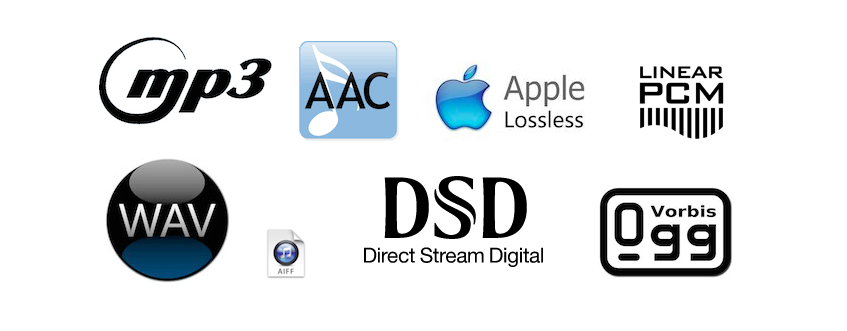
AAC (Advanced Audio Coding): It was designed to be the successor to MP3 and, although it is a lossy CODEC, the results in terms of sound quality are superior to those of MP3 for the same bit rate. The AAC has adopted a wide range of portable audio devices such as the iPod and its derivatives for use.
AIFF (Audio Interchange File Format): It is the version of WAV created by Apple. Works with uncompressed (ie “lossless”) files that maintain full resolution and size.
 

ALE (Apple Lossless Encoder), also known as ALAC (Apple Lossless Audio Codec): Uses lossless compression to save storage space. Once unzipped for listening, the file will be bit by bit identical to a full size WAV or AIFF encoded file. As in AIFF or FLAC, in ALE / A files

What is audio compression?

What is audio compression?

I have finally returned to the tutorials, we are going to talk about the compression of audio from the most basic to the most advanced, it is a subject that many as producers have had a hard time learning and understanding.

So what is audio compression and what can you do to help?

Basically, compression reduces the dynamic range of your recording by reducing the level of the loudest parts, which means that the noisy and silent parts are now closer together in volume and the natural volume variations are less obvious. The audio compressor unit can increase the overall level of this compressed signal.

So, the end result is that the quieter parts sound as if they had increased their volume to be closer to the louder parts. Dynamic changes in the volume of a recording are now under more control, and a side effect is that the overall level of the compressed recording can be increased within its mix. The recording will also be located within the entire mix much more easily.

What are the compression controls?

The compression device itself has many different controls that can affect the sound it is processing. We will review the main controls that are commonly found.

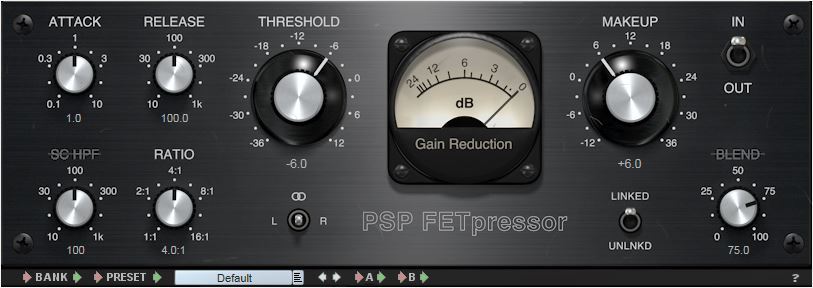
Input Gain
This controls the level of the signal entering the audio compressor.
Threshold
Compression reduces the overall level of the loudest parts of your recording. But how does the compressor know what part of the signal is “high” and what part of the signal is compressed? When setting the threshold.
The threshold sets the level at which the compressor starts and begins to change the recording dynamics. So, for example, if you set your threshold to -20 dB, everything below this level will not be affected by the compressor. But everything higher than this level (-20 dB) will be compressed.
Ratio
How much will the signal be compressed once it has exceeded this threshold? This is controlled with the relationship. The higher the ratio, the greater the compression.
The easiest way to show you how reason works is by showing you some numbers, if the ratio is 1: 1, there is no compression at all. On the other hand, if the ratio is set to 2: 1, for every 2 dB of sound that exceeds the threshold, you will get 1 dB of output above the threshold. So, if the signal exceeds the threshold by 10 dB, the compressor reduces this signal, so it is now 5 dB above the threshold.
If the ratio goes up to 8: 1, for every 8 dB of sound above the threshold you would get 1 dB of output above the threshold. Then, if the signal exceeds the threshold by 16 dB, the compressor reduces it, so only 2 dB exceeds the threshold.
Attack
This is the time it takes for the compressor to act on the input, once the sound level has exceeded the threshold. It is usually measured in milliseconds (ms).
Release
This is the time it takes for the compressor to let the signal return to normal once it has fallen below the threshold. Again, usually measured in ms.
Makeup
If the audio signal has been compressed, the overall level of the signal will be reduced. Increasing the output gain increases the level that comes out of the compressor, so the volume can more easily adapt to the levels of the rest of its tracks in its mix.
Knee
The soft compression of the knee is softer in the sound as it passes through the audio compressor: the change of uncompressed sound to compressed is softer. Hard knee compression is a more immediate and obvious effect.
Compressors are a very effective tool for us engineers, in the next post I will talk about the different types of compressors.