What is the compressor and how does it work?


Free Download Mp4Gain
picture

The compressor, together with the equalizer, is one of the most important and most used processors in professional audio, but its operation is not always so intuitive and knowing how to master the compression technique sometimes requires years of experience. In this new article we begin to explore this fundamental processor.

What is the compressor for?

First of all, let’s start to see what the compressor’s function is: to reduce the dynamic range of an audio track, that is, to decrease the distance in volume between the weakest signal and the strongest signal. Initially created to optimize recording on magnetic tape and to avoid saturation of the input stages, the compressor is still used today during recording and mixing. Reducing dynamic range also allows us to keep multiple tracks in the mix, such as a voice, for example, always at the same volume throughout the song so that they are not dominated by the other instruments in the most crowded sections, as well as to avoid Output saturation.
Compressor

Back to basics: what is the compressor and how does it work

The controls

Now let’s see in detail what the various compressor controls are and what they are for:
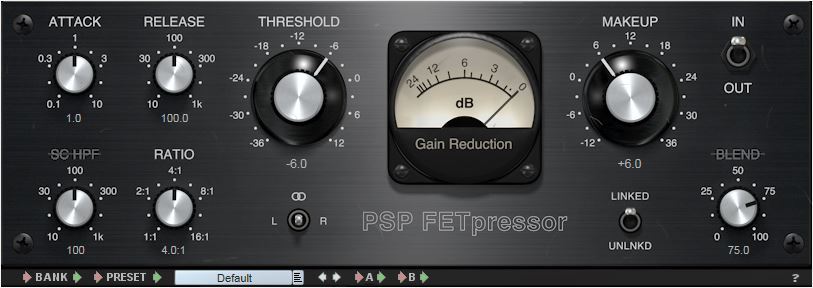
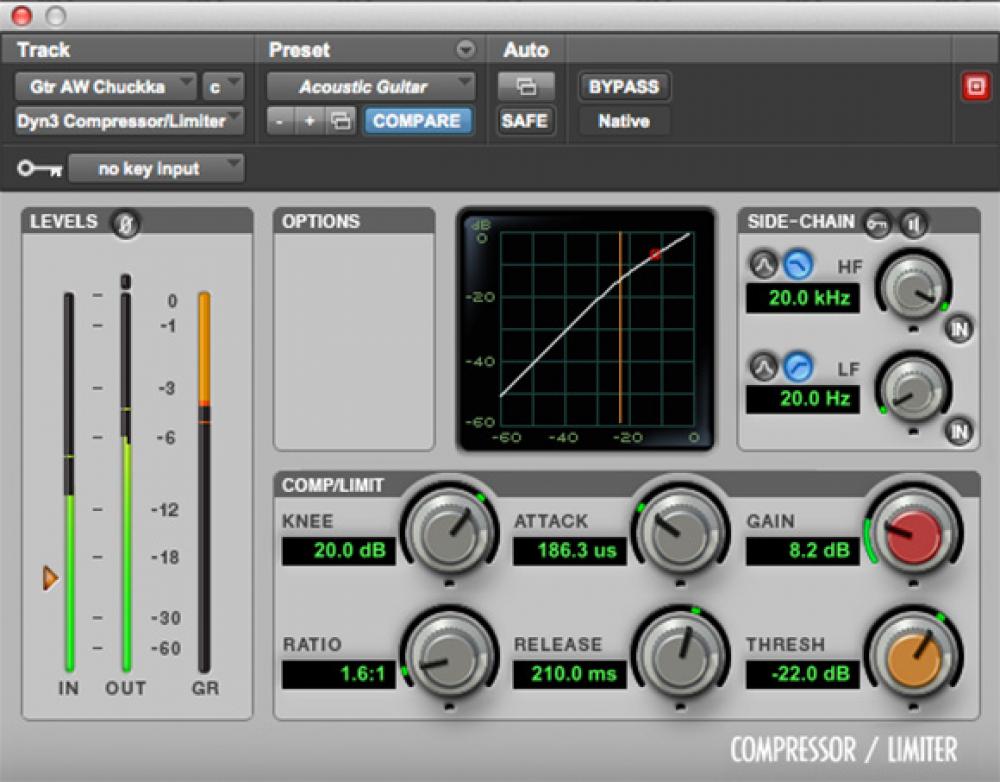
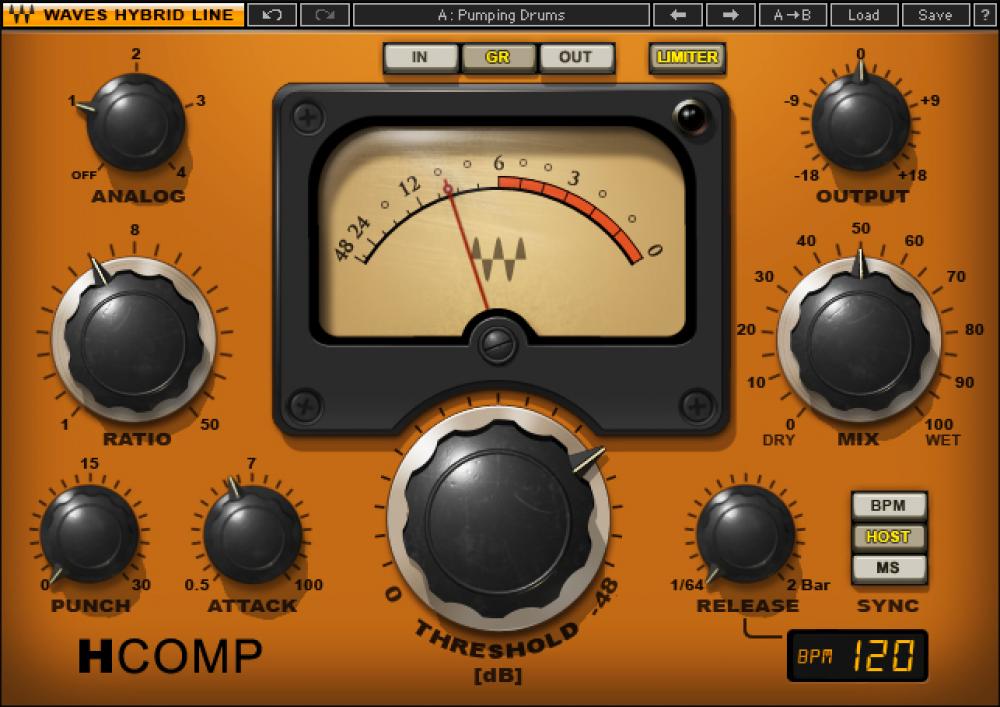
— Threshold: or threshold, expressed in dB, indicates the point beyond which the compressor begins to operate.
— Ratio: is the compression ratio and indicates how much the signal will compress when it exceeds the Threshold. For example, with a 2: 1 ratio, each signal that exceeds the threshold will be halved at the output, that is, every 2 dB at input 1 will be returned at the output.
— Make Up Gain: This is the output of the compressor and is used to recover the volume lost due to compression.
— Attack: expressed in milliseconds is the time it takes for the compressor to start once the signal has passed the threshold.
— Release: always expressed in milliseconds, it indicates the time it takes for the compressor to stop compression once the signal has returned below the threshold.
— Gain reduction meter: it is not a control but a visual indicator, led or pointer, which informs how much the signal is compressed, through a scale in dB.
— Bypass: shuts down the processor, making the signal pass through the machine without alteration.

With the advent of digital and accessories, we can find controls that not all hardware compressors have:
— Knee: indicates the type of curve at the point where the compressor begins to operate, which can be abrupt (Hard Knee), soft (Soft Knee) or various intermediate values.
— Automatic: sets the time control to which it refers (attack, release or both) automatically, depending on the input signal (program dependent).
— Sidechain eq or External Sidechain: Sidechain is the signal that drives the compression circuit, where in most cases it is the signal itself to compress, but sometimes it can be a version of the input signal with different equalization, for example without low frequencies, so that they don’t start the compressor too soon. Or it can be an external signal, such as the one used on the radio where the speaker’s voice signal drives a compressor on the background music signal, so it automatically turns off when it starts to speak (Ducking), or Classic Speaker Use to activate the compressor on various instruments in the mix or the Master Buss.
— Mix: used to mix the compressed signal with the original signal. This way, you can use Parallel Compression directly on the compressor, without having to use two mixer tracks (one for the dry signal and one for the compressed signal).
Back to basics: what is the compressor and how does it work
Compressor

Compressor or limiter?

What is the difference between a compressor and a limiter?

Essentially, the compression ratio: over 10 dB ratio, the processor is considered a limiter. A separate case is the Brickwall Limiter, a compressor with immediate attack and a compression ratio of infinity to 1, so that no signal can exceed the Threshold. It is mainly used on the master buses so as not to exceed 0dBFS on the output and then send the converters to clips.

Usage examples

As we already said, the compressor is used to keep the volume excursion under control. One track in the mix: in this case, using a fairly fast attack, slow release and not too aggressive ratio, allows us to compress the signal constantly and transparently, that is, without making your intervention feel excessively.
The compressor can also serve to emphasize the attack of a percussion instrument: in one case, for example, by setting a medium slow attack.


Free Download Mp4Gain
picture


Mp4Gain Main Window
picture


Mp4Gain Features
picture


Free Download Mp4Gain
picture

Audio normalization or compression

The function of a compressor is to reduce the dynamic range of the signal, that is, the level difference between the strongest and weakest signal parts.

Why compression or normalize?

At the time of analog, the limited dynamics of the main musical supports (vinyl, audio and video cassettes) did not allow to reproduce the dynamics of a classical, jazz or even rock orchestra in the case of the audio cassette. Therefore, the signal was compressed to avoid distortion in the transmission medium.

audio compression or normalization

Now that the music is converted to 16-bit or more, recorded in digital format, and then streamed to CD / DVD or downloaded, the dynamics of the media is enough to faithfully reproduce the dynamics of almost any orchestra. The old technical limitations have disappeared, therefore compression is no longer essential.

However, whatever the musical genre, some sources (voices) are compressed almost systematically. The goal of modern compression is therefore to optimize sound recording, either to get closer to reality or, conversely, to create a less faithful but denser, more controlled, more powerful sound, etc., or even a sound. totaly new.

And to do all this, the compressor is satisfied with a simple principle: it reduces dynamics by attenuating the signal level when the latter exceeds a given threshold level.

Level settings

– Threshold (threshold level, in dB)

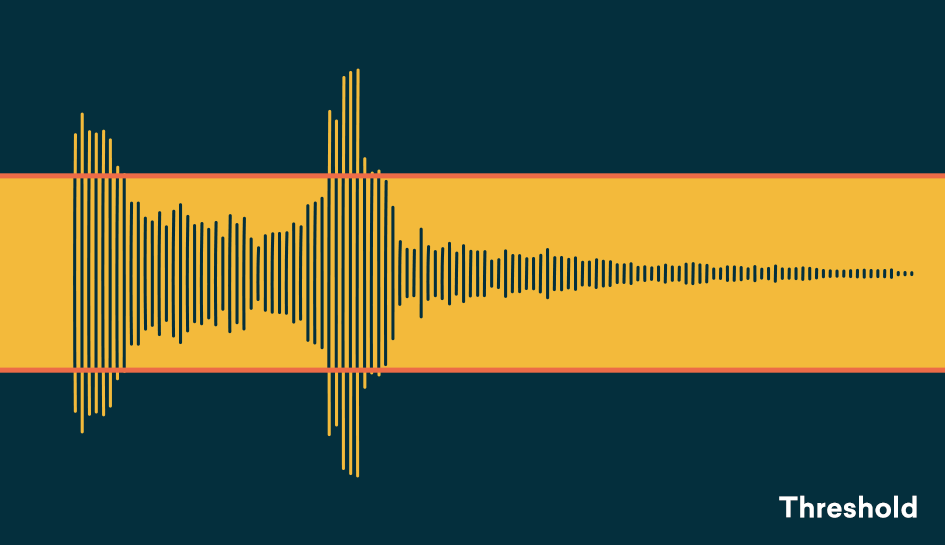
This parameter determines the threshold level from which the compressor is triggered. As long as the input signal level remains below the threshold, the compressor does not start and no treatment is applied. As soon as the source signal exceeds the threshold level, compression is applied.

– Ratio (compression ratio)

The ratio determines the amount of level reduction applied to the part of the signal that exceeds the threshold level, the rest of the signal is not processed. Depending on the compressor, the ratio can vary from 1: 1 to Inf: 1. Quésaco?

Set up a compressor

With a 1: 1 ratio, no compression is applied, the level of the input signal is equal to that of the output signal. With a ratio of 2: 1, the level of the signal portion that exceeds the threshold is divided by 2 in the output signal. With a 3: 1 ratio, it is divided by 3, etc. When the compression ratio is infinite (Inf: 1 ratio), the compressor behaves like a limiter: the output signal never exceeds the threshold level, regardless of the input level.

Therefore, the compression intensity applied to the signal is a compromise between the threshold and the compression rate setting:

The lower the threshold, the larger the compressed signal portion.
The higher the ratio, the greater the level reduction applied to the signal portion above the threshold.
Depending on the compressors, you may find other parameters, for example, an input level setting instead of the threshold, or a gain setting (also called the offset or output level) that amplifies the signal to compensate for the drop in level resulting from compression.

Time settings

– Attack (attack, in ms)

Attack corresponds to the time the compressor needs to reach the given ratio when the signal level exceeds the threshold level. A quick attack of a few milliseconds triggers strong compression as soon as the signal level exceeds the threshold; With a slower attack, the compressor passes the first transients of the signal peaks, keeping one side alive and well cut.

Set up a compressor

– Launch (launch, in ms and s)

Release corresponds to the time the compressor needs to return to the 1: 1 unit ratio when the source signal falls below the threshold level. A quick launch of a few tens of ms allows the original character to stay alive. Slower relaxation improves instrument resonance and reverberation, but can cause compression of the first peak transients when the latter are close together.

– Knee (literally knee!)

The Knee parameter determines the increase in compression, that is, the transition between the compression ratio of the unit (1: 1, no compression) and the compression ratio set to ratio.

Applications

At the output, the compressor can be used as a limiter to control signal peaks and prevent distortion from occurring in the analog / digital conversion stage.
When taking and mixing, light compression can bring out weak parts of the signal and thus reveal certain details.
In the mix, the compressor allows you to increase the average level of the audio volume output.

Destructive compression vs non-destructive

Destructive compression is compression obtained by losing information. This means that if you extract the compressed signal with this technique, you will not find the start signal.

Destructive Vs Non-Destructive Audio compression

In destructive compression techniques, there are basically methods that take advantage of the properties of the human ear. The latter listens to frequencies between 20 Hz and 20 kHz. If a song contains frequencies outside this range, we can easily delete them without losing the audio quality because the ear does not hear them. In fact, frequencies between 2 kHz and 5 kHz are generally heard correctly. In fact, less than 5 dB is required to hear frequencies in this band, while more than 20 dB is required to hear frequencies below 100 Hz or above 10 kHz. These results can be used to reduce the size of the files. For example, we can conclude that all frequencies above 15 kHz are suppressed.

audio compression

MP3 also uses the principle of masked frequencies. If in a frequency group some have a much higher noise level than others, it is not necessary to keep the frequencies low – we will not hear them. Imagine yourself in your garden listening to the birds sing. The chord goes over your head (even very high). We no longer listen to birds because the sound they make is much quieter than that of the plane. It is as if the birds no longer exist or have stopped singing. Obviously, it is not necessary to code all the frequencies present in a song so that the human ear can always perceive it well. Finally like the two ways

What do we find among non-destructive techniques?

Mainly coding techniques.

Let’s explain. A sound is a frequency. A second of music is therefore a sequence of frequencies. Imagine that in the series of samples that make up a second of music (remember that there are 44,100), we have the same frequency several times in succession, for example 10 times. If instead of storing these 10 points, we only store 1 and the number of times it is repeated, we must encode 2 digits and not 10. If we also apply this method to frequencies which are no longer identical, but very dense together (so close that the average human ear cannot distinguish them), we can still save space. This time, the compression is destructive because we are replacing one frequency with another frequency (almost identical).

MP3 also uses the algorithm of Huffman (1952) as a method of encoding information. This method is used in all compression algorithms (compression of text files, compression of images, compression of sound). It is based on the use of a variable length code and the probability that an event (in this case a frequency) will occur. The more a frequency appears, the shorter the code (low number of bits to display it). The file is read for the first time and a table appears with the frequencies that appear and the number of times they appear. We derive the right code. This encryption was last used. It is the final phase of compression. This is non-destructive coding.

MP3 works on the properties of the ear, first to reduce the size of a part, then processes the stereo sound and possibly applies encodings which end with Huffman encoding.

The use of all the reduction options mentioned depends on the location you want to give within 1 minute of your tablet and therefore on the compression speed to apply.
To encode MP3 audio files, we are talking more in terms of bit rate than compression rate.
Bit rate is the number of bits allowed in 1 second.
Therefore, we have the following relationship: the more we want to compress a song (so that it takes up the least space possible), the lower the bit rate.

Choice of compression ratio (bit rate)

Obviously, the more you compress, the worse the sound quality.
You have to compromise the file size and audio quality.
This commitment can be dictated by your needs, but also by the use you want to make of your MP3 files. It may not even be demanding if your MP3s are intended for your portable music player and are too demanding to be listened to on a stereo system.

What is audio compression?

What is audio compression?

I have finally returned to the tutorials, we are going to talk about the compression of audio from the most basic to the most advanced, it is a subject that many as producers have had a hard time learning and understanding.

So what is audio compression and what can you do to help?

Basically, compression reduces the dynamic range of your recording by reducing the level of the loudest parts, which means that the noisy and silent parts are now closer together in volume and the natural volume variations are less obvious. The audio compressor unit can increase the overall level of this compressed signal.

So, the end result is that the quieter parts sound as if they had increased their volume to be closer to the louder parts. Dynamic changes in the volume of a recording are now under more control, and a side effect is that the overall level of the compressed recording can be increased within its mix. The recording will also be located within the entire mix much more easily.

What are the compression controls?

The compression device itself has many different controls that can affect the sound it is processing. We will review the main controls that are commonly found.

Input Gain
This controls the level of the signal entering the audio compressor.
Threshold
Compression reduces the overall level of the loudest parts of your recording. But how does the compressor know what part of the signal is “high” and what part of the signal is compressed? When setting the threshold.
The threshold sets the level at which the compressor starts and begins to change the recording dynamics. So, for example, if you set your threshold to -20 dB, everything below this level will not be affected by the compressor. But everything higher than this level (-20 dB) will be compressed.
Ratio
How much will the signal be compressed once it has exceeded this threshold? This is controlled with the relationship. The higher the ratio, the greater the compression.
The easiest way to show you how reason works is by showing you some numbers, if the ratio is 1: 1, there is no compression at all. On the other hand, if the ratio is set to 2: 1, for every 2 dB of sound that exceeds the threshold, you will get 1 dB of output above the threshold. So, if the signal exceeds the threshold by 10 dB, the compressor reduces this signal, so it is now 5 dB above the threshold.
If the ratio goes up to 8: 1, for every 8 dB of sound above the threshold you would get 1 dB of output above the threshold. Then, if the signal exceeds the threshold by 16 dB, the compressor reduces it, so only 2 dB exceeds the threshold.
Attack
This is the time it takes for the compressor to act on the input, once the sound level has exceeded the threshold. It is usually measured in milliseconds (ms).
Release
This is the time it takes for the compressor to let the signal return to normal once it has fallen below the threshold. Again, usually measured in ms.
Makeup
If the audio signal has been compressed, the overall level of the signal will be reduced. Increasing the output gain increases the level that comes out of the compressor, so the volume can more easily adapt to the levels of the rest of its tracks in its mix.
Knee
The soft compression of the knee is softer in the sound as it passes through the audio compressor: the change of uncompressed sound to compressed is softer. Hard knee compression is a more immediate and obvious effect.
Compressors are a very effective tool for us engineers, in the next post I will talk about the different types of compressors.