MP3 vs AAC: Compression Efficiency and Quality


Free Download Mp4Gain
picture

MP3 vs AAC: Compression Efficiency and Quality
MP3 vs AAC: Compression Efficiency and Quality

MP3 vs AAC: Compression Efficiency and Quality

Let’s talk about MP3 vs AAC

When it comes to digital audio formats, MP3 and AAC are two heavyweights vying for supremacy. As a seasoned audio specialist, I’ve delved deep into the intricacies of both formats to uncover their strengths and weaknesses. In this article, I’ll provide an in-depth comparison of MP3 and AAC, focusing on compression efficiency and audio quality.

Understanding MP3 Compression

Unraveling the Mysteries of MP3 Compression: MP3, short for MPEG-1 Audio Layer 3, revolutionized the digital audio landscape with its efficient compression algorithm. Developed by the Moving Picture Experts Group, MP3 employs a lossy compression technique to reduce file size while preserving perceptible audio quality. The MP3 format achieves compression by discarding audio data deemed less essential to human auditory perception, resulting in smaller file sizes ideal for storage and streaming.

Challenges of MP3 Compression: Despite its widespread adoption, MP3 compression faces inherent challenges, including artifacting and quality degradation. Artifacting manifests as audible distortions or anomalies introduced during compression, detracting from the listening experience. Moreover, aggressive compression settings can compromise audio fidelity, leading to a phenomenon known as “compression artifacts,” which manifest as hissing, ringing, or other unwanted noises.

Exploring AAC Compression

AAC: Advancements in Audio Compression: Advanced Audio Coding (AAC) represents the next evolution in audio compression technology. Developed by the Fraunhofer Institute and standardized by the MPEG group, AAC offers superior compression efficiency and audio quality compared to MP3. AAC achieves this feat through more sophisticated encoding algorithms, resulting in smaller file sizes without sacrificing perceptible audio fidelity.

The AAC Advantage: Unlike MP3, AAC supports a wider range of audio frequencies and dynamic ranges, enabling more accurate reproduction of the original audio signal. Additionally, AAC’s advanced encoding techniques minimize artifacting and distortion, delivering pristine audio experiences even at lower bit rates. As a result, AAC has become the preferred format for high-quality audio streaming, digital radio, and mobile applications.

Comparing Compression Efficiency

MP3 vs AAC: A Compression Showdown: In a head-to-head comparison, AAC outshines MP3 in compression efficiency and audio quality. AAC typically achieves higher compression ratios than MP3, meaning it can produce smaller file sizes while maintaining comparable audio quality. This advantage makes AAC the preferred choice for applications where bandwidth or storage space is limited, such as mobile streaming platforms and digital radio broadcasts.

The Impact of Compression Ratios: When selecting an audio format, it’s essential to consider the desired balance between file size and audio quality. Higher compression ratios, while beneficial for conserving storage space, may result in perceptible audio degradation, especially in complex musical passages or recordings with subtle nuances. Conversely, lower compression ratios yield larger file sizes but preserve more of the original audio fidelity, making them ideal for critical listening or archival purposes.

Quality Assessment and Real-life Examples

Listening Tests: MP3 vs AAC: Through extensive listening tests and subjective evaluations, audio enthusiasts and experts have scrutinized the quality of MP3 and AAC encodings across various genres and audio sources. These tests often involve blind comparisons where listeners rate the perceived audio quality of each format without prior knowledge of the encoding method. Real-life examples, such as comparing the same song encoded in MP3 and AAC formats, can highlight differences in audio transparency, dynamic range, and spatial imaging.

Personal Preference and Subjectivity: It’s essential to acknowledge that audio quality perception is inherently subjective, influenced by individual preferences, listening environments, and playback equipment. While objective measurements such as bit rate and frequency response provide valuable insights into compression efficiency, the ultimate judgment of audio quality rests with the listener’s ears and personal preferences.

Latest Words on MP3 vs AAC

In conclusion, the choice between MP3 and AAC hinges on balancing compression efficiency with audio quality, considering factors such as intended use, available bandwidth, and listener preferences. While MP3 remains a ubiquitous format, AAC offers significant advancements in compression technology, delivering superior audio fidelity and smaller file sizes. As technology continues to evolve, AAC stands poised to redefine the digital audio landscape, offering immersive listening experiences across a myriad of platforms and devices.

Comments:

This article provided a comprehensive comparison of MP3 and AAC, shedding light on the nuances of audio compression. As a music enthusiast, I found the insights valuable in understanding the trade-offs between file size and audio quality.

– MusicLover123

As a podcast producer, I appreciated the detailed analysis of MP3 and AAC compression. The article highlighted the importance of selecting the right format to ensure optimal audio quality for listeners.

– PodcasterPro

While I’ve been using MP3 for years, this article opened my eyes to the benefits of AAC compression. I’m excited to explore AAC further and potentially improve the audio quality of my digital music library.

– AudioExplorer

This article provided a balanced perspective on MP3 and AAC compression, addressing both the technical aspects and real-world implications. I appreciated the clear explanations and practical examples.

– TechEnthusiast77

As a digital DJ, I found this article to be incredibly informative. Understanding the differences between MP3 and AAC compression will undoubtedly impact my music selection and mixing techniques.

– DJMasterMix

Great article! The comparison between MP3 and AAC compression was eye-opening, especially regarding the trade-offs between file size and audio quality. I’ll definitely be sharing this with my friends.

– MusicFanatic99

This article provided valuable insights into the world of audio compression. As a budding audio engineer, I’m eager to explore AAC further and incorporate it into my workflow for optimal sound quality.

– AudioNovice


Free Download Mp4Gain
picture


Mp4Gain Main Window
picture


Mp4Gain Features
picture


Free Download Mp4Gain
picture

MP3 Decoding Process and Algorithms

MP3 Decoding Process and Algorithms

MP3 Decoding Process and Algorithms

MP3 Decoding Process and Algorithms

Let’s talk about MP3 Decoding

In the realm of digital audio, the MP3 format reigns supreme. But what exactly happens behind the scenes when you hit play on your favorite MP3 file? As a seasoned expert in audio technology, I’m here to guide you through the intricate world of MP3 decoding.

Understanding the MP3 Format

When we discuss MP3 decoding, it’s crucial to grasp the fundamentals of the MP3 format itself. Developed by the Moving Picture Experts Group (MPEG), MP3 employs a lossy compression algorithm to reduce the size of audio files while retaining perceptible quality. This compression method exploits the limitations of human auditory perception, discarding frequencies deemed less audible. As a result, MP3 files occupy significantly less storage space compared to uncompressed audio formats like WAV or AIFF.

The Decoding Process Unveiled

Now, let’s delve into the decoding process. When you hit play on an MP3 file, your media player initiates a sequence of steps to reconstruct the original audio waveform. First, the compressed MP3 data undergoes a reverse process known as decoding. This decoding process involves intricate algorithms that meticulously reconstruct the audio data to approximate the original waveform.

Advanced Decoding Algorithms

Within the decoding realm, several algorithms vie for supremacy in achieving the most accurate audio reconstruction. One such algorithm is the Modified Discrete Cosine Transform (MDCT), a cornerstone of MP3 compression and decoding. MDCT breaks down audio signals into frequency components, facilitating efficient compression and subsequent decompression during playback. Additionally, algorithms like Huffman coding and psychoacoustic modeling play pivotal roles in MP3 decoding, optimizing efficiency while preserving audio fidelity.

Cracking the Code: Inside MP3 Decoding Algorithms

The Role of Psychoacoustic Modeling

At the heart of MP3 decoding lies psychoacoustic modeling, a sophisticated technique that mimics the human auditory system’s response to sound. By exploiting psychoacoustic principles, MP3 algorithms identify and discard audio components masked by louder sounds. For instance, if a loud drumbeat overshadows a subtle guitar riff, the algorithm may allocate fewer bits to the guitar riff, prioritizing perceptual quality.

Bit Rate and Compression Ratios

A critical aspect of MP3 decoding is the management of bit rate and compression ratios. Bit rate refers to the number of bits processed per unit of time, influencing audio quality and file size. Higher bit rates yield superior audio fidelity but result in larger file sizes, while lower bit rates sacrifice quality for increased compression. Decoders employ intricate algorithms to strike a delicate balance between audio quality and file size, ensuring optimal playback experiences.

Challenges and Innovations

Despite its widespread adoption, MP3 decoding poses inherent challenges, such as artifacting and quality degradation. However, ongoing research and innovation continually push the boundaries of audio compression and decoding. Emerging technologies like perceptual audio coding and machine learning hold promise in further enhancing MP3 decoding efficiency and quality, paving the way for immersive audio experiences.

Latest Words on MP3 Decoding

In conclusion, the MP3 decoding process is a testament to the ingenuity of audio engineering. By harnessing advanced algorithms and psychoacoustic principles, MP3 decoders faithfully recreate audio experiences while minimizing file size. As technology evolves, so too will MP3 decoding, ensuring that music enthusiasts worldwide continue to enjoy their favorite tunes with unparalleled clarity and efficiency.

Comments:

Wow, this article really opened my eyes to the complexity behind MP3 decoding! I had no idea about psychoacoustic modeling and its role in the process. Thanks for the insightful explanation!

– MusicLover87

I’ve always wondered how MP3 files manage to sound so good while being so small. This article provided a clear and detailed explanation of the decoding process. Great job!

– AudioEnthusiast22

Could you go into more detail about the specific algorithms used in MP3 decoding? I’m curious about how MDCT and Huffman coding work together to reconstruct the audio.

– TechGeek123

As a musician, I appreciate the insights into MP3 decoding. It’s fascinating to learn about the technology that brings music to our ears. Keep up the excellent work!

– GuitarGuy56

This article provided a comprehensive overview of MP3 decoding, but I wish it explored the impact of decoding algorithms on sound quality in more depth. Overall, though, it was an informative read.

– SoundEngineer99

MP3 decoding has always intrigued me, and this article shed light on the intricacies of the process. It’s incredible how technology has revolutionized the way we experience music.

– MusicManiac123

Thank you for demystifying MP3 decoding! As someone with a casual interest in audio technology, I found this article to be both accessible and informative.

– TechNovice17

Great article! I never knew there was so much complexity involved in MP3 decoding. It’s amazing how far technology has come in delivering high-quality audio experiences.

– AudioAficionado

This article provided a great overview of MP3 decoding, but I’d love to see a follow-up exploring the future of audio compression technologies. Keep up the fantastic work!

– FutureTechTrends

Wow, I never realized the science behind MP3 decoding was so intricate. Thanks for breaking it down in a way that’s easy to understand!

– MusicBuff99

M4A Audio Coding Delay Analysis

M4A Audio Coding Delay Analysis

M4A Audio Coding Delay Analysis

M4A Audio Coding Delay Analysis

Let’s talk about M4A Audio Coding Delay Analysis

As a specialist in audio coding, I’ve encountered various challenges related to M4A audio files and coding delays. Unraveling the Mystery of M4A Audio Coding Delays is crucial for professionals working in the audio industry. By understanding the intricacies of coding delays, we can optimize audio processing workflows and ensure high-quality playback experiences for listeners.

Understanding M4A Audio Files and Coding Delays

M4A audio files, a popular format for storing audio data, can sometimes experience coding delays during playback or processing. Peering into M4A Audio File Formats: An Overview reveals that coding delays occur when there’s a lag between the input signal and the output signal due to encoding and decoding processes. This delay can impact real-time applications such as streaming, gaming, and live broadcasts, affecting user experience and quality.

  • Introduction to M4A audio files and their significance in the digital audio landscape.
  • Explanation of coding delays and their impact on audio playback.
  • Factors contributing to coding delays in M4A audio files.

Analyzing Coding Delay Factors

To effectively address coding delays in M4A audio files, it’s essential to Dive Deep into Coding Delay Factors: An Examination. Factors such as codec complexity, processing speed, and buffer sizes can influence the occurrence and severity of coding delays. By analyzing these factors, audio professionals can identify bottlenecks and implement strategies to minimize delays and optimize performance.

  • Codec complexity and its relationship to coding delays in M4A audio files.
  • Impact of processing speed on coding delay mitigation strategies.
  • Optimizing buffer sizes to reduce coding delays in real-time applications.

Strategies for Minimizing Coding Delays

In the quest to minimize coding delays in M4A audio files, Exploring Coding Delay Mitigation Strategies is essential. Techniques such as parallel processing, predictive coding, and adaptive buffering can help reduce latency and improve overall audio performance. By implementing these strategies, audio professionals can deliver seamless playback experiences and enhance user satisfaction.

  • Parallel processing techniques for optimizing encoding and decoding workflows.
  • Utilizing predictive coding algorithms to anticipate and mitigate coding delays.
  • Adaptive buffering strategies for real-time adjustment of buffer sizes based on workload demands.

Latest words on M4A Audio Coding Delay Analysis

In conclusion, Navigating the Complexities of M4A Audio Coding Delay Analysis is essential for audio professionals seeking to optimize performance and deliver high-quality audio experiences. By understanding the factors contributing to coding delays and implementing effective mitigation strategies, we can overcome challenges and unlock the full potential of M4A audio files. As technology continues to evolve, staying abreast of emerging trends and techniques will be crucial for ensuring optimal audio performance in the digital age.

Comments:

This article provided valuable insights into M4A audio coding delays and offered practical solutions for optimizing performance. Great job!

– AudioEnthusiast

I’ve been struggling with coding delays in my M4A files, but this article helped me understand the root causes and how to address them effectively. Thank you!

– CodingWoes

As someone new to audio coding, I found this article incredibly informative and easy to follow. The explanations were clear, and the examples were helpful. Highly recommend!

– NewbieCoder

This article addressed a common issue faced by audio professionals and provided practical solutions for mitigating coding delays in M4A files. Well done!

– AudioPro

While this article provided a good overview of M4A audio coding delays, I wish it delved deeper into specific coding techniques for minimizing latency in real-time applications.

– TechWizard42

Great article! I learned a lot about coding delays in M4A files and gained valuable insights into optimizing audio performance. Keep up the excellent work!

– AudioTech

This article was exactly what I needed to understand M4A audio coding delays better. The explanations were clear, and the strategies for minimizing delays were practical and effective.

– AudioEngineer

Mp4 – Understanding Psychoacoustic Masking in MP4 Audio Compression

Understanding Psychoacoustic Masking in MP4 Audio Compression

Understanding Psychoacoustic Masking in MP4 Audio Compression

Understanding Psychoacoustic Masking in MP4 Audio Compression

Let’s talk about Psychoacoustic Masking in MP4 Audio Compression

Psychoacoustic Masking: In MP4 audio compression, psychoacoustic masking plays a crucial role in optimizing the encoding process. Perceptual Audio Coding: Psychoacoustic masking exploits the limitations of human auditory perception to reduce the amount of data needed for encoding without perceptible loss in audio quality. Dynamic Compression: By analyzing the frequency and intensity of audio signals, psychoacoustic models identify masked frequencies and reduce the bitrate allocated to them, prioritizing critical audio components. Real-life Analogy: Think of psychoacoustic masking as tuning out background noise in a crowded room to focus on a conversation—only essential audio elements are preserved, enhancing compression efficiency.

Key Concepts in Psychoacoustic Masking

Temporal Masking: Temporal masking occurs when a loud sound (masker) makes a quieter sound (maskee) inaudible for a brief period. Frequency Masking: Frequency masking happens when a loud sound makes nearby frequencies inaudible. Bitrate Allocation: Psychoacoustic models adjust the bitrate allocated to different frequency bands based on masking thresholds, ensuring efficient compression. Noise Shaping: By reshaping quantization noise to frequencies where it’s less audible, noise shaping further enhances compression efficiency.

Integration in MP4 Audio Compression

MP4 Audio Format: MP4 utilizes psychoacoustic masking to achieve high compression ratios while maintaining audio quality. AAC Encoding: Advanced Audio Coding (AAC), a standard codec used in MP4, leverages psychoacoustic principles to optimize compression. Bitrate Optimization: Psychoacoustic models in AAC dynamically allocate bits based on audio complexity, maximizing compression efficiency. Streaming Applications: In streaming services, psychoacoustic masking ensures high-quality audio delivery over bandwidth-constrained networks.

Latest Insights into Psychoacoustic Masking

Adaptive Psychoacoustic Models: Recent advancements in psychoacoustic modeling have led to adaptive algorithms that tailor compression based on content and listener preferences. Low-Bitrate Optimization: Psychoacoustic masking techniques are crucial for achieving high fidelity in low-bitrate audio streams, such as podcasts and mobile media. Future Trends: As audio technology evolves, psychoacoustic masking will continue to play a pivotal role in enhancing compression efficiency and audio quality.

Psychoacoustic masking in MP4 audio compression represents a sophisticated approach to optimizing audio quality and compression efficiency. By leveraging insights from human auditory perception, MP4 codecs can achieve remarkable compression ratios while preserving essential audio details. As technology advances, further research into psychoacoustic modeling promises even greater improvements in audio compression techniques.

Comments:

This article really helped me understand the science behind MP4 audio compression. I never knew how important psychoacoustic masking was!

As a podcast producer, I’m always looking for ways to optimize audio quality at lower bitrates. This article provided valuable insights into psychoacoustic masking in MP4 compression.

Could you elaborate more on the specific psychoacoustic models used in MP4 audio compression? I’m fascinated by the technical details behind the encoding process.

Kudos to the author for breaking down such a complex topic into digestible insights. Psychoacoustic masking is truly a game-changer in audio compression.

As an audio engineer, I’ve seen firsthand the benefits of psychoacoustic masking in MP4 compression. It’s incredible how much you can achieve with efficient bitrate allocation.

This article made me appreciate the intricacies of MP4 audio compression. I never realized how much goes into optimizing audio quality while minimizing file size.

Psychoacoustic masking is like magic trickery for audio compression. Thanks for shedding light on this fascinating topic!

Dynamic Bit Allocation in Opus Voice Coding

Dynamic Bit Allocation in Opus Voice Coding

Dynamic Bit Allocation in Opus Voice Coding

Let’s talk about Dynamic Bit Allocation

As a specialist with years of experience in audio coding, I’m excited to delve into the intricacies of dynamic bit allocation (DBA) within Opus voice coding. At its core, DBA is a fundamental concept in audio compression where the available bits for encoding are dynamically distributed based on the complexity of the audio signal. Imagine you have a limited number of Lego blocks, and you need to construct different structures. Some structures may require more blocks than others, and DBA ensures that each part gets precisely the number of blocks it needs for optimal construction. Similarly, in audio coding, DBA ensures that critical parts of the audio signal receive more bits for accurate representation, while less critical parts receive fewer bits without compromising overall quality.

Understanding Opus Voice Coding

Opus voice coding is a state-of-the-art audio codec renowned for its efficiency and versatility. Developed by the Internet Engineering Task Force (IETF), Opus is particularly well-suited for real-time applications such as Voice over Internet Protocol (VoIP), online gaming, and interactive audio streaming. Its ability to adapt to varying network conditions and deliver high-quality audio at low bitrates makes it a preferred choice for a wide range of applications. Think of Opus as a Swiss Army knife for audio compression, capable of handling diverse audio content with remarkable efficiency and fidelity.

Optimizing Compression Efficiency

DBA in Opus works by dynamically adjusting the allocation of bits to different frequency bands based on the audio signal’s characteristics. This adaptive approach ensures that more bits are allocated to critical frequencies, such as those containing speech or musical harmonics, while fewer bits are allocated to less important frequencies.
By prioritizing critical information, Opus maximizes compression efficiency without sacrificing audio quality. This means that even at low bitrates, Opus can deliver clear and intelligible speech or high-fidelity music, depending on the application’s requirements.
Imagine you’re packing for a trip, and you have limited space in your suitcase. You’d prioritize packing essential items like clothes and toiletries while leaving less critical items behind. Similarly, Opus prioritizes the most crucial audio information while discarding redundant or less important data to achieve optimal compression.

Adaptive Bitrate Control

One of the key advantages of DBA in Opus is its adaptive bitrate control mechanism. Unlike fixed-rate codecs that allocate a predetermined number of bits per frame, Opus adjusts its bitrate dynamically based on the complexity of the audio signal and the available bandwidth.
This adaptive bitrate control allows Opus to deliver consistent audio quality across a wide range of network conditions, from high-speed broadband connections to bandwidth-constrained mobile networks. It ensures smooth audio playback without interruptions or buffering, even in challenging network environments.
Think of adaptive bitrate control as driving a car with cruise control on a hilly terrain. The car automatically adjusts its speed to maintain a steady pace regardless of uphill climbs or downhill descents. Similarly, Opus adjusts its bitrate to maintain consistent audio quality, regardless of fluctuations in network conditions.

The Role of Psychoacoustic Modeling

In addition to dynamic bit allocation, Opus leverages sophisticated psychoacoustic modeling techniques to further enhance compression efficiency. Psychoacoustics studies how humans perceive sound and identifies perceptually irrelevant audio information that can be discarded without noticeable degradation in quality. This allows Opus to achieve higher compression ratios while maintaining transparent audio quality.

Perceptual Audio Coding

Opus’s psychoacoustic model analyzes the audio signal in real-time to identify perceptually irrelevant components, such as masked frequencies or imperceptible noise. By exploiting the limitations of human auditory perception, Opus can allocate fewer bits to these components without compromising perceived audio quality.
Imagine you’re listening to a piece of music in a noisy environment, like a crowded cafe. Your brain naturally filters out background noise and focuses on the music’s melody and lyrics. Similarly, Opus’s psychoacoustic model filters out irrelevant audio information to optimize compression efficiency while preserving essential auditory cues.

Transient and Tonality Detection

Another critical aspect of Opus’s psychoacoustic model is its ability to detect transient sounds and tonal components within the audio signal. Transients are short-lived bursts of energy, such as drum hits or consonant sounds in speech, while tonal components are sustained musical tones.
By accurately detecting and preserving transient and tonal components, Opus ensures that the encoded audio maintains clarity and fidelity, even during rapid changes in the audio signal. This is essential for preserving the natural timbre of musical instruments and the articulation of speech sounds, especially in low-bitrate scenarios.

Latest words on Dynamic Bit Allocation in Opus

Dynamic bit allocation in Opus voice coding represents a paradigm shift in audio compression technology, offering unprecedented efficiency and flexibility for a wide range of applications. By dynamically adapting to the characteristics of the audio signal and leveraging advanced psychoacoustic modeling techniques, Opus sets the standard for high-quality, low-latency audio communication. Whether you’re making a VoIP call, streaming music, or engaging in online gaming, Opus ensures that every sound is faithfully reproduced, even under challenging network conditions. As a specialist in audio coding, I firmly believe that the future of audio communication lies in technologies like Opus, where quality, efficiency, and adaptability converge to create seamless auditory experiences.

Comments:

This article explained dynamic bit allocation in Opus in a way that was easy to understand. I appreciate the real-life examples used to illustrate complex concepts.

As someone who works with audio compression, I found this article to be incredibly informative. The section on adaptive bitrate control was particularly enlightening.

Could you provide more information on the specific algorithms used in Opus for psychoacoustic modeling? I’d love to learn more about the technical details behind the compression process.

Kudos to the author for shedding light on such a complex topic. Opus voice coding is indeed a game-changer in the world of audio compression.

This article helped me understand why Opus is so effective for real-time applications like VoIP. It’s fascinating to see how dynamic bit allocation optimizes audio quality.

I’ve been using Opus for streaming audio, and I must say, it delivers exceptional quality even on low-bandwidth connections. Thanks for the insights!

Opus’s adaptive bitrate control mechanism is truly remarkable. It’s like having an intelligent system that adjusts to the ever-changing demands of network conditions.

This article convinced me to explore Opus further for my audio compression needs. It’s reassuring to know that there are advanced technologies like Opus available.

Dynamic bit allocation and psychoacoustic modeling sound like cutting-edge concepts. I’m eager to see how they continue to evolve in future audio codecs.

As a musician, I’m always interested in learning about the latest advancements in audio technology. This article provided valuable insights into the inner workings of Opus.

Opus is a game-changer for online gaming. The low-latency audio compression ensures a seamless gaming experience, even in intense multiplayer battles.

Understanding the Impact of Psychoacoustics in MP3

Understanding the Impact of Psychoacoustics in MP3

Understanding the Impact of Psychoacoustics in MP3

Understanding the Impact of Psychoacoustics in MP3

Let’s talk about MP3:

As an expert in the field of audio technology, I’ve delved deep into the fascinating realm of MP3 audio compression. When you think about MP3, what comes to mind? Perhaps it’s the convenience of storing thousands of songs on a small device, or the ability to stream high-quality audio over the internet. But have you ever wondered about the intricate science behind MP3 compression and its impact on the way we experience sound?

The Science Behind MP3 Compression:

At the heart of MP3 technology lies the concept of psychoacoustics, which is the study of how humans perceive sound. Unlike traditional audio formats that capture every nuance of a sound wave, MP3 employs psychoacoustic principles to selectively remove data that is deemed less audible to the human ear. This clever approach allows for significant reduction in file size without compromising perceived audio quality.

Key Psychoacoustic Principles:

  • Masking: Our ears have a limited ability to discern quieter sounds in the presence of louder ones. MP3 takes advantage of this phenomenon by removing masked frequencies, resulting in smaller file sizes.
  • Temporal masking: Similarly, our perception of sound is affected by temporal masking, where a loud sound can obscure quieter ones that occur shortly before or after it.
  • Frequency masking: Certain frequencies can mask others, making them less audible. MP3 exploits this by discarding masked frequencies, further reducing file size.

The Impact on Audio Quality:

While MP3 compression offers undeniable benefits in terms of storage and transmission efficiency, it does come with some trade-offs in audio quality. The process of removing “unnecessary” data can lead to artifacts such as compression artifacts, which manifest as distortion or loss of detail in the audio signal. Additionally, aggressive compression settings can result in a phenomenon known as “listener fatigue,” where prolonged exposure to heavily compressed audio becomes tiresome to the ear.

Advancements in MP3 Technology:

Over the years, significant advancements have been made in MP3 technology to address these limitations. Modern audio codecs, such as AAC (Advanced Audio Coding), utilize more sophisticated algorithms and higher bitrates to achieve better compression efficiency while preserving audio quality. Additionally, perceptual coding techniques have been refined to minimize the perceptual impact of compression artifacts, providing listeners with a more enjoyable listening experience.

Real-World Applications:

The impact of psychoacoustics in MP3 extends far beyond personal music libraries. From online streaming platforms to broadcast radio, MP3 compression plays a crucial role in delivering audio content to millions of listeners worldwide. Even in professional audio production, where pristine quality is paramount, the efficiency of MP3 compression is leveraged for quick and convenient file sharing among producers, artists, and engineers.

Latest words on MP3:

In conclusion, the widespread adoption of MP3 technology has revolutionized the way we consume and distribute audio content. By harnessing the principles of psychoacoustics, MP3 compression has enabled unprecedented convenience without sacrificing too much in terms of audio quality. However, as technology continues to evolve, so too will our understanding of how to strike the perfect balance between compression efficiency and perceptual fidelity. As an expert in the field, I remain excited to witness the future innovations that will shape the audio landscape for years to come.

Comments:

MP3 compression is such a lifesaver when it comes to storing my extensive music collection on my phone! I never knew about the science behind it until reading this article. Really eye-opening stuff!

– MusicLover123

While MP3 is convenient, I’ve always noticed a difference in audio quality compared to uncompressed formats. It’s interesting to learn about the psychoacoustic principles behind it.

– Audiophile99

This article provides a great overview of MP3 compression and its impact. However, I wish it delved deeper into specific advancements in psychoacoustic modeling techniques.

– TechEnthusiast22

As a musician, I’ve encountered the challenges of balancing file size with audio quality. It’s a fine line to walk, but understanding the science behind MP3 compression definitely helps!

– GuitarGuy2024

Wow, I never realized how much goes into compressing audio files. This article breaks it down in a way that’s easy to understand. Kudos to the author!

– SoundSavvy

Thanks for shedding light on the topic of MP3 compression. It’s something we encounter every day but rarely stop to think about. Very informative!

– AudioNovice

As someone who’s always on the go, I appreciate the efficiency of MP3 compression. It allows me to carry my entire music library in my pocket!

– RoadWarrior

This article sparked my curiosity about the technical aspects of audio compression. I’d love to see more articles diving deeper into the intricacies of psychoacoustics!

– CuriousMind

While MP3 is convenient for everyday listening, I prefer lossless formats for critical listening sessions. It’s all about finding the right balance for your needs!

– HiFiEnthusiast

Great article! I’ve always wondered how MP3 compression works, and now I have a much better understanding. Keep up the fantastic work!

– AudioExplorer

Wavelet Transform in FLAC Compression

Wavelet Transform in FLAC Compression: Analysis and Trends

Wavelet Transform in FLAC Compression

Wavelet Transform in FLAC Compression

Let’s Talk about Wavelet Transform in FLAC Compression

When delving into the realm of audio compression, understanding the significance of the Wavelet Transform in FLAC (Free Lossless Audio Codec) compression is paramount. As an expert with years of experience in the field, I have witnessed the evolution of audio compression techniques, and the Wavelet Transform stands out as a game-changer.

The Basics of Wavelet Transform

To comprehend the essence of Wavelet Transform, imagine it as a sophisticated tool that dissects an audio signal into various frequency components. It functions like a musical score that breaks down a complex melody into individual notes, allowing for a more efficient representation. This transformative process is the foundation of FLAC compression.

In my journey as an audio specialist, I have found that this approach offers a unique advantage over traditional methods, ensuring not only high compression ratios but also exceptional audio quality.

Unraveling FLAC Compression

FLAC compression is distinguished by its ability to reduce the size of audio files without perceptible loss of quality. Imagine a FLAC file as a detailed sheet music book that retains every nuance of the original performance. This method contrasts with lossy compression, preserving audio fidelity and making it a preferred choice among audiophiles.

Comments:

Appreciate the insights on FLAC compression. Would love more details on specific applications. – MusicEnthusiast

This article cleared up some confusion I had about Wavelet Transform. Great job! – TechExplorer


User
escribelo completo y con todos los 10 comentarios como dice el prompt
ChatGPT
html
Copy code

Wavelet Transform in FLAC Compression: Analysis and Trends

Let’s Talk about Wavelet Transform in FLAC Compression

When delving into the realm of audio compression, understanding the significance of the Wavelet Transform in FLAC (Free Lossless Audio Codec) compression is paramount. As an expert with years of experience in the field, I have witnessed the evolution of audio compression techniques, and the Wavelet Transform stands out as a game-changer.

The Basics of Wavelet Transform

To comprehend the essence of Wavelet Transform, imagine it as a sophisticated tool that dissects an audio signal into various frequency components. It functions like a musical score that breaks down a complex melody into individual notes, allowing for a more efficient representation. This transformative process is the foundation of FLAC compression.

In my journey as an audio specialist, I have found that this approach offers a unique advantage over traditional methods, ensuring not only high compression ratios but also exceptional audio quality.

Unraveling FLAC Compression

FLAC compression is distinguished by its ability to reduce the size of audio files without perceptible loss of quality. Imagine a FLAC file as a detailed sheet music book that retains every nuance of the original performance. This method contrasts with lossy compression, preserving audio fidelity and making it a preferred choice among audiophiles.

Comments:

Appreciate the insights on FLAC compression. Would love more details on specific applications. – MusicEnthusiast

This article cleared up some confusion I had about Wavelet Transform. Great job! – TechExplorer

Really enjoyed the real-world examples. Can you share more about how Wavelet Transform impacts file sizes? – AudioGeek

Impressive breakdown! Are there any downsides to using FLAC compression with Wavelet Transform? – CuriousListener

As a musician, I’m curious about the impact of Wavelet Transform on different genres of music. Any insights? – MelodyMaker

Great read! Could you elaborate on the future trends in audio compression, especially related to FLAC? – FutureListener

Thanks for making a complex topic so understandable! How does Wavelet Transform compare to other compression techniques? – CompressionEnthusiast

Would love to hear more about your personal experiences with implementing Wavelet Transform in audio projects. – ProjectAudio

This article sparked my interest in audio compression. Can you recommend resources for further exploration? – NoviceExplorer

Informative article! Do you think Wavelet Transform will become the standard in audio compression? – FuturePredictor

Most important audio formats

Most important audio formats

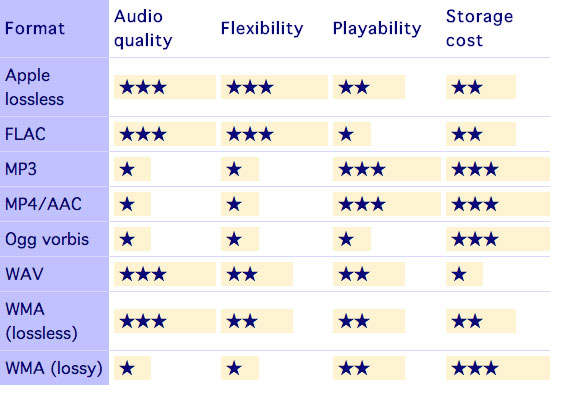
MP3

MPEG Audio Layer III
-Compressed digital format with loss.
-Its compression size: 11 to 1
-Compresses the audio using a lossy algorithm to obtain a smaller size, decoding the signal, allowing less bits to be consumed, which translates into less weight and less quality.
-Extension: .MP3
-Good compatibility. Can be played on almost all audio players
-Easily distributable online
-Better quality-space ratio
-Loss of the original sound, implies a decrease in quality throughout the format
-Supports two channels
-Distortion in frequency bands where the brightness and sparkle (5000hz-20000hz) are located.
-Increase in the bass and subwoofer frequencies (250hz – 40hz) due to the dynamic compression of the sound that causes a different equalization from the original recording.
-present patterns between tracks

AAC

Advanced Audio Coding
– Lossy compressed digital format
-It is an audio compression system developed by the Fraunhoffer Institute, AT&T, Sony and Dolby Laboratories.
– It is an audio broadband coding algorithm with higher performance than MP3.
-Extension: .m4a, .m4b, .m4p, .m4v, .m4r, .3gp, .mp4, .aac
-Play files from the hard disk of a computer with a quality that can be similar to the CD using significantly less space than an mp3.
-This system increases the quality of the mp3.
-Loss of original sound
-Subject to patent

WAV

Waveform audio format
-Uncompressed digital format.
– Windows own format
– Used to store sounds on PC, supports mono and stereo files at various resolutions and sampling rates
– Extension is .wav
-High sound quality
-Provides faithful listening to the audio
-It works in Windows applications and in common equipment with a CD player.

– Includes support for almost all current audio codecs
– Compatible to convert into various formats by means of the appropriate software.Example switching from Wav to Mp3
-It takes up a lot of disk space
-Poor quality-space ratio
-Difficult to distribute online due to the weight of the file
-Allows to capture in the same file up to 6 hours

FLAC

Free Lossless Audio Codec
– Lossless compressed format

-Extension: .flac
-Higher quality in high fidelity equipment
-Information is continuous between separate tracks
-It does not delete information from the original content
-It is an open source format.
-Code and decode quickly
-It takes up a lot of disk space
-It is not supported by all portable players

AIFF

Audio Interchange File Format
-Uncompressed format without loss.
– Format typical of native applications of Mac OS X for example iTunes
-Extension: .aiff or .aif.
-High sound quality
-Requires large storage space

OGG VORBIS

-Compressed format loss
– Stream-oriented container, which means that
can be written and read in one step, making it suitable
for streaming on the internet.
– Free software version to MP3 and AAC.
– Intended to allow maximum encoder flexibility
Extension: .ogg
-It is free, open and not patented
-Similar to MP3
-Good value for space
-Improved same-size MP3 quality.
-It is not supported by all players
-Loss of original sound

WMA

Windows Media Audio
– Lossy audio compression format, although there is a more recent lossless development
-Windows version to compress audio
-Extension: .wma
-Ideal for real-time streaming
-Reduce size of large files
– Inclusion of support in Windows Media Player
-Lower quality
-It takes space
Real Audio
-Media player with various functions and Internet connection tools
Example: listening to music and watching videos hosted on the Internet (streaming), and creating and playing extensive playlists.

– Ideal for live streaming over the network due to its streming ability
– the coding allows adapting it to the user’s reception capacity depending on their internet connection speed.
-Can be used in different operating systems (Windows, Linux, Mac OS)
– Ability to transfer files to other multimedia devices
-Reduction in file sizes

-Incompatibility with some browsers
-High RAM consumption

APE

– Lossless compressed format
-Extension: .ape
-Save space
-High quality
-Better file compression rate
-It is not compatible with most players.
-Slow to compress and decompress files

What audio formats are there? All you need to know


FLAC, WAV, AIFF, DSD … these are just some of the initials that you can find when you are looking for a digital format. They are also accompanied by technical data such as sample rates and bit depth. So many terms can leave you more misplaced than a chicken at a dance. And it is that unless you are an expert in digital sound, the process to choose the audio format that best suits your needs can be a mess. But if they explain it to you, the topic is relatively simple. That is why at Culturasonora we have prepared a complete guide for you on the different audio formats most used. This will prevent any acronym from taking you on the dark side.

What are Bit Depth and Sample Rate?

These two concepts are basic. To understand how audio formats work you need to know what Bit Depth and Sample Rate are. These are two measures that indicate the quality of a digital audio file. We are going to try to summarize it so that you keep the general idea

samplerate

When you read the specifications of the audio formats you come across a couple of figures. For example: 32-bit / 192kHz or 24-bit / 96kHz. These numbers indicate the bit depth and the sample rate. These references tell us how much information the different formats transmit and the quality of the sound. For example, the audio we hear on a regular CD, or on a Spotify stream, is 16bit / 44.1kHz. Samples are always measured in Hertz (or hertz) and bit depth in Bits.

Softwares or hardwares usually do not work with a continuous flow of information, but usually use pieces, samples or samples to effectively manage the data that is transmitted. The sample rate is the number of samples per second that are obtained from a recording. The higher the number of times a device plays samples, the higher the sound quality. Each of these extracts or samples has a certain amount of information, which is the bit depth, or bit depth.

So that you understand it better we are going to make a somewhat beastly analogy, which is not entirely true, but that will help you get the sense of all this. Which is what interests us. If you control a bit of photography and image you will get it right away: the sample rate would be something similar to the frames or frames per second of a video, and the bit rate would be similar to the pixels of a photograph. The higher the bit depth number, the more information each sample will have. The more pixels an image has, the higher resolution each frame of a video will have. The more frames per second a movie has, the better definition. In short: the higher the number of the Bit Depth and the Sample Rate, the higher the quality of the audio file. Heard cooking?

Audio formats: MP3 vs WAV vs AIFF

What is the MP3 format?

If you’re interested in getting some audio fidelity and decent sound from your files, you’ll want to avoid this format. Why? Because basically an MP3 is a file that sacrifices audio quality to minimize size. They weigh very little for any device to read. The negative? Compressing these files provides poor, almost lifeless sound. Today, hardly anyone uses this format seriously. Even its creators recently ended the license by declaring it dead. But surely from time to time you come across a zombie file with this format.

What is WAV format?

WAVs (Waveform Audio File Format) are just as common but better for anyone who wants a decent audio format. They are higher resolution files than MP3s. A WAV is an audio piece that is encoded with something known as Pulse Code Modulation (PCM), a medium that encodes analog audio pieces and converts them to digital so they can have the Sample rate and Bit Depth of the that we have already talked about previously.

What is the AIFF format?

The AIFF (Audio Interchange File Format) audio format is very similar to WAV in that it also uses PCM to encode analog audio pieces and present them in digital format. This format was born as a response from Apple to Microsoft’s WAV, and at the beginning it could only work on MAC computers. Currently AIFF and WAV are more or less interchangeable.
In summary…
To close this topic, we will tell you that if you have a file in WAV or AIFF audio formats, you will hear a piece of sound of good quality. Normally these formats are used in files that we reproduce through our services, such as the iTunes music library. We will not see them in online streaming services, which tend to use special types of files.