Many people do not have a clear idea that in general most audio formats compress music.
In fact, thanks to that compression, the mp3 became so popular. It is not because it sounded better, as an uncle of mine creates … but because it allows you to store much more music on a USB stick, on a CD, etc. even when it sacrifices a bit of quality.
That is to say, technically the mp3 sounds worse than the original raw format like a wav.
But handling wavs is usually unmanageable, unless you are an audio professional.
But, going back to talk about my uncle, who wants to listen to Frank Sinatra in his car, using the mp3 is much more friendly. Even because it has a metadata (artist name, track, lyrics, etc.) and also, if a good bitrate is used (160 m or more) it is almost imperceptible to most of the people the difference between an mp3 and a wav .

Experiments have been carried out in famous universities that managed to show that not even the people who claimed to have an auditory training (for being musicians, djs, etc.) managed to distinguish in most cases a 192-bit mp3 from the original wav.
This explains why mp3 is still king, even before the appearance of FLAC for example, that it is free (without patents) and that it has a much better quality.
But, again to mention my uncle, he believes that FLAC is a colorful cereal … and he still says that he really likes that cereal for breakfast !!
Compression
But then, the fame of the mp3 is due exclusively to its ability to save space?
Yes.
And how does the music compress the mp3?
Follow several methods. Here I will tell you superficially and only by way of introduction how it manages to save space.
The first tactic is almost logical. As the human ear only listens to a part of the sound spectrum, the mp3 erases everything that is outside that spectrum, thus saving a lot of space.
Then it uses another well-known mechanism of the human ear (if you look at the mp3 it is based on the ability to perceive the human ear … THAT’S why people DO NOT manage to perceive a good mp3 from the original wav !!).
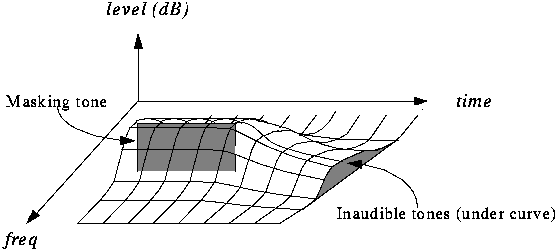
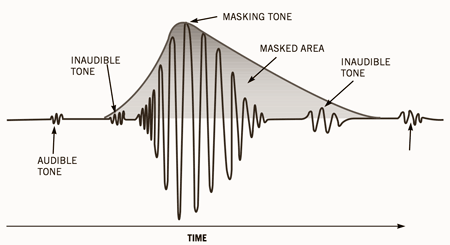
That mechanism is called masking, and it’s about the following. If there are two or more sounds at nearby frequencies and one of them suddenly sounds loud enough, the ear will NOT hear the other sounds that are lower in volume at nearby frequencies. So the mp3 uses that acoustic principle of the human ear and gets rid of those other sounds with which it again removes information.
And removing information means SAVING SPACE.
And if you finally use some mechanism to compress (type .zip or type .rar), a great saving of space is achieved.
For example, let’s imagine (it is a false example, but it illustrates what I mean), if we had this string in the audio “xxxxxxxxxxxxxxxxxxxx”, one way to compress it would be to say that there are 20 x, instead of writing 10 x, note :
xxxxxxxxxxxxxxxxxxxx
20x
Which takes up more space and which takes less?
Both strings of signs or characters say the same thing, there are 20 x, but it is shorter to write it as 20x, than to write “xxxxxxxxxxxxxxxxxxxx”
Onbiamente in all loss of information, there is a loss of quality. But the same thing happens with colors.
They say there are computers capable of handling not how many millions of different colors … it would be smart to ask how many different colors the human eye can perceive.
So, there will always be a purist who says that the mp3 loses quality … but it would be good to see if her ear can distinguish it. Music is made to be heard by human ears, with its limitations.
Well, in short, this is how you make an mp3 to save space. I will send a copy of this article to my uncle.