MP3 curiosities about the format that changed the music


Free Download Mp4Gain
picture

The Moving Picture Expert Group 1/2 Audio Layer 3, the audio compression format that has changed the music world forever, has officially disappeared, at least for the Fraunhofer Institute for Integrated Circuits.

mp3 compression

The German institution that was working on the format and that funded its development in the late 1980s recently announced his death at the end of the licensing program for some registered patents related to the MP3 format. According to the official statement, the reason is: “More efficient audio codecs are available today.”

Despite the enormous popularity that was gained in about 30 years, the MP3 format was surpassed by the formats of the Aac family used by modern multimedia services such as streaming or TV and radio broadcasts, and soon also by the extraordinary Mpeg-H .

mp3 quality

The new formats guarantee better audio quality and a lower bit rate, hence a heavier audio file with the same quality compared to MP3 and offer greater functionality. According to Bernhard Grill, director of the institute, AAC is today the de facto standard for downloading music and videos on smartphones. If MP3 was the symbol of a revolution, today nobody cares about the name of the institute format in which an audio file is encoded, only “sounds” good.

Let’s return to the history of MP3 thanks to these 10 “Maybe not everyone knows”:

1) An idea from the late 19th century. Studies of an algorithm that reduced the weight of audio files in order to transmit them more easily through very slow networks in the late 1980s relate to the concept of “auditory masking” or the phenomenon by which the perception of a Presence of another sound masked.

The first observations on this phenomenon were made in 1894 by the American physicist Alfred M. Mayer.

2) Hello, I’m MP3 The father of MP3 can be seen as a codec for the psychoacoustic masking introduced in 1979. The aim was to create an audio format for telephone messages that does not “weigh” the lines. The basic idea that was later taken up when creating the MP3 format is that the human ear cannot perceive some audio frequencies.

For this reason, it is sufficient to eliminate these frequencies in order to reduce the weight of an audio file while maintaining an apparent quality. In fact, the basic assumption has proven to be wrong in recent years. Read also: The virtual reality changes the music and fights the secondary ticket sales. And Keith Richards teaches you how to play

3) An Italian is listening Leonardo Chiariglione Mp3 seen at “The Visible City” at the Turin International Book Fair 2012. Valerio Pennicino / Getty Images Leonar do Chiariglione, an engineer from Almese, Turin, is considered one of the fathers of the MP3 format as the founder of the working group MPEG (Moving Pictures Expert Group) in 1988, which developed several audio / video compression formats in world standards.

In December 1988, the MPEG group launched a public request to develop an audio compression algorithm. Because of their similarity, the 14 algorithms obtained were divided into four main categories.

4. Brandenburg uses it. Suzanne Vega. Carlos Alvarez / Getty Images It is the thesis of the doctoral student Karlheinz Brandenburg that was discussed in 1989 at the German University of Erlangen-Nuremberg to illustrate the specifications of the MP3 format in detail.

The first song encoded in the new format was Tom’s Diner by singer Suzanne Vega. Brandenburg coded it countless times to understand whether the omitted frequencies had affected the sound of Vegas’ voice. Also Read: 10 Songs To Keep Fit: Here’s The Spotify Playlist

5. Light weights With the introduction of the MP3 format, the weight of a song was reduced to approximately 4 MB compared to ten MB of an audio file on a CD. It was a revolution because it was finally possible to transmit the songs over the Internet, although the transmission speed was still tied to the limits of the 56 kbit / s modems or even to a lower download speed.

6. The hacker in a coat In the summer of 1996, the NetFrack user published a message in the Affinity online fanzine that he had found a way to reduce the size of audio files thanks to a new compression format and thus hard drives. from that time on they could have contained many more songs. Subsequently, NetFrack founded the online group Compress Da Audio, which only distributed music files, and made Metallica’s song Doesi It Sleeps available in MP3 format.

August 10, 1996 is the official date of birth of music piracy.

7. The beginning of the revolution. In 1997 NullSoft created Winamp, the first software to encode audio files in MP3 format. The following year, Diamond Multimedia introduced the first portable MP3 player, the Rio PMPm300, which could hardly hold the contents of an album, used a pencil battery, and cost around $ 200. In 1999 it was Shawn Fanning and Sean Parker. Years later, when Mark Zuckerberg advised to remove “The” from the Facebook name, Napster founded it.

8. A useful service. Despite about $ 35 million in claims and considered utterly evil, Radioheads Kid A wouldn’t have had the success it had had without Napster. The group was not yet known worldwide and the record company had not planned to advertise the new album, release or video clips. In October 2000, the album was Radiohead’s first to top the billboard charts, also thanks to the fact that it was released three months before Napster’s official release.

And Thom Yorke said unlike Madonna, Metallica and Dr. Dre, who had filed million dollar lawsuits: “The best thing about Napster is that it instills enthusiasm for music in a way that the music industry has stopped. Hour”.

9. Apple, thank you In 2001, Apple introduced the iPod, the MP3 file player that played a key role in tracking china down to the Cupertino home. Almost 400 million units were sold in around 13 years of life. In 2003, Apple always invented the first paid and legal music download service. Today, 70% of online music is purchased on iTunes, which is an average of approximately 20,000 songs per minute.

10. An announced death. The development of the AAC format, which is now the de facto standard for digital audio, began in 1990, but only understood in 2007 when Apple decided to only make audio files in Aac format with 256 Kbit / s available in iTunes Plus Experts the end. MP3 was close.


Free Download Mp4Gain
picture


Mp4Gain Main Window
picture


Mp4Gain Features
picture


Free Download Mp4Gain
picture

MP3 – Compression criteria

MP3 – Compression criteria

To perform such compression, the MP3 format is based on a simple concept: filter a digital piece of music and eliminate all unnecessary information, thus reducing space.

mp3 compression

The human ear is an almost perfect instrument but it also has its limits. The human ear pass band extends from 20 Hz to 20,000 Hz, but is much more sensitive to those in the midrange, 700 to 6,000 Hz, where most of the information is concentrated.
The study of auditory perception is a matter of psychoacoustics that mainly analyzes 2 factors that are later used in MP3 encoding:

Mp3 – Auditory perception

In the area of ​​sounds, only a few can be heard by the human ear. The following figure shows these areas that represent the different sound frequencies. Only those in the white area are audible from our ear.

The sounds that the ear perceives are only those of the white areas

Masking

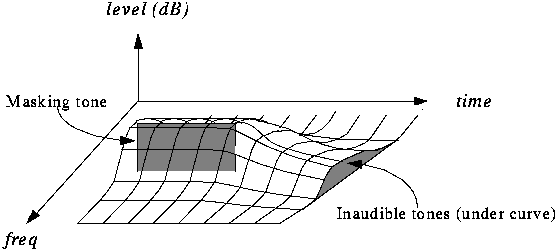
Masking is nothing more than the superposition of weak sounds with loud sounds. It almost always happens that the sounds of different instruments overlap each other. In cases where the loudest sound completely covers the lowest, there is a so-called masking. In MP3 files, masking allows you to remove the information from the weakest sounds, which, however, because they are not perceived by the ear, are virtually irrelevant.

mp3 audio masking

MP3 – The Name

The name MP3 comes from the MPEG standard, which means Moving Picture Experts Group. This group was created specifically for the development of systems and standards used in video compression. DVD movies and satellite broadcasts (DBS) use the MPEG standard to efficiently compress video information.

MPEG compression includes a subsystem for sound compression with three different compression levels (layers) depending on the quality of the information. Layer-3 is the one used for the MP3 standard, which stands for MPEG Layer-3.

MP3 – Step by step compression

The MP3 Encoder is that program that analyzes the uncompressed digital file (for example, a Wav file) and transforms it into an MP3 file.

The audio signal is filtered and divided into 576 areas (called subbands) through a process that uses DCT (Discrete Cosine Transformation) and manages to eliminate all unnecessary frequencies. The human ear, as already said, perceives sounds only beyond a certain threshold so that all the audio below is not encoded.

At this point, the resulting signal is passed through the psychoacoustic model in which the masking thresholds of which we spoke earlier are identified. This is done using Discrete Fourier Transformation (DFT).

During the masking of the 576 subbands, the frequencies to be masked are determined and therefore can be removed.

After masking, the defined Stereo Ensemble process is applied. Below a certain frequency, the ear cannot perceive the spatial position of the sounds, so they can be recorded on a single channel (therefore, in mono format) with significant space savings.

Once the file is ready, the data is re-analyzed and compressed using Hufmann encoding which enables a data reduction (without loss of information) of approximately 20%.

At this point, after all the data has been collected, the encoder proceeds to create the bit stream that will form the final MP3 file.

Mp3, description of audio compression technique

Mp3, description of audio compression technique

Digitization

Sound is a continuous wave that propagates through air or other media, formed by pressure differences, so that it can be detected by measuring the pressure level at a point. Sound waves have the proper and studyable characteristics of waves in general, such as reflection, refraction and diffraction.

To the Being a continuous wave, a digitization process is required to represent it as a series of numbers. Currently, most of the operations performed on sound signals are digital, since both storage and
Processing and transmitting the signal in digital form offers very significant advantages over analog methods. Digital technology is more advanced and offers greater possibilities, less sensitivity to transmission noise and the ability to include error protection codes, as well as encryption. With the appropriate decoding mechanisms, moreover, they can be processed simultaneously signals of different types transmitted by the same channel. The main disadvantage of the digital signal is that it requires a much greater bandwidth than that of the analog signal, hence an exhaustive study is carried out regarding data compression, some of whose techniques will be the center of our study.

Digitalization of the audio

The digitization process consists of two phases: sampling and quantization. At sampling divides the time axis into segments
discrete: the sampling frequency will be the inverse
the time between a measurement and the
following. At this time the
quantization, which, in its simplest form,
it simply consists of measuring the value of the signal
in breadth and save it.

Nyquist’s theorem

Nyquist’s theorem ensures that the frequency required to sample a signal that has its highest components at a given frequency f is at least 2f. Therefore, being the upper range of human hearing around 20 Khz, the frequency that guarantees adequate sampling for any audible sound will be around 40 Khz.
Specifically, to obtain high quality sound, frequencies of 44’1 Khz are used,
in the case of CD, for example, and up to 48 Khz, in the case of DAT. Other typical values ​​are submultiples of the first, 22 and 11 Khz.

Depending on the nature of the application, of course, the appropriate frequencies can be much lower, such that the voice process is usually performed at a frequency between 6 and
20 Khz. or even less. Regarding quantization, it is evident that the more bits used for the division of the amplitude axis, the “finer” the partition will be and therefore the less error when attributing a specific amplitude to the sound at each moment.

For example, 8 bits offer 256 levels of quantization and 16,65536. The dynamic range of human hearing is about 100 dB. The axis division can be carried out at equal intervals or according to a specific density function, seeking more resolution in certain sections if the signal in question has more components in
certain zone of intensity, as we will see in the coding techniques.

The complete process is usually called PCM (Pulse Code Modulation) and we will refer to it hereinafter. It has been described in a very simplistic way, mainly because it is widely treated and is well known, being
another the field of study of this work. However, we will go into detail at any time that is necessary for the development of the exhibition.

Coding and Compression.

Before describing coding and compression systems, we must pause in a brief analysis of human auditory perception, to understand why a significant amount of the information provided by PCM can be discarded.

The heart of the matter, as far as we are concerned, is based on a phenomenon known as masking.

The human ear perceives a frequency range between 20 Hz. And 20 Khz.

Firstly, the sensitivity is greater in the area around 2-4 Khz., So that the sound is more difficult to hear the closer to the ends of the scale.

Second is masking, the properties of which are used extensively by the most interesting algorithms: when the component at a certain frequency of a signal has high energy, the ear cannot perceive lower energy components at close frequencies, both lower and higher.

At a certain distance from the masking frequency, the effect is reduced so much that it is negligible; the range of frequencies in which the phenomenon occurs is called the critical band.

The components that belong to the same critical band influence each other and do not affect nor are affected by those that appear outside it. The width of the critical band is different according to the
frequency in which we are located and is given by certain data that shows that it is greater with frequency.

It should be noted that these data are obtained by psychoacoustic experiments, which are carried out with experts trained in
sound perception, giving rise to psychoacoustic models with their impressions.

This we have described is the so-called simultaneous or frequency masking.

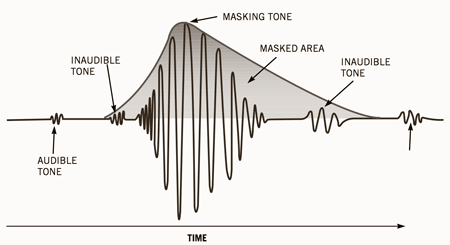
There is also the so-called asynchronous or time masking, as well as other phenomena of hearing that are not relevant in this point. For now, let’s focus on the idea that certain signal frequency components support higher noise than we would generally consider to be tolerable, and therefore require fewer bits to be encoded if the encoder is endowed.
of the right algorithms to solve masks.

Digitizing the signal using PCM is the simplest form of signal encoding, and is used by both CDs and DAT systems. Like still digitizing, it adds noise to the signal, generally undesirable. As we have seen, the fewer bits used in sampling and quantization, the greater the error in
accept discrete values ​​for the continuous signal, that is, the higher the noise.

To avoid that the noise reaches an excessive level, it is necessary to use a large number of bits, so that at 44.1 Khz. and using 16 bits to quantize the signal, one of the two channels on a CD produces more than 700 kilobits per second (kbps). As we will see,
Much of this information is unnecessary and takes up bandwidth that could be freed, at the cost of increasing the complexity of the decoder system and incurring some loss of quality.

The compromise between bandwidth, complexity and quality
it is the one that produces the different market standards and will form the essential part of our study.

Mp3: What is it really?

Mp3: What is it really?

MP3 is a data format that gets its name from an algorithm
encoding called MPEG 1 Layer 3, which, in turn, is an audio compression system that allows you to store sound with a quality similar to that of a CD and with a very high compression ratio, on the order of 1:11

In practice, this means that about 11 audio CDs can be recorded on a CD-Rom, that is, approximately 150 songs.
The encoding system that MP3 uses is a loss algorithm. That is, the original sound and the one that we obtain later are not identical.

This is because MP3 takes advantage of the deficiencies of the human ear and eliminates all the information that we are not able to perceive. A multitude of studies of acoustic perception have been carried out, discovering that there are a series of effects that can aid the coding of sound with the aim of reducing as much as possible the amount of useless or redundant information. The most important are: The limits of hearing. Our ear only works with frequencies that go between 20 Hz and 20 Khz
approximately, so the remaining frequencies are disposable.

Masking effect.

It is one that occurs when two signals of similar frequency are
overlap. So we can only perceive the one that
it has more volume and, therefore, the one with a smaller volume is
liable to be removed

Stereo redundancy.

There are redundancies between the tonal and non-tonal components of the sound on the two stereo channels, and furthermore
below a certain frequency the human ear is not capable of
perceive the directionality of the sound, so below these
frequencies it is even possible to encode a single channel together with
complementary information to restore the spatial feeling for the other channel.

To carry out this “loss of information” action, a system called Subband Coding is used, a process by which the signal is broken down into subbands through a filter bank.

These subbands are then compared to the original using a psychoacoustic model that is responsible for determining which bands can be removed and which cannot.

Depending on the quality we want to obtain, more or less will be eliminated
bands. To end the process, the resulting subbands are quantized and encoded, and the final result is compressed using a standard algorithm, thus obtaining the resulting MP3 file. The encoding process is much more complicated than the decoding process, so it takes much longer to encode an MP3 file than to play it.

This perceptual coding algorithm was developed by the company MPEG (Moving Picture Expert Group) in conjunction with the Franunhofer Institute of Technology, and has been standardized as an ISO standard.

How much compresses an MP3

How much compresses an MP3

MP3 compression was an engineering response to the problem of digital storage and its large memory resource requirements. A conventional digital signal called PCM (Pulse Code Modulation) could easily require up to 10 Megabytes of memory per minute. This would represent about 30 Mb for a three minute song.
That requirement for storage memory could be handled by any computer if it were a few files, but when talking about three thousand songs the numbers become worrying. As if this were not enough, there is the problem of the Internet and its current transmission speeds. In the case of telephone lines, they have a limitation on their transmission bandwidth, so very large or heavy files represent a problem for conventional network traffic.

MPEG3 compression is considered the sound part of the original MPEG1 format that was intended for cinematography. Its abbreviations, Moving Picture Experts Group come from the committee that was created by the ISO Organization (international Standards Organization) and IEC ((International Electrotechnical Commission) to develop this format. Its principle is based on the Psychoacoustic model.

The human ear is known to discriminate sound according to its limitations. According to subject matter expert Paul Sellars, “If you hear solitary applause in a room, it will surely sound loud, but if it is preceded by the sound of a gunshot, it will sound fainter. The same thing happens in a room when you record a rock band, at a certain moment the strongest sound guitar in the mix, until the moment the drummer plays a certain cymbal, at which point the guitar will seem to attenuate “This phenomenon is used by the MP3 algorithm to perform its compression . I once explained it in the article that talked about ATRAC compression of the Minidisc.

The MP3 format divides the sound into 32 sub-bands, which allows it, according to the Psychoacoustic model on which it is based, to give priority to one element over another. At a certain moment in the material we can have a predominant low frequency sound of the kick drum, a high frequency of the cymbal and the vocalist at the same time. The algorithm is not that it eliminates two of them, but that it dedicates less storage space to them.

The mathematical part used with MP3 compression goes through the Shannon-Nyquist theorem, which states that for a wave to be properly reproduced in PCM digital format, its frequency of takes (Sampléo) must be twice the highest that is want to reproduce. In this case if we want to reproduce the frequency of 22.5KHz, (The auditory range oscillates between 20Hz-20KHz), our sampling frequency should be 44.1KHz.

The Fast Fourier Transform (FFT) is also used, which as we know can decompose a complex wave (PCM material) into a fundamental wave with its harmonics, all from its amplitude. The Discrete Cosine Transform is also used, which is based on the FFT but only using the real numbers

UNTIL IT IS RECOMMENDED

These formats will continue to be perfected and emerge, but it should be understood that despite being disseminated there may be details that will not be perceived. In other words, for serious Audio work this format should not be used.

Some improvements can be made by looking for compressors that have a better ratio, such as 224, 256 and 320 Kbps. You can also consider using VBR (Variable Bit Rate) encoding where musical passages with greater dynamic complexity are treated with a higher rate. storage in contrast to the simplest. However, this will bring other complications because not all the reproducers can handle them.

How an MP3 compresses music

We all know that MP3 was the audio format that quickly became popular and the main reason is because it took up much less space than the WAV format that has no compression and therefore was very difficult to transfer via internet from one computer to another.

And then it was when the MP3 made its appearance because it had a very good sound and yet it took between 7 and 10 times less space than the original file.

We all know that this caused people to easily exchange music files online and this changed even the way the music industry works thereafter.

But although we all know that MP3 takes up less space, it is very few people who understand that in the first place in MP3 what it does is compress the music. But it also uses some other procedures to make music take up less disk space, Today we will briefly explain how this mp3 performs this compression.

Remove inaudible sounds

One of the first things MP3 does is to analyze the music file and eliminate all those frequencies that are not audible to the human ear but nevertheless occupy a space in the original file. Then the MP3 saves a lot of space without losing quality by eliminating sound frequencies that the human ear cannot hear.

Eliminate redundancy

Another of the mechanics that is used for an mp3 saves space is to eliminate redundant sounds. And with that we understand sounds that sound very similar and basically occupy the same Soundtracks. Therefore, the ear will only perceive some. And then the MP3 eliminates those redundant sounds that will not be heard by the human ear.

Sound masking

Acoustics and audio specialists have long discovered that when the human ear perceives more than one sound simultaneously it is very likely that one of them masks the others.

The Sound perception produces that when a person perceives 2 sounds of different intensity at the same time the weakest sound, with less volume, is inaudible to the one who is listening. This, as we indicated earlier, is what is called the sound perception and the MP3 is based a lot on the sound perception to be able to eliminate sounds under this principle of sound masking.

In other words, in MP3 you decide which sound will mask others and then eliminate these others.

It should be noted that when one decides if the MP3 encodes at 128 kilo bytes per second or at 320 kbs it is modifying the amount of sounds that will be eliminated in the masking. Well, at 320 to eliminate very few sounds and as I lowered the number of kbs it will eliminate more sounds which the person can produce if he can distinguish a difference between the original audio file and the encoded file.

How is an mp3 file compressed?

How is an mp3 file compressed?

The MP3 file takes up less space but loses information from the original recording, so it is a lossy compression. The question is, what is the algorithm for scrapping those details of music? How are they removed from the recording? Don’t they really matter and we don’t perceive those losses?

MP3 and auditory masking

The algorithm for MP3 compression eliminates details of the original music based on the phenomenon of the sound masking of our sense of hearing, a psychoacoustic phenomenon so daily that surely many will not have paid attention before, and that it is necessary to know to understand the MP3 .

Imagine that we are talking to someone on the street, a car passes by and suddenly we stop hearing our interlocutor. Why have we stopped hearing the other person? If we had recorded this situation with a microphone we would see that both sounds, the voice and the car, would have been perfectly recorded …

This phenomenon occurs because there are situations in which our sense of hearing gives prominence to one sound and ignores another if both are simultaneous, what is called sound masking, and that depends on well-defined causes that can be summarized as follows.

A sound can mask another when they reach the ear simultaneously depending on their relative frequencies and volumes. As seen in the figure, at the loudest sound our ear creates a new limit of hearing or masking at that time. If another simultaneous sound is under that frequency environment, we will not perceive it.

Temporary masking

When there is a sound of sufficient power to be masking, there are moments before and after that we will not perceive other sounds, depending on how closely they are in time and their relative volume, with the behavior represented in the figure. As you can see, a sound can be masked whether it occurs immediately after the masking, or if it occurs before!

The MP3 compression algorithm

When we perform an MP3 compression, the coding algorithm divides the music into a multitude of short-lived fragments. Each of these fragments are analyzed individually in many frequency bands, to be able to detect if in any of them there is any masking sound that is masking sounds of the other bands of the fragment, and therefore are inaudible or expendable. In that case, what you will do is encode that fragment with fewer bits than the original fragment, so resolution of the more subtle details (those details that have been dispensable) will be lost and the background noise of the fragment will increase.

The amount of bit reduction for that fragment will depend on the quality sought in the encoding. If we set it to high quality, it will reduce the resolution of the fragment only just enough so that the new background noise is still masked by the masking sound that was detected in that fragment.

Therefore, and according to the masking theory, no change will be perceived after the resolution reduction: neither by the loss of the details that were already originally masked, nor by the new background noise, which will remain imperceptible by also maintaining below that masking sound detected.

After this process, the fragment could have been encoded with fewer bits, occupying less information than the original. Once this attempt at bit reduction has been repeated with all the multitude of fragments into which the original file had been divided, the song is reconstructed and a compressed file is obtained that will now take up less space.

In addition to this masking-based coding, finally an “Huffman” arithmetic coding is applied to the resulting bits, similar to that performed in a “.zip” compression. This process will not entail additional quality losses.

Sound quality in MP3 files

The sound quality of the compression depends on the size that we want the compressed song to occupy, therefore the bitrate we indicate when performing the compression. If we choose a high bitrate, the algorithm will not be forced to eliminate much information, so it will eliminate really inaudible details according to the masking curves. But if we want the file to take up less space and choose a lower bitrate, the algorithm will have to be more drastic overcoming the most imperceptible masking curves, and it will be inevitable that the loss of information will be noticed.

For example, in the most common 128 kbps MP3s a few years ago, the quality is significantly lower than the original for most people, if a direct comparison is made. On the other hand, an MP3 file with the maximum bitrate of 320 kbps hardly loses information, and is practically indistinguishable from the original in most cases.

HOW MP3 COMPRESSION WORKS

Everyone knows MP3 music files. This format occupies less space than the original audio file since when converting to MP3, a compression algorithm is applied that analyzes the original sound and eliminates some details of the recording that are considered expendable, which supposedly our ear was never going to perceive.

The MP3 file takes up less space but loses information from the original recording, so it is a lossy compression. The question is, what is the algorithm for scrapping those details of music? How are they removed from the recording? Don’t they really matter and we don’t perceive those losses?

MP3 and auditory masking

The algorithm for MP3 compression eliminates details of the original music based on the phenomenon of the sound masking of our sense of hearing, a psychoacoustic phenomenon so daily that surely many will not have paid attention before, and that it is necessary to know to understand the MP3 .

Imagine that we are talking to someone on the street, a car passes by and suddenly we stop hearing our interlocutor. Why have we stopped hearing the other person? If we had recorded this situation with a microphone we would see that both sounds, the voice and the car, would have been perfectly recorded …

This phenomenon occurs because there are situations in which our sense of hearing gives prominence to one sound and ignores another if both are simultaneous, what is called sound masking, and that depends on well-defined causes that can be summarized as follows.

Frequency masking

Sound masking

A sound can mask another when they reach the ear simultaneously depending on their relative frequencies and volumes. As seen in the figure, at the loudest sound our ear creates a new limit of hearing or masking at that time. If another simultaneous sound is under that frequency environment, we will not perceive it.

Temporary masking

When there is a sound of sufficient power to be masking, there are moments before and after that we will not perceive other sounds, depending on how closely they are in time and their relative volume, with the behavior represented in the figure. As you can see, a sound can be masked whether it occurs immediately after the masking, or if it occurs before!

The MP3 compression algorithm

MP3 encoding

When we perform an MP3 compression, the coding algorithm divides the music into a multitude of short-lived fragments. Each of these fragments are analyzed individually in many frequency bands, to be able to detect if in any of them there is any masking sound that is masking sounds of the other bands of the fragment, and therefore are inaudible or expendable. In that case, what you will do is encode that fragment with fewer bits than the original fragment, so that resolution of the more subtle details (those details that have been dispensable) will be lost and the background noise of the fragment will increase.

The amount of bit reduction for that fragment will depend on the quality sought in the coding. If we set it to high quality it will reduce the resolution of the fragment only just enough so that the new background noise is still masked by the masking sound that had been detected in that fragment.

Therefore, and according to the masking theory, no change will be perceived after the resolution reduction: neither for the loss of the details that were already originally masked, nor for the new background noise, which will continue to be imperceptible by also maintaining below that masking sound detected.

After this process, the fragment could have been encoded with fewer bits, occupying less information than the original. Once this attempt at bit reduction has been repeated with all the multitude of fragments into which the original file had been divided, the song is reconstructed and a compressed file is obtained that will now take up less space.

In addition to this masking-based coding, finally an “Huffman” arithmetic coding is applied to the resulting bits, similar to that performed in a “.zip” compression. This process will not entail additional quality losses.

Sound quality in MP3 files

MP3 encoding quality

The sound quality of the compression depends on the size that we want the compressed song to occupy, therefore the bitrate that we indicate when performing the compression. If we choose a high bitrate, the algorithm will not be forced to eliminate much information, so it will eliminate really inaudible details according to the masking curves.