What is the difference between MP3 and MP4?


Free Download Mp4Gain
picture

What is the difference between MP3 and MP4?

MP3 vs. MP4

MP4 files are just a newer and better version of MP3 files, right? The answer is no. This ambiguous difference may give the impression that they are the same thing, but nothing could be further from the truth. Each has its own uses, history, and benefits, so let me repeat: MP3 and MP4 are not two versions of the same thing. In this article, I’ll explain some of the key differences that everyone should know about.

MP3 vs MP4

When you have finished reading, you will know exactly which file type is right for your needs. MPEG Overview But before delving into the differences, it is important to understand where these two types of files come from. Mp3 is short for MPEG-1 Audio Layer 3. It was one of two formats that were considered for the MPEG audio standard in the early 1990s. Philips, the French research institute CCETT, and the German Institute of Technology for Broadcasting have supported the format because of its simplicity, minimal error, and computational efficiency.

The decision was made in 1991 and the MP3 files were made available to the public in 1993. MP4 stands for MPEG-4 Part 14. This technology is based on Apple’s QuickTime MOV format, but adds support for various other MPEG functions. . The file type was first released in 2001, but it is a 2003 reissue and is now commonly used when viewing MP4 files. Audio and digital media only

The most fundamental difference between MP3 and MP4 is the type of data they store. MP3 files can only be used for audio, while MP4 files can store audio, video, still images, subtitles, and text. Technically speaking, MP3 is an “audio encoding” format and MP4 is a “digital media container.” MP3: King of Audio Because they are so good at storing audio, MP3 files have become the de facto standard for audio formats for music software, digital audio players, and music streaming sites. Regardless of the operating system or device you have, you can be sure that MP3s will work right out of the box without any problems. The main reason they are so popular is the way the file type works. MP3 files use lossy compression, which greatly reduces the size of the audio file with little effect on its quality.

The process works by removing all the data that is beyond the average person’s hearing and then compressing the rest as much as possible. MP3 also allows users to balance sound quality and file size. If you are an audiophile, you can go for larger files with higher bit rates and better sound quality. On the other hand, if you want to compress as much music as possible on your portable device, you can reduce the file size and sound quality accordingly. Also, MP3s will always be smaller than equivalent MP4 files.

If your audio player or smartphone is getting crowded, you can convert any audio saved as MP4 format to MP3. Be aware that the sound quality may decrease in the process. MP4: more use, more flexibility MP4 files are “containers”: instead of storing the code of the file, they store data. So MP4 files don’t have their own way of handling file encoding. They are based on specific codecs to determine how encoding and compression will be handled. There are currently hundreds of codecs, but not many work with MP4. For the device to be able to read and play the MP4 file, it must have the same codec. Most supported codecs: Video: MPEG-4 Part 10 (H.264) and MPEG-4 Part 2. Audio: AAC, ALS, SLS, TTSI, MP3 and Subtitles: MPEG-4 Timed Text. These codecs give MP4 much more flexibility than MP3. For example, M4A files (which are MP4 files that only contain audio) can handle both Advanced Audio Coding (AAC) and Apple Lossless Audio Coding (ALAC). The choice of quality is up to the user. Either way, the file will appear as an MP4 file, but the data in the file will vary significantly. Besides audio, MP4 files can also contain video, images, and text. You will often see multiple file extensions indicating the type of data in the container. Some of the most common are: MP4 is an official extension. M4A: unprotected audio. M4 P: encrypted audio recording (digital rights management) M4B: audiobooks and podcasts. M4V: MPEG-4 visual bitstreams.


Free Download Mp4Gain
picture


Mp4Gain Main Window
picture


Mp4Gain Features
picture


Free Download Mp4Gain
picture

Interview with the inventor of the mp3: “We weren’t the only ones, we were just better”

A handful of German inventors from the Fraunhofer Institute in white coats invent a revolutionary process against all odds to compress music files to one-twelfth of their original size compared to CD with virtually no loss of quality. When was the moment they felt : Are we doing something bigger here?

mp3 developers

There are several moments. When I was still a student at the University of Erlangen in 1988 and doing basic research, someone visited our laboratory. My PhD supervisor, Dieter Seitzer, proudly demonstrated to this guest what we were currently working on: compressing digital music files. And when he asked what could become of our work, I replied: “Either our work will be forgotten and it will be accumulating dust in the library, or technology will become a standard that will be used by millions of people.” But I did not dare to dream about it. that really happened.

Developing mp3
Developing mp3

In 1977, his PhD supervisor, Seitzer, from Erlangen, had the idea of ​​transmitting music by telephone wire. And they all said, “I can’t.” And then you came. What application did you originally have in mind? Was it music in your pocket?

Back then, all textbooks said that you could compress images, videos, and voice, but definitely not music. It is too sensitive and complex. That was the starting point.

We asked ourselves: How can we compress music in that way, that is, reduce the amount of data per piece of music, so that people don’t hear the difference?

The question is to understand how the human ear works so that very similar things happen in our encoder, which compresses the music, as in the inner ear. Even in the inner ear, not all data is transmitted to the brain through nerve fibers. The brain always compares pitches with an internal reference, basically checking what it knows. In addition, there are so-called masking effects: if the sensory hairs tremble in the ear, the other sensory hairs are also automatically stimulated. This leads to the fact that the tones overlap and cannot be perceived at all. This is due to the mechanics of the inner ear. We use this as a guide when we come to the question: For what data can we reduce the level of detail, without being heard? Where would a coarser data structure be acceptable? We did not invent this trick in Erlangen. We weren’t the only ones working on it. We have only brought this knowledge to concrete results faster and optimized it better.

Is it true that you bought records for 1,000 marks in a music store in Erlangen to have compression material?

It is true. We had requested the project and absolutely needed better speakers, a small sound booth, and most of all, lots of audio samples. So I went to buy records: simple pieces, complex pieces, music of all genres, in all areas. We didn’t know what would work and, more importantly, what wouldn’t.

You mean the famous example of the Suzanne Vegas song “Tom’s Diner”, whose a cappella intro with “Da da da da …” was used to fine-tune the psychoacoustic MP3 model. What exactly was it about?

That was a special challenge: dense tones that the ear can still filter very well. My dissertation was almost done at the time and I really believed: I’m done, my process works for all kinds of music. But then I read in a hi-fi magazine that Suzanne Vegas’ voice had been used to test speakers. A colleague bought the CD because we wanted to know: What happens if we compress this music? The result was a disaster.

And how did you solve the problem?

There were two solutions. The first was to realize that what we had read in the specialized literature about how the masking of signals so rich in spectra works was not really true. Then we realized that psychoacoustics in these cases works differently than what the publications of the time suggested. We then test what happens when we transmit the lower frequencies very precisely and become less complex at the higher frequencies in favor of less storage space. That worked

Mp3 Compression, step by step

The MP3 Encoder is that program that analyzes the uncompressed digital file (for example, a Wav file) and transforms it into an MP3 file.

The audio signal is filtered and divided into 576 areas (called subbands) through a process that uses DCT (Discrete Cosine Transformation) and manages to eliminate all unnecessary frequencies. The human ear, as already stated, perceives sounds only beyond a certain threshold so that all the audio below is not encoded.

Auditory Perception

At this point, the resulting signal passes through the psychoacoustic model in which the masking thresholds of which we have spoken previously are identified. This is done using the discrete Fourier transform (DFT, Discrete Fourier Transform).

During the masking of the 576 subbands, the frequencies to be masked are determined and therefore can be removed.

Auditory perception

After masking, the defined Stereo Ensemble process is applied. Below a certain frequency, the ear cannot perceive the spatial position of sounds, so they can be recorded on a single channel (therefore in mono format) with significant space savings.

Once the file is ready, the data is further analyzed and compressed using Hufmann encoding which allows for a data reduction (without loss of information) of approximately 20%.

At this point, after all the data has been collected, the encoder proceeds to create the bit stream that will form the final MP3 file.

Compression criteria

To perform such compression, the MP3 format is based on a simple concept: filter a digital musical piece and eliminate all unnecessary information, thus reducing space.

The human ear is an almost perfect instrument but it also has its limits. The human ear pass band extends from 20 Hz to 20,000 Hz, but is much more sensitive to those in the mid-range, 700 to 6,000 Hz, where most of the information is concentrated.
The study of auditory perception is a matter of psychoacoustics that mainly analyzes 2 factors that are later used in MP3 encoding:

Auditory perception

In the area of ​​sounds, only a few can be heard by the human ear. The following figure shows these areas that represent the different sound frequencies. Only those in the white area are audible from our ear.

Masking

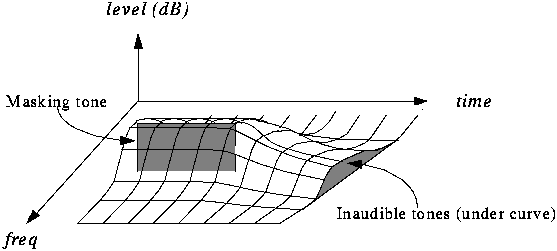
Masking is nothing more than the superposition of weak sounds with loud sounds. It almost always happens that the sounds of different instruments overlap each other. In cases where the loudest sound completely covers the lowest, there is a so-called masking. In MP3 files, masking allows you to remove the information from the weakest sounds, which, however, because they are not perceived by the ear, are virtually irrelevant.

How does music compress the mp3 format?

Many people do not have a clear idea that in general most audio formats compress music.

In fact, thanks to that compression, the mp3 became so popular. It is not because it sounded better, as an uncle of mine creates … but because it allows you to store much more music on a USB stick, on a CD, etc. even when it sacrifices a bit of quality.

mp3 compression

That is to say, technically the mp3 sounds worse than the original raw format like a wav.

But handling wavs is usually unmanageable, unless you are an audio professional.

But, going back to talk about my uncle, who wants to listen to Frank Sinatra in his car, using the mp3 is much more friendly. Even because it has a metadata (artist name, track, lyrics, etc.) and also, if a good bitrate is used (160 m or more) it is almost imperceptible to most of the people the difference between an mp3 and a wav .

mp3 compression

Experiments have been carried out in famous universities that managed to show that not even the people who claimed to have an auditory training (for being musicians, djs, etc.) managed to distinguish in most cases a 192-bit mp3 from the original wav.

This explains why mp3 is still king, even before the appearance of FLAC for example, that it is free (without patents) and that it has a much better quality.

But, again to mention my uncle, he believes that FLAC is a colorful cereal … and he still says that he really likes that cereal for breakfast !!

Compression

But then, the fame of the mp3 is due exclusively to its ability to save space?

Yes.

And how does the music compress the mp3?

Follow several methods. Here I will tell you superficially and only by way of introduction how it manages to save space.

The first tactic is almost logical. As the human ear only listens to a part of the sound spectrum, the mp3 erases everything that is outside that spectrum, thus saving a lot of space.

Then it uses another well-known mechanism of the human ear (if you look at the mp3 it is based on the ability to perceive the human ear … THAT’S why people DO NOT manage to perceive a good mp3 from the original wav !!).

That mechanism is called masking, and it’s about the following. If there are two or more sounds at nearby frequencies and one of them suddenly sounds loud enough, the ear will NOT hear the other sounds that are lower in volume at nearby frequencies. So the mp3 uses that acoustic principle of the human ear and gets rid of those other sounds with which it again removes information.

And removing information means SAVING SPACE.

And if you finally use some mechanism to compress (type .zip or type .rar), a great saving of space is achieved.

For example, let’s imagine (it is a false example, but it illustrates what I mean), if we had this string in the audio “xxxxxxxxxxxxxxxxxxxx”, one way to compress it would be to say that there are 20 x, instead of writing 10 x, note :

xxxxxxxxxxxxxxxxxxxx
20x

Which takes up more space and which takes less?

Both strings of signs or characters say the same thing, there are 20 x, but it is shorter to write it as 20x, than to write “xxxxxxxxxxxxxxxxxxxx”

Onbiamente in all loss of information, there is a loss of quality. But the same thing happens with colors.

They say there are computers capable of handling not how many millions of different colors … it would be smart to ask how many different colors the human eye can perceive.

So, there will always be a purist who says that the mp3 loses quality … but it would be good to see if her ear can distinguish it. Music is made to be heard by human ears, with its limitations.

Well, in short, this is how you make an mp3 to save space. I will send a copy of this article to my uncle.

MP3 format (Disadvantages and encoding methods)

First of all, remember that “MP3” is short for the term “Audio MPEG-1/2 Layer 3 Compression”, which is an audio data encoding format that allows you to divide the weight of a computer file by more than ten.

The word MP3 also refers by extension to portable audio players that play the audio in MP3 format.

Compression
The main role of the MP3 format is to compress music so that it is lighter (to store more in our player) without the listener noticing the differences.
Therefore, we will remove everything considered “superfluous” from the audio signal, but this is the whole controversy: what is really superfluous or unimportant or superfluous in the sound to be encoded?
Some people who oppose this method of storage speak of signal mutilation. Others describe this operation with a nice comparison: “The more potatoes you put in a pan? It’s simple, we make it puree!

In fact it is not that simple, the compression method is much more complex than you think.

Mp3 Compression

Music compression

To make MP3 music lighter, it is compressed, but without the user hearing or perceiving the difference. The principle is to eliminate sounds that are inaudible to the human ear, such as ultrasound (treble) or infrasound (bass). But be careful, this “light” music (12 times less heavy than the standard format music) should remain “of good quality” to satisfy listeners.

To achieve this, MP3 does not encode all the data necessary for full sound reproduction, but only what is perceived by the human ear. This is how we achieve what we call the “skinny”.

1st phase: the first skimming takes place in all sounds that are not perceived by the ear. They are simply removed.

Compression allows the spectrometric components of an audio signal to be analyzed and a psychoacoustic model applied to them, so that only “audible” sounds are preserved.

The human ear can distinguish sounds on average between 0.02 kHz and 20 kHz, knowing that the sensitivity is maximum for frequencies between 2 and 5 kHz, according to a curve given by Fletcher and Munson’s law. Therefore, this first compression phase consists of determining the sounds we do not hear and eliminating them, therefore it is a destructive compression, that is, with loss of information.

2nd step: Next we will more accurately encode the sounds to which the ear is most sensitive (those between 2 and 5 kilohertz). The rest of the sounds contain the frequencies that are less perceived by the ear and will be encoded with less precision. Then they will be of lesser quality, and, that is the goal, they will take up less space because they are almost undetected. The listener will not notice this “degradation” of the original sound because these are frequencies to which the ear is not sensitive.

In this same phase, a second treatment is added: dynamic compression. Dynamic compression consists of raising the weak levels and the low levels to keep them lower, to erase the contrasts the music has.
These two stages will lighten music without altering the perception of sound.

Sound masking

After heavily compressing the sound, the MP3 continues using the masking phenomenon. When a sound reaches a certain intensity, it masks the sounds with the lowest intensities closest to it. The ear does not detect the weakest sound and MP3 will therefore easily remove these so-called “masked” sounds.

If you look at the sun and a bird goes along its axis, you will not see it because the light from the sun is too important. It is the same in acoustics. If there are loud sounds, you cannot hear the weakest. For example, if a sound of 80 dB with a frequency of 1000 Hz is followed by a sound of 20 dB and has the same frequency, formatting in MP3 will preserve the sound of 80 dB and hide the others

Therefore, the blue sound is masked by the black sound.

The danger of this size

The MP3 format poses two kinds of danger to our hearing: – The first is that it encourages the listener to increase the volume of the sound from his player.

Second, our ears are getting used to this type of sound, which we could describe as “dematerialized,” and it is getting slow.

Special hearing disorders related to MP3 formatting. The human ear is used to perceiving strong dynamic contrasts and is not made for compressed MP3 format signals. In fact, the compression of the music will act as an optical illusion. If we listen to this compressed music, we will unconsciously

MP3 curiosities about the format that changed the music

The Moving Picture Expert Group 1/2 Audio Layer 3, the audio compression format that has changed the music world forever, has officially disappeared, at least for the Fraunhofer Institute for Integrated Circuits.

mp3 compression

The German institution that was working on the format and that funded its development in the late 1980s recently announced his death at the end of the licensing program for some registered patents related to the MP3 format. According to the official statement, the reason is: “More efficient audio codecs are available today.”

Despite the enormous popularity that was gained in about 30 years, the MP3 format was surpassed by the formats of the Aac family used by modern multimedia services such as streaming or TV and radio broadcasts, and soon also by the extraordinary Mpeg-H .

mp3 quality

The new formats guarantee better audio quality and a lower bit rate, hence a heavier audio file with the same quality compared to MP3 and offer greater functionality. According to Bernhard Grill, director of the institute, AAC is today the de facto standard for downloading music and videos on smartphones. If MP3 was the symbol of a revolution, today nobody cares about the name of the institute format in which an audio file is encoded, only “sounds” good.

Let’s return to the history of MP3 thanks to these 10 “Maybe not everyone knows”:

1) An idea from the late 19th century. Studies of an algorithm that reduced the weight of audio files in order to transmit them more easily through very slow networks in the late 1980s relate to the concept of “auditory masking” or the phenomenon by which the perception of a Presence of another sound masked.

The first observations on this phenomenon were made in 1894 by the American physicist Alfred M. Mayer.

2) Hello, I’m MP3 The father of MP3 can be seen as a codec for the psychoacoustic masking introduced in 1979. The aim was to create an audio format for telephone messages that does not “weigh” the lines. The basic idea that was later taken up when creating the MP3 format is that the human ear cannot perceive some audio frequencies.

For this reason, it is sufficient to eliminate these frequencies in order to reduce the weight of an audio file while maintaining an apparent quality. In fact, the basic assumption has proven to be wrong in recent years. Read also: The virtual reality changes the music and fights the secondary ticket sales. And Keith Richards teaches you how to play

3) An Italian is listening Leonardo Chiariglione Mp3 seen at “The Visible City” at the Turin International Book Fair 2012. Valerio Pennicino / Getty Images Leonar do Chiariglione, an engineer from Almese, Turin, is considered one of the fathers of the MP3 format as the founder of the working group MPEG (Moving Pictures Expert Group) in 1988, which developed several audio / video compression formats in world standards.

In December 1988, the MPEG group launched a public request to develop an audio compression algorithm. Because of their similarity, the 14 algorithms obtained were divided into four main categories.

4. Brandenburg uses it. Suzanne Vega. Carlos Alvarez / Getty Images It is the thesis of the doctoral student Karlheinz Brandenburg that was discussed in 1989 at the German University of Erlangen-Nuremberg to illustrate the specifications of the MP3 format in detail.

The first song encoded in the new format was Tom’s Diner by singer Suzanne Vega. Brandenburg coded it countless times to understand whether the omitted frequencies had affected the sound of Vegas’ voice. Also Read: 10 Songs To Keep Fit: Here’s The Spotify Playlist

5. Light weights With the introduction of the MP3 format, the weight of a song was reduced to approximately 4 MB compared to ten MB of an audio file on a CD. It was a revolution because it was finally possible to transmit the songs over the Internet, although the transmission speed was still tied to the limits of the 56 kbit / s modems or even to a lower download speed.

6. The hacker in a coat In the summer of 1996, the NetFrack user published a message in the Affinity online fanzine that he had found a way to reduce the size of audio files thanks to a new compression format and thus hard drives. from that time on they could have contained many more songs. Subsequently, NetFrack founded the online group Compress Da Audio, which only distributed music files, and made Metallica’s song Doesi It Sleeps available in MP3 format.

August 10, 1996 is the official date of birth of music piracy.

7. The beginning of the revolution. In 1997 NullSoft created Winamp, the first software to encode audio files in MP3 format. The following year, Diamond Multimedia introduced the first portable MP3 player, the Rio PMPm300, which could hardly hold the contents of an album, used a pencil battery, and cost around $ 200. In 1999 it was Shawn Fanning and Sean Parker. Years later, when Mark Zuckerberg advised to remove “The” from the Facebook name, Napster founded it.

8. A useful service. Despite about $ 35 million in claims and considered utterly evil, Radioheads Kid A wouldn’t have had the success it had had without Napster. The group was not yet known worldwide and the record company had not planned to advertise the new album, release or video clips. In October 2000, the album was Radiohead’s first to top the billboard charts, also thanks to the fact that it was released three months before Napster’s official release.

And Thom Yorke said unlike Madonna, Metallica and Dr. Dre, who had filed million dollar lawsuits: “The best thing about Napster is that it instills enthusiasm for music in a way that the music industry has stopped. Hour”.

9. Apple, thank you In 2001, Apple introduced the iPod, the MP3 file player that played a key role in tracking china down to the Cupertino home. Almost 400 million units were sold in around 13 years of life. In 2003, Apple always invented the first paid and legal music download service. Today, 70% of online music is purchased on iTunes, which is an average of approximately 20,000 songs per minute.

10. An announced death. The development of the AAC format, which is now the de facto standard for digital audio, began in 1990, but only understood in 2007 when Apple decided to only make audio files in Aac format with 256 Kbit / s available in iTunes Plus Experts the end. MP3 was close.

The secrets of how MP4 film and video compression works

You watch videos on an electronic device, tablet, smartphone or PC every day, but have you ever wondered how they work?

mp4 video

If we can stream high-definition films on our computers today, it is ideal for the technologies that have been developed over the past 30 years and that have revolutionized our view of digital film archiving. Technologies that are part of video compression systems.

How does a video work?

In general, a video is nothing more than a series of photos that appear in quick succession as quickly as possible.

By displaying the images in succession on the order of a few tens per second, it is possible to achieve the motion effect typical of films.

mp4 videos

In particular, the video we see every day generally shows 24 to 25 frames per second. The number of frames per second displayed in a video is called the frame rate or even FPS (frames per second), which you have probably heard in the field of video games.

Video compression

If you do a quick calculation, it is clear that displaying 25 frames per second and saving exactly as you would save a photo on your computer would reach dimensions that are not realistic in terms of space.

A short example: A medium resolution photo in JPEG requires 300 KB. If 25 photos per second have to be displayed, we need 7.5 MB per second. So a 1 hour movie would be 27 GB. Considering that a DVD can generally hold 4.7 GB of data, this would mean that the average movie should be spread over a dozen DVDs, with the effort required to replace the disc every ten minutes of the movie .

Fortunately, we have managed to find a smarter way to play these films, and today we are generally used to recording video in kbps. H. eighth KB per second.

An hour of 300 kbps video only consumes 135 MB, much less than the previous 27 GB, and a value that allows you to realistically transfer these videos over the Internet, creating systems like YouTube, Netflix, and the competition.

Reducing the size of these videos is called “compression”. We generally speak of lossy compression, which is a type of compression that results in a slight loss of quality, most of which is aimed at being invisible to the eye. Human.

The higher the compression, the greater the loss of quality, of course. And if poorly compressed video can be of very high quality if you increase the compression, you will easily get into the mistake of moving around the screen.

How does video compression work?

The compression process of a video is quite long and varied. A lot depends on the type of format used. MPEG2, H264, WEBM … There are dozens of ways to compress a video, and they all give more or less different results depending on the video type.

In principle, however, all of these video compression formats have some strengths in common, which we will describe below.

First we said that the video consists of a series of pictures and that we have to show all of these pictures one after the other to show the video.

The problem is that storing all of these images takes up a lot of space. To save space, video formats generally don’t save all of the images. However, you save a single frame for every N images. Usually a complete picture is saved every 12 pictures. Of the remaining 11, only the parts of the image that have changed from the previous image are saved.

This way, instead of having to save 12 whole images, we can save the first in its entirety and then only the piece that changes between the first and the second, then only the piece that changes between the second and the third and so on.

The images that are completely saved are called I-FRAME and those whose only difference from the previous image is P-FRAME.

mp4 compression ratio,,mp4 compression software,,mp4 compression percentage,,mp4 compression online,,mp4 compression tool,,mp4 compression information,,mp4 compression algorithm,,mp4 compression type,,mp4 compression app,,mp4 compression android,,mp4 compression audio,,mp4 compression apk,,mp4 average compression ratio,,mp4 average compression percentage,,mp4 vs avi compression,,mp4 best compression,,best mp4 compression software,,mp4 file size before compression,,best mp4 compression codec,,best mp4 compression settings,,mp4 compression codec,,mp4 compressor.com,,mp4 converter compressor,,mp4 codec compressor,,convert mp4 compression,,mp4 compression code,,mp4 compressor download,,mp4 compressor free download,,.mp4 compression,,mp4 compression explained,,compression mp4 en ligne,,compression mp4 en ligne gratuit,,mp4 compression for web,,mp4 compression free,,mp4 compression facts,,mp4 compression format,,mp4 compressor freeware,,mp4 compression factor,,mp4 compression file,,free mp4 compression,,compression mp4 gratuit,,logiciel compression mp4 gratuit,,how mp4 compression works,,handbrake mp4 compression,,how mp4 compression,,is mp4 compression lossy or lossless,,ios mp4 compression,,is mp4 compression lossy,,improve mp4 compression,,mp4 compression size,,mp4 compress,,mp4 compression lossy or lossless,,mp4 compression linux,,mp4 compression lossless,,mp4 lossy compression,,ffmpeg mp4 lossless compression,,mp4 compressor mac,,mp4 vs mov compression,,maximum mp4 compression,,mp4 compression to mov,,mp4 video compression,,ffmpeg mp4 no compression,,mp4 to gif no compression,,mp4 compression online free,,mp4 compression open source,,mp4 video compression online,,mp4 file compression online,,mp4 video compression online free,,mp4 compression software online,,mp4 compression premiere,,mp4 percent compression,,how much does mp4 compression percentage,,mp4 compression rate,,mp4 compression reddit,,mp4 file compression rate,,mp4 video compression ratio,,mov to mp4 compression ratio,,avi to mp4 compression ratio,,mp3 vs mp4 compression ratio,,mp4 compression software freeware,,mp4 compression settings,,mp4 video compression software,,mp4 compression technique,,mp4 unsupported compression type,,online mp4 compression tool,,free mp4 compression tool,,mp4 compression utility,,does mp4 use compression,,mp4 compression vlc,,mp4 compression virtualdub,,mp4 compressor vlc,,mp4 compressor video,,mp4 compression windows 10,,mp4 compression windows,,mp4 compression wiki,,mp4 compression wikipedia,,mp4 web compression,,how does mp4 compression work,,wordpress mp4 compression,,mp4 zip compression,,7zip mp4 compression

MP3 – Compression criteria

MP3 – Compression criteria

To perform such compression, the MP3 format is based on a simple concept: filter a digital piece of music and eliminate all unnecessary information, thus reducing space.

mp3 compression

The human ear is an almost perfect instrument but it also has its limits. The human ear pass band extends from 20 Hz to 20,000 Hz, but is much more sensitive to those in the midrange, 700 to 6,000 Hz, where most of the information is concentrated.
The study of auditory perception is a matter of psychoacoustics that mainly analyzes 2 factors that are later used in MP3 encoding:

Mp3 – Auditory perception

In the area of ​​sounds, only a few can be heard by the human ear. The following figure shows these areas that represent the different sound frequencies. Only those in the white area are audible from our ear.

The sounds that the ear perceives are only those of the white areas

Masking

Masking is nothing more than the superposition of weak sounds with loud sounds. It almost always happens that the sounds of different instruments overlap each other. In cases where the loudest sound completely covers the lowest, there is a so-called masking. In MP3 files, masking allows you to remove the information from the weakest sounds, which, however, because they are not perceived by the ear, are virtually irrelevant.

mp3 audio masking

MP3 – The Name

The name MP3 comes from the MPEG standard, which means Moving Picture Experts Group. This group was created specifically for the development of systems and standards used in video compression. DVD movies and satellite broadcasts (DBS) use the MPEG standard to efficiently compress video information.

MPEG compression includes a subsystem for sound compression with three different compression levels (layers) depending on the quality of the information. Layer-3 is the one used for the MP3 standard, which stands for MPEG Layer-3.

MP3 – Step by step compression

The MP3 Encoder is that program that analyzes the uncompressed digital file (for example, a Wav file) and transforms it into an MP3 file.

The audio signal is filtered and divided into 576 areas (called subbands) through a process that uses DCT (Discrete Cosine Transformation) and manages to eliminate all unnecessary frequencies. The human ear, as already said, perceives sounds only beyond a certain threshold so that all the audio below is not encoded.

At this point, the resulting signal is passed through the psychoacoustic model in which the masking thresholds of which we spoke earlier are identified. This is done using Discrete Fourier Transformation (DFT).

During the masking of the 576 subbands, the frequencies to be masked are determined and therefore can be removed.

After masking, the defined Stereo Ensemble process is applied. Below a certain frequency, the ear cannot perceive the spatial position of the sounds, so they can be recorded on a single channel (therefore, in mono format) with significant space savings.

Once the file is ready, the data is re-analyzed and compressed using Hufmann encoding which enables a data reduction (without loss of information) of approximately 20%.

At this point, after all the data has been collected, the encoder proceeds to create the bit stream that will form the final MP3 file.

Mp3, description of audio compression technique

Mp3, description of audio compression technique

Digitization

Sound is a continuous wave that propagates through air or other media, formed by pressure differences, so that it can be detected by measuring the pressure level at a point. Sound waves have the proper and studyable characteristics of waves in general, such as reflection, refraction and diffraction.

To the Being a continuous wave, a digitization process is required to represent it as a series of numbers. Currently, most of the operations performed on sound signals are digital, since both storage and
Processing and transmitting the signal in digital form offers very significant advantages over analog methods. Digital technology is more advanced and offers greater possibilities, less sensitivity to transmission noise and the ability to include error protection codes, as well as encryption. With the appropriate decoding mechanisms, moreover, they can be processed simultaneously signals of different types transmitted by the same channel. The main disadvantage of the digital signal is that it requires a much greater bandwidth than that of the analog signal, hence an exhaustive study is carried out regarding data compression, some of whose techniques will be the center of our study.

Digitalization of the audio

The digitization process consists of two phases: sampling and quantization. At sampling divides the time axis into segments
discrete: the sampling frequency will be the inverse
the time between a measurement and the
following. At this time the
quantization, which, in its simplest form,
it simply consists of measuring the value of the signal
in breadth and save it.

Nyquist’s theorem

Nyquist’s theorem ensures that the frequency required to sample a signal that has its highest components at a given frequency f is at least 2f. Therefore, being the upper range of human hearing around 20 Khz, the frequency that guarantees adequate sampling for any audible sound will be around 40 Khz.
Specifically, to obtain high quality sound, frequencies of 44’1 Khz are used,
in the case of CD, for example, and up to 48 Khz, in the case of DAT. Other typical values ​​are submultiples of the first, 22 and 11 Khz.

Depending on the nature of the application, of course, the appropriate frequencies can be much lower, such that the voice process is usually performed at a frequency between 6 and
20 Khz. or even less. Regarding quantization, it is evident that the more bits used for the division of the amplitude axis, the “finer” the partition will be and therefore the less error when attributing a specific amplitude to the sound at each moment.

For example, 8 bits offer 256 levels of quantization and 16,65536. The dynamic range of human hearing is about 100 dB. The axis division can be carried out at equal intervals or according to a specific density function, seeking more resolution in certain sections if the signal in question has more components in
certain zone of intensity, as we will see in the coding techniques.

The complete process is usually called PCM (Pulse Code Modulation) and we will refer to it hereinafter. It has been described in a very simplistic way, mainly because it is widely treated and is well known, being
another the field of study of this work. However, we will go into detail at any time that is necessary for the development of the exhibition.

Coding and Compression.

Before describing coding and compression systems, we must pause in a brief analysis of human auditory perception, to understand why a significant amount of the information provided by PCM can be discarded.

The heart of the matter, as far as we are concerned, is based on a phenomenon known as masking.

The human ear perceives a frequency range between 20 Hz. And 20 Khz.

Firstly, the sensitivity is greater in the area around 2-4 Khz., So that the sound is more difficult to hear the closer to the ends of the scale.

Second is masking, the properties of which are used extensively by the most interesting algorithms: when the component at a certain frequency of a signal has high energy, the ear cannot perceive lower energy components at close frequencies, both lower and higher.

At a certain distance from the masking frequency, the effect is reduced so much that it is negligible; the range of frequencies in which the phenomenon occurs is called the critical band.

The components that belong to the same critical band influence each other and do not affect nor are affected by those that appear outside it. The width of the critical band is different according to the
frequency in which we are located and is given by certain data that shows that it is greater with frequency.

It should be noted that these data are obtained by psychoacoustic experiments, which are carried out with experts trained in
sound perception, giving rise to psychoacoustic models with their impressions.

This we have described is the so-called simultaneous or frequency masking.

There is also the so-called asynchronous or time masking, as well as other phenomena of hearing that are not relevant in this point. For now, let’s focus on the idea that certain signal frequency components support higher noise than we would generally consider to be tolerable, and therefore require fewer bits to be encoded if the encoder is endowed.
of the right algorithms to solve masks.

Digitizing the signal using PCM is the simplest form of signal encoding, and is used by both CDs and DAT systems. Like still digitizing, it adds noise to the signal, generally undesirable. As we have seen, the fewer bits used in sampling and quantization, the greater the error in
accept discrete values ​​for the continuous signal, that is, the higher the noise.

To avoid that the noise reaches an excessive level, it is necessary to use a large number of bits, so that at 44.1 Khz. and using 16 bits to quantize the signal, one of the two channels on a CD produces more than 700 kilobits per second (kbps). As we will see,
Much of this information is unnecessary and takes up bandwidth that could be freed, at the cost of increasing the complexity of the decoder system and incurring some loss of quality.

The compromise between bandwidth, complexity and quality
it is the one that produces the different market standards and will form the essential part of our study.

Mp3: What is it really?

Mp3: What is it really?

MP3 is a data format that gets its name from an algorithm
encoding called MPEG 1 Layer 3, which, in turn, is an audio compression system that allows you to store sound with a quality similar to that of a CD and with a very high compression ratio, on the order of 1:11

In practice, this means that about 11 audio CDs can be recorded on a CD-Rom, that is, approximately 150 songs.
The encoding system that MP3 uses is a loss algorithm. That is, the original sound and the one that we obtain later are not identical.

This is because MP3 takes advantage of the deficiencies of the human ear and eliminates all the information that we are not able to perceive. A multitude of studies of acoustic perception have been carried out, discovering that there are a series of effects that can aid the coding of sound with the aim of reducing as much as possible the amount of useless or redundant information. The most important are: The limits of hearing. Our ear only works with frequencies that go between 20 Hz and 20 Khz
approximately, so the remaining frequencies are disposable.

Masking effect.

It is one that occurs when two signals of similar frequency are
overlap. So we can only perceive the one that
it has more volume and, therefore, the one with a smaller volume is
liable to be removed

Stereo redundancy.

There are redundancies between the tonal and non-tonal components of the sound on the two stereo channels, and furthermore
below a certain frequency the human ear is not capable of
perceive the directionality of the sound, so below these
frequencies it is even possible to encode a single channel together with
complementary information to restore the spatial feeling for the other channel.

To carry out this “loss of information” action, a system called Subband Coding is used, a process by which the signal is broken down into subbands through a filter bank.

These subbands are then compared to the original using a psychoacoustic model that is responsible for determining which bands can be removed and which cannot.

Depending on the quality we want to obtain, more or less will be eliminated
bands. To end the process, the resulting subbands are quantized and encoded, and the final result is compressed using a standard algorithm, thus obtaining the resulting MP3 file. The encoding process is much more complicated than the decoding process, so it takes much longer to encode an MP3 file than to play it.

This perceptual coding algorithm was developed by the company MPEG (Moving Picture Expert Group) in conjunction with the Franunhofer Institute of Technology, and has been standardized as an ISO standard.