What audio formats are compatible with iPhone, iPad, iPod?


Free Download Mp4Gain
picture

What audio formats are compatible with iPhone, iPad, iPod?

Iphone

Now there are far fewer such questions on the net, but before in many forums people asked before buying an iPhone: “What audio formats are compatible with iPhone, iPad, iPod?”

Apple Music

iPhone and iPad support the following audio file formats:
AAC (8 to 320 kbps), AAC (from iTunes Store), HE-AAC, MP3 (8 to 320 kbps), MP3 VBR, Audible (formats 2, 3, 4, Audible Enhanced Audio, AAX and AAX +) , AIFF and WAV, Apple Lossless (ALAC).

Most of the time iPhone and iPad users prefer MP3 and ALAC (Apple Lossless) formats, which they download from trackers, so there is practically no problem to copy music to iPhone, iPad.

What is Apple Lossless (ALAC) and how is it different from FLAC?
A few separate words should be said about the rather unusual Apple Lossless (ALAC) – this is an analog of the FLAC audio codec. Apple Lossless was specially designed by Apple to ensure that the user can enjoy the highest quality music while keeping battery consumption within reasonable limits.

Apple Lossless (ALAC) does not require high performance, so you can listen to music without quality loss, even on old iPod Nano. Apple takes great care to ensure that its devices can work for a long time without recharging, which is why we have a FLAC analog in the person of Apple Lossless.


Free Download Mp4Gain
picture


Mp4Gain Main Window
picture


Mp4Gain Features
picture


Free Download Mp4Gain
picture

In what format is it better to listen to music? PART 4

In what format is it better to listen to music? PART 4

Audio File Format

What has changed today

AUDIO FORMATS

A rare sound engineer makes a digital master recording (which is then played back on physical media), using modern technologies to the full. So the chance that a 24-bit track is actually only 16-bit is extremely high.

High-quality analog recording on high-end gear is even harder to find today, if only for fans of this sound. Such is, for example, Jack White, the former leader of the White Stripes. At the same time, some of his recordings reference lo-fi variations, and looking for the scandalous sonic characteristics of the song becomes something of a foodie treat.

If you imagine an ideal source, only the trained ear or listening on high-quality audio equipment will allow you to find a compressed file. And already based on this (and without forgetting perception), it is worth drawing the following conclusion:

AAC is necessary and sufficient for medium-priced equipment, in the absence of which (and in the absence of sources that can be encoded in AAC) – MP3 with a constant 320 kbps bit rate, created with the Lame 3.93 codec (recommended keys for decoding: -cbr -b320 -q0 -k -ms).

The exceptions are recordings originally recorded in high quality, say, recorded on DVD-Audio, SACD, or recordings originally collected in DSD (or similar format) with a high bit rate.

Although without losses it has some characteristics. And we will tell about them next time.

The author does not like Apple. The author greatly appreciates the achievements of the Fraunhofers and was greatly surprised to learn that AAC is his work. 🙂

In what format is it better to listen to music? Part 3

In what format is it better to listen to music? Part 3

audio formats

Due to its advanced age, MP3 has significant limitations: the bit depth can be 16-24 bits, the sample rate is expressed only in discrete values ​​(8, 11,025, 12, 16, 22.05, 24, 32, 44.1, 48), the bit rate is limited to 320 kbps. Also, in the normal version of MP3, the number of channels is limited to two.

audio formats

AAC
The same rake, only in profile. Also developed by the Fraunhofer Society. Later and uses a different, more modern psychoacoustic model. The publicly available information allows us to conclude: yes, they managed to improve their own creation.

Even with the simplest numbers, AAC is a more flexible format. The bit depth of the files obtained with the help of this development varies from 16 to 24, the sampling frequency, if desired, will also allow not to lose the sound image and is in the range of 8-192 kHz. The data stream is generally close to lossless formats (up to 512 kbps), while the maximum number of AAC file channels reaches 48.

Which format is definitely the best?
Considering that AAC is MP3 reinvented after a dozen years, then the choice is in its favor. If you want, it makes sense to only compare MP3 and OGG.

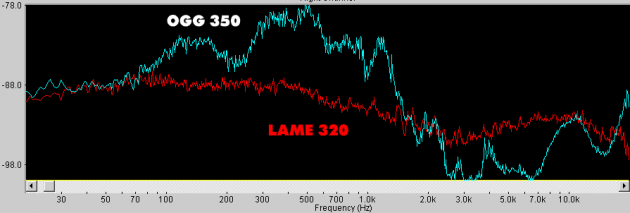
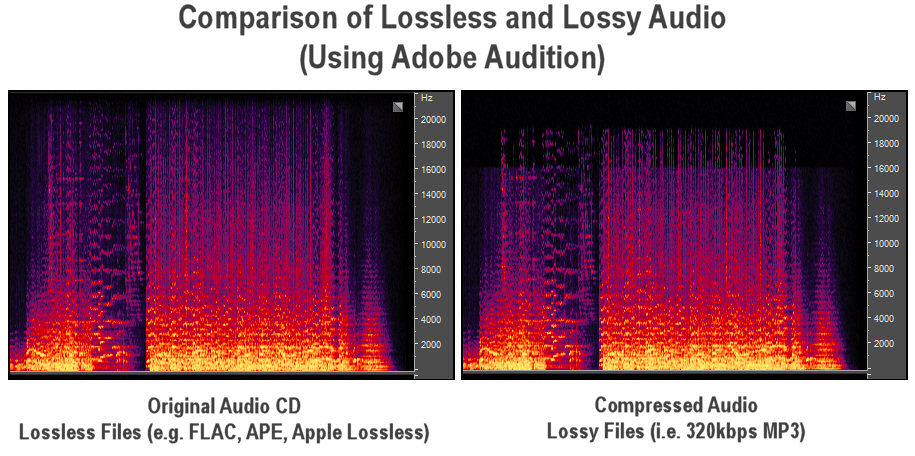
On the graphics – good AudioCD, compressed OGG with 350 kbps variable bit rate and MP3 using Lame. The lower the graph, the closer the sound is to the original. It turns out to be a very interesting image. Although MP3 has clearly cut the high frequencies, unlike OGG, in which you can see a blockage below 2 kHz.

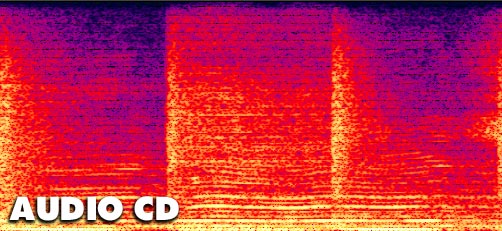
The frequency-time distribution of sound does not speak of less interesting things. At a constant 320kbps bit rate, MP3 is almost identical to the original recording. Everything seems to fit now. But … In fact, everything is even more confusing.

Why use at a loss at all when there is no loss available?
Common sense.

The fact is that most analog recordings do not contain the amount of information that would need to be stored in high-quality formats. Don’t forget that the native sample rate for CD is 44.1 kHz, the quantization is only 16 bits.

The above graphics well demonstrate the high fidelity of MP3 streaming. But for an audio cassette, magnetic tape (unless of course it is a master tape), the characteristics of an audio CD are unattainable. And for mass studio equipment, the ability to record analog sound corresponding to AudioCD has appeared relatively recently. It makes no sense to digitize in FLAC (and even more so in WAV) a concert recording or a disc from the pre-digital era, especially those made with magnetic media. They do not contain those spectra and the amount of information that containers can store without compression.

In what format is it better to listen to music? Part 2

In what format is it better to listen to music? Part 2

Audio Formats

The reference value of the audible range for humans is 16 Hz to 20 kHz, but you cannot hear and be aware of all incoming sounds simultaneously.

audio files

Hearing is discreet and your hearing sensitivity is not linear.

Modern psychoacoustic models accurately assess human hearing and are constantly improving. In fact, despite the guarantees of music lovers, musicians and audiophiles, to the inexperienced middle ear, the initial appearance of MP3 in maximum quality has become extremely noticeable. There are exceptions, they cannot cease to exist. But they are not always easily noticed by blind listening.

Formats using psychoacoustic compression models
There are many of these formats for lossy audio compression. The most common today are the following.

OGG (Vorbis)
In general, a file with the * .ogg extension is a “container”: it can contain multiple sound recordings with their own tags and characteristics. Most of the time, the files stored in it are compressed with the Ogg Vorbis codec, although others can be used, including MP3 or FLAC.

Its main advantages include a wide range of possible parameters during encoding: the audio sampling frequency can reach 192 kHz, the bit depth is 32 bits. By default, OGG uses a variable bit rate (although this is not shown on the properties screen), which can go up to 1000 kbps.

MP3
Unlike the free OGG, MP3 was developed by the Fraunhofer Society, an association of German institutes for applied research, which is very important for modern acoustics. Among audiophiles, by the way, this is an extremely respected office, yet they don’t like to admit it. But its developments are closely watched.

Unlike OGG, it can have variable (VBR) and constant (CBR) bit rate. By the way, it was thanks to MP3 that it was discovered that not all recordings can be encoded with high quality with a variable bit rate (see the above reasons, the encoding algorithms and their results in this case may be different when encoding the same source ).

In what format is it better to listen to music?

In what format is it better to listen to music?

Lossy compression

Understanding digital audio formats is not easy. It is even more difficult to come to an unequivocal conclusion in which format it is better to listen to music.

Lossy Formats

If you look at the audio format comparison table on Wikipedia, your eyes will start to flutter with columns of silent numbers. Let’s try to find out what’s behind this.
In what format is it better to listen to music? Three lost whales
Share this
sixteen
Let’s make a reservation right away that the article talks ONLY about general characteristics and will not include some details. Moving forward, Lifehacker will conduct its own unbiased investigation. And today we will try to generalize the already known experience in one way or another.

There is an analog and a figure.

The analog is good, but short-lived and inconvenient. Therefore, analog media, despite high vinyl sales, will not be making a comeback.

Digital audio can be of three main types:

in a format that does not use compression;
in a format that uses lossless compression;
in a format that uses lossy compression.
At first glance, lossless formats are more promising. This is not always the case, as we will discuss in more detail in one of the following materials. Uncompressed formats make no sense other than storing the master recordings needed to create audio content. They are easier to restore. Storing and listening to home recordings is superfluous.

Of the many parameters of digital audio, the user must first be concerned with sample rate (the accuracy of digitizing an analog signal in time), bit depth (the accuracy of digitizing in amplitude – volume) , the bit rate (the amount of information contained in the file in terms of one second).

Today we will talk about lossy.

For compressed sound, the concept of the psychoacoustic model is very important – the ideas of scientists and engineers about how a person perceives sound. The ear perceives the entire spectrum of acoustic waves entering it. However, the brain processes the signals.

Lossy compression format at a glance

Lossy compression format at a glance

lossy compression

“As you know, the music we listen to consists of a set of signals, each of which has its own characteristics, including loudness.

LOSSY COMPRESSION

The human hearing aid is designed so that we do not distinguish or poorly distinguish a weak (low) signal from the background of a strong (strong) signal. This principle forms the basis of modern means of compression (compression) of audio data.

If we imagine that a signal of a certain length is divided into many parts, and each part is processed in such a way that a weaker signal, which is difficult to distinguish from the background of a strong one, falls under the knife, and one remains a signal louder, then this will be an approximate audio compression model. Consequently, the level of data compression will depend on how many parts (samples) the original file will be divided into and how many weak signals from each individual sample will be removed (what the bit rate will be, the number of bits in a sample). sample of a specified duration). This coding principle is called lossy coding or lossy coding.

Ogg Vorbis is a completely open and patent-free audio format that allows you to store and transmit audio information with high sound quality (44.1-48.0 kHz sample rate, more than 16 bits, polyphony (multi-channel audio) ) and bit rates ranging from 16 to 512 Kbps per channel. In this case, the number of processed channels can reach 255.

MP3 or MPEG-1 Layer 3 audio is by far the most popular format for storing and transmitting compressed data. This format was developed by the Fraunhofer Institut, Germany. “Http://ru.wikibooks.org/wiki/Compression_Audio_data_with_lossy

Comparative tests

Sound Forge 7.0 (Spectral Analysis / Spectrum Analysis function) was used for the analysis of the sound signal.

“Spectral analysis is a signal processing technique that can reveal the frequency content of a signal. Solving the problems of spectral analysis is possible through the use of the fast Fourier transform, which makes it possible to determine the contribution of individual components of the vibration spectrum to the overall vibration picture. “Http: //masters.donntu. edu.ua/2007/fema/belinskaya/library/a4/art4.htm

The following graphs were obtained in the form of an amplitude distribution in the frequency domain, the spectrum of the signal is presented using a Blackman-Harris / Blackman-Harris window and a maximum sampling frequency (FFT size) of 65536, this gives allows you to analyze the smallest details of the signal at frequencies around 20,000 Hz, without smoothing.

The analysis of the spectrum of the compressed signal assumes the presence of a recording of the original quality, for this we use a licensed audio CD made in the USA “Kevin Yost – Bongo Madness”, with standard characteristics 44100 Hz / 16 bit

The rich electronic sound spans the entire frequency spectrum and captures even the inaudible range (20,000 Hz to 22,000 Hz), as can be seen in the graph below. Considering that it is generally possible to notice codec compression at higher frequencies, the 10-20 kHz range will be considered.

Interview with the inventor of the mp3: “We weren’t the only ones, we were just better”

A handful of German inventors from the Fraunhofer Institute in white coats invent a revolutionary process against all odds to compress music files to one-twelfth of their original size compared to CD with virtually no loss of quality. When was the moment they felt : Are we doing something bigger here?

mp3 developers

There are several moments. When I was still a student at the University of Erlangen in 1988 and doing basic research, someone visited our laboratory. My PhD supervisor, Dieter Seitzer, proudly demonstrated to this guest what we were currently working on: compressing digital music files. And when he asked what could become of our work, I replied: “Either our work will be forgotten and it will be accumulating dust in the library, or technology will become a standard that will be used by millions of people.” But I did not dare to dream about it. that really happened.

Developing mp3
Developing mp3

In 1977, his PhD supervisor, Seitzer, from Erlangen, had the idea of ​​transmitting music by telephone wire. And they all said, “I can’t.” And then you came. What application did you originally have in mind? Was it music in your pocket?

Back then, all textbooks said that you could compress images, videos, and voice, but definitely not music. It is too sensitive and complex. That was the starting point.

We asked ourselves: How can we compress music in that way, that is, reduce the amount of data per piece of music, so that people don’t hear the difference?

The question is to understand how the human ear works so that very similar things happen in our encoder, which compresses the music, as in the inner ear. Even in the inner ear, not all data is transmitted to the brain through nerve fibers. The brain always compares pitches with an internal reference, basically checking what it knows. In addition, there are so-called masking effects: if the sensory hairs tremble in the ear, the other sensory hairs are also automatically stimulated. This leads to the fact that the tones overlap and cannot be perceived at all. This is due to the mechanics of the inner ear. We use this as a guide when we come to the question: For what data can we reduce the level of detail, without being heard? Where would a coarser data structure be acceptable? We did not invent this trick in Erlangen. We weren’t the only ones working on it. We have only brought this knowledge to concrete results faster and optimized it better.

Is it true that you bought records for 1,000 marks in a music store in Erlangen to have compression material?

It is true. We had requested the project and absolutely needed better speakers, a small sound booth, and most of all, lots of audio samples. So I went to buy records: simple pieces, complex pieces, music of all genres, in all areas. We didn’t know what would work and, more importantly, what wouldn’t.

You mean the famous example of the Suzanne Vegas song “Tom’s Diner”, whose a cappella intro with “Da da da da …” was used to fine-tune the psychoacoustic MP3 model. What exactly was it about?

That was a special challenge: dense tones that the ear can still filter very well. My dissertation was almost done at the time and I really believed: I’m done, my process works for all kinds of music. But then I read in a hi-fi magazine that Suzanne Vegas’ voice had been used to test speakers. A colleague bought the CD because we wanted to know: What happens if we compress this music? The result was a disaster.

And how did you solve the problem?

There were two solutions. The first was to realize that what we had read in the specialized literature about how the masking of signals so rich in spectra works was not really true. Then we realized that psychoacoustics in these cases works differently than what the publications of the time suggested. We then test what happens when we transmit the lower frequencies very precisely and become less complex at the higher frequencies in favor of less storage space. That worked

Mp3 Compression, step by step

The MP3 Encoder is that program that analyzes the uncompressed digital file (for example, a Wav file) and transforms it into an MP3 file.

The audio signal is filtered and divided into 576 areas (called subbands) through a process that uses DCT (Discrete Cosine Transformation) and manages to eliminate all unnecessary frequencies. The human ear, as already stated, perceives sounds only beyond a certain threshold so that all the audio below is not encoded.

Auditory Perception

At this point, the resulting signal passes through the psychoacoustic model in which the masking thresholds of which we have spoken previously are identified. This is done using the discrete Fourier transform (DFT, Discrete Fourier Transform).

During the masking of the 576 subbands, the frequencies to be masked are determined and therefore can be removed.

Auditory perception

After masking, the defined Stereo Ensemble process is applied. Below a certain frequency, the ear cannot perceive the spatial position of sounds, so they can be recorded on a single channel (therefore in mono format) with significant space savings.

Once the file is ready, the data is further analyzed and compressed using Hufmann encoding which allows for a data reduction (without loss of information) of approximately 20%.

At this point, after all the data has been collected, the encoder proceeds to create the bit stream that will form the final MP3 file.

Compression criteria

To perform such compression, the MP3 format is based on a simple concept: filter a digital musical piece and eliminate all unnecessary information, thus reducing space.

The human ear is an almost perfect instrument but it also has its limits. The human ear pass band extends from 20 Hz to 20,000 Hz, but is much more sensitive to those in the mid-range, 700 to 6,000 Hz, where most of the information is concentrated.
The study of auditory perception is a matter of psychoacoustics that mainly analyzes 2 factors that are later used in MP3 encoding:

Auditory perception

In the area of ​​sounds, only a few can be heard by the human ear. The following figure shows these areas that represent the different sound frequencies. Only those in the white area are audible from our ear.

Masking

Masking is nothing more than the superposition of weak sounds with loud sounds. It almost always happens that the sounds of different instruments overlap each other. In cases where the loudest sound completely covers the lowest, there is a so-called masking. In MP3 files, masking allows you to remove the information from the weakest sounds, which, however, because they are not perceived by the ear, are virtually irrelevant.

How does music compress the mp3 format?

Many people do not have a clear idea that in general most audio formats compress music.

In fact, thanks to that compression, the mp3 became so popular. It is not because it sounded better, as an uncle of mine creates … but because it allows you to store much more music on a USB stick, on a CD, etc. even when it sacrifices a bit of quality.
mp3 compression

That is to say, technically the mp3 sounds worse than the original raw format like a wav.

But handling wavs is usually unmanageable, unless you are an audio professional.

But, going back to talk about my uncle, who wants to listen to Frank Sinatra in his car, using the mp3 is much more friendly. Even because it has a metadata (artist name, track, lyrics, etc.) and also, if a good bitrate is used (160 m or more) it is almost imperceptible to most of the people the difference between an mp3 and a wav .

mp3 compression

Experiments have been carried out in famous universities that managed to show that not even the people who claimed to have an auditory training (for being musicians, djs, etc.) managed to distinguish in most cases a 192-bit mp3 from the original wav.

This explains why mp3 is still king, even before the appearance of FLAC for example, that it is free (without patents) and that it has a much better quality.

But, again to mention my uncle, he believes that FLAC is a colorful cereal … and he still says that he really likes that cereal for breakfast !!

Compression

But then, the fame of the mp3 is due exclusively to its ability to save space?

Yes.

And how does the music compress the mp3?

Follow several methods. Here I will tell you superficially and only by way of introduction how it manages to save space.

The first tactic is almost logical. As the human ear only listens to a part of the sound spectrum, the mp3 erases everything that is outside that spectrum, thus saving a lot of space.

Then it uses another well-known mechanism of the human ear (if you look at the mp3 it is based on the ability to perceive the human ear … THAT’S why people DO NOT manage to perceive a good mp3 from the original wav !!).

That mechanism is called masking, and it’s about the following. If there are two or more sounds at nearby frequencies and one of them suddenly sounds loud enough, the ear will NOT hear the other sounds that are lower in volume at nearby frequencies. So the mp3 uses that acoustic principle of the human ear and gets rid of those other sounds with which it again removes information.

And removing information means SAVING SPACE.

And if you finally use some mechanism to compress (type .zip or type .rar), a great saving of space is achieved.

For example, let’s imagine (it is a false example, but it illustrates what I mean), if we had this string in the audio “xxxxxxxxxxxxxxxxxxxx”, one way to compress it would be to say that there are 20 x, instead of writing 10 x, note :

xxxxxxxxxxxxxxxxxxxx
20x

Which takes up more space and which takes less?

Both strings of signs or characters say the same thing, there are 20 x, but it is shorter to write it as 20x, than to write “xxxxxxxxxxxxxxxxxxxx”

Onbiamente in all loss of information, there is a loss of quality. But the same thing happens with colors.

They say there are computers capable of handling not how many millions of different colors … it would be smart to ask how many different colors the human eye can perceive.

So, there will always be a purist who says that the mp3 loses quality … but it would be good to see if her ear can distinguish it. Music is made to be heard by human ears, with its limitations.

Well, in short, this is how you make an mp3 to save space. I will send a copy of this article to my uncle.

MP3 format (Disadvantages and encoding methods)

First of all, remember that “MP3” is short for the term “Audio MPEG-1/2 Layer 3 Compression”, which is an audio data encoding format that allows you to divide the weight of a computer file by more than ten.

The word MP3 also refers by extension to portable audio players that play the audio in MP3 format.

Compression
The main role of the MP3 format is to compress music so that it is lighter (to store more in our player) without the listener noticing the differences.
Therefore, we will remove everything considered “superfluous” from the audio signal, but this is the whole controversy: what is really superfluous or unimportant or superfluous in the sound to be encoded?
Some people who oppose this method of storage speak of signal mutilation. Others describe this operation with a nice comparison: “The more potatoes you put in a pan? It’s simple, we make it puree!

In fact it is not that simple, the compression method is much more complex than you think.

Mp3 Compression

Music compression

To make MP3 music lighter, it is compressed, but without the user hearing or perceiving the difference. The principle is to eliminate sounds that are inaudible to the human ear, such as ultrasound (treble) or infrasound (bass). But be careful, this “light” music (12 times less heavy than the standard format music) should remain “of good quality” to satisfy listeners.

To achieve this, MP3 does not encode all the data necessary for full sound reproduction, but only what is perceived by the human ear. This is how we achieve what we call the “skinny”.

1st phase: the first skimming takes place in all sounds that are not perceived by the ear. They are simply removed.

Compression allows the spectrometric components of an audio signal to be analyzed and a psychoacoustic model applied to them, so that only “audible” sounds are preserved.

The human ear can distinguish sounds on average between 0.02 kHz and 20 kHz, knowing that the sensitivity is maximum for frequencies between 2 and 5 kHz, according to a curve given by Fletcher and Munson’s law. Therefore, this first compression phase consists of determining the sounds we do not hear and eliminating them, therefore it is a destructive compression, that is, with loss of information.

2nd step: Next we will more accurately encode the sounds to which the ear is most sensitive (those between 2 and 5 kilohertz). The rest of the sounds contain the frequencies that are less perceived by the ear and will be encoded with less precision. Then they will be of lesser quality, and, that is the goal, they will take up less space because they are almost undetected. The listener will not notice this “degradation” of the original sound because these are frequencies to which the ear is not sensitive.

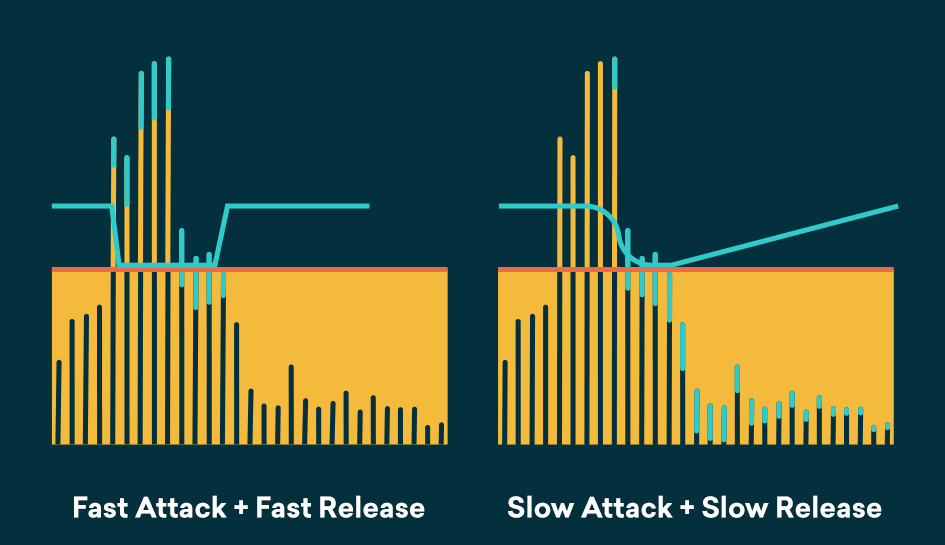
In this same phase, a second treatment is added: dynamic compression. Dynamic compression consists of raising the weak levels and the low levels to keep them lower, to erase the contrasts the music has.
These two stages will lighten music without altering the perception of sound.

Sound masking

After heavily compressing the sound, the MP3 continues using the masking phenomenon. When a sound reaches a certain intensity, it masks the sounds with the lowest intensities closest to it. The ear does not detect the weakest sound and MP3 will therefore easily remove these so-called “masked” sounds.

If you look at the sun and a bird goes along its axis, you will not see it because the light from the sun is too important. It is the same in acoustics. If there are loud sounds, you cannot hear the weakest. For example, if a sound of 80 dB with a frequency of 1000 Hz is followed by a sound of 20 dB and has the same frequency, formatting in MP3 will preserve the sound of 80 dB and hide the others

Therefore, the blue sound is masked by the black sound.

The danger of this size

The MP3 format poses two kinds of danger to our hearing: – The first is that it encourages the listener to increase the volume of the sound from his player.

Second, our ears are getting used to this type of sound, which we could describe as “dematerialized,” and it is getting slow.

Special hearing disorders related to MP3 formatting. The human ear is used to perceiving strong dynamic contrasts and is not made for compressed MP3 format signals. In fact, the compression of the music will act as an optical illusion. If we listen to this compressed music, we will unconsciously