Interview with the inventor of the mp3: “We weren’t the only ones, we were just better”


Free Download Mp4Gain
picture

A handful of German inventors from the Fraunhofer Institute in white coats invent a revolutionary process against all odds to compress music files to one-twelfth of their original size compared to CD with virtually no loss of quality. When was the moment they felt : Are we doing something bigger here?

mp3 developers

There are several moments. When I was still a student at the University of Erlangen in 1988 and doing basic research, someone visited our laboratory. My PhD supervisor, Dieter Seitzer, proudly demonstrated to this guest what we were currently working on: compressing digital music files. And when he asked what could become of our work, I replied: “Either our work will be forgotten and it will be accumulating dust in the library, or technology will become a standard that will be used by millions of people.” But I did not dare to dream about it. that really happened.

Developing mp3
Developing mp3

In 1977, his PhD supervisor, Seitzer, from Erlangen, had the idea of ​​transmitting music by telephone wire. And they all said, “I can’t.” And then you came. What application did you originally have in mind? Was it music in your pocket?

Back then, all textbooks said that you could compress images, videos, and voice, but definitely not music. It is too sensitive and complex. That was the starting point.

We asked ourselves: How can we compress music in that way, that is, reduce the amount of data per piece of music, so that people don’t hear the difference?

The question is to understand how the human ear works so that very similar things happen in our encoder, which compresses the music, as in the inner ear. Even in the inner ear, not all data is transmitted to the brain through nerve fibers. The brain always compares pitches with an internal reference, basically checking what it knows. In addition, there are so-called masking effects: if the sensory hairs tremble in the ear, the other sensory hairs are also automatically stimulated. This leads to the fact that the tones overlap and cannot be perceived at all. This is due to the mechanics of the inner ear. We use this as a guide when we come to the question: For what data can we reduce the level of detail, without being heard? Where would a coarser data structure be acceptable? We did not invent this trick in Erlangen. We weren’t the only ones working on it. We have only brought this knowledge to concrete results faster and optimized it better.

Is it true that you bought records for 1,000 marks in a music store in Erlangen to have compression material?

It is true. We had requested the project and absolutely needed better speakers, a small sound booth, and most of all, lots of audio samples. So I went to buy records: simple pieces, complex pieces, music of all genres, in all areas. We didn’t know what would work and, more importantly, what wouldn’t.

You mean the famous example of the Suzanne Vegas song “Tom’s Diner”, whose a cappella intro with “Da da da da …” was used to fine-tune the psychoacoustic MP3 model. What exactly was it about?

That was a special challenge: dense tones that the ear can still filter very well. My dissertation was almost done at the time and I really believed: I’m done, my process works for all kinds of music. But then I read in a hi-fi magazine that Suzanne Vegas’ voice had been used to test speakers. A colleague bought the CD because we wanted to know: What happens if we compress this music? The result was a disaster.

And how did you solve the problem?

There were two solutions. The first was to realize that what we had read in the specialized literature about how the masking of signals so rich in spectra works was not really true. Then we realized that psychoacoustics in these cases works differently than what the publications of the time suggested. We then test what happens when we transmit the lower frequencies very precisely and become less complex at the higher frequencies in favor of less storage space. That worked


Free Download Mp4Gain
picture


Mp4Gain Main Window
picture


Mp4Gain Features
picture


Free Download Mp4Gain
picture

MP3 curiosities about the format that changed the music

The Moving Picture Expert Group 1/2 Audio Layer 3, the audio compression format that has changed the music world forever, has officially disappeared, at least for the Fraunhofer Institute for Integrated Circuits.

mp3 compression

The German institution that was working on the format and that funded its development in the late 1980s recently announced his death at the end of the licensing program for some registered patents related to the MP3 format. According to the official statement, the reason is: “More efficient audio codecs are available today.”

Despite the enormous popularity that was gained in about 30 years, the MP3 format was surpassed by the formats of the Aac family used by modern multimedia services such as streaming or TV and radio broadcasts, and soon also by the extraordinary Mpeg-H .

mp3 quality

The new formats guarantee better audio quality and a lower bit rate, hence a heavier audio file with the same quality compared to MP3 and offer greater functionality. According to Bernhard Grill, director of the institute, AAC is today the de facto standard for downloading music and videos on smartphones. If MP3 was the symbol of a revolution, today nobody cares about the name of the institute format in which an audio file is encoded, only “sounds” good.

Let’s return to the history of MP3 thanks to these 10 “Maybe not everyone knows”:

1) An idea from the late 19th century. Studies of an algorithm that reduced the weight of audio files in order to transmit them more easily through very slow networks in the late 1980s relate to the concept of “auditory masking” or the phenomenon by which the perception of a Presence of another sound masked.

The first observations on this phenomenon were made in 1894 by the American physicist Alfred M. Mayer.

2) Hello, I’m MP3 The father of MP3 can be seen as a codec for the psychoacoustic masking introduced in 1979. The aim was to create an audio format for telephone messages that does not “weigh” the lines. The basic idea that was later taken up when creating the MP3 format is that the human ear cannot perceive some audio frequencies.

For this reason, it is sufficient to eliminate these frequencies in order to reduce the weight of an audio file while maintaining an apparent quality. In fact, the basic assumption has proven to be wrong in recent years. Read also: The virtual reality changes the music and fights the secondary ticket sales. And Keith Richards teaches you how to play

3) An Italian is listening Leonardo Chiariglione Mp3 seen at “The Visible City” at the Turin International Book Fair 2012. Valerio Pennicino / Getty Images Leonar do Chiariglione, an engineer from Almese, Turin, is considered one of the fathers of the MP3 format as the founder of the working group MPEG (Moving Pictures Expert Group) in 1988, which developed several audio / video compression formats in world standards.

In December 1988, the MPEG group launched a public request to develop an audio compression algorithm. Because of their similarity, the 14 algorithms obtained were divided into four main categories.

4. Brandenburg uses it. Suzanne Vega. Carlos Alvarez / Getty Images It is the thesis of the doctoral student Karlheinz Brandenburg that was discussed in 1989 at the German University of Erlangen-Nuremberg to illustrate the specifications of the MP3 format in detail.

The first song encoded in the new format was Tom’s Diner by singer Suzanne Vega. Brandenburg coded it countless times to understand whether the omitted frequencies had affected the sound of Vegas’ voice. Also Read: 10 Songs To Keep Fit: Here’s The Spotify Playlist

5. Light weights With the introduction of the MP3 format, the weight of a song was reduced to approximately 4 MB compared to ten MB of an audio file on a CD. It was a revolution because it was finally possible to transmit the songs over the Internet, although the transmission speed was still tied to the limits of the 56 kbit / s modems or even to a lower download speed.

6. The hacker in a coat In the summer of 1996, the NetFrack user published a message in the Affinity online fanzine that he had found a way to reduce the size of audio files thanks to a new compression format and thus hard drives. from that time on they could have contained many more songs. Subsequently, NetFrack founded the online group Compress Da Audio, which only distributed music files, and made Metallica’s song Doesi It Sleeps available in MP3 format.

August 10, 1996 is the official date of birth of music piracy.

7. The beginning of the revolution. In 1997 NullSoft created Winamp, the first software to encode audio files in MP3 format. The following year, Diamond Multimedia introduced the first portable MP3 player, the Rio PMPm300, which could hardly hold the contents of an album, used a pencil battery, and cost around $ 200. In 1999 it was Shawn Fanning and Sean Parker. Years later, when Mark Zuckerberg advised to remove “The” from the Facebook name, Napster founded it.

8. A useful service. Despite about $ 35 million in claims and considered utterly evil, Radioheads Kid A wouldn’t have had the success it had had without Napster. The group was not yet known worldwide and the record company had not planned to advertise the new album, release or video clips. In October 2000, the album was Radiohead’s first to top the billboard charts, also thanks to the fact that it was released three months before Napster’s official release.

And Thom Yorke said unlike Madonna, Metallica and Dr. Dre, who had filed million dollar lawsuits: “The best thing about Napster is that it instills enthusiasm for music in a way that the music industry has stopped. Hour”.

9. Apple, thank you In 2001, Apple introduced the iPod, the MP3 file player that played a key role in tracking china down to the Cupertino home. Almost 400 million units were sold in around 13 years of life. In 2003, Apple always invented the first paid and legal music download service. Today, 70% of online music is purchased on iTunes, which is an average of approximately 20,000 songs per minute.

10. An announced death. The development of the AAC format, which is now the de facto standard for digital audio, began in 1990, but only understood in 2007 when Apple decided to only make audio files in Aac format with 256 Kbit / s available in iTunes Plus Experts the end. MP3 was close.

How an MP3 compresses music

We all know that MP3 was the audio format that quickly became popular and the main reason is because it took up much less space than the WAV format that has no compression and therefore was very difficult to transfer via internet from one computer to another.

And then it was when the MP3 made its appearance because it had a very good sound and yet it took between 7 and 10 times less space than the original file.

We all know that this caused people to easily exchange music files online and this changed even the way the music industry works thereafter.

But although we all know that MP3 takes up less space, it is very few people who understand that in the first place in MP3 what it does is compress the music. But it also uses some other procedures to make music take up less disk space, Today we will briefly explain how this mp3 performs this compression.

Remove inaudible sounds

One of the first things MP3 does is to analyze the music file and eliminate all those frequencies that are not audible to the human ear but nevertheless occupy a space in the original file. Then the MP3 saves a lot of space without losing quality by eliminating sound frequencies that the human ear cannot hear.

Eliminate redundancy

Another of the mechanics that is used for an mp3 saves space is to eliminate redundant sounds. And with that we understand sounds that sound very similar and basically occupy the same Soundtracks. Therefore, the ear will only perceive some. And then the MP3 eliminates those redundant sounds that will not be heard by the human ear.

Sound masking

Acoustics and audio specialists have long discovered that when the human ear perceives more than one sound simultaneously it is very likely that one of them masks the others.

The Sound perception produces that when a person perceives 2 sounds of different intensity at the same time the weakest sound, with less volume, is inaudible to the one who is listening. This, as we indicated earlier, is what is called the sound perception and the MP3 is based a lot on the sound perception to be able to eliminate sounds under this principle of sound masking.

In other words, in MP3 you decide which sound will mask others and then eliminate these others.

It should be noted that when one decides if the MP3 encodes at 128 kilo bytes per second or at 320 kbs it is modifying the amount of sounds that will be eliminated in the masking. Well, at 320 to eliminate very few sounds and as I lowered the number of kbs it will eliminate more sounds which the person can produce if he can distinguish a difference between the original audio file and the encoded file.

How is an mp3 file compressed?

How is an mp3 file compressed?

The MP3 file takes up less space but loses information from the original recording, so it is a lossy compression. The question is, what is the algorithm for scrapping those details of music? How are they removed from the recording? Don’t they really matter and we don’t perceive those losses?

MP3 and auditory masking

The algorithm for MP3 compression eliminates details of the original music based on the phenomenon of the sound masking of our sense of hearing, a psychoacoustic phenomenon so daily that surely many will not have paid attention before, and that it is necessary to know to understand the MP3 .

Imagine that we are talking to someone on the street, a car passes by and suddenly we stop hearing our interlocutor. Why have we stopped hearing the other person? If we had recorded this situation with a microphone we would see that both sounds, the voice and the car, would have been perfectly recorded …

This phenomenon occurs because there are situations in which our sense of hearing gives prominence to one sound and ignores another if both are simultaneous, what is called sound masking, and that depends on well-defined causes that can be summarized as follows.

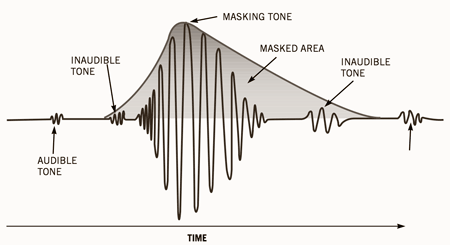
A sound can mask another when they reach the ear simultaneously depending on their relative frequencies and volumes. As seen in the figure, at the loudest sound our ear creates a new limit of hearing or masking at that time. If another simultaneous sound is under that frequency environment, we will not perceive it.

Temporary masking

When there is a sound of sufficient power to be masking, there are moments before and after that we will not perceive other sounds, depending on how closely they are in time and their relative volume, with the behavior represented in the figure. As you can see, a sound can be masked whether it occurs immediately after the masking, or if it occurs before!

The MP3 compression algorithm

When we perform an MP3 compression, the coding algorithm divides the music into a multitude of short-lived fragments. Each of these fragments are analyzed individually in many frequency bands, to be able to detect if in any of them there is any masking sound that is masking sounds of the other bands of the fragment, and therefore are inaudible or expendable. In that case, what you will do is encode that fragment with fewer bits than the original fragment, so resolution of the more subtle details (those details that have been dispensable) will be lost and the background noise of the fragment will increase.

The amount of bit reduction for that fragment will depend on the quality sought in the encoding. If we set it to high quality, it will reduce the resolution of the fragment only just enough so that the new background noise is still masked by the masking sound that was detected in that fragment.

Therefore, and according to the masking theory, no change will be perceived after the resolution reduction: neither by the loss of the details that were already originally masked, nor by the new background noise, which will remain imperceptible by also maintaining below that masking sound detected.

After this process, the fragment could have been encoded with fewer bits, occupying less information than the original. Once this attempt at bit reduction has been repeated with all the multitude of fragments into which the original file had been divided, the song is reconstructed and a compressed file is obtained that will now take up less space.

In addition to this masking-based coding, finally an “Huffman” arithmetic coding is applied to the resulting bits, similar to that performed in a “.zip” compression. This process will not entail additional quality losses.

Sound quality in MP3 files

The sound quality of the compression depends on the size that we want the compressed song to occupy, therefore the bitrate we indicate when performing the compression. If we choose a high bitrate, the algorithm will not be forced to eliminate much information, so it will eliminate really inaudible details according to the masking curves. But if we want the file to take up less space and choose a lower bitrate, the algorithm will have to be more drastic overcoming the most imperceptible masking curves, and it will be inevitable that the loss of information will be noticed.

For example, in the most common 128 kbps MP3s a few years ago, the quality is significantly lower than the original for most people, if a direct comparison is made. On the other hand, an MP3 file with the maximum bitrate of 320 kbps hardly loses information, and is practically indistinguishable from the original in most cases.