Medical and physical examinations of human hearing and noise processing in the brain have shown that the hearing aid has its own perceptual characteristics. In certain circumstances, the brain does not register sounds or only partially registers them. Many signal components that are present in the acoustic signal are not even perceived by humans. The psychoacoustic call is concerned with investigating these facts. So far the following deficits in human ear perception have been discovered:
Hearing perception range:
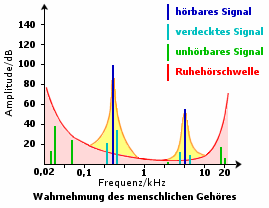
The waves can be emitted in a wide range of frequencies. However, the human ear can only really perceive a small section of this frequency range, the audio frequency range. In theory, humans can hear sounds with frequencies between 20 Hz and 20 kHz. In practice, however, it has been shown that ear sensitivity decreases considerably towards low and high frequencies. In the image above, amplitude, that is, sound pressure, is plotted against frequency.
Measurements have shown that all signals that are completely below the threshold of hearing at rest (red line) are inaudible. The amplitude of these tones (green peaks in the image) is too low, so their volume is too low to be perceived. It is interesting to see that the silent hearing threshold is not constant at a certain amplitude value, but changes with frequency. Very low tones (less than 50 Hz) are only perceptible from very high amplitudes, as are tones above 15 kHz. It should also be noted that not everyone has the same silent hearing threshold. Children can hear high frequencies much better than older people.
Masking:
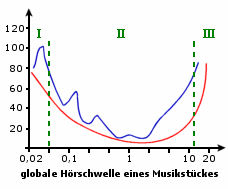
Another deficit of the human hearing aid is the inability to distinguish between tones of very similar frequency and very different volume that occur simultaneously. This effect is also called auditory masking. Or German called simultaneous masking. A high-amplitude signal (dark blue in the image above), also known as a masker, hides quieter signals that have a similar frequency. In the image, these are all signals that are within the area highlighted in yellow. Some turquoise peaks are shown as an example. The yellow area is outlined by the orange individual masking threshold of the masker. The individual masking threshold and the silent hearing threshold can be combined to form the so-called global masking threshold. Thus, all signals below the global masking threshold are inaudible. In practice, auditory masking means nothing more than loud music signals cover the quiet parts and make them inaudible.
Another masking effect occurs when two tones follow each other in a very short time. Of these two tones, only the one with greater amplitude is perceived, that is, greater volume. Interestingly, even if the soft sound reaches the ear first, only the strong signal that arrives later is registered in the brain. This second important masking effect is also called temporary masking in technical jargon.
Low-frequency localization deficits:
Although the human ear is able to pinpoint the origin of high and mid-frequency tones in the room well, problems arise in the lower-frequency region. The brain calculates the location of the sound source from the difference in signal transit time between the left and right ears. If there is a sound source on the right, the waves emitted by this source are perceived earlier by the right ear than by the left. The origin of the tones is calculated from the time interval between the perception of the left and right ears. However, very low-frequency sound signals have very long wavelengths, making clear localization impossible. Therefore, there is practically no tonal difference between a mono sound source for low-frequency signals and a stereo sound source for very low-frequency sounds. Joint stereo effect. It is used, for example, in the construction of subwoofer satellite systems and is also a starting point for audio compression in the area of low tones.
Therefore, the human ear can only improperly or not at all perceive a complete series of frequency ranges. In electrical engineering, the field of digital signal processing (DSP) deals, among other things, with mathematical processes that, in combination with the psychoacoustic model of the hearing aid, lead to data reduction.