Reversible Variable Length Codes in MP3


Free Download Mp4Gain
picture

Reversible Variable Length Codes in MP3
Reversible Variable Length Codes in MP3

Let’s talk about Reversible Variable Length Codes in MP3

When you think about MP3 files, you probably focus on their compact size and widespread use. But what makes MP3 so efficient is the smart compression techniques it employs, one of which is reversible variable length coding (RVLC). This technology ensures that even compressed, the audio retains excellent quality, and data corruption has minimal impact.

In my years of working with audio codecs, I’ve seen how RVLC revolutionized MP3. It’s not just about compressing files but doing so in a way that preserves as much data integrity as possible. Think of RVLC as a puzzle piece designed to make audio compression seamless and reversible if needed.

How Reversible Variable Length Codes Work

RVLC is a method for encoding data where the length of each codeword depends on the frequency of the symbol it represents. Frequently occurring symbols are given shorter codes, while less common ones get longer ones.

Imagine packing a suitcase for a trip. You’d place the most important items in the easiest-to-reach spots. RVLC does something similar by efficiently packing frequent data at the forefront. This arrangement allows decoding to be faster and more accurate, even if some data is lost.

Why RVLC Is Crucial in MP3 Compression

The MP3 format relies on psychoacoustic models to discard inaudible sounds and uses RVLC to encode the remaining data. This dual process is what makes MP3 both lightweight and robust.

For example, think about how you pack delicate glassware for shipping. You’d use padding to keep it safe. RVLC adds a similar layer of protection by making data reversible. If the audio file encounters an error, the reversible coding can reconstruct it without significant distortion.

RVLC and Error Resilience

One of RVLC’s standout features is its error resilience. In a real-world scenario, no transmission channel is perfect, and errors can creep into MP3 streams. RVLC can mitigate these issues, ensuring playback remains smooth.

I once dealt with a corrupted MP3 file sent over an unstable network. Thanks to RVLC, only a small portion of the file was affected, and the rest played without hiccups. This adaptability makes RVLC indispensable for streaming services and other audio applications.

Applications of RVLC in Everyday Life

You might be surprised to know how often you benefit from RVLC without realizing it. From streaming music on your phone to downloading podcasts, RVLC ensures these files remain intact and high-quality.

Think about GPS navigation systems. The spoken directions are often in MP3 format. RVLC ensures the audio remains clear even if the connection drops momentarily. This makes RVLC more than just a technical innovation—it’s a part of our daily lives.

Advantages of Reversible Variable Length Codes

  • Efficient Data Compression: RVLC minimizes file sizes without compromising quality.
  • Error Resilience: RVLC allows partial recovery of corrupted data.
  • Faster Decoding: With shorter codes for frequent symbols, decoding speeds up significantly.
  • Broad Application: Used in streaming, broadcasting, and file storage.

Challenges in Implementing RVLC

Despite its benefits, RVLC isn’t perfect. Its implementation requires careful balancing between compression efficiency and computational cost.

For example, if you’ve ever worked with older MP3 encoders, you might’ve noticed longer encoding times. That’s because RVLC requires additional processing to ensure the codes are both variable and reversible. Overcoming these challenges has been a focus of audio engineering for decades.

Real-Life Example: RVLC in Streaming Services

Streaming platforms like Spotify and YouTube rely on RVLC to provide uninterrupted audio experiences. Even when network conditions fluctuate, RVLC ensures minimal audio degradation.

Imagine driving through a tunnel while streaming music. RVLC works in the background to keep the playback smooth, even if the connection wavers. This practical application highlights the importance of reversible coding in modern technology.

Future of RVLC in Audio Technology

RVLC has paved the way for advanced audio coding formats. As streaming and digital audio continue to grow, RVLC’s principles will influence future compression techniques.

I see a future where RVLC evolves to handle even more complex audio streams, including multi-channel surround sound. This progression will keep digital audio efficient and reliable, ensuring we enjoy high-quality sound for years to come.

Latest words on Reversible Variable Length Codes in MP3

Reversible variable length codes are more than just a technical feature in MP3—they’re a cornerstone of modern audio compression. By making audio files smaller, error-resilient, and high-quality, RVLC has revolutionized how we consume digital sound.

For those looking to enhance their MP3 files’ quality or manage errors, tools like Mp4Gain can provide practical solutions. With features designed for audio optimization, it’s an excellent choice for achieving professional results.

FAQ about Reversible Variable Length Codes in MP3

What are reversible variable length codes?

Reversible variable length codes are encoding techniques where shorter codes are assigned to frequent data, making them compact and reversible for error correction.

Why are RVLCs used in MP3?

RVLCs are used in MP3 to enhance compression efficiency while maintaining error resilience, ensuring reliable audio playback even with data loss.

How do RVLCs improve error resilience?

RVLCs allow partial reconstruction of data in case of corruption, minimizing the impact on audio quality and ensuring smoother playback.

Can RVLCs be used outside MP3?

Yes, RVLCs are used in various formats requiring efficient compression, including streaming protocols and some video codecs.

Are RVLCs computationally intensive?

RVLCs do require additional computational resources during encoding and decoding, but advancements in technology have mitigated these costs significantly.

How do RVLCs affect MP3 file sizes?

RVLCs help compress MP3 files efficiently, reducing size without compromising audio quality, making them ideal for storage and streaming.

Are RVLCs backward compatible?

Yes, RVLCs are designed to work seamlessly with older decoders, ensuring compatibility across different devices and systems.

What challenges do RVLCs face?

Challenges include balancing compression efficiency with computational demands and ensuring error resilience without increasing file size excessively.

How do RVLCs handle data loss?

RVLCs use their reversible nature to recover as much data as possible, minimizing disruptions in playback quality.

Can RVLCs improve streaming quality?

Yes, RVLCs enhance streaming quality by ensuring stable audio even in fluctuating network conditions.

Comments:

This article really helped me understand RVLC. I always wondered how MP3s stayed so compact yet so reliable. Thanks for explaining it clearly!

I didn’t realize RVLC was behind the smooth playback of MP3s. This article gave me a new appreciation for the format.

Great breakdown! I wish there were more details about how RVLC compares to other coding methods. Still, super informative.

Why didn’t anyone explain it this way before? Now I know why streaming works even with bad internet. Thanks for this!

I feel like I learned a lot from this article. RVLC makes so much sense now. Keep up the good work!

Can you go deeper into the computational costs? I’d love to know how modern devices handle RVLC efficiently.

This was a great read! It’s amazing how much

tech goes into something as common as MP3s. Thanks for sharing.

I’ve always wondered what made MP3s so resilient. This article explained it perfectly. Thanks a lot!

This is some next-level information. I didn’t even know RVLC existed, but now I can see how important it is. Awesome stuff!

Good read, but could you provide more comparisons to other codecs like AAC or FLAC? That would really round out the article.


Free Download Mp4Gain
picture


Mp4Gain Main Window
picture


Mp4Gain Features
picture


Free Download Mp4Gain
picture

MP3 Bit Allocation

What Are the Key Principles Behind MP3 Bit Allocation?

MP3 Bit Allocation
MP3 Bit Allocation

Latest Words on MP3 Bit Allocation

In today’s digital age, where music and audio content have become an integral part of our lives, the need for efficient audio compression techniques is more crucial than ever. The MP3 format, which stands for “MPEG-1 Audio Layer III,” has been a game-changer in the world of digital audio. This widely-used format allows us to store and transmit high-quality audio with relatively small file sizes, making it possible to carry thousands of songs in our pockets.

The magic behind the MP3 format lies in its bit allocation principles. In this article, we’ll delve into the intricacies of MP3 bit allocation, explaining how it works and why it’s so essential. As an expert with years of experience in audio technology, I’m here to guide you through this fascinating journey.

Let’s Talk About MP3 Bit Allocation

MP3 Bit Allocation
MP3 Bit Allocation

Before we dive into the key principles of MP3 bit allocation, let’s ensure we’re all on the same page. You might be wondering what “bit allocation” even means. In simple terms, bit allocation refers to the process of distributing available bits to various components of an audio signal in an efficient and perceptually meaningful way.

Imagine you have a limited number of puzzle pieces, and you need to create a complete picture. Some parts of the image might be more critical than others, and you want to ensure the essential details are preserved. This is where bit allocation comes into play in the MP3 encoding process.

Now, let’s get deeper into the principles behind MP3 bit allocation.

The Psychoacoustic Model: A Vital Component

At the core of MP3 bit allocation is the psychoacoustic model. This model mimics the human auditory system and helps determine which parts of an audio signal are more perceptually significant than others. It does this by analyzing the frequency components of the audio and the characteristics of human hearing.

Imagine you’re in a room filled with people talking at various volumes. Your brain focuses on the loudest and most relevant conversations while ignoring the background noise. Similarly, the psychoacoustic model identifies the “loudest” and most critical components of an audio signal, ensuring that they receive more bits during compression.

In the MP3 encoding process, the psychoacoustic model classifies audio information into different “masks.” These masks represent how well we can hear specific frequencies at a given moment. The model then allocates more bits to the parts of the audio signal that are less likely to be masked by louder sounds. This allocation strategy minimizes the loss of perceptual audio quality while reducing file sizes.

Masking Effect: An Everyday Analogy

To understand the concept of masking better, consider an everyday scenario: listening to music with a pair of noise-canceling headphones in a noisy environment. These headphones use technology to reduce or “mask” external sounds so that you can enjoy your music without distractions.

Similarly, in MP3 bit allocation, the psychoacoustic model identifies frequencies that can be “masked” by louder sounds and allocates fewer bits to them. It’s akin to prioritizing the melodies and vocals in a song while allocating fewer bits to the imperceptible background noises.

This approach is what makes MP3 compression so efficient. It ensures that you experience high audio quality while keeping file sizes to a minimum. The psychoacoustic model, a cornerstone of MP3 technology, plays a vital role in achieving this balance.

The Bit Reservoir: Ensuring Smooth Playback

Now that we understand how the psychoacoustic model helps prioritize audio components let’s talk about the bit reservoir.

Comments:

Comment 1.

I really enjoyed this article! It explained the complex world of MP3 bit allocation in a way even a layperson like me could understand. Great job!

Comment 2.

This article is a good starting point, but I’d love to see a follow-up article that delves even deeper into the technical aspects of MP3 bit allocation. Keep up the good work!

Comment 3.

Kudos to the author for making such a technical topic accessible. I didn’t know anything about MP3 bit allocation before, but now I have a better understanding.

Comment 4.

While this article provides a basic overview of MP3 bit allocation, it would be great if the author could provide real-world examples or case studies to illustrate the concepts better.

Comment 5.

Great explanation! It’s nice to read an article written by someone who knows their stuff. Keep writing more on audio technology, please.

Comment 6.

This article covers the fundamentals well. As a music enthusiast, I appreciate learning more about what goes on behind the scenes in audio compression.

Comment 7.

Wow, I had no idea MP3s were so complex. The part about the psychoacoustic model was fascinating. I look forward to reading more from this author.

Comment 8.

This article could benefit from more practical applications. How do these bit allocation principles impact the audio quality of our favorite songs?

Comment 9.

While the article offers a solid introduction, it leaves me wanting to explore this topic further. It’s a compelling read that piques curiosity.

Comment 10.

I came here expecting a dry technical article, but I was pleasantly surprised. The analogy with noise-canceling headphones was spot on.

Comment 11.

I appreciate the clear and concise language in this article. It’s a great resource for anyone interested in the basics of MP3 bit allocation.

Comment 12.

More, please! I can’t get enough of this topic now. Looking forward to part two. Thanks for making this accessible to the average reader.

Critical Bandwidths in MP3

Calculating Critical Bandwidths in MP3 Compression

Critical Bandwidths in MP3

As an expert in the realm of MP3 compression and audio technology, I’m here to unravel the intricate world of critical bandwidths in MP3 compression. Understanding this concept is pivotal in achieving optimal audio quality while minimizing file size. Let’s dive into the details and explore this fascinating topic.

What Are Critical Bandwidths in MP3 Compression?

Critical bandwidths, often referred to as critical bands, are a fundamental concept in the field of psychoacoustics. They relate to the way our ears perceive different frequencies and play a vital role in audio compression, particularly in the MP3 format. To put it simply, critical bandwidths represent the range of frequencies that our ears can distinguish and process.

Real-Life Example: Think of critical bandwidths as a set of buckets, each representing a range of frequencies. Our ears can only fill a limited number of buckets at once, and these buckets are wider for low frequencies and narrower for high frequencies.

MP3 compression exploits the knowledge of critical bandwidths to remove audio information that falls outside the range of human hearing. This selective approach allows for significant data reduction while retaining audio quality. It’s akin to trimming the fat while preserving the meat, resulting in a leaner audio file.

How Are Critical Bandwidths Determined?

Critical bandwidths are not fixed; they vary depending on the specific frequency and the environment in which the sound is heard. Psychoacoustic studies have led to the development of critical bandwidth curves, which provide a graphical representation of how our ears perceive different frequencies.

Real-Life Example: Imagine you’re in a noisy café, trying to listen to a conversation. Your ears focus on the frequency range of the voices while ignoring the surrounding noise. This selective attention is similar to how critical bandwidths work in audio compression.

In the context of MP3 compression, these critical bandwidth curves are used to determine which parts of the audio spectrum can be discarded without a noticeable impact on the listening experience. This fine-tuned approach ensures that the compression process is both efficient and transparent to our ears.

Balancing Compression and Quality

The art of MP3 compression lies in finding the delicate balance between reducing file size and maintaining audio quality. Critical bandwidths are a crucial tool in achieving this equilibrium. By identifying and preserving the most relevant audio information while discarding what falls outside the critical bandwidths, MP3 compression delivers impressive results.

Real-Life Example: Consider the act of watching a high-definition movie on your smartphone while saving data. The device adjusts the video quality based on the screen size and your internet speed, providing a smooth viewing experience without unnecessary data consumption. MP3 compression operates in a similar fashion, optimizing audio for digital consumption.

In essence, critical bandwidths in MP3 compression serve as a guide to ensure that the compression process is as imperceptible as possible to the human ear. By focusing on the audio information that matters most, we can enjoy high-quality audio experiences with smaller file sizes.

Last Words about Critical Bandwidths in MP3 Compression

In my journey through the realm of audio compression, I’ve come to appreciate the profound impact of critical bandwidths. These frequency ranges shape the way we perceive sound and play a pivotal role in the world of MP3 compression. By understanding this concept, we can navigate the intricacies of audio technology, striking a harmonious balance between quality and efficiency.

Video codecs and containers.

Video codecs and containers.

Video Codec

This article is intended to refer here to those who are trying to “convert” something, without understanding what they are doing and why.

Video Codecs

To work as efficiently as possible with any object, you need to understand how it works. If the video file is for you a mysterious black box, inside which mysterious things happen, perhaps not without the help of black magic, then your effectiveness will be minimal.

So. All information on the computer is in the form of files. This, I hope, is not a surprise to anyone. Here we will start from this basic concept.

Any video file must be a container. A container is a repository of content. There are multi-structure storages – these are container formats. For example, a bento box is an example of a container. You can put sushi or tempura on it. What can you put in a video container? Well, at least image and sound, one at a time. This is a set without which there is nothing to do. What can you put to the maximum? The modern Matryoshka container allows you to put various video and audio tracks, text and graphic subtitles, fonts to display them, images and I don’t know what else.

Going back to the bento box example, note that miso cannot be poured into it; will flow in fig. Not all containers can accept all flows. There are compatibility restrictions that make life difficult.

Container examples: mpeg, avi, mkv, mp4, ogm, vob, mov, rm, divx, asf. You don’t have to look closely at the list to understand that these are standard file extensions. Of course. Because file = container.

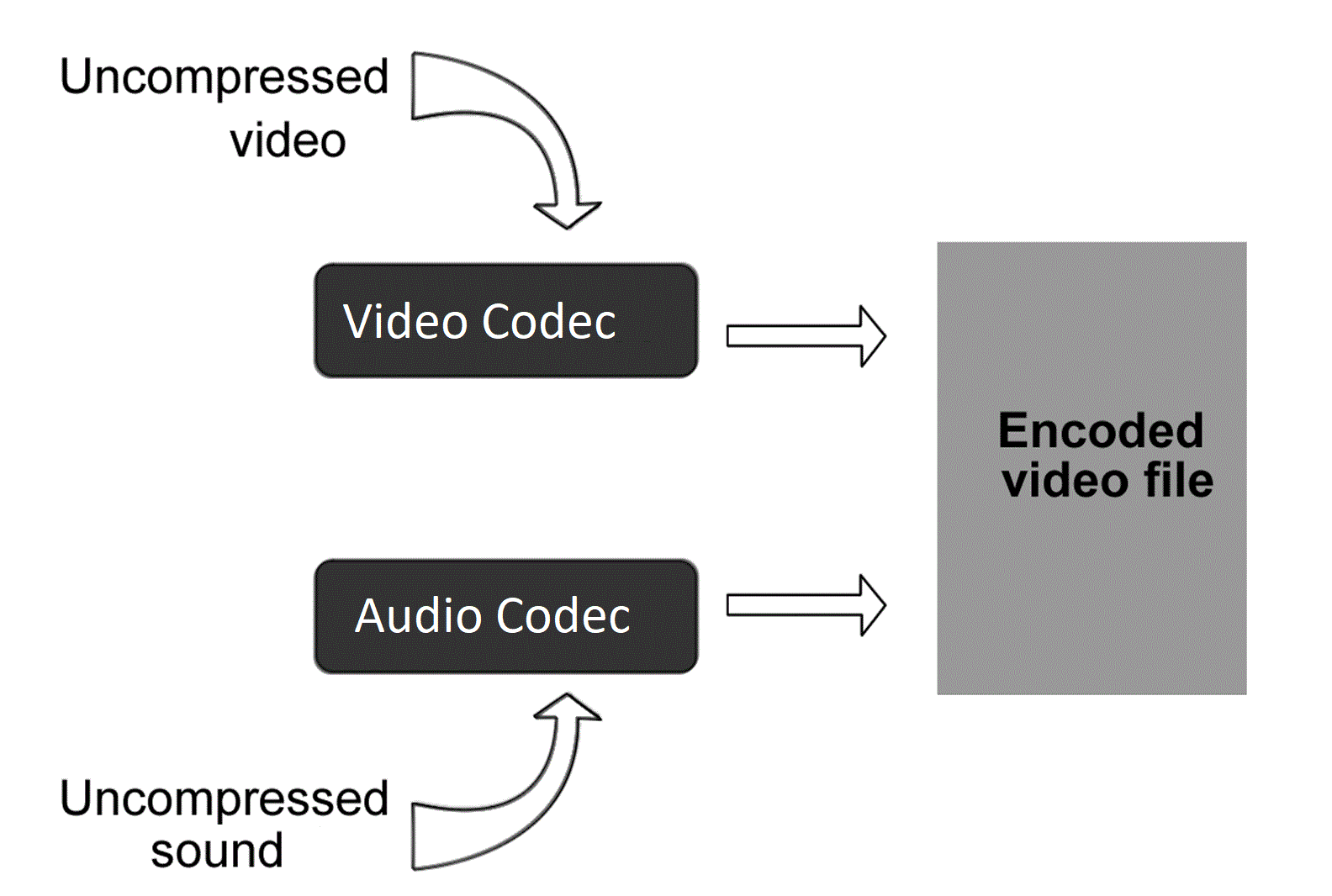
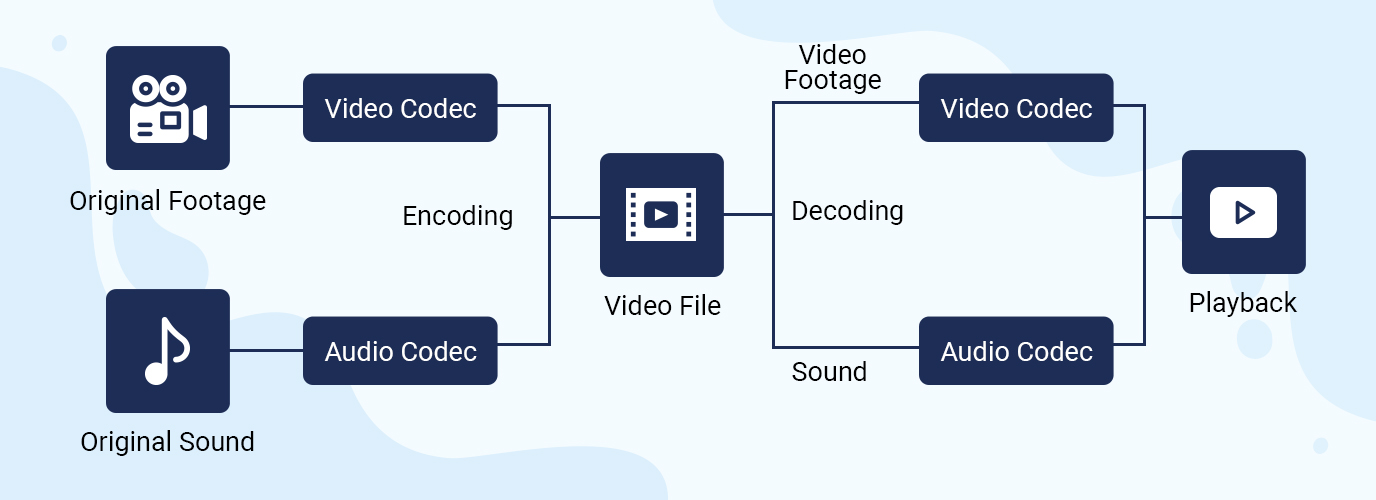
Streams or tracks are stored inside the container. These streams have a format called a codec. And this difference must be understood with particular clarity. The container is a file format. And the codec is the stream format it contains. They are two independent things. Yes, there are some inextricably linked containers and codecs. For example, the Real Media container can only store real video and real audio streams. And vice versa, these formats cannot be stored in any other container (almost, as I have already been corrected). But they are still different concepts that should not be confused.

The codec concept usually includes the following aspects:
1) The actual data storage format.
2) Software that allows you to encode information in this format and / or decode it from it.

Examples of video codecs: divx, xvid, avc, x264, vp6, vp7, mpeg-1, mpeg-2, huffyuv.
Examples of audio codecs: mp3, ogg, ac3, aac.

While containers are generally distinguished by file extensions, codecs are distinguished by the four-character FourCC code.

The codec concept is usually associated with a kind of compression. Raw (uncompressed) streams also have their own formats, but they do not require decoding, and therefore the concept of codec is generally not applied to them.

Now let’s take a look at the most popular containers, codecs, and related issues. As a general rule, the problems we have are of two types: related to reproduction and related to editing.

MPEG is one of the oldest containers. It can store only video in mpeg-1 format and audio in mp2 format. And in a friendly way, with quite strict restrictions on the size of the image and the bitrate of the sound. Due to the age and primitiveness of the format, almost all players and publishers understand it. But for the same reasons, it became almost impossible to meet him. Nobody needs these things.

AVI is also quite old, but it is still a very useful container. It’s good because, again, all the players and all the editors get it. Almost all mpeg-based formats fit into it, as well as many that support them. The following video formats do not fit avi: avc (aka Nero AVC or Nero H.264), wmv below version 9, as well as any tinsel like actual video, which was originally designed to be incompatible with anything in the world. By sounds, supposedly anything, except Vorbis ogg.

OGM is where Vorbis ogg goes. Because the format was created on the basis of this very ogg. At the moment, he is practically ousted by the matryoshka because he can do the same, only better. It is also not compatible with any conventional software.

MKV is a nesting doll that can fit just about anything except flash video. But due to its complexity and versatility, it is still possible to do with it only things like: mount, look and dismount.

MP4 is actually modern MPEG. It only takes things that are compatible with the MPEG standard, but at the same time includes its latest updates.

Compressed audio encoding formats.

Compressed audio encoding formats.

audio encoding

MP3 (or rather, MPEG 1 Audio Level 3): no comment, compatible everywhere and by everyone, the lack of this “eternal” format is one: only two channels, which limits its use in cinema systems at home modern.
Multi-channel MP3 (5.1) MPEG 2 Audio Level 3.

audio encoding
WMA: Windows Media Audio, formally a better and more modern competitor to Microsoft’s mp3. It is not used much, although it is widely compatible with hardware.
OGG Vorbis is a best modern mp3 competitor from the open source community. Deprived of any license restrictions, it is used more and more frequently.
AAC: Advanced Audio Coding is Apple’s main audio format built into all of its iPads, iPhones, iTunes, etc. The main advantage is that it is technically more advanced than mp3, allowing sample rates of up to 96 kHz and theoretically a completely insane number of channels in one file, up to 48. It is also used in digital satellite radio. Just as mp3 is a compressed format, the quality of 96Kbps AAC is comparable to the quality of 128Kbps of mp3 (we are talking about two channels in both cases).
Dolby Digital (AC-3) is probably the most popular standard for digital audio in cinematography, due to the fact that it appeared on the market as early as 1995, it exists in two versions: DD2.0 (for high-quality stereo sound) and DD5 .1 – five full channels and one defective for a subwoofer. Players are compatible with all of them for obvious reasons, the bitrate is 640Kbps in all cases.
Dolby Digital Plus or E-AC-3 is an attempt to improve on the usual Dolby Digital, but the previous generation decoders and receivers do not support tracks in the Dolby Digital Plus format, the reasons for this are radical changes: the number of channels increased to 7.1, the bit rate – to 1, 7 Mbps This will not go through S / PDIF (when transmitting via such a cable, you will have to use downmix on DD5.1 ​​or on DTS with quality loss), but HDMI normally copes with Dolby Digital Plus as of version 1.3, you can find such tracks on Blu-Ray discs …
Dolby TrueHD – We practically have 8 tracks almost uncompressed at 96 KHz / 24 bits or 6 at 192 KHz / 24 bits, the total bit rate reaches 18 Mbit / sec, which requires decoding in the player and transmission to the receiver in the analog path, or using HDMI 1.3 or higher. For Blu-Ray, this audio coding system is optional.
DTS is a lossy digital audio coding system for cinemas, which later appeared on DVD, it is analogous to Dolby Digital 5.1, but somewhat more flexible, allowing in addition to 2.0 and 5.1 to use other schemes, such as 4.0 and 4.1, there is also a choice between two fixed bit rates of 1500 Kbps and 750 Kbps. In the first case, DTS clearly outperforms Dolby Digital in sound quality; in the second, the difference between systems is controversial.
DTS-HD is a further evolution of DTS, the number of channels has been brought to 7.1 in 96KHz / 24bit mode, the bit rate can be selected between 6Mbps and 3Mbps, it is an optional audio format for Blu-Ray. The situation with the sound transmission to the receiver is almost the same as with DolbyTrueHD.

Lossless or uncompressed compressed audio encoding formats.

LPCM is simply uncompressed audio. It is usually stereo. It should not be confused with a WAV file, it is a container and there may be something other than PCM WAV inside.
APE is a specific lossless audio compression format. Loved by audiophiles.
Flac is its competitor and analog, the differences between them are beyond the scope of this review.
Lossless audio
Lossless apple

Subtitle formats.
SRT: text format, can be attached as a separate file with the same extension. Compared to the first versions of this format, the design possibilities have been significantly increased. It can also exist within MKV.
SUB / IDX is a graphic subtitle format extracted from DVD. It can fit MKV or MP4.
s2k, ssa, ass: some more advanced text formats, ass can be placed inside MKV.
smi is a textual format based on SGML, the direct ancestor of HTML.
PGS is a graphical subtitle format, the main one for Blu-Ray, but it can also exist in ts and MKV containers.

Audio encoding and processing

Audio encoding and processing

Audio processing

Sound information. Sound is a wave that travels through air, water, or other medium with a continuously changing intensity and frequency.

Audio processing

A person perceives sound waves (air vibrations) with the help of hearing in the form of sound of different volume and pitch. The higher the intensity of the sound wave, the louder the sound, the higher the frequency of the wave, the higher the pitch of the sound

The human ear perceives sound at a frequency of 20 vibrations per second (low sound) to 20,000 vibrations per second (high sound).

A person can perceive sound in a wide range of intensities, in which the maximum intensity is 10 14 times greater than the minimum (one hundred thousand billion times). To measure the volume of sound, a special unit “decibel” (dbl) is used (Table 5.1). Decreasing or increasing the sound volume by 10 dB corresponds to a decrease or increase in sound intensity by 10 times.

Table 5.1. Sound volume
Sound Volume in decibels
Lower limit of human ear sensitivity 0
Leaf whisper ten
Conversation 60
Horn 90
Jet engine 120
Pain threshold 140
Sound time sampling. In order for a computer to process sound, a continuous audio signal must be converted to a discrete digital form using time sampling. A continuous sound wave is divided into separate small time sections, for each section a certain value of sound intensity is set.

Therefore, the continuous dependence of the loudness of the sound at time A (t) is replaced by a discrete sequence of loudness levels. On the graph, this appears to replace a smooth curve with a sequence of “steps”

Sampling frequency. A microphone connected to the sound card is used to record analog sound and convert it to digital format. The quality of the digital sound obtained depends on the number of measurements of the sound volume level per unit of time, that is, the sampling frequency. The more measurements that are made in 1 second (the higher the sampling frequency), the more accurately the “ladder” of the digital audio signal repeats the curve of the dialogue signal.

Audio sample rate is the number of audio volume measurements in one second.

The audio sample rate can vary between 8000 and 48000 sound volume measurements per second.

Audio encoding depth. Each “step” is assigned a specific value for the sound volume level. Loudness levels of sound can be viewed as a set of possible states N, for which a certain amount of information I is required, which is called audio coding depth.

Audio encoding depth is the amount of information required to encode the discrete volume levels of digital audio.

If the known encoding depth, the number of digital audio volume levels can be calculated using the formula N = 2 I. Let the audio encoding depth be 16 bit, then the number of sound volume levels is:

N = 2 I = 2 16 = 65 536.

During the encoding process, each sound volume level is assigned its own 16-bit binary code, the lowest sound level will correspond to the code 0000000000000000 and the highest – 1111111111111111.

The quality of digitized sound. The higher the sampling frequency and depth of the sound, the better the sound of the digitized sound. The lowest quality of digitized sound, corresponding to the quality of telephone communication, is obtained at a sampling rate of 8000 times per second, a sampling rate of 8 bits, and by recording an audio track (“mono” mode). The highest quality of digitized sound, corresponding to the quality of an audio CD, is achieved with a sampling rate of 48,000 times per second, a sampling rate of 16 bits and the recording of two audio tracks (stereo mode) .

It should be remembered that the higher the quality of the digital sound, the greater the volume of information in the audio file. It is possible to estimate the volume of information of a digital stereo sound file with a duration of 1 second with an average sound quality (16 bits, 24,000 measurements per second). To do this, the encoding depth must be multiplied by the number of measurements in 1 second and multiplied by 2 (stereo sound):

16 bits × 24,000 × 2 = 768,000 bits = 96,000 bytes = 93.75 KB.

Sound editors. Sound editors allow you not only to record and play sound, but also to edit it.

Audio encoding: secrets revealed

Audio encoding: secrets revealed

audio encoding

Audio settings for video capture and transmission.
As people directly connected to the AV sphere, we constantly talk about audio coding and audio codecs, but what is it? An audio codec is essentially a device or algorithm that can encode and decode a digital audio signal.

Audio Encoding

In practice, the audio waves that are transmitted over the air are continuous analog signals. Signals are converted to digital format by a device called an analog-to-digital converter (ADC), and the reverse conversion device is a digital-to-analog converter (DAC). The codec is between these two functions and it is he who allows you to adjust some important parameters for the successful capture, recording and transmission of an audio signal: codec algorithm, sample rate, bit depth and data rate.

The three most popular audio codecs are Pulse-Code Modulation (PCM), MP3, and Advanced Audio Coding (AAC). The choice of codec determines the compression rate and the recording quality. PCM is a codec used by computers, CDs, digital phones, and sometimes SACD. The source of the PCM signal is sampled at regular intervals and each sample is the digital amplitude of the analog signal. PCM is the simplest option for digitizing an analog signal.

With the correct parameters, this digitized signal can be completely converted back to analog without any loss. Unfortunately, this codec, which provides almost complete identity with the original audio, is not very cheap, which results in large files, and these files are not suitable for streaming. We recommend using PCM to record digital images for your sources or when doing audio post-processing.

Fortunately, we always have the option of choosing a different codec that can compress digital data (rather than PCM) based on some helpful observations on the behavior of sound waves. But in this case, you have to make a compromise: all alternative algorithms are associated with “losses”, since it is impossible to completely restore the original signal, but nevertheless the result is so good that most users will not be able to notice the difference.

MP3 is an audio encoding format that uses a digital data compression algorithm that allows you to save the audio signal in smaller files. The MP3 codec is the most used by users to record and store music files. We recommend using MP3 to stream audio content as it requires less network bandwidth.

AAC is a newer audio encoding algorithm that is the successor to MP3. AAC has become the standard for MPEG-2 and MPEG-4 formats. In fact, this is also a digital data compression codec, but with less quality loss than MP3 when encoded with the same bit rate. We recommend using this codec for online streaming.

Sampling frequency (kHz, kHz)
Sample rate (or sample rate): the frequency with which the signal is digitized, stored, processed or converted from analog to digital. Time sampling means that the signal is represented by a number of its samples (samples) taken at regular intervals.

Measured in hertz (Hz, Hz) or kilohertz (kHz, kHz,) 1 kHz equals 1000 Hz. For example, 44,100 samples per second can be labeled 44,100 Hz or 44.1 kHz. The selected sample rate will determine the maximum playback frequency and, as follows from Kotelnikov’s theorem, to fully restore the original signal, the sample rate must be twice the highest frequency in the signal spectrum.

As you know, the human ear is capable of picking up frequencies between 20 Hz and 20 kHz. Given these parameters and the values ​​shown in the table below, you can understand why 44.1 kHz was chosen as the sampling frequency for CD and is still considered a very good frequency for recording.

There are several reasons for choosing a higher sample rate, although it may seem like a waste of time and effort to reproduce sound outside the range of human hearing. At the same time, 44.1 – 48 kHz will suffice for the average listener for a high-quality solution to most problems.

Bit depth
Along with the sample rate, there is the bit depth or depth of the sound. Bit depth is the number of bits of digital information to encode each sample. Simply put, bit depth determines the “accuracy” of the input signal measurement. The larger the digit capacity, the smaller the error for each individual conversion from the magnitude of an electrical signal to a number and vice versa.