Bitrate control methods in MP4 encoding


Free Download Mp4Gain
picture

Bitrate control methods in MP4 encoding
Bitrate control methods in MP4 encoding

Let’s talk about Bitrate control methods in MP4 encoding

Bitrate control in MP4 encoding is a crucial aspect when you want to strike the perfect balance between file size and video quality. Having worked with MP4 encoding for years, I can confidently say that mastering bitrate control will make a world of difference. It’s like adjusting the quality of your video, similar to how a photographer sets the right aperture for a perfect shot. If you set the bitrate too low, you risk poor quality, but if it’s too high, you end up with unnecessarily large files. Here, I’ll break down the various bitrate control methods that can help you get the best results.

What is bitrate control and why does it matter?

Bitrate control is all about managing how much data is allocated to encode a video in MP4 format. The bitrate directly affects the final output in terms of video quality and file size. A higher bitrate means better quality but larger files, while a lower bitrate reduces file size at the cost of video clarity.

When I first started working with MP4 encoding, I didn’t realize how critical bitrate was. After a few projects, I quickly learned that controlling the bitrate correctly could turn a decent video into an exceptional one. It’s like when you’re watching a stream; if the bitrate is too low, the video stutters or becomes blurry. If it’s too high, the stream takes forever to load.

Types of bitrate control methods in MP4 encoding

There are several methods of bitrate control in MP4 encoding, each suited for different types of projects. Here are the most common methods I’ve used and what I recommend.

Constant Bitrate (CBR)

CBR is one of the oldest and most basic bitrate control methods. It involves setting a fixed bitrate throughout the entire encoding process. The main advantage of CBR is its predictability. You know exactly what size your file will be, which can be useful when you’re working within strict size limitations.

However, CBR has its downsides. If the video has fast motion or complex scenes, the quality can degrade, as the bitrate remains the same despite the varying demands of different scenes. It’s like trying to pour the same amount of water into different-sized containers; it works, but it’s not always the most efficient.

Variable Bitrate (VBR)

VBR, on the other hand, is a more advanced approach that adjusts the bitrate depending on the complexity of the video content. The bitrate is higher during complex scenes and lower during simpler parts. This method delivers better quality at smaller file sizes, which is why I often recommend it for most modern video encoding projects.

One thing to keep in mind with VBR is that it can take longer to encode since the bitrate is constantly changing. But if you’re working on a high-quality video project and you want the best results, VBR is usually the way to go.

Average Bitrate (ABR)

ABR is a hybrid of CBR and VBR. It averages the bitrate across the entire video but allows for some fluctuation based on scene complexity. It’s less predictable than CBR but more efficient than VBR in terms of speed. This makes it an excellent choice for those who want good video quality without the need for long encoding times.

If you’re encoding videos for streaming platforms, ABR could be your best friend, as it strikes a balance between quality and file size. It’s like having a smart playlist that adjusts the volume just right so that each song plays at the perfect level.

Real-life examples of bitrate control

I’ve worked on many projects where selecting the right bitrate control method was critical. For instance, when I encoded a documentary for a client, I used VBR because the video included both fast-moving action scenes and long static shots. The VBR method ensured that I didn’t lose any quality in the fast-paced scenes while keeping the file size manageable.

In another project, a client needed a video for a mobile app, and they had strict file size limits. For this, I opted for CBR because I knew exactly how big the file would be, and it helped avoid unpredictable buffering or loading issues on users’ devices.

Choosing the right bitrate control method

Choosing the right bitrate control method depends largely on the specific requirements of your video project. If you’re targeting a high-quality final product and have the time to dedicate to encoding, VBR is often the best choice. On the other hand, if you need fast encoding times and predictable file sizes, CBR might be more appropriate.

Here are some factors to consider when making your choice:

  • Video content complexity: If your video has lots of fast action scenes, VBR may be a better fit.
  • File size constraints: CBR can be helpful if you need to stay within a certain file size, like for streaming.
  • Encoding time: If you’re on a tight schedule, ABR or CBR might save you time.
  • Quality preference: If the video quality is your top priority, VBR should be your go-to method.

Latest words on Bitrate control methods in MP4 encoding

As a specialist in MP4 encoding, I can say that mastering bitrate control methods is essential for any project. Whether you’re encoding videos for streaming, web use, or personal archives, the method you choose can significantly impact both the quality and efficiency of your workflow. By understanding the strengths and weaknesses of each bitrate control method, you can make informed decisions that result in better videos and more efficient encoding processes.

If you find that your video projects are not performing the way you’d like in terms of quality and file size, experimenting with these bitrate control methods is a good place to start. And remember, Mp4Gain is the perfect solution if you’re looking for a tool to help you achieve the ideal balance between file size and video quality.

Frequently Asked Questions (FAQ) on Bitrate Control Methods in MP4 Encoding

What is bitrate control in MP4 encoding?

Bitrate control refers to the method used to allocate data during the encoding of an MP4 video file. It impacts both the quality and the size of the final video. By controlling the bitrate, you can either prioritize file size or video quality depending on the method used. Common methods include Constant Bitrate (CBR), Variable Bitrate (VBR), and Average Bitrate (ABR).

What is the difference between Constant Bitrate (CBR) and Variable Bitrate (VBR)?

CBR maintains a fixed bitrate throughout the entire video, ensuring consistent file size but potentially sacrificing quality during complex scenes. VBR, on the other hand, adjusts the bitrate based on the complexity of the video content, offering better video quality at a smaller file size, especially for videos with diverse scenes.

Which bitrate control method should I use for my video project?

The best method depends on your project’s requirements. If file size is critical and you need predictability, CBR is a good choice. For high-quality videos where the content varies greatly, VBR provides better results. ABR is a good middle ground, offering a balance between quality and encoding speed.

Is VBR always better than CBR?

Not always. VBR is better when video quality is the priority, especially for complex scenes. However, CBR is more efficient when file size must be tightly controlled or when encoding time is a critical factor. It depends on your specific needs and the type of video you’re working on.

What are the benefits of using Average Bitrate (ABR) for MP4 encoding?

ABR offers a balance between CBR and VBR by maintaining an average bitrate over the entire video. It provides reasonable video quality while keeping file sizes manageable, making it ideal for streaming or situations where a good balance between quality and size is needed.

How do I choose the right bitrate control method for streaming?

For streaming, I recommend using ABR or VBR, depending on your platform and audience. ABR ensures faster streaming with a consistent experience, while VBR offers better quality for high-resolution or action-packed content. Both methods adapt to network conditions, improving the user experience.

How does bitrate affect the video file size?

Higher bitrates result in larger video files because more data is used to encode each frame, which increases video quality. On the other hand, lower bitrates reduce the video quality but also shrink the file size. It’s a balance between maintaining quality and minimizing file size, which is why bitrate control is crucial.

Comments:

This article really cleared up some of the confusion I had with CBR and VBR. I was using CBR for everything, but now I see VBR might be better for my action-heavy content. Thanks for sharing these tips! – VideoGeek

I had no idea about the ABR method! I’m going to try it for my next project since it sounds like a good middle ground. Thanks for the info! – PixelMaster

This was super helpful! I was stuck deciding between VBR and CBR for an upcoming video. Your advice on using VBR for complex scenes really helped. – SteveO

Honestly, I didn’t think bitrate control mattered that much until I started doing videos for my business. After reading this, I can see how important it is. – OliviaW

The real-life examples are so helpful. I’ve always struggled with figuring out what bitrate to choose, but now I get it. – TechyTim

This article is great, but I was hoping for more details on how to calculate the bitrate for my specific project. Maybe you could dive deeper into that next time? – CuriousCoder

What’s the best bitrate control for mobile streaming? I usually go with CBR, but I feel like I’m missing out on something better. – StreamerSarah

Really enjoyed this! I’ve been using VBR for my videos, and now I feel even more confident about it. – RealFilmFan

Had no idea there were so many options for bitrate control. This article helped me a lot with my next video project. – VideoJunkie

Great read! I still feel a bit confused about ABR, but I’ll try it next time. – JoshH


Free Download Mp4Gain
picture


Mp4Gain Main Window
picture


Mp4Gain Features
picture


Free Download Mp4Gain
picture

MP3 finally goes into the public domain

MP3 finally goes into the public domain

mp3

Open Source

Mp3 Public Domain

Perhaps many did not think so, but the mp3 standard so well known to all had problems with the purity of patents. On April 23, 2017, the last patents expired and the format was finally free. Technicolor has officially stopped collecting royalties from manufacturers of software and embedded solutions.

License

Although hardware mp3 decoding is built into all other coffee machines, until recently its use in commercial projects required royalties from the developer: Fraunhofer Society. In 2005 alone, the amount paid was one hundred million euros. Most of the patents became invalid in the European Union in 2012. However, some of them continued to operate in the United States due to peculiarities of local law. What does this news bring to the community? At least now it will be possible to compile Gentoo and listen to music at the same time immediately on the base distribution. Many distributions will be able to provide support for the standard to the main repository. Now, for example, Ubuntu itself requires the installation of non-free components from a separate Ubuntu Restricted Extras meta-package to support mp3.

Bourbon vanilla vs vanillin

How does this standard, which has been the main standard in this area for 24 years, despite many more advanced free options? mp3 is in many ways similar in principle to its cousin in the photo world: JPEG. Due to the imperfection of our hearing aid and the peculiarities of psychoacoustics, it is possible to “discard” those parts of the audio spectrum that do not make a significant contribution to the musical pattern. In particular, in the illustration above, you can see how the amount of information encoded in the high-frequency region increases.

High frequencies are often sacrificed for the sake of preserving detail in the lower region – vocals, most instruments (thanks for the comment, KorDen32). Standard values ​​of cutoff frequencies for the lame encoder:

CBR 096 kbps: 14000 – 15000 Hz;
CBR 112 kbps: 15000-15600 Hz;
CBR 128 kbps: 16000 – 16500 Hz;
CBR 160 kbps: 16500-17500 Hz;
CBR 192 kbps: 18000-18700 Hz;
CBR 224 kbps: 19000-19400 Hz;
CBR 256 kbps: 19500-19700 Hz;
CBR 320 kbps: 20,000 – 21,000 Hz.

The method can be compared to the creativity of flavor chemists. You’ve probably noticed that strawberry gum is very conventionally strawberry, and there isn’t enough lemon in synthetic lemon tea. Any natural flavoring composition contains dozens and even hundreds of chemical compounds. But the main core generally creates only a very limited amount. So, for example, vanillin defines most of the aroma of natural vanilla, and if you don’t appreciate the subtle nuances too much, the remaining components can be neglected. mp3 uses the same principles, removing insignificant portions of the spectrum. Most people cannot tell the lossless formats by ear from the normally encoded 320kbps mp3s, which saves a lot of space when storing your media library.

Audio Coding: Secrets Revealed Part 2

Audio Coding: Secrets Revealed Part 2

Bit Depth

Bit depth

audio encoding

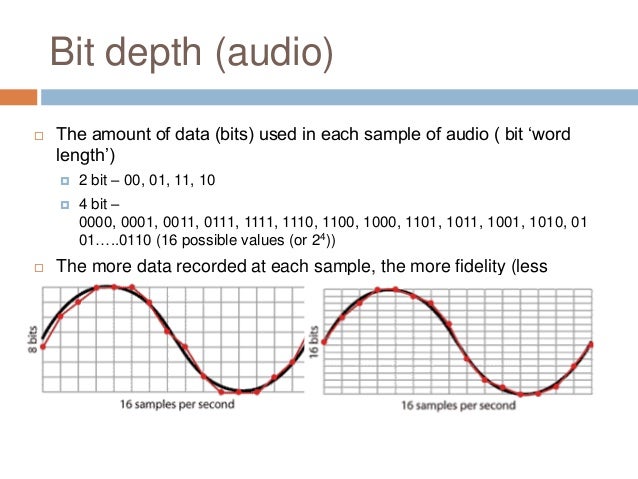
Along with the sample rate, there is the bit depth or depth of the sound. Bit depth is the number of bits of digital information to encode each sample. Simply put, the bit depth determines the “accuracy” of the input signal measurement. The larger the digit capacity, the smaller the error will be for each individual conversion from the magnitude of an electrical signal to a number and vice versa. With the smallest possible bit depth, there are only two options for measuring sound accuracy: 0 for full silence and 1 for full sound. If the bit width is 8 (16), then by measuring the input signal, 2 8 = 256 (2 16 = 65,536) different values ​​can be obtained.

Bit depth is fixed in the PCM codec, but for codecs that assume compression (eg MP3 and AAC), this parameter is calculated during encoding and may vary from sample to sample.

Bitrate
Bit rate is an indicator of the amount of information that one second of sound encodes. The higher it is, the less distortion and the closer the encoded composition is to the original. For linear PCM, the bit rate is very easy to calculate.

bitrate = sample rate × bit depth × channels

For systems like the Epiphan Pearl Mini that encode 16-bit (16-bit) linear PCM, this calculation can be used to determine how much additional bandwidth the PCM audio might require. For example, for stereo (two channels), the signal is digitized at 44.1 kHz at 16 bits and the bit rate is calculated as follows:

44.1 kHz × 16 bit × 2 = 1411.2 kbps

Meanwhile, audio compression algorithms like AAC and MP3 have fewer bits to transmit the signal (that’s their purpose), so they use low bit rates. Typically, the values ​​are in the range of 96 kbps to 320 kbps. For these codecs, the higher the bit rate you choose, the more audio bits you get per sample and the better the sound quality.

Sample rate, bit depth and bit rates in real life.
Audio CDs, one of the most popular early inventions for the general public for storing digital audio, used 44.1 kHz (20 Hz – 20 kHz, human ear range) and 16 bits. These values ​​were chosen to be able to save as much audio as possible to disk with good sound quality.

When video was added to audio and DVD and then Blu-ray discs came along, a new standard was created. DVD and Blu-Ray recordings typically use 48 kHz (stereo) or 96 kHz (5.1 surround) linear PCM format and 24-bit depth. These settings have been selected as ideal for keeping audio in sync with video while obtaining the best possible quality using the additional available disk space.

Our recommendations
CDs, DVDs, and Blu-Ray discs all have one goal: to provide the consumer with a high-quality playback engine. The goal of all developments was to provide high-quality audio and video without worrying about file size (if only it could fit on disk). Such quality could be provided by linear PCM.

In contrast, mobile media and streaming media have a completely different goal: to use the lowest bit rate, as low as possible, while still being sufficient to maintain acceptable quality for the listener. Compression algorithms are best suited for this task. You can follow the same principles for your records.

When recording audio from a video …
In case the record is used for the next on-ra-ki-bot, choose the 48 kHz PCM codec and the maximum bit depth (16 or 24) to provide the best audio quality. We recommend these parameters for Epiphan Pearl Mini.

When streaming audio from video …
With streaming or recording for later translation, good sound can be obtained with less bandwidth, using MP3 or AAC codecs with a frequency of 44.1 kHz and a bit rate of 128 kbit / s or higher. These parameters ensure that the sound is good enough without affecting the quality of the transmission.

Audio encoding: secrets revealed

Audio encoding: secrets revealed

Audio Encoding

Audio settings for video capture and transmission.

audio and video encoding

As people directly related to the AV sphere, we constantly talk about audio coding and audio codecs, but what is it? An audio codec is essentially a device or algorithm that can encode and decode a digital audio signal.

In practice, the audio waves that travel through the air are continuous analog signals. The signals are converted to digital form by a device called an analog-to-digital converter (ADC), and the reverse converter is called a digital-to-analog converter (DAC). The codec lies between these two functions and it is he who allows you to adjust some important parameters for the successful capture, recording and transmission of an audio signal: the codec algorithm, the sampling frequency, the bit width and the speed of the audio signal. data.

The three most popular audio codecs are Pulse-Code Modulation (PCM), MP3, and Advanced Audio Coding (AAC). The choice of codec determines the compression rate and the recording quality. PCM is a codec used by computers, CDs, digital phones, and sometimes SACD. The PCM signal source is sampled at regular intervals, and each sample is the digital amplitude of the analog signal. PCM is the simplest option for digitizing an analog signal.

With the correct parameters, this digitized signal can be completely converted back to analog without any loss. But this codec, which provides an almost complete identity with the original audio, is unfortunately not very cheap, which translates into very large file sizes, and such files are not suitable for streaming. We recommend using PCM to record digital images for your sources or when doing audio post-processing.

Fortunately, we always have the option of choosing a different codec that can compress digital data (rather than PCM) based on some helpful observations on the behavior of sound waves. But in this case, you have to make a compromise: all alternative algorithms are associated with “losses”, since it is impossible to completely restore the original signal, but nevertheless the result is still so good that most users will not be able to to catch the difference.

MP3 is an audio encoding format that uses a digital data compression algorithm that allows you to save the audio signal in smaller files. The MP3 codec is the most used by users to record and store music files. We recommend using MP3 to stream audio content as it requires less network bandwidth.

AAC is a newer audio encoding algorithm that is the successor to MP3. AAC has become the standard for MPEG-2 and MPEG-4 formats. In fact, this is also a digital data compression codec, but with less quality loss than MP3 when encoded with the same bit rate. We recommend using this codec for online streaming.

Sampling frequency (kHz, kHz)
Sample rate (or sample rate): the frequency with which the signal is digitized, stored, processed, or converted from analog to digital. Time sampling means that the signal is represented by several of its samples (samples) taken at regular intervals.

Measured in hertz (Hz, Hz) or kilohertz (kHz, kHz,) 1 kHz equals 1000 Hz. For example, 44,100 samples per second can be labeled 44,100 Hz or 44.1 kHz. The selected sample rate will determine the maximum playback frequency and, as follows from Kotelnikov’s theorem, to fully restore the original signal, the sample rate must be twice the highest frequency in the signal spectrum.

As you know, the human ear is capable of picking up frequencies between 20 Hz and 20 kHz. Given these parameters and the values ​​shown in the table below, you can understand why 44.1 kHz was chosen as the sampling frequency for CD and is still considered a very good frequency for recording.

There are several reasons for choosing a higher sample rate, although it may seem like a waste of time and effort to reproduce sound outside the range of human hearing. At the same time, 44.1 – 48 kHz will suffice for the average listener for a high-quality solution to most problems.

Audio encoding and processing

Audio encoding and processing

Encoding

Sound information.

ENCODING

Sound is a wave that travels through air, water, or other medium with a continuously changing intensity and frequency.

A person perceives sound waves (air vibrations) with the help of hearing in the form of sound of different volume and pitch. The higher the intensity of the sound wave, the louder the sound, the higher the frequency of the wave, the higher the pitch of the sound

The human ear perceives sound at a frequency of 20 vibrations per second (low sound) to 20,000 vibrations per second (high sound).

A person can perceive sound in a wide range of intensities, in which the maximum intensity is 10 14 times greater than the minimum (one hundred thousand billion times). A special unit “decibel” (dbl) is used to measure the volume of sound (Table 5.1). Decreasing or increasing the volume of the sound by 10 dB corresponds to a decrease or increase in the intensity of the sound by 10 times.

Table 5.1. Sound volume
Sonar Volume in decibels
Lower limit of human ear sensitivity 0
Whisper of Leaves 10
Conversation 60
Horn 90
Jet engine 120
Pain threshold 140
Sound time sampling. For a computer to process sound, a continuous audio signal must be converted to a discrete digital form using time sampling. A continuous sound wave is divided into separate small time sections, for each section a certain value of sound intensity is set.

Therefore, the continuous dependence of the loudness of the sound at time A (t) is replaced by a discrete sequence of loudness levels.

Sampling frequency.

A microphone connected to the sound card is used to record analog sound and convert it to digital format. The quality of the digital sound obtained depends on the number of measurements of the sound volume level per unit time, that is, the sampling frequency. The more measurements that are made in 1 second (the higher the sampling frequency), the more accurately the “ladder” of the digital audio signal repeats the curve of the dialogue signal.

The audio sample rate is the number of measurements of the volume of a sound in one second.

The audio sample rate can range from 8000 to 48000 sound volume measurements per second.

Audio encoding depth. Each “step” is assigned a specific value for the volume level of the sound. Loudness levels of sound can be viewed as a set of possible states N, for which a certain amount of information is needed to encode, which is called audio encoding depth.

Audio encoding depth is the amount of information required to encode the discrete volume levels of digital audio.

If the known encoding depth, the number of digital audio volume levels can be calculated using the formula N = 2 I. Let the sound encoding depth be 16 bit, then the number of sound volume levels is:

N = 2 I = 2 16 = 65 536.

During the encoding process, each sound volume level is assigned its own 16-bit binary code, the smallest sound level will correspond to the code 0000000000000000 and the highest, 1111111111111111.

The quality of digitized sound. The higher the sound sampling frequency and depth, the better the digitized sound will sound. The lowest quality of digitized sound, corresponding to the quality of telephone communication, is obtained at a sampling rate of 8000 times per second, a sampling rate of 8 bits, and by recording an audio track (“mono” mode). The highest quality digitized audio, corresponding to the quality of an audio CD, is achieved with a sampling rate of 48,000 times per second, a sampling rate of 16 bits, and the recording of two audio tracks (“stereo” mode ).

It should be remembered that the higher the quality of the digital sound, the greater the volume of information in the audio file. It is possible to estimate the information volume of a digital stereo sound file with a duration of 1 second with an average sound quality (16 bits, 24,000 measurements per second). To do this, the encoding depth must be multiplied by the number of measurements in 1 second and multiplied by 2 (stereo sound):

16 bits × 24,000 × 2 = 768,000 bits = 96,000 bytes = 93.75 KB.

Audio Coding: Secrets Revealed – Part 2

Audio Coding: Secrets Revealed – Part 2

AUDIO ENCODING

Audio settings for video capture and transmission.

AUDIO ENCODING

Sampling frequency (kHz, kHz)
Sample rate (or sample rate): the frequency with which the signal is digitized, stored, processed, or converted from analog to digital. Time sampling means that the signal is represented by several of its samples (samples) taken at regular intervals.

Measured in hertz (Hz, Hz) or kilohertz (kHz, kHz,) 1 kHz equals 1000 Hz. For example, 44,100 samples per second can be labeled 44,100 Hz or 44.1 kHz. The selected sample rate will determine the maximum playback frequency and, as follows from Kotelnikov’s theorem, to fully restore the original signal, the sample rate must be twice the highest frequency in the signal spectrum.

As you know, the human ear is capable of picking up frequencies between 20 Hz and 20 kHz. Given these parameters and the values ​​shown in the table below, you can understand why 44.1 kHz was chosen as the sampling frequency for CD and is still considered a very good frequency for recording.

There are several reasons for choosing a higher sample rate, although it may seem like a waste of time and effort to reproduce sound outside the range of the human ear. At the same time, 44.1 – 48 kHz will suffice for the average listener for a high-quality solution to most problems.

Bit depth
Along with the sample rate, there is the bit depth or depth of sound. Bit depth is the number of bits of digital information to encode each sample. Simply put, the bit depth determines the “accuracy” of the input signal measurement. The larger the digit capacity, the smaller the error for each individual conversion from the magnitude of an electrical signal to a number and vice versa. With the smallest possible bit depth, there are only two options for measuring sound accuracy: 0 for full silence and 1 for full sound. If the bit width is 8 (16), then by measuring the input signal, 2 8 = 256 (2 16 = 65,536) different values ​​can be obtained.

Bit depth is fixed in the PCM codec, but for codecs that assume compression (eg MP3 and AAC), this parameter is calculated during encoding and may vary from sample to sample.

Bitrate
Bit rate is an indicator of the amount of information that one second of sound encodes. The higher it is, the less distortion and the closer the encoded composition is to the original. For linear PCM, the bit rate is very easy to calculate.

bitrate = sample rate × bit depth × channels

For systems such as the Epiphan Pearl Mini that encode 16-bit (16-bit) linear PCM, this calculation can be used to determine how much additional bandwidth the PCM audio might require. For example, for stereo (two channels), the signal is digitized at 44.1 kHz at 16 bits and the bit rate is calculated as follows:

44.1 kHz × 16 bit × 2 = 1411.2 kbps

Meanwhile, audio compression algorithms like AAC and MP3 have fewer bits to transmit the signal (that’s their purpose), so they use low bit rates. Typically, the values ​​are in the range of 96 kbps to 320 kbps. For these codecs, the higher the bit rate you choose, the more audio bits you get per sample and the better the sound quality.

Sample rate, bit depth and bit rates in real life.
Audio CDs, one of the most popular early inventions for the general public for storing digital audio, used 44.1 kHz (20 Hz – 20 kHz, human ear range) and 16 bits. These values ​​were chosen to be able to save as much audio as possible to disk with good sound quality.

When video was added to audio and DVD and then Blu-ray discs came along, a new standard was created. DVD and Blu-Ray recordings typically use 48 kHz (stereo) or 96 kHz (5.1 surround) linear PCM format and 24-bit depth. These settings have been chosen as ideal for keeping the audio in sync with the video while obtaining the best possible quality using additional available disk space.

Our recommendations
CDs, DVDs, and Blu-Ray discs all have one goal: to provide the consumer with a high-quality playback engine. The goal of all developments was to provide high-quality audio and video without worrying about file size (if only it could fit on disk). Such quality could be provided by linear PCM.

By contrast, mobile media and streaming media have a completely different goal: to use the lowest bit rate possible, while still being sufficient to maintain acceptable quality for the listener.

Audio encoding: secrets revealed

Audio encoding: secrets revealed

audio encoding

Audio settings for video capture and transmission.

AUDIO ENCODING

As people directly related to the AV sphere, we constantly talk about audio coding and audio codecs, but what is it? An audio codec is essentially a device or algorithm that can encode and decode a digital audio signal.

In practice, the audio waves that travel through the air are continuous analog signals. The signals are converted to digital form by a device called an analog-to-digital converter (ADC), and the reverse converter is called a digital-to-analog converter (DAC). The codec lies between these two functions and it is he who allows you to adjust some important parameters for the successful capture, recording and transmission of an audio signal: the codec algorithm, the sampling frequency, the bit width and the speed of the audio signal. data.

The three most popular audio codecs are Pulse-Code Modulation (PCM), MP3, and Advanced Audio Coding (AAC). The choice of codec determines the compression rate and the recording quality. PCM is a codec used by computers, CDs, digital phones, and sometimes SACD. The PCM signal source is sampled at regular intervals, and each sample is the digital amplitude of the analog signal. PCM is the simplest option for digitizing an analog signal.

With the correct parameters, this digitized signal can be completely converted back to analog without any loss. But this codec, which provides an almost complete identity with the original audio, is unfortunately not very cheap, which results in very large file sizes, and such files are not suitable for streaming. We recommend using PCM to record digital images for your sources or when doing audio post-processing.

Fortunately, we always have the option of choosing a different codec that can compress digital data (rather than PCM) based on some helpful observations on the behavior of sound waves. But in this case, you have to make a compromise: all alternative algorithms are associated with “losses”, since it is impossible to completely restore the original signal, but nevertheless the result is still so good that most users will not be able to to catch the difference.

MP3 is an audio encoding format that uses a digital data compression algorithm that allows you to save the audio signal in smaller files. The MP3 codec is the most used by users to record and store music files. We recommend using MP3 to stream audio content as it requires less network bandwidth.

AAC is a newer audio encoding algorithm that is the successor to MP3. AAC has become the standard for the MPEG-2 and MPEG-4 formats. In fact, this is also a digital data compression codec, but with less quality loss than MP3 when encoded with the same bit rate. We recommend using this codec for online streaming.

Digital audio encoding

Digital audio encoding

Digital audio encoding

PC-based audio coding is based on the process of converting air vibrations into electrical current fluctuations and the subsequent sampling of an analog electrical signal.

DIGITAL AUDIO ENCODING

The encoding and reproduction of audio information is carried out using special programs. The quality of reproduction of the encoded sound depends on the sampling frequency and its resolution (sound encoding depth – the number of levels).

Digital audio is an analog audio signal represented by discrete numerical values ​​of its amplitude.

Sound digitization is a technology with a divided time step and subsequent recording of the values ​​obtained in numerical form. Another name for digitizing audio is analog to digital audio conversion, which includes the following operations:

Bandwidth limiting is done by using a low pass filter to suppress spectral components that are more than half the sample rate.

Time sampling, that is, replacing a continuous analog signal with a sequence of its values ​​at discrete moments of time: samples.

Level quantization is the replacement of the signal’s reference value with the closest value of a set of fixed values: quantization levels.

Encoding or digitization, as a result of which the value of each quantized sample is represented as a number corresponding to the ordinal number of the quantization level.

This is done as follows: a continuous analog signal is “cut” into sections with a sample rate, a discrete digital signal is obtained, which goes through the quantization process with a certain bit depth, and is then encoded, that is, it is replaced by a sequence of code symbols. To record sound in a 20-20,000 Hz frequency band, a sampling frequency of 44.1 and higher is required (today there are ADCs and DACs with a sampling frequency of 192 and even 384 kHz). To obtain a high-quality recording, 16-bit is sufficient, however, to expand the dynamic range and improve the quality of the sound recording, 24 (less often 32) bits are used.

Sound coding methods (of course an electrical signal coming from a microphone) are based on the fact that, theoretically, any complex sound can be decomposed into a sequence of simpler harmonic signals of different frequencies, each of which it is a sinusoid, called the spectrum of the original signal. The task of encoding sound, like any other analog signal, is to represent it in the form of another analog or digital signal, which is more convenient for its transmission or storage in each specific case. Real sound sources have a limited spectrum width, therefore, for encoding, transformation methods are used that transform the original signal into one, the spectrum of which is more suitable for transmission on the selected channel. Representing an analog signal as another analog signal is commonly referred to as modulation and digitally as encoding. This division is very arbitrary. An analog signal can be represented as a harmonic signal (that is, a sinusoid), the parameters of which change depending on the value of the original signal. In the event that the amplitude of the sinusoid changes with a change in the original signal, it is amplitude modulation (AM). If, depending on the value of the original signal, the frequency or phase of the sinusoid changes, we are dealing with frequency modulation (FM) or phase modulation (PM). Amplitude and frequency modulation, for example, is widely used to transmit sound by radio. These types of modulation, of course, are not the decomposition of the original signal into harmonics. The development of digital technology and the use of computer processing and information storage has led to the widespread use of pulse encoding or modulation methods. Such types of modulation are, for example, pulse code modulation, in which the value of the original signal at regular intervals is represented in code form. The vast majority of “computer sound” is precisely the recording of the binary code of the received signal in short equal time intervals, determined by the sampling frequency. For storage and transmission through communication channels, this signal is usually compressed (reducing the volume by discarding unnecessary or insignificant information). In addition to pulse code modulation, other types of digital modulation (pulse width, pulse frequency, etc.) are also used to encode sound.

Audio encoding.

Audio encoding.

AUDIO ENCODING

Digital audio is an analog audio signal represented by discrete numerical values ​​of its amplitude.

audio encodig

Sound digitization is a technology with a divided time step and subsequent recording of the values ​​obtained in numerical form.

Another name for digitizing audio is analog to digital audio conversion.

Sound digitization involves two processes:

sample (sample) a signal over time
amplitude quantification process.
Meanwhile, there is no need to worry about it. ”

Discretization of time.

Meanwhile, there is no need to worry about it. ”

The time sampling process is the process of obtaining the values ​​of the signal that is being converted, with a certain time step: the sampling step. The number of measurements of the magnitude of the signal, carried out in one second, is called the sampling frequency or the sampling rate, or sampling frequency (from the English “sampling” – “sampling”). The lower the sampling step, the higher the sampling frequency and the more accurate representation of the signal that we will obtain.

This is confirmed by Kotelnikov’s theorem (in foreign literature it is found as Shannon’s theorem, Shannon). According to him, an analog signal with a limited spectrum can be accurately described by a discrete sequence of values ​​of its amplitude, if these values ​​are taken with a frequency that is at least twice the highest frequency in the spectrum of the signal. That is, an analog signal in which the highest spectrum frequency is F m can be accurately represented by a sequence of discrete amplitude values ​​if F d> 2F m is satisfied for the sampling frequency F d.

In practice, this means that for the digitized signal to contain information on the full audible frequency range of the original analog signal (0 – 20 kHz), it is necessary that the selected sample rate be at least 40 kHz. The number of amplitude measurements per second is called the sampling rate (if the sampling step is constant).

The main difficulty of digitization is the inability to record the measured signal values ​​with perfect precision.

Analog to digital converters (ADC).

Meanwhile, there is no need to worry about it. ”

The above process of digitizing sound is done using analog-to-digital converters (ADCs).

This transformation includes the following operations:

Bandwidth limiting is done by a low pass filter to suppress spectral components that are more than half the sample rate.
Discretization in time, that is, substitution of a continuous analog signal with a sequence of its values ​​at discrete moments in time: samples. This problem is solved by using a special circuit at the input of the ADC – a sample and hold device.
Level quantization is the replacement of the signal’s reference value with the closest value of a set of fixed values: quantization levels.
Encoding or digitization, as a result of which the value of each quantized sample is represented as a number corresponding to the ordinal number of the quantization level.
This is done as follows: a continuous analog signal is “cut” into sections with a sample rate, a discrete digital signal is obtained, which goes through a quantization process with a certain bit depth, and is then encoded, that is, it is replaced by a sequence of code symbols. To record sound in a frequency band of 20-20,000 Hz, a sampling frequency of 44.1 and higher is required (today there are ADCs and DACs with a sampling frequency of 192 and even 384 kHz). To obtain a high-quality recording, 16 bits are sufficient, however, to expand the dynamic range and improve the quality of sound recording, 24 (less often 32) bits are used.

Meanwhile, there is no need to worry about it. ”

Encoding methods.

Frequency modulation.

Sound coding methods (of course we mean the electrical signal coming from the microphone) are based on the fact that, in theory, any complex sound can be broken down into a sequence of the simplest harmonic signals of different frequencies, each one of which is a sinusoid, called the original signal spectrum. The task of encoding sound, like any other analog signal, is to represent it in the form of another analog or digital signal, more convenient for its transmission or storage in each specific case.

Methods used to compress digital audio.

Methods used to compress digital audio.

Audio Encoding

Information compression methods when working with sound.

Audio Encoding

The larger the memory capacity of the WT card, the more realistic the sound will be (as more samples are stored in memory, they are recorded at a higher resolution). The General MIDI standard describes more than 200 instruments; To store your sound samples (tables), at least 8 MB of memory is required (at least 20 KB for each sample).

Known WF (Wave Form) method of sound generation, based on the transformation of sounds into complex mathematical formulas and the subsequent application of these formulas to control a powerful processor in order to reproduce the sound; from WF synthesis expect an even better reality (relative to FM and WT technologies) of musical instruments playing with limited volumes of sound files.

To reduce data flow, other analog (non-PCM) encoding methods are used. For example, a coding technique based on known characteristics of an analog signal is known to significantly reduce the amount of data stored; with the so-called -The encoding of the analog signal is converted into a digital code determined by the logarithm of the magnitude of the signal (and not by its linear transformation). The disadvantage of this method is the need to have a priori information about the characteristics of the original signal.

Conversion methods are known that do not require a priori information about the original signal. When differential pulse code modulation (DPCM, Differential Pulse Code Modulation) persists single signal difference between current and previous levels (the difference requires a digital representation of fewer bits than the full amplitude value). With delta modulation (DM, delta modulation), each sample consists of a single bit, which determines the sign of the change in the original signal (increase or decrease); Delta modulation requires a higher sample rate. Differential PCM technologies involve the accumulation of errors over time, so special measures are taken to periodically calibrate the ADC.

The most common when recording received audio is adaptive pulse code modulation (ADPCM, Adaptive Pulse Code Modulation), using 8- or 4-bit coding for the difference signals. The technology was first applied by Creative Labs and provides data compression up to 4: 1.

However, other audio information compression / decompression methods (software) are often used; Among them, the most popular lately is the MP3 format developed by Fraunhofer IIS (Fraunhofer Institute Integrierte Schaltungen, www.iis.fhg.de) and by THOMSON (the full specification of the MP3 format is published on the website www.mp3tech.org ). The full name of the MP3 standard sounds like MPEG-Audio Layer-3 (where MPEG is the essence of the Moving Picture Expert Group, not to be confused with the MPEG-3 standard designed for use in high definition television).

MP3 encoding of data occurs through the allocation of independent independent data blocks: frames. To do this, the original signal during encoding is divided into equal length parts, called frames, and encoded separately (to further reduce the amount of data, compression is applied using the Huffman algorithm); When decoding, the signal is formed from a sequence of decoded frames. The encoding process takes a significant amount of time; decoding (during playback) is done on the fly.

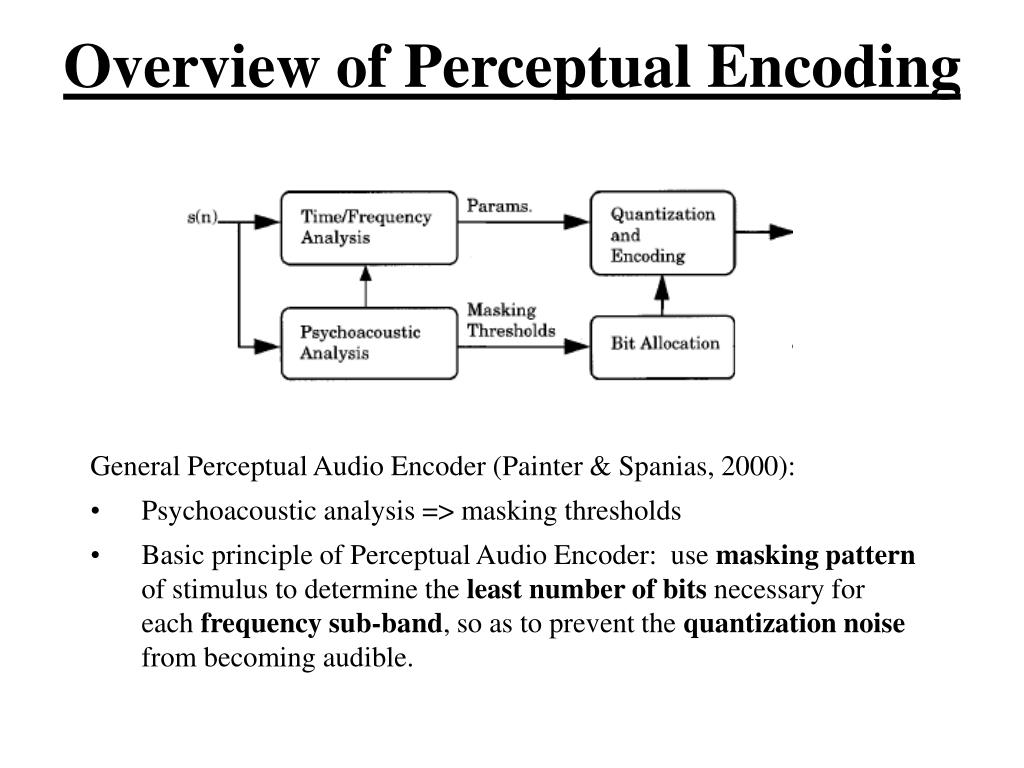
The MP3 format provides the best sound quality with the smallest file size. This is achieved by taking into account the peculiarities of human hearing, including the effect of masking a weak signal from one frequency range with a stronger signal from an adjacent range (when it occurs) or a strong signal from the previous frame, causing a temporary decrease in the ear’s sensitivity to the signal of the current frame (in other words, minor sounds are eliminated, which are not heard by the human ear due to the presence at this / previous moment of another – louder sound). It also takes into account the inability of most people to distinguish signals that are below a certain power level, different for different frequency ranges. This process is called adaptive coding, and it saves at least sound details that are meaningful from the point of view of human perception. The compression ratio (hence the quality) is not determined by the MP3 format, but by the width of the data stream during encoding.