FLAC Deflate Compression


Free Download Mp4Gain
picture

FLAC Deflate Compression

I. Let’s talk about FLAC Deflate Compression

As a specialist in audio technology, I’m here to demystify a fascinating subject – FLAC Deflate Compression. If you’re an audio enthusiast or someone who values top-notch sound quality, this topic is right up your alley. We’ll dive into the details of what FLAC Deflate Compression is and why it’s significant in the world of digital audio.

II. The Basics of Lossless Audio Compression

Lossless Audio Compression

Before we get into the specifics of FLAC Deflate Compression, let’s clarify some fundamentals. When we talk about lossless audio compression, we mean a method that reduces file size without sacrificing audio quality. Audiophiles and music professionals adore this approach because it keeps the sound pristine.

Imagine you have a favorite book, and you want to make it more portable. Lossless compression is like a magic spell that shrinks the book into a smaller edition without losing any words or details.

III. What Is FLAC?

What Is FLAC?
What Is FLAC?

Now, let’s meet our star, FLAC – the Free Lossless Audio Codec. It’s a popular choice in the world of lossless audio formats. FLAC has gained recognition for its open-source nature and exceptional compression capabilities.

Imagine FLAC as a wizard who can make your giant backpack of books fit into your pocket without tearing a single page. It does this by using different spells, one of which is Deflate Compression.

IV. The Science Behind Deflate Compression

So, what’s Deflate Compression? Picture this: you have a bag full of balloons. Each balloon represents a piece of data. The Deflate algorithm is like squeezing the balloons to remove the air, making them smaller. This is precisely what Deflate does to data – it removes redundancies and minimizes file size without losing any information.

Imagine you have a document with a lot of repeated words. Deflate is like a smart friend who tells you to write those words only once and refer to them when needed.

V. FLAC and Deflate: A Perfect Pair

Here’s where the magic happens. FLAC employs the Deflate algorithm to compress audio data. Think of it as a well-organized suitcase. Instead of haphazardly throwing clothes into your bag, you fold them neatly, saving space. Similarly, Deflate organizes data in a way that efficiently reduces the file size while keeping the audio quality intact.

VI. Compression Efficiency and File Size

Let’s put this into perspective. You have a backpack filled with your favorite toys. When you use Deflate Compression, it’s like arranging those toys neatly and compactly, allowing you to carry more toys without a bigger bag. In the digital realm, this means you can store more music on your device without consuming excessive storage space.

VII. FLAC Deflate Compression in Practice

Practicality is key, right? Suppose you’re looking to use FLAC with Deflate. It’s as user-friendly as organizing your wardrobe. There are various tools and software available to help you compress your audio files. Just a few clicks, and you can save precious space on your device while keeping your audio quality top-notch.

VIII. Achieving High-Quality Audio

For an audiophile, this is a dream come true. With FLAC and Deflate, you get to enjoy high-quality audio without compromise. It’s like having a gourmet chef preparing your favorite dish with the finest ingredients – the end result is simply exceptional.

IX. FLAC Deflate Compression vs. Other Formats

Let’s compare. FLAC with Deflate isn’t the only player in the lossless audio game. There are other formats like WAV and AIFF. These formats have their strengths, but they may not be as efficient in terms of file size reduction. It’s like comparing different car models – they all have unique features, but you choose the one that suits your needs best.

X. The Future of Lossless Compression

The world of audio compression is constantly evolving. With technology advancing at lightning speed, we can expect even more efficient methods for preserving audio quality while reducing file sizes. FLAC and Deflate will likely continue to play significant roles in this journey.

XI. Conclusion

In summary, FLAC Deflate Compression is a fantastic solution for those who want to savor the highest audio quality without compromising on storage space. It’s like having your cake and eating it too – maintaining quality while saving space. I encourage you to explore this incredible combination for your audio needs.

XII. Comments


Comments:

“I’ve been using FLAC with Deflate for a while now, and it’s a game-changer. I can store so much more music without losing quality!” – MusicMaestro

“This article makes the technical stuff sound so simple. Great job!” – TechSavvyUser

“I’m excited about the future of lossless compression. This article got me thinking about the possibilities.” – AudioEnthusiast

“Would love to see more details on the technical aspects of FLAC and Deflate. Otherwise, informative!” – CuriousListener


Free Download Mp4Gain
picture


Mp4Gain Main Window
picture


Mp4Gain Features
picture


Free Download Mp4Gain
picture

Critical Bandwidths in MP3

Calculating Critical Bandwidths in MP3 Compression

Critical Bandwidths in MP3

As an expert in the realm of MP3 compression and audio technology, I’m here to unravel the intricate world of critical bandwidths in MP3 compression. Understanding this concept is pivotal in achieving optimal audio quality while minimizing file size. Let’s dive into the details and explore this fascinating topic.

What Are Critical Bandwidths in MP3 Compression?

Critical bandwidths, often referred to as critical bands, are a fundamental concept in the field of psychoacoustics. They relate to the way our ears perceive different frequencies and play a vital role in audio compression, particularly in the MP3 format. To put it simply, critical bandwidths represent the range of frequencies that our ears can distinguish and process.

Real-Life Example: Think of critical bandwidths as a set of buckets, each representing a range of frequencies. Our ears can only fill a limited number of buckets at once, and these buckets are wider for low frequencies and narrower for high frequencies.

MP3 compression exploits the knowledge of critical bandwidths to remove audio information that falls outside the range of human hearing. This selective approach allows for significant data reduction while retaining audio quality. It’s akin to trimming the fat while preserving the meat, resulting in a leaner audio file.

How Are Critical Bandwidths Determined?

Critical bandwidths are not fixed; they vary depending on the specific frequency and the environment in which the sound is heard. Psychoacoustic studies have led to the development of critical bandwidth curves, which provide a graphical representation of how our ears perceive different frequencies.

Real-Life Example: Imagine you’re in a noisy café, trying to listen to a conversation. Your ears focus on the frequency range of the voices while ignoring the surrounding noise. This selective attention is similar to how critical bandwidths work in audio compression.

In the context of MP3 compression, these critical bandwidth curves are used to determine which parts of the audio spectrum can be discarded without a noticeable impact on the listening experience. This fine-tuned approach ensures that the compression process is both efficient and transparent to our ears.

Balancing Compression and Quality

The art of MP3 compression lies in finding the delicate balance between reducing file size and maintaining audio quality. Critical bandwidths are a crucial tool in achieving this equilibrium. By identifying and preserving the most relevant audio information while discarding what falls outside the critical bandwidths, MP3 compression delivers impressive results.

Real-Life Example: Consider the act of watching a high-definition movie on your smartphone while saving data. The device adjusts the video quality based on the screen size and your internet speed, providing a smooth viewing experience without unnecessary data consumption. MP3 compression operates in a similar fashion, optimizing audio for digital consumption.

In essence, critical bandwidths in MP3 compression serve as a guide to ensure that the compression process is as imperceptible as possible to the human ear. By focusing on the audio information that matters most, we can enjoy high-quality audio experiences with smaller file sizes.

Last Words about Critical Bandwidths in MP3 Compression

In my journey through the realm of audio compression, I’ve come to appreciate the profound impact of critical bandwidths. These frequency ranges shape the way we perceive sound and play a pivotal role in the world of MP3 compression. By understanding this concept, we can navigate the intricacies of audio technology, striking a harmonious balance between quality and efficiency.

Data Compression Part 3

Data Compression Part 3

Data Compression
Data Compression

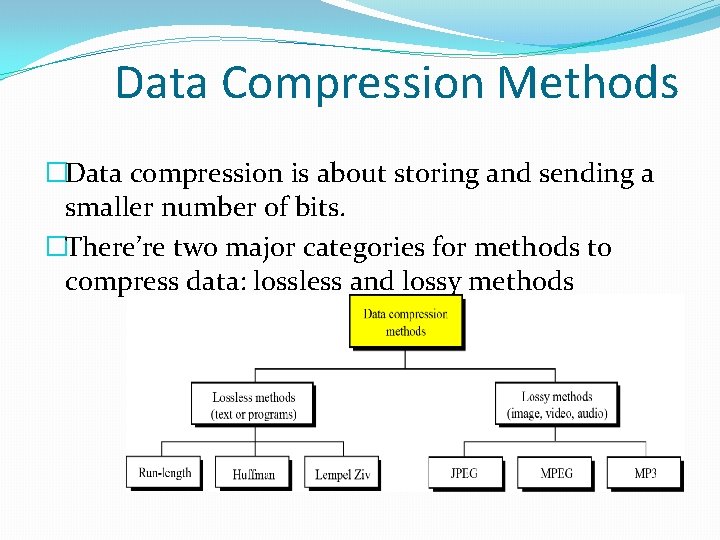
The Lempel-Ziv (LZ) compression method is one of the most popular lossless storage algorithms.

Data Compression
Data Compression

DEFLATE is a variant of LZ that is optimized for decompression speed and compression ratio, although its compression speed can be very slow, PKZIP , gzip and PNG all use DEFLATE. LZW (Lempel-Ziv-Welch) was a Unisys patent until the patent expired in June 2003, this method was used for GIF images. Also worth mentioning is the LZR (LZ-Renau) method, which is the basis of the Zip method. The LZ method uses a table-based compression model, in which table entries are replaced with repeated data strings. For most LZ methods, this table is dynamically generated from the initial input data. This table is often maintained using Huffman coding (eg SHRI, LZX). A current LZ-based encoding scheme that works well is LZX , which is used in Microsoft’s CAB format.

The best compression tools use probabilistic model predictions for arithmetic coding. Arithmetic coding was invented by the Finnish information theorist Jorma Rissanen and turned into a practical method by Witten, Neal and Cleary. This approach allows better compression than the well-known Huffman algorithm and is well suited for adaptive data compression, where predictions are context sensitive. Arithmetic encoding has been used in the JBIG binary image compression standard, the DejaVu document compression standard. The Dasher text input system is a reverse arithmetic encoder.

Data Compression Part 2

Data Compression Part 2

Data Compression
Data Compression

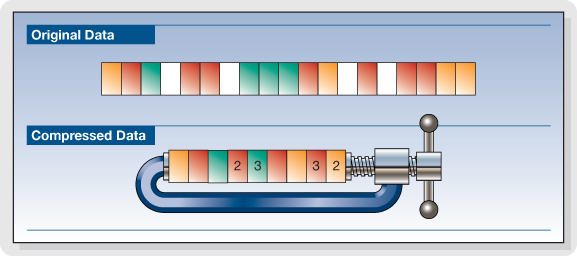
A very simple compression method is run-length encoding, which replaces the same continuous data with simple data-length encoding, which is an example of lossless data compression.

Data Compression
Data Compression

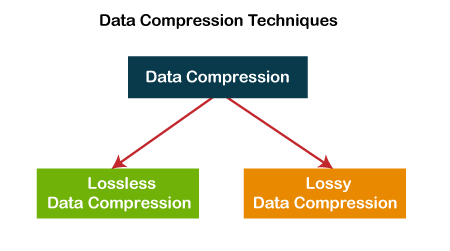
This method is often used on office computers to make better use of disk space, or to make better use of bandwidth on a computer network. Losslessness is a very important requirement for symbolic data such as spreadsheets, text, executables, etc., because in most cases even a single bit of data change is unacceptable, except in some limited cases.

For video and audio data, some level of quality degradation is acceptable as long as a significant portion of the data is not lost. Taking advantage of the limitations of the human perception system, a lot of storage space can be saved and the quality of the results obtained does not differ significantly from the quality of the original data. These lossy data compression methods generally require a trade-off between compression speed, compressed data size, and quality loss.

Lossy image compression is used in digital cameras to dramatically increase storage capacity with little degradation in image quality. Video compression with lossy MPEG-2 codec for DVD implements a similar function.

In lossy audio compression, psychoacoustic methods are used to remove inaudible or hard-to-hear components of a signal. Human speech compression often uses more specialized techniques, so “speech compression” or “speech coding” is also sometimes distinguished from “audio compression” as a separate field of study. Different audio and speech compression standards fall under the category of audio codecs. For example, voice compression is used for Internet telephony, while audio compression is used for ripping and decoding CDs using MP3 players.

theory
Edit
Compression theory (which is closely related to algorithmic information theory) and rate distortion theory, research work in this area was established primarily by the American academic Claude Elwood Shannon, who in the late 1990s In the 1940s and 1950s, fundamental articles were published on the subject. in the early 1900s. Doyle and Carlson wrote in 2000 that data compression “is one of the simplest and most elegant design theories in all engineering fields.” Cryptography and coding theory are also closely related disciplines, and the idea of ​​data compression and statistical inference also have deep roots.

Many lossless data compression systems can be viewed as a four-step model, and lossy data compression systems generally contain more steps, such as prediction, frequency transformation, and quantization.

Data compression

Data compression

Data compression
Data compression

The process of encoding information using fewer bits than the original representation

Data compression
Data compression

In computer science and information theory, data compression or source coding is the process of representing information with fewer data bits (or other information-related units) than if it were not encoded, according to an encoding mechanism specific . For example, if we encode “compression” as “comp”, the item can be represented with fewer data bits. A common example is the ZIP archive format, which not only provides compression but also acts as an archiver, capable of storing many files in the same archive.

We can use data consistency (represented by information entropy, entropy), regularity, and predictability to achieve data compression. The compression technology first developed by humans is actually natural language. Generally speaking, if a thing can be described in a relatively simplified natural language, then it will be better able to compress such things. The more consistent the data, the more concentrated its statistical features. Take image compression as an example, which centrally accounts for the time domain and frequency domain of the Fourier transform, the histogram, and the eigenvalues.


Data compression is possible because most real-world data has statistical redundancy. For example, the letter “e” is more commonly used in English than the letter “z”, and it is very unlikely that the letter “q” will be followed by a “z”. Non-destructive data compression generally exploits statistical redundancy so that the sender’s data can be represented more succinctly, but fully.

The compression ratio of non-destructive data compression is not sufficient to handle the large volume of audio and video data, but if some loss of fidelity is allowed, higher compression can be achieved. For example, when people look at photographs or television images, they may not realize that some details are not perfect. Similarly, two audio recording sample streams may sound the same, but they are not actually exactly the same. Destructive data compression uses fewer bits to represent images, video, or audio with acceptable or imperceptible numbers.

However, there are often files that cannot be compressed using destructive data compression, and in fact cannot be compressed using any compression algorithm for data that does not contain discernible patterns. Also, trying to compress already compressed data often results in data bloat.

In fact, destructive data compression will eventually get to the point where it won’t work. For example, an extreme example: the compression algorithm deletes the last byte of the file every time, and after this algorithm continues to compress until the file is empty, the compression algorithm will not continue to work.

Compression is important because it helps reduce the consumption of expensive resources such as hard drive space and connection bandwidth, however, compression requires information processing resources, which can also be expensive. Therefore, the design of the data compression mechanism requires a compromise between the compression capacity, the degree of distortion, the computing resources required, and various other factors that must be taken into account.

As with any form of communication, compressed data communication only works if both the sender and receiver of the information understand the encryption mechanism. For example, the article only makes sense if the recipient knows that the article is to be interpreted in Chinese characters. Also, the compressed data can only be understood by the receiver if he knows the encoding method.

Audio and Video Data Compression Part 2

Audio and Video Data Compression Part 2

Audio and Video Compression

In fact, destructive data compression will eventually get to the point where it won’t work. For example, an extreme example: the compression algorithm deletes the last byte of the file every time, and after this algorithm continues to compress until the file is empty, the compression algorithm will not continue to work.

Compression

Compression is important because it helps reduce the consumption of expensive resources such as hard drive space and connection bandwidth, however, compression requires information processing resources, which can also be expensive. Therefore, the design of the data compression mechanism must compromise on compression capability, degree of distortion, required computing resources, and various other factors that must be taken into account.

As with any form of communication, compressed data communication only works if both the sender and receiver of the information understand the encryption mechanism. For example, the article only makes sense if the recipient knows that the article is to be interpreted in Chinese characters. Also, the compressed data can only be understood by the receiver if he knows the encoding method.

In fact, destructive data compression will eventually get to the point where it won’t work. For example, an extreme example: the compression algorithm deletes the last byte of the file every time, and after this algorithm continues to compress until the file is empty, the compression algorithm will not continue to work.

Compression is important because it helps reduce the consumption of expensive resources such as hard drive space and connection bandwidth, however, compression requires information processing resources, which can also be expensive. Therefore, the design of the data compression mechanism must compromise on compression capability, degree of distortion, required computing resources, and various other factors that must be taken into account.

As with any form of communication, compressed data communication only works if both the sender and receiver of the information understand the encryption mechanism. For example, the article only makes sense if the recipient knows that the article is to be interpreted in Chinese characters. Also, compressed data can only be understood by the receiver if it knows the encoding method.

Audio and video data compression

Audio and video data compression

Audio and video data compression

In computer science and information theory, data compression or source coding is the process of representing information with fewer data bits (or other information-related units) than if it were not encoded, according to an encoding mechanism specific .

Audio and video data compression

For example, if we encode “compression” as “comp”, the item can be represented with fewer data bits. A common example is the ZIP archive format, which not only provides compression but also acts as an archiver, capable of storing many files in the same archive.

We can use data consistency (represented by information entropy, entropy), regularity, and predictability to achieve data compression. The compression technology first developed by humans is actually natural language. Generally speaking, if a thing can be described in a relatively simplified natural language, then it will be better able to compress such things.

The more consistent the data, the more concentrated its statistical features. Taking image compression as an example, it centrally represents the time domain and frequency domain of the Fourier transform, the histogram, and the eigenvalues.

Data compression is possible because most real-world data has statistical redundancy. For example, the letter “e” is more commonly used in English than the letter “z”, and it is very unlikely that the letter “q” will be followed by a “z”. Non-destructive data compression generally exploits statistical redundancy so that the sender’s data can be represented more succinctly, but fully.

The compression ratio of non-destructive data compression is not sufficient to handle large volumes of audio and video data, but higher compression can be achieved if some loss of fidelity is tolerated. For example, when people look at photographs or television images, they may not realize that some details are not perfect. Similarly, two audio recording sample streams may sound the same, but they are not actually exactly the same. Destructive data compression uses fewer bits to represent images, video, or audio with acceptable or imperceptible numbers.

However, there are often files that cannot be compressed using destructive data compression, and in fact cannot be compressed using any compression algorithm for data that does not contain discernible patterns. Also, trying to compress already compressed data often results in data bloat.

What is an audio compressor.

In the field of professional sound, a compressor is an electronic sound processor designed to reduce the dynamic range of the signal without noticing its presence too much. This task is done by reducing the system gain, when the signal exceeds a certain threshold.

Traditionally, compressors have been electronic equipment with one or two rack units, but software versions of them have appeared for some years.

A compressor acts in such a way that it attenuates the electrical signal by a certain amount (normally measured in decibels) and from a certain input level. The objective is to ensure that the resulting dynamic excursion is lower than the original, to protect certain equipment against possible signal peaks or, if it is a saturated sound, to try to hide the error.

Reasons to compress a signal

-Control the energy of the signal: The human ear is very sensitive, so the compression must be smooth and subtle so as not to capture it. This type of compression is used when there is a signal in which the intensity varies, so it is compressed to achieve a more constant signal within the values ​​assigned to it.

-Control the peak level of the signal: Often the equipment is limited, so the amplifiers can saturate and therefore be damaged. In this case the compression is used to control the signal and thus protect the equipment.

-Reduce the dynamic range of the signal: By attenuating the peaks of a signal, we reduce its dynamic range. Many devices are limited by the peaks, and this allows the RMS level of the signal to be raised.

Compressor Uses

In the field of music, its use ranges from applications for musical recordings to live sound. For example, it is often used to add more glued to the sound, an effect that is achieved by compressing the signal to subsequently apply a gain to the output of the device, which usually conceals possible interpretation failures by the artist, at least as Dynamic control refers. A compressor is highly recommended (and with certain musical styles, indispensable) for when using an electric bass. The slapping effect (hitting the strings with the finger) produces extremely high output peaks (20 dB or 10 times more than normal), which at low output levels generate distortion, and at high volumes (as in recitals) they can cause serious damage to the amplifier, and even the speaker (an excess of “excursion” can cause the speaker to tear from its suspension). Even in the (theoretical) case of a musical system with an infinite dynamic range, the difference, auditory speaking, using or not the compressor is imperceptible. Its use is also very frequent in voices, since not all singers use the appropriate technique so the signal level varies constantly.

-It is widely used in broadcasting, to improve the speaker’s diction.
-Compress during mastering improves the sound definition of the final mix.
-To protect the equipment (speakers).