Data compression


Free Download Mp4Gain
picture

Data compression

Data compression
Data compression

The process of encoding information using fewer bits than the original representation
Data compression
Data compression

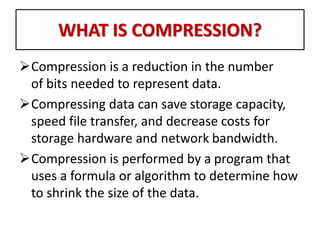
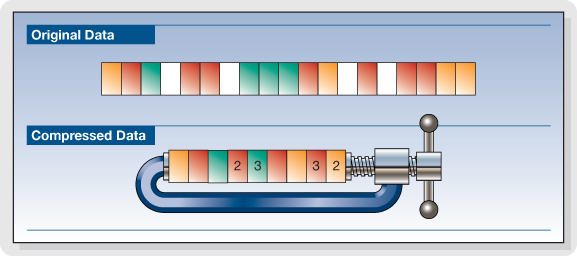
In computer science and information theory, data compression or source coding is the process of representing information with fewer data bits (or other information-related units) than if it were not encoded, according to an encoding mechanism specific . For example, if we encode “compression” as “comp”, the item can be represented with fewer data bits. A common example is the ZIP archive format, which not only provides compression but also acts as an archiver, capable of storing many files in the same archive.

We can use data consistency (represented by information entropy, entropy), regularity, and predictability to achieve data compression. The compression technology first developed by humans is actually natural language. Generally speaking, if a thing can be described in a relatively simplified natural language, then it will be better able to compress such things. The more consistent the data, the more concentrated its statistical features. Take image compression as an example, which centrally accounts for the time domain and frequency domain of the Fourier transform, the histogram, and the eigenvalues.


Data compression is possible because most real-world data has statistical redundancy. For example, the letter “e” is more commonly used in English than the letter “z”, and it is very unlikely that the letter “q” will be followed by a “z”. Non-destructive data compression generally exploits statistical redundancy so that the sender’s data can be represented more succinctly, but fully.

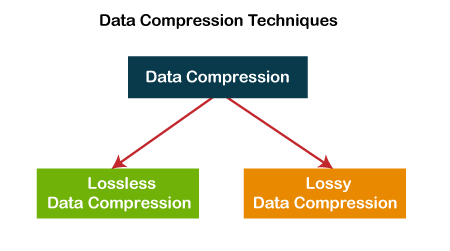
The compression ratio of non-destructive data compression is not sufficient to handle the large volume of audio and video data, but if some loss of fidelity is allowed, higher compression can be achieved. For example, when people look at photographs or television images, they may not realize that some details are not perfect. Similarly, two audio recording sample streams may sound the same, but they are not actually exactly the same. Destructive data compression uses fewer bits to represent images, video, or audio with acceptable or imperceptible numbers.

However, there are often files that cannot be compressed using destructive data compression, and in fact cannot be compressed using any compression algorithm for data that does not contain discernible patterns. Also, trying to compress already compressed data often results in data bloat.

In fact, destructive data compression will eventually get to the point where it won’t work. For example, an extreme example: the compression algorithm deletes the last byte of the file every time, and after this algorithm continues to compress until the file is empty, the compression algorithm will not continue to work.

Compression is important because it helps reduce the consumption of expensive resources such as hard drive space and connection bandwidth, however, compression requires information processing resources, which can also be expensive. Therefore, the design of the data compression mechanism requires a compromise between the compression capacity, the degree of distortion, the computing resources required, and various other factors that must be taken into account.

As with any form of communication, compressed data communication only works if both the sender and receiver of the information understand the encryption mechanism. For example, the article only makes sense if the recipient knows that the article is to be interpreted in Chinese characters. Also, the compressed data can only be understood by the receiver if he knows the encoding method.


Free Download Mp4Gain
picture


Mp4Gain Main Window
picture


Mp4Gain Features
picture


Free Download Mp4Gain
picture

Audio and video data compression

Audio and video data compression

Audio and video data compression

In computer science and information theory, data compression or source coding is the process of representing information with fewer data bits (or other information-related units) than if it were not encoded, according to an encoding mechanism specific .

Audio and video data compression

For example, if we encode “compression” as “comp”, the item can be represented with fewer data bits. A common example is the ZIP archive format, which not only provides compression but also acts as an archiver, capable of storing many files in the same archive.

We can use data consistency (represented by information entropy, entropy), regularity, and predictability to achieve data compression. The compression technology first developed by humans is actually natural language. Generally speaking, if a thing can be described in a relatively simplified natural language, then it will be better able to compress such things.

The more consistent the data, the more concentrated its statistical features. Taking image compression as an example, it centrally represents the time domain and frequency domain of the Fourier transform, the histogram, and the eigenvalues.

Data compression is possible because most real-world data has statistical redundancy. For example, the letter “e” is more commonly used in English than the letter “z”, and it is very unlikely that the letter “q” will be followed by a “z”. Non-destructive data compression generally exploits statistical redundancy so that the sender’s data can be represented more succinctly, but fully.

The compression ratio of non-destructive data compression is not sufficient to handle large volumes of audio and video data, but higher compression can be achieved if some loss of fidelity is tolerated. For example, when people look at photographs or television images, they may not realize that some details are not perfect. Similarly, two audio recording sample streams may sound the same, but they are not actually exactly the same. Destructive data compression uses fewer bits to represent images, video, or audio with acceptable or imperceptible numbers.

However, there are often files that cannot be compressed using destructive data compression, and in fact cannot be compressed using any compression algorithm for data that does not contain discernible patterns. Also, trying to compress already compressed data often results in data bloat.

What is an audio compressor.

In the field of professional sound, a compressor is an electronic sound processor designed to reduce the dynamic range of the signal without noticing its presence too much. This task is done by reducing the system gain, when the signal exceeds a certain threshold.

Traditionally, compressors have been electronic equipment with one or two rack units, but software versions of them have appeared for some years.

A compressor acts in such a way that it attenuates the electrical signal by a certain amount (normally measured in decibels) and from a certain input level. The objective is to ensure that the resulting dynamic excursion is lower than the original, to protect certain equipment against possible signal peaks or, if it is a saturated sound, to try to hide the error.

Reasons to compress a signal

-Control the energy of the signal: The human ear is very sensitive, so the compression must be smooth and subtle so as not to capture it. This type of compression is used when there is a signal in which the intensity varies, so it is compressed to achieve a more constant signal within the values ​​assigned to it.

-Control the peak level of the signal: Often the equipment is limited, so the amplifiers can saturate and therefore be damaged. In this case the compression is used to control the signal and thus protect the equipment.

-Reduce the dynamic range of the signal: By attenuating the peaks of a signal, we reduce its dynamic range. Many devices are limited by the peaks, and this allows the RMS level of the signal to be raised.

Compressor Uses

In the field of music, its use ranges from applications for musical recordings to live sound. For example, it is often used to add more glued to the sound, an effect that is achieved by compressing the signal to subsequently apply a gain to the output of the device, which usually conceals possible interpretation failures by the artist, at least as Dynamic control refers. A compressor is highly recommended (and with certain musical styles, indispensable) for when using an electric bass. The slapping effect (hitting the strings with the finger) produces extremely high output peaks (20 dB or 10 times more than normal), which at low output levels generate distortion, and at high volumes (as in recitals) they can cause serious damage to the amplifier, and even the speaker (an excess of “excursion” can cause the speaker to tear from its suspension). Even in the (theoretical) case of a musical system with an infinite dynamic range, the difference, auditory speaking, using or not the compressor is imperceptible. Its use is also very frequent in voices, since not all singers use the appropriate technique so the signal level varies constantly.

-It is widely used in broadcasting, to improve the speaker’s diction.
-Compress during mastering improves the sound definition of the final mix.
-To protect the equipment (speakers).