adjust audio and video volume


Free Download Mp4Gain
picture

adjust audio and video volume

adjust audio and video volume

Let’s talk about Audio and Video Adjust Volume

Audio and video adjust volume is essential for a good viewing experience. I’ve spent years working in multimedia, and let me tell you, nothing ruins a movie night faster than inconsistent sound. Think of it like a rollercoaster – exciting ups and downs are great, but unpredictable, jarring shifts can be unpleasant. Adjusting audio and video volume lets you fine-tune the experience, creating a balanced and enjoyable soundscape. It’s about control, ensuring that whispers are audible and explosions don’t blow out your speakers.

Why Adjusting Audio and Video Volume is Important

Adjusting audio and video volume is crucial for several reasons. It enhances clarity, improves accessibility, and creates a comfortable listening environment. I’ve used volume adjustments to make quiet dialogue crystal clear and to tame overly loud commercials.

How to Adjust Audio and Video Volume

Volume adjustment methods vary depending on the device and software you use. From simple sliders on your phone to advanced controls in editing software, I’ve used them all. Each method offers a different level of control and precision.

Device Volume Controls

Most devices have physical or on-screen volume controls. These are like the volume knob on a radio – simple and straightforward.

Software Volume Controls

Media players and editing software offer more precise control over volume levels. Think of these as the fine-tuning knobs on a mixing board, allowing for granular adjustments.

System-Wide Volume Control

Operating systems also have volume controls that affect all audio output. This is like the main water valve for your house, controlling the overall flow.

Adjusting Volume on Different Devices

Volume adjustment varies across different devices, from smartphones and computers to TVs and streaming devices. I’ve worked with all these platforms, and understanding the nuances of each is crucial.

Smartphones

Volume adjustments are typically done through hardware buttons or on-screen sliders.

Computers

Computers offer a combination of hardware controls, operating system settings, and software-specific volume adjustments.

TVs

TV volume controls are usually accessed via remote controls or on-screen menus.

Streaming Devices

Streaming devices like Roku or Fire TV often have dedicated volume controls on their remotes.

Advanced Volume Adjustment Techniques

Beyond basic volume control, several advanced techniques offer more granular control over audio levels. I use these frequently in my professional work, achieving polished and balanced sound.

Normalization

Normalization adjusts the overall volume of an audio track without affecting its dynamic range.

Compression

Compression reduces the difference between the loudest and quietest parts of an audio track.

Equalization

Equalization adjusts the balance of different frequencies in an audio track.

Troubleshooting Volume Issues

Sometimes, you may encounter volume problems that require troubleshooting. I’ve seen it all, from faulty cables to software glitches. Identifying the source of the issue is the first step towards a solution.

Checking Cables and Connections

Make sure all cables and connections are secure and functioning correctly. A loose cable can be like a kink in a garden hose, disrupting the flow.

Updating Drivers and Software

Outdated drivers or software can sometimes cause volume problems.

Adjusting System Settings

Incorrect system settings can also affect audio output.

FAQ about Audio and Video Adjust Volume

How do I adjust the volume on my phone?

Most phones have physical volume buttons or on-screen sliders in the control center or media player.

How can I make my computer’s audio louder?

Check your system volume, media player volume, and speaker connections. You can also use volume booster software.

Why is the audio on my videos so quiet?

The recording level might be low, or there could be issues with your playback device or software.

How do I adjust the audio and video volume separately?

Some video editing software allows you to adjust audio and video tracks independently.

What is audio normalization?

Audio normalization adjusts the overall volume of a track to a target level without affecting its dynamic range.

How can I fix audio that’s too loud or too quiet?

Adjusting the volume, normalization, and compression can help balance audio levels.

What are some common causes of volume fluctuations?

Volume fluctuations can be caused by inconsistent audio mastering, automatic gain control, or issues with your playback setup.

How do I adjust the volume on my streaming device?

Use the volume buttons on your streaming device’s remote or the on-screen controls.

How can I adjust the volume of a video I’m editing?

Video editing software typically provides tools to adjust the audio track’s volume.

What’s the difference between adjusting volume and gain?

Volume refers to the output level, while gain refers to the input level. Adjusting gain affects the signal before it reaches the volume control.

Latest words on Audio and Video Adjust Volume

From fine-tuning movie dialogue to balancing music levels, audio and video adjust volume is crucial for an optimal experience. I’ve used these techniques extensively throughout my career, and they are essential for anyone working with multimedia. Remember to explore the different methods available and troubleshoot any issues systematically. Mp4Gain can be a great tool for precise volume adjustments.

Comments:

Great article! I learned a lot about adjusting volume on different devices. Thanks! – TechTim

Super helpful explanation of normalization and compression. I’m going to experiment with those techniques in my video editing. – VideoEditorVicky

I’ve been having trouble with quiet audio on my videos, and this article gave me some great troubleshooting tips. – AudioAceAlex

Thanks for explaining the different ways to adjust volume. I never knew there were so many options! – VolumeVictor

This article is a must-read for anyone who works with audio and video. – MultimediaMasterMia

I’m a podcaster, and this article gave me some great ideas on how to improve my audio quality. – PodcastProPaul

I appreciate the clear explanations and real-life examples. This article made understanding audio and video volume adjustment so much easier. – AVLearnerLisa

This article is a lifesaver! My movie nights were always ruined by inconsistent volume, but now I know how to fix it. Thanks! – MovieNightMegan

I’m new to video editing and I was completely lost when it came to audio. This article explained everything perfectly. – EditingNewbieEmily

This is the most comprehensive guide to audio and video volume adjustment I’ve found. Thanks for sharing your expertise! – AVExpertEric


Free Download Mp4Gain
picture


Mp4Gain Main Window
picture


Mp4Gain Features
picture


Free Download Mp4Gain
picture

Volume Booster

Volume Booster

Volume Booster

Let’s talk about Volume Booster

I’ve spent years working with audio, and let me tell you, the quest for louder sound is a constant. Think of it like trying to get a bigger splash in a pool. You can jump higher (increase the gain), but sometimes you just need more water (a higher volume level). That’s where a volume booster comes in. In my experience, from boosting quiet recordings of birdsong to pumping up the volume on movie dialogue, these tools are invaluable.

A volume booster is like a magnifying glass for sound. It takes existing audio and amplifies it, making it louder. There are different types, from simple sliders in media players to dedicated software and apps. I remember trying to hear a faint recording of a lecture, and a simple volume booster made all the difference. But choosing the right one depends on your needs.

Understanding Volume and Gain

Volume and gain are often confused, but they are distinct. Imagine a faucet. The volume is the total amount of water coming out, while the gain is how much you’ve opened the tap. A volume booster increases the overall “water flow” of your audio.

What is Volume?

Volume is the perceived loudness of a sound. It’s what you adjust with the volume knob on your phone or stereo.

What is Gain?

Gain is the amplification applied to a signal. Think of the amplifier in a guitar rig—it boosts the signal from the guitar, increasing its volume.

Different Types of Volume Boosters

Volume boosters come in various forms, each with its strengths and weaknesses. From software for your computer to apps for your phone, there’s a booster for every situation. I’ve used them all, from simple browser extensions for quick boosts to professional software for detailed audio editing.

Software Boosters

Software boosters are installed on your computer and offer more control over the boosting process.

App Boosters

App boosters are perfect for mobile devices, allowing you to quickly adjust the volume on the go.

Browser Extensions

Browser extensions offer a convenient way to boost the volume of online content.

How Volume Boosters Work

Volume boosters essentially increase the amplitude of the audio signal. Think of a swing. A small push creates a small swing (low volume). A bigger push creates a bigger swing (higher volume). The booster provides that bigger push.

Digital Signal Processing

Volume boosters use digital signal processing (DSP) to manipulate the audio. It’s like adjusting the recipe of a cake – changing the ingredients (audio data) to get a different outcome (louder sound).

Amplification

The core function of a volume booster is amplification – increasing the amplitude of the audio signal. I’ve used this to make quiet dialogues in movies audible without blasting the sound effects.

Safe Volume Limits

While boosting volume can be helpful, it’s crucial to be mindful of safe listening levels. Think of your ears like delicate flowers. Too much sun (loud noise) can damage them.

Protecting Your Hearing

Prolonged exposure to loud sounds can cause permanent hearing damage. Like overwatering a plant, too much volume can be harmful.

Choosing the Right Volume Booster

Selecting the right volume booster depends on your specific needs and devices. From enhancing music to making online videos louder, different tools excel in different areas.

Consider Your Needs

What are you trying to boost? Music, movies, podcasts? Different boosters offer various features and levels of control.

Device Compatibility

Make sure the booster is compatible with your device (computer, phone, etc.).

Benefits of Using a Volume Booster

Volume boosters offer a range of benefits, from improving the audibility of quiet audio to enhancing your overall listening experience. I’ve used them to make soft-spoken narrators in audiobooks clearer and to enjoy podcasts in noisy environments.

Improved Audio Clarity

Boosting the volume can make quiet sounds more audible and improve clarity.

Enhanced Listening Experience

A volume booster can transform a weak audio signal into a richer, more enjoyable experience.

FAQ about Volume Booster

What are the benefits of using a volume amplifier?

A volume amplifier can improve clarity in quiet audio and enhance the overall listening experience, especially for soft sounds or in noisy environments.

How do volume boosters differ from equalizers?

Volume boosters increase overall loudness, while equalizers adjust specific frequency bands to balance sound. It’s like adjusting the overall volume versus fine-tuning individual instruments in a band.

Can volume boosters damage my speakers?

Excessively boosting volume can distort audio and potentially damage speakers if they are pushed beyond their limits. Think of it like overfilling a balloon; too much air and it can burst.

Are volume boosters safe for headphones?

Similar to speakers, boosting volume too much can strain headphone drivers and potentially damage your hearing if listened to at high volumes for extended periods.

What are some common uses for a volume increaser?

Volume increasers can be useful for improving the audibility of quiet dialogues in movies, making online videos easier to hear, or enhancing music playback on devices with low volume output.

How can I boost volume without distortion?

Avoid extreme boosting. Gradual increases are less likely to cause distortion. It’s like adding spices to food; a little at a time is better than a sudden dump.

What’s the difference between a volume booster and a sound amplifier?

The terms are often used interchangeably. Generally, “volume booster” refers to software or apps, while “sound amplifier” can include physical devices as well.

Can I use a volume maximizer on live audio?

Yes, volume maximizers can be used in live settings, often as part of a mixing console or sound system to optimize audio levels. However, careful adjustments are essential to avoid feedback and distortion.

div>

What’s the best volume booster for my phone?

Many volume booster apps are available for smartphones. The best one depends on your device’s operating system and your specific needs. User reviews and ratings can help you choose.

Can a volume booster improve the quality of a low-quality recording?

While a volume booster can make a quiet recording louder, it won’t necessarily improve the underlying audio quality. It’s like zooming in on a blurry picture – it gets bigger, but not clearer.

Latest words on Volume Booster

From boosting quiet podcasts to enhancing music, volume boosters have become an essential tool in my audio toolkit. Just like a good pair of glasses improves your vision, a volume booster clarifies and enhances your audio experience. Remember to use them responsibly to protect your hearing and avoid damaging your equipment. For a reliable and user-friendly solution, Mp4Gain is a great option.

Comments:

Wow, this is a goldmine of info! I always wondered about the difference between volume and gain. Thanks for clearing that up! – AudioNewbie

Great article! I’ve been looking for a way to boost the volume on my laptop without distorting the sound. Any specific software recommendations? – SoundSeeker

Super helpful explanation of how volume boosters work. I used to think they were magic, but now I actually understand the science behind it! – TechieTom

I’ve been having trouble hearing dialogue in movies, and this article gave me some great ideas. Gotta try a volume booster app! – MovieFanatic

This is the best explanation I’ve found on volume boosters. Thanks for sharing your expertise! – AudiophileAnnie

I’m a musician and I’m always looking for ways to improve my audio. This article is bookmarked! – GuitarGuyGreg

This was really insightful. I’m a podcaster, and I’m definitely going to explore some of these volume boosting tools. – PodcastProPatty

Learned a ton from this article! Thanks for the tips on safe listening levels. – EarCareEddie

I have some old recordings that are really quiet. I’m hoping a volume booster can help make them listenable again. – MemoryLaneMike

Mp3 Sound Booster

Boosting MP3 Sound Quality and Loudness

Mp3 Sound Booster
Mp3 Sound Booster
Mp3 Sound Booster
Mp3 Sound Booster

Mp3 Sound Booster

In today’s digital age, where music and audio are an integral part of our lives, it’s crucial to ensure that our MP3 files sound their best. Whether you’re a casual listener or an audiophile seeking perfection, this comprehensive guide is here to help you master the art of enhancing MP3 sound quality. I’m an audio expert, and I’ll take you on a journey through various techniques and strategies to elevate your MP3 listening experience.

The Importance of Quality MP3 Sound

Before we dive into the nitty-gritty details of improving MP3 sound, let’s first understand why it matters. MP3 is one of the most popular audio formats, known for its compatibility and convenience. However, the sound quality of MP3 files can vary widely, depending on factors like compression, source material, and encoding settings.

Factors Affecting MP3 Sound Quality

To achieve the best MP3 sound quality, you need to consider several key factors:

Bitrate

The bitrate determines the amount of data used to represent audio. Higher bitrates generally result in better sound quality but larger file sizes.

Compression

MP3 files are compressed to reduce their size. Understanding the balance between compression and quality is essential.

Source Material

The quality of the original audio source greatly influences the final MP3 sound. Starting with high-quality recordings is crucial.

Encoding Settings

Adjusting parameters during encoding, such as sample rate and stereo mode, can impact sound quality significantly.

Techniques for Enhancing MP3 Sound Quality

Now that we’ve established the importance of quality MP3 sound, let’s explore various techniques and strategies to enhance it. Whether you’re dealing with older low-bitrate MP3s or you want to optimize your new downloads, these methods will help you achieve the best possible sound.

1. Bitrate Selection

The choice of bitrate plays a fundamental role in MP3 sound quality. Higher bitrates, such as 320 kbps, preserve more audio details, resulting in clearer and more immersive sound. However, they also lead to larger file sizes, so you should strike a balance based on your storage capacity and listening preferences.

2. Source Material Enhancement

Improving MP3 sound quality starts with the source material. If you have control over the recording process, use high-quality microphones, eliminate background noise, and ensure proper mixing and mastering techniques are employed. Starting with a pristine source will yield better MP3s.

3. Proper Encoding Settings

When converting audio to MP3 format, it’s crucial to choose the right encoding settings. Opt for a higher sample rate (e.g., 44.1 kHz or 48 kHz) and stereo mode for richer sound. Experiment with different settings to find the sweet spot for your audio.

4. Noise Reduction

If your MP3s suffer from background noise or artifacts, consider using noise reduction software. This can help eliminate unwanted hisses, clicks, and pops, resulting in a cleaner listening experience.

5. Equalization (EQ)

Using an equalizer allows you to adjust the balance of frequencies in your MP3s. You can enhance bass, boost treble, or make other custom adjustments to tailor the sound to your preferences.

6. Volume Normalization

Normalization ensures consistent volume levels across your MP3 library. This prevents sudden volume jumps between tracks, providing a more enjoyable listening experience.

7. High-Quality Playback Devices

Investing in high-quality headphones or speakers can make a significant difference in how you perceive MP3 sound. Look for devices with accurate sound reproduction and comfortable fit for extended listening sessions.

8. Room Acoustics

If you primarily listen to MP3s in a room, consider optimizing the acoustics. Simple changes like adding acoustic panels or rearranging furniture can reduce reflections and enhance sound quality.

9. Lossless Formats

Consider archiving your favorite music in lossless formats like FLAC or WAV for the utmost audio fidelity. While these formats result in larger file sizes, they preserve audio quality without compression.

10. Regular Maintenance

Maintaining your MP3 library is essential. Periodically check for corrupted files, update metadata, and back up your collection to prevent data loss.

Final Words

Enhancing the sound quality of your MP3 files is a rewarding endeavor for any music lover. By understanding the factors influencing sound quality and employing the right techniques, you can elevate your MP3 listening experience to new heights. Whether you’re a casual listener or an audiophile, these strategies will help you make the most of your digital music collection. Remember, the quest for perfect sound is a journey, so enjoy every moment of it. Happy listening!

Boost sound

Boost sound

Boost Sound

Mp4Gain is the perfect app if you are looking for boost sound.

Boost Sound

It is very likely that if you have a large collection of audio and video files, you will find yourself in the situation where one or more of these files play at a lower volume than the rest, forcing you to manually correct those songs or videos that you they have a low, quiet volume.

Most likely, you have been building your collection of audio or video files little by little, taking an audio or video from here and another from there. But I do not take into account that they were encoded with different settings, for example, with a different amount of bit rate, among other things, which caused a different power or loudness.

In the time of vinyl records there were also some differences in volume, perhaps less significant because common people did not touch the settings, but also, as it took time to change each record, your ear forgot the volume reference of the previous one. Today, it happens that we play one video after another or one song after another, with 1 second of difference and our ear still maintains the reference of the volume or loudness level and if it changes, we notice it immediately.

In the radio broadcasting stations F.M. They avoid this phenomenon by using audio compressors, which are expensive pieces of hardware that perform this function.

Mp4Gain provides the same quality as an expensive sound compressor from a TV company or an F.M. radio. but Mp4Gainb is really cheap comparatively.

Definitely download Mp4Gain and you will experience the difference.

Does bitrate influence? A 320 kbps Mp3 sounds better than a 128 kbps one?

Much has been speculated about the bitrate. Most people do not understand clearly what it is. A few understand, but almost nobody knows if a file with 320 kbps really sounds different or better than the same file but with 128 kbps.

The easiest way is to test:

The first is at 128 kbps

Now let’s hear the 320 kbps option

Notice the difference? In case the note is because it was encoded using the Mp4Gain.
Normally it is almost impercentible, but using a good encoder you get to notice some subtle difference.

It should be taken into account that at higher kbps, if there is a higher quality – although it is not always noticeable – and will always use more disk space.

Therefore it is not the best option to say “all my mp3s will be 320 kbps”, unless the space does not mean any problem at all.

What it is and how to perform a volume normalization on your MP3


What it is and how to perform a volume normalization on your MP3

Have you ever heard the term audio normalization, without being sure of what it meant? As a lover of music and technology, I also encountered such a doubt many years ago. Basically, giving a short definition, it is about the standardization of the volume, or rather, of the audio spectrum with respect to other subjects, usually of the same disc.

And that, to put it more simply, is the equalization of the volume of the different tracks on a disc. The reasons are many, and usually if the tracks are extracted from the same job they already have the same volume and gain, but what happens if we want to make a mixtape? For example, we decided to make a compilation called The Best 100 Rock Songs in History. Surely have songs from The Beatles or The Rolling Stones, and therefore from different albums. Depending on the year, type of mastering, etc. etc., we can end up with a CD that contains many different volumes, something that can be annoying when listening. That is just one of the reasons to normalize our MP3 collection.

There are add-ons for players that allow us to normalize on the fly. In fact we can say that programs like Spotify already do this by means of the option to equalize volume of all the songs, however the application that I present below allows us to permanently normalize modifying MP3 files and many other formats, both audio and Of video..

This is Mp4Gain, which stands out for its simplicity of use and is presented under an interface that is ideal to understand exactly what a normalization is and see the before and after. When we open the application we find a window in which we have a grid, which will be populated when we add files or folders, and a keypad with various options.

How do we normalize? Simply change the gain through the specific menu for this.

By pressing OK the application will start working and save our files with the same gain, so it is ideal that before doing the first tests we make a backup. It must also be taken into account that it is an operation that can take time, something that depends on the speed of our processor, the number of issues to normalize and also the size and quality of them.

Audio normalization

Audio normalization

audio normalization

The normalization of the audio level is something that is achieved by applying a constant and maintained amount of gain, in volume, to an audio recording to bring the average peak amplitude to a desired level that has been previously defined. To which the same amount of gain is applied to the entire range, the signal-to-noise ratio generally does not change. Normalization differs from dynamic range compression, which applies different levels of gain to a recording so that the amplitude is within a minimum and maximum range. Standardization is one of the most common functions provided by a digital audio workstation.

Peak normalization

One type of normalization is peak normalization, in which the gain is changed to bring the highest PCM value or the highest peak of an analog signal to a given level.1

Since it only searches for the highest level, it does not take into account the apparent volume of the content. As such, peak normalization is generally used to change the volume in such a way as to ensure optimum use of the distribution medium in the mastering stage of a recording. loudness normalization.

Normalization of loudness

Another type of normalization is based on a loudness measure, in which the gain is changed to bring the average amplitude to an objective level. This average may be a simple measurement of average power, such as the RMS value, or it may be a measure of the loudness perceived by humans, such as that offered by ReplayGain.

Depending on the dynamic range of the content and the target level, the normalization of the loudness can lead to peaks that exceed the limits of the recording medium. Some software has the option of using dynamic range compression to avoid saturation when this happens. In this situation, the signal-to-noise ratio is altered.

volume booster

Modern Audio Normalization

Currently Mp4Gain uses an audio normalizationn that is more similar to that used in modern recording studios or live music group recitals.

It is a normalization of volume focused from a new perspective.

Under this new paradigm, not only does it achieve that all songs have the gain of loudness at the best possible level, but it also achieves that each instrument and / or voice obtains a level of gain that makes it audible. Achieve an optimized level of volume gain normalization.

There is no other normalizer in the market that obtains this level of result. People with training in hearing listening can easily notice the difference., very similar to that obtained with expensive hardware in radio stations or in recording studios or in recital consoles, combining limiters, modern compressors and other processors.
All these results that offer expensive hardware equipment, Mp4Gain does for a few dollars.

In fact, the opposite result is achieved than that achieved with masking, because with masking, which is a method used to compress music, you can no longer perceive some sounds that are behind a more audible sound, that is what is called masking, which leads to the loss of audio quality.

Mp4Gain manages to highlight hidden instruments and sounds, performing an audio normalization by frequency bands to achieve this.

That is why we say that Mp4Gain achieves the same results as those obtained through a series of hardware equipment (limiters, compressors, normalizers, etc.) that are very expensive, while Mp4Gain costs only a few dollars.

Digital Audio – Beginners guide

The Cost of a High Sampling Rate

Although it is true that high sampling rates produce better sound quality … that comes at a price.

That price translates into:

Higher processing load.
Less number of tracks.
Heavier audio files.
So you always give something in return. Professional studies can support higher sampling rates because they use better equipment.

But for most home studios, people often find that the standard 48 kHz configuration is the best.

Following…

4. Bit Depth

In order to understand what bit depth is, we first have to know what bits are.

A bit (or binary digit) is a single unit of binary code, with a value of 1 or 0.

The more bits, the more possible combinations. For example…

As you can see in the diagram below, 4 bits allow a total of 16 combinations.

4 bits

When used to encode information, each of these numbers is assigned a specific value.

As the number of bits increases, the possible values ​​grow exponentially.

4 Bits = 16 possible values
8 Bits = 256 possible values
16 Bits = 16,536 possible values
24 Bits = 16,777,215 possible values
With the bit depth in the digital audio, each value is assigned a specific amplitude of the waveform.

The greater the bit depth, the greater the volume increase between high and low … and a greater dynamic range in the recording.

A good rule of thumb is: for every extra bit, the dynamic range increases by 6dB.

For example:

4 Bits = 24 dB
8 Bits = 48 dB
16 Bits = 96 dB
24 Bits = 144 dB
In the end, what this means is that… the greater the bit depth, the less noise.

Because by adding more processing margin (or headroom), the useful signal (at the high end of the spectrum) can be recorded higher above the background noise (at the low end of the spectrum).

small vs large bit depths

Following…

5. Quantization Noise

Impressive that a 24-bit recording can result in almost 17 million possible values, right?

However, that remains much less than the infinite number of possible values ​​that exist in an analog signal.

Therefore, in almost all samples, the actual value is somewhere between two possible values. The solution of the converter is simply to round it or “quantify” it to the nearest value.

The resulting distortion, known as quantization noise, takes place in 2 phases of the recording process:

at the beginning, during the A / D conversion, and
at the end, during mastering
With mastering, the sampling frequency / bit depth of the final track is usually reduced by converting to the final digital format (CD, mp3, etc.).

When that happens, some of the information is erased and “re-quantized”, generating more distortion in the sound.

The most frequent solution to deal with this problem is …

6. Dither

When reducing a 24-bit file to 16 bits, the screen is used to mask much of the resulting distortion …

Adding a low level of “random noise” to the audio signal.

As it can be difficult to visualize the concept in audio, to explain it, we usually turn to the popular analogy of the screen plot.

Is that how it works:

When a color photo is converted to black and white, a mathematical estimate is made to determine if each color pixel should be “quantized” in a black pixel, or a white one …

As is the case when digital audio samples are quantized.

As you can see in this picture, the “before” photo is pretty bad, right?

dither

But with the plot …

a small number of white pixels are randomly distributed in black parts, and …
a small number of black pixels are randomly distributed in white parts …
By adding that “random noise” to the image, the “after” photo looks much better. Well, the screen in the audio works very similarly.

Following…

7. Latency

The GREAT PROBLEM of current digital studies is the amount of latency that accumulates in the signal chain, especially with DAWs.

With all the calculations that are processed, the audio signal takes time to leave the system between a few milliseconds and a few DOCENAS of milliseconds.

Between 0-11 ms of latency – it is short enough, so a normal person does not notice it.
Between 11-22 ms – an annoying delay is heard which it is difficult to get used to.
More than 22 ms – there is so much delay that it is impossible to play or sing at tempo with the track.
In a normal digital signal chain there are usually 4 phases that contribute to the total latency:

A / D conversion
DAW Buffer
Delay of the Plugins
A / D conversion
The A / D and D / A conversion are the least harmful, contributing to total latency with less than 5 ms.

But nevertheless…

The DAW buffer and certain plugins (including compressors and virtual instruments) can add up to 20, 30 or 40 ms or

Beginner’s Guide to Digital Audio for Recording Music

62c-digital audio When recording at home began to become popular …

It happened for a simple reason:

The analog equipment of the past decades was being slowly but inexorably replaced …

For a new generation of audio interfaces and other digital equipment that was cheaper and easier to use.

And that trend has continued since then.

Today … digital audio is the standard in almost all studios, both professional and amateur.

However, surprisingly, there are few people who really understand what it is about.

So let’s see what it is about:

1. The Rise of the Digital Age

binary code Although digital audio is the standard in today’s music …

It has not always been that way.

Originally, music information only existed as sound waves in the air.

Then, as technology progressed, people discovered new ways to convert that information to other formats, including:

notes on a page
electrical signals inside a cable
radio waves in the atmosphere
relief on vinyl records
But in the end, with the rise of computers, digital audio ended up being the dominant format in the music production industry, since it allowed copying and transporting songs in a simple and free way.

And the device that made all that possible was … the digital converter.

Let’s see how they work …

2. Digital Converters

In recording studios there are 2 types of digital converters:

Those that are an independent device, which are normally seen in more advanced studies, or …
Those that are integrated into the audio interfaces, which are usually seen in home studios.
To convert the audio to binary code, they take tens of thousands of samples (samples) per second to make an “approximate” image of the analog waveform.

The image is not accurate because in the intervals between samples, the converter basically has to guess what is happening.

Digital waveform

As you can see in the diagram, in which:

the red line is the analog signal, and …
the black line is the conversion …
The results are not perfect, but they are good enough to generate excellent sound quality.

How excellent? That depends largely on …

3. Sample Rate

Check out this image:

sample rate diagram

As you can see…

When taking more samples per second, the highest sampling rate:

Collect more real information,
Go less to the estimate, and
It generates a much more accurate image of the analog signal.
Logically, the end result is … better sound quality.

Let’s talk about specific data:

Normal sampling frequencies in professional audio range around:

44.1 kHz (audio CD)
48 kHz
88.2 kHz
96 kHz
192 kHz
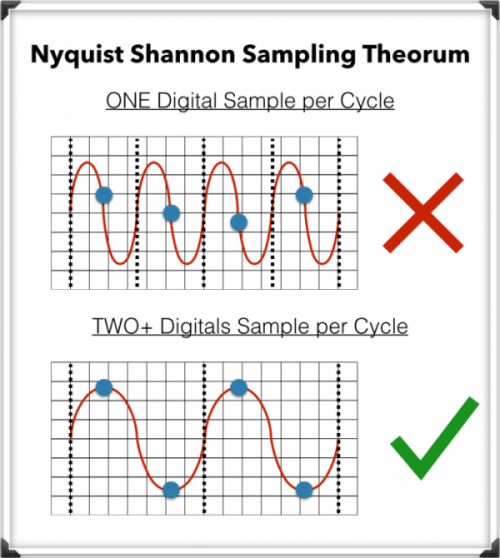
The minimum of 44.1kHz is due to a mathematical principle known as …

The Nyquist-Shannon Sampling Theorem

To record digital audio accurately, converters have to capture the entire human listening spectrum, which is between 20Hz – 20kHz.

According to the Nyquist-Shannon Sampling Theorem …

To capture a specific frequency, at least 2 samples are needed for each cycle … to measure both the upper and lower points of the sound wave.

That means that recording frequencies of up to 20kHz require a sampling rate of 40kHz or more, which explains why the audio CDs are just above that minimum, at 44.1kHz.

What is an audio compressor.

In the field of professional sound, a compressor is an electronic sound processor designed to reduce the dynamic range of the signal without noticing its presence too much. This task is done by reducing the system gain, when the signal exceeds a certain threshold.

Traditionally, compressors have been electronic equipment with one or two rack units, but software versions of them have appeared for some years.

A compressor acts in such a way that it attenuates the electrical signal by a certain amount (normally measured in decibels) and from a certain input level. The objective is to ensure that the resulting dynamic excursion is lower than the original, to protect certain equipment against possible signal peaks or, if it is a saturated sound, to try to hide the error.

Reasons to compress a signal

-Control the energy of the signal: The human ear is very sensitive, so the compression must be smooth and subtle so as not to capture it. This type of compression is used when there is a signal in which the intensity varies, so it is compressed to achieve a more constant signal within the values ​​assigned to it.

-Control the peak level of the signal: Often the equipment is limited, so the amplifiers can saturate and therefore be damaged. In this case the compression is used to control the signal and thus protect the equipment.

-Reduce the dynamic range of the signal: By attenuating the peaks of a signal, we reduce its dynamic range. Many devices are limited by the peaks, and this allows the RMS level of the signal to be raised.

Compressor Uses

In the field of music, its use ranges from applications for musical recordings to live sound. For example, it is often used to add more glued to the sound, an effect that is achieved by compressing the signal to subsequently apply a gain to the output of the device, which usually conceals possible interpretation failures by the artist, at least as Dynamic control refers. A compressor is highly recommended (and with certain musical styles, indispensable) for when using an electric bass. The slapping effect (hitting the strings with the finger) produces extremely high output peaks (20 dB or 10 times more than normal), which at low output levels generate distortion, and at high volumes (as in recitals) they can cause serious damage to the amplifier, and even the speaker (an excess of “excursion” can cause the speaker to tear from its suspension). Even in the (theoretical) case of a musical system with an infinite dynamic range, the difference, auditory speaking, using or not the compressor is imperceptible. Its use is also very frequent in voices, since not all singers use the appropriate technique so the signal level varies constantly.

-It is widely used in broadcasting, to improve the speaker’s diction.
-Compress during mastering improves the sound definition of the final mix.
-To protect the equipment (speakers).