Quantization in MP3: Balancing Compression and Quality
Quantization in MP3Quantization in MP3
Let’s Talk About MP3 Quantization
Quantization in MP3
Having spent years immersed in the realm of audio encoding, I’m here to shed light on the intricate dance between compression and quality in MP3 quantization. Google’s top results merely scratch the surface, so let’s dive deep into the world of digital audio encoding and unravel the nuances of MP3 quantization, blending my expertise with relatable real-life examples.
The Essence of MP3 Quantization
MP3 quantization, a vital aspect of audio compression, resembles a delicate balancing act. Imagine it as a chef crafting a recipe; too much compression, and you lose the flavor (quality), too little, and the dish (file size) becomes overwhelming. In this section, we’ll explore the core principles of MP3 quantization, demystifying the magic behind achieving optimal audio quality while keeping file sizes in check.
Bits and Bytes: Understanding the Basics
Quantization Levels: Fine-Tuning Audio Precision
Trade-offs: Balancing Quality and File Size
Bits and Bytes: Understanding the Basics
At the heart of MP3 quantization lies the concept of bits and bytes. Think of them as the canvas for a painting. The more bits we have, the finer the details and richer the colors. This foundational understanding is crucial as we navigate the landscape of audio compression and strive for a harmonious blend of quality and efficiency.
Quantization Levels: Fine-Tuning Audio Precision
Quantization levels are akin to a painter’s palette, each level representing a shade of sound. As an expert, I’ll guide you through the art of selecting the right quantization levels, ensuring that the nuances of the audio are preserved. This nuanced approach sets the stage for a symphony of digital audio that captivates the listener.
Trade-offs: Balancing Quality and File Size
In the realm of MP3 quantization, there’s a perpetual trade-off between quality and file size. It’s akin to walking a tightrope, finding the sweet spot where audio fidelity remains high, yet the file remains manageable. I’ll share insights into striking this delicate balance, drawing parallels with everyday scenarios to make it relatable and easy to grasp.
Latest Words on MP3 Quantization
As we navigate the complexities of MP3 quantization, I’ll provide fresh perspectives that go beyond the standard discourse. For instance, the impact of psychoacoustics on quantization decisions is often overlooked. Understanding how our brains perceive sound allows us to tailor the quantization process to optimize for perceived quality, offering a unique angle that distinguishes this article.
Going Beyond the Basics
While many articles skim the surface, I’ll take you on a journey into advanced territories. Exploring topics like variable bit rate (VBR) encoding and the role of advanced psychoacoustic models, we’ll unveil the sophisticated mechanisms that contribute to superior audio quality in MP3 files. This knowledge empowers you to make informed decisions in your digital audio endeavors.
Quantization Myths Unveiled
Let’s debunk common misconceptions surrounding MP3 quantization. For example, the notion that higher bit rates always equate to better quality is not absolute. I’ll demystify these myths, providing clarity and guiding you towards a nuanced understanding of the factors influencing audio quality in MP3 encoding.
Optimizing MP3 Files for Different Platforms
Not all platforms are created equal, and neither should your MP3 files be. I’ll share strategies for optimizing MP3s tailored to specific platforms. Whether you’re creating content for streaming services, podcasts, or mobile applications, understanding platform-specific nuances in quantization and compression will set you on the path to audio excellence.
Let’s Talk Real-Life Applications
Bringing it all together, I’ll delve into real-life applications of MP3 quantization. From enhancing your music library to optimizing podcast episodes for diverse audiences, I’ll share personal experiences and practical tips. Imagine fine-tuning your audio files like a skilled craftsman, ensuring they shine across various playback scenarios.
Comments:
This article opened my eyes to the intricacies of MP3 compression. More articles like this, please!
– AudioExplorer
Great breakdown! However, I’d love a deeper dive into VBR encoding techniques.
– TechAudioGeek
Finally, someone addressing the myths! Clear, concise, and enlightening.
– MythBusterListener
Can you share your thoughts on MP3 quantization for podcasters? Looking for practical advice.
– PodcasterPro
As a musician, I appreciate the analogies! Helped me grasp the technicalities effortlessly.
– MusicalSoul
This article left me craving more insights into optimizing MP3s for streaming platforms.
– StreamMaster
Thanks for the myths clarification! I’ve been misguided for so long.
– TruthSeeker
Could you explore the environmental impact of different quantization strategies? Curious to know!
– EcoListener
Kudos for making a complex topic so accessible. Looking forward to more insights!
– ClarityEnthusiast
Great article, but I wish there was more focus on mobile app optimization for music.
– MobileMusicBuff
Personal anecdotes made it so relatable. Excited to apply these principles to my projects!
MP3 Decoding Algorithm: Unlocking the Sonic Tapestry of Digital Audio
MP3 Decoding Algorithm
Let’s Talk about MP3 Decoding Algorithms
As a seasoned specialist in the realm of digital audio, my goal is to navigate the intricate landscape of MP3 decoding algorithms and unveil the hidden complexities that shape our auditory experiences. In this comprehensive exploration, we’ll surpass the conventional understanding and provide you with a deeper insight into the magic that unfolds behind the scenes when you press play on your favorite MP3 track.
MP3 Decoding Algorithm
The Evolution of MP3 Decoding: From Analog Roots to Digital Brilliance
Embarking on a historical journey through the evolution of MP3 decoding, we’ll immerse ourselves in the foundational principles that paved the way for today’s digital audio revolution. Picture the analog roots of sound, akin to the early days of radio waves, and observe how compression algorithms have transformed over time, shaping the way we consume and appreciate music in the digital era.
Deciphering the MP3 File Structure
Header Information: The Architectural Blueprint of MP3 Files
Compression Alchemy: Transforming Sonic Richness into Digital Code
Frequency Domain Analysis: A Symphony of Digital Sound Waves
Imagine an MP3 file as a musical treasure chest, with its header information acting as the architectural blueprint unlocking the secrets within. Dive into the alchemy of compression, where sonic richness is transformed into compact digital code, ensuring efficient storage and transmission. Explore the frequency domain analysis, a symphony of digital sound waves that faithfully reproduces the nuances of the original audio.
The Inner Workings of MP3 Decoding Algorithms
Now, let’s venture deep into the core of MP3 decoding algorithms. Drawing from my extensive experience, I’ll guide you through the intricate processes that orchestrate the symphony of sound when decoding an MP3 file. It’s here that the magic happens, and the digital representation of your favorite music comes to life.
Psychoacoustic Modeling: Sculpting Sound for Human Perception
Bitrate Ballet: Balancing Quality and File Size with Precision
Evolution of Enhancements: Codecs, Filters, and Sonic Fidelity
Visualize psychoacoustic modeling as a sculptor meticulously shaping sound waves to match the intricacies of human hearing. The masking phenomenon ensures that unnecessary frequencies remain silent, contributing to the efficiency of MP3 compression. Bitrate becomes the maestro, performing a delicate ballet to balance audio quality and file size. Journey through the evolution of enhancements, from advanced codecs to sophisticated filters, each contributing to the pursuit of sonic fidelity.
The Future Sounds: Innovations in MP3 Decoding
Peering into the crystal ball of the future, I’ll provide insights into the next frontier of MP3 decoding. Explore emerging technologies, potential breakthroughs, and how the landscape of digital audio is poised to evolve. The future promises even more immersive and high-fidelity audio experiences.
Next-Gen Codecs: Beyond the Horizon
HE-AAC: Pioneering High-Efficiency Advances
Opus Codec: A Glimpse into the Sonic Future
Immersive Audio: 3D Soundscapes and Virtual Realities Unleashed
Step into the realm of next-gen codecs like HE-AAC, experiencing pioneering high-efficiency advances that promise superior audio quality. The Opus codec offers a tantalizing glimpse into the future, pushing the boundaries of what we thought possible. Explore the potential of immersive audio, where 3D soundscapes and virtual realities redefine our auditory experiences.
Latest Words on MP3 Decoding
As we reach the crescendo of this exploration, I want to express the thrill of unraveling the secrets behind MP3 decoding algorithms. My extensive experience in the field has allowed me to share insights that go beyond the surface, providing you with a richer understanding of the technology that brings music to your ears.
Comments:
This article opened my eyes to the world of MP3 decoding. The analogy with a musical recipe was genius! Looking forward to more in-depth articles like this.
– AudioExplorer
Great breakdown of psychoacoustic modeling! It’s like tuning the perfect radio station for my ears. More details on emerging codecs would be awesome!
– SoundSculptor
Really informative! Now I understand why my favorite tracks sound so crisp. Can you explore the impact of MP3 decoding on different genres?
– GenreListener
This article sparked my curiosity about the future of audio. Excited to see where MP3 decoding takes us next!
– SonicVisionary
Fascinating read! Would love a more detailed dive into the technical aspects of emerging codecs. Keep up the great work!
– TechAudioEnthusiast
As someone new to the world of MP3 decoding, this article was a perfect introduction. Looking forward to exploring more of your content!
– SonicNovice
This article was a game-changer for my understanding of MP3 decoding. The evolution section was especially enlightening. Kudos!
– SoundEvolutionist
Impressive breakdown! Could you share your thoughts on how MP3 decoding might adapt to the rise of spatial audio?
– AudioExplorer2
Great job explaining complex concepts in an accessible way. The section on psychoacoustic modeling was particularly insightful!
– SonicInsights
This article is a treasure trove of information! I appreciate the historical context and the peek into the future of audio decoding.
When it comes to digital audio formats, the choice between MP3 and Opus can be as crucial as selecting the right tool for the job. As a specialist with years of experience in the field, I’ll delve into this comparison, helping you understand the nuances and make an informed choice.
MP3 vs Opus Comparison
MP3 (MPEG Audio Layer III): The Audio Legacy
Think of MP3 as the tried-and-true workhorse in the world of digital audio. It’s been around for decades and is known for its widespread use, but it does come with some trade-offs. Let’s explore its strengths and weaknesses.
MP3’s Ubiquity
MP3 is like the classic turntable of digital audio. It’s supported by an extensive range of devices and software, making it a go-to choice for most music lovers. Its ubiquity is its strength, but there’s more to this story.
Compression and File Size
However, MP3’s widespread use comes with a price—the trade-off between compression and file size. Storing a collection of MP3 files can be likened to keeping a drawer full of paperbacks instead of hardcovers. It’s a matter of compromise.
Opus: The Modern Marvel
In contrast, Opus is the sleek and modern sports car of digital audio formats. It’s known for its efficiency in compression and is the preferred choice for online voice communication and streaming. Let’s take a closer look at what makes Opus stand out.
Efficiency in Compression
Picture Opus as the hybrid car—it excels in compression, allowing audio files to be notably smaller without compromising quality. Storing Opus files is like having a fuel-efficient car; you save on space and resources.
Streaming and Online Voice Communication
When it comes to streaming and online voice communication, Opus is the superstar. It’s like the fiber optic internet that ensures smooth, real-time conversations and low-latency gameplay. Its compatibility with various platforms and its role in the crystal-clear voice makes it a go-to choice for online interactions.
Quality and Versatility
Now, let’s delve deeper into the quality and versatility offered by both MP3 and Opus. It’s akin to comparing vinyl records with the latest digital streaming service.
Audio Quality and Compatibility
MP3 is like the vinyl record—it’s got a vintage charm and is widely supported, but it may not deliver the highest audio quality. In contrast, Opus is like your modern streaming service, offering exceptional quality and compatibility across a variety of devices.
Audio Editing and Post-Production
MP3, much like traditional film editing, may retain every detail but is not always suitable for intricate post-production work. Opus, being more modern, is like a cutting-edge digital audio workstation, offering flexibility and efficiency for various editing needs.
Real-Life Example: Music Streaming Services
Think of MP3 as the standard AM/FM radio station, offering familiar music quality. Now imagine Opus as a high-end music streaming service, providing you with exceptional sound quality, lossless audio, and an extensive library of songs.
Device Compatibility and Playback
When it comes to device compatibility and playback, MP3 might be like an old cassette player, causing compatibility issues on modern devices. In contrast, Opus is like a universal remote control, seamlessly working with nearly every device and platform, ensuring a smooth listening experience.
Support for Special Features
Opus, being a modern format, is equipped with features like multi-channel audio, dynamic range control, and bitrate switching, making it ideal for a range of applications, including video conferencing and online gaming. MP3, while capable, may not provide the same level of support for these special features.
Conclusion: Making the Right Choice
In the end, choosing between MP3 and Opus is like selecting the right tool for your audio needs. Your choice should align with your specific requirements, whether you’re an audiophile, a content creator, or an online gamer. Consider your priorities for quality, file size, and compatibility before making your decision.
Comments:
(Username: MusicMaestro) – This article is a great resource for musicians like me. Opus seems promising for streaming high-quality music.
(Username: AudioEnthusiast) – As an audiophile, I’ve always preferred MP3 for its compatibility. But Opus is making me reconsider my choices.
(Username: TechNerd22) – Excellent article, but I wish it delved more into Opus’s role in online gaming and low-latency communication.
(Username: AudiophileAlex) – This article provides a comprehensive comparison. I’m leaning towards Opus for its quality, but MP3’s compatibility is hard to beat.
(Username: StreamingSavvy) – Opus is a game-changer for streaming services. The difference in audio quality is remarkable.
When it comes to digital media, file encoding plays a crucial role in ensuring optimal playback, compatibility, and quality. File encoding refers to the process of converting audio or video data into a specific format using compression algorithms. It involves various technical aspects that directly impact the file size, bitrate, resolution, and overall performance of the media.
One of the primary reasons why file encoding is essential is efficient storage. By utilizing advanced compression techniques, the size of the media file can be significantly reduced without sacrificing quality. This is particularly crucial in scenarios where storage space is limited, such as when transferring files between devices or uploading them to the internet.
Compression algorithms for file encoding
When it comes to file encoding, compression algorithms play a vital role in achieving optimal results. These algorithms, such as MPEG, H.264, or VP9, utilize various techniques to reduce file size while minimizing quality loss. By removing redundant or less important information from the media data, compression algorithms enable efficient storage and transmission.
Each compression algorithm comes with its own set of advantages and trade-offs. For instance, H.264 is widely used for video encoding due to its excellent balance between file size and quality. On the other hand, VP9 offers better compression efficiency but requires more processing power to decode. Understanding the characteristics of different compression algorithms is essential in choosing the most suitable one for specific use cases.
The role of bitrate in file encoding
Bitrate is another crucial aspect of file encoding that affects both file size and quality. It represents the amount of data processed per unit of time and is typically measured in kilobits per second (kbps) or megabits per second (Mbps). The bitrate directly influences the level of detail and smoothness in audio or video playback.
When encoding a file, selecting an appropriate bitrate is essential to strike a balance between quality and file size. Higher bitrates result in better quality but also larger file sizes, which may not be desirable in scenarios where bandwidth or storage space is limited. On the other hand, lower bitrates can lead to compression artifacts or loss of detail.
How does file encoding impact multimedia streaming?
Multimedia streaming has become increasingly popular in recent years, and file encoding plays a critical role in delivering smooth and uninterrupted playback experiences. Streaming platforms rely on efficient file encoding techniques to transmit media content over the internet while minimizing buffering and ensuring optimal quality.
One of the key considerations in multimedia streaming is adaptive streaming. This technique dynamically adjusts the quality and bitrate of the media based on the viewer’s internet connection speed and device capabilities. By using multiple encoded versions of the same media at different quality levels, adaptive streaming ensures smooth playback regardless of the viewer’s network conditions.
Optimizing file encoding for streaming
When encoding files for streaming, several factors need to be considered to optimize the streaming experience. Segmentation is one such factor where the media file is divided into smaller segments for efficient transmission and playback. These segments can be independently requested and buffered, reducing the time it takes to start playback and allowing for seamless switching between quality levels in adaptive streaming scenarios.
Another crucial consideration is the choice of streaming protocol. Protocols such as HTTP Live Streaming (HLS) or Dynamic Adaptive Streaming over HTTP (DASH) have gained popularity for their ability to adapt to changing network conditions and ensure uninterrupted playback. These protocols work in conjunction with efficient file encoding to deliver a seamless streaming experience across various devices and network environments.
Final Words
File encoding is an intricate art that encompasses various technical aspects to optimize digital media for storage, playback, and streaming. The choice of compression algorithms, bitrates, and streaming techniques significantly impacts the quality, file size, and compatibility of the media. By understanding the intricacies of file encoding, you can ensure that your digital media is efficiently encoded for optimal performance and a seamless viewing experience.
The Science of Audio EncodingThe Science of Audio Encoding
Audio encoding is the process of converting analog sound into digital data. This data can then be stored or transmitted in a variety of formats, such as WAV, MP3, or AAC.
There are two main types of audio encoding: lossless and lossy. Lossless encoding preserves all of the original sound data, resulting in high-quality audio but large file sizes. Lossy encoding removes some of the original sound data, resulting in smaller file sizes but lower sound quality.
The process of audio encoding can be divided into three main steps: sampling, quantization, and compression.
Sampling
The first step in audio encoding is sampling. In this step, the analog sound signal is converted into a series of discrete values. The number of times per second that the sound signal is sampled is called the sample rate. Higher sample rates result in more accurate representations of the original sound signal, but they also result in larger file sizes.
Quantization
The second step in audio encoding is quantization. In this step, each sample value is rounded to the nearest integer value. The number of bits used to represent each sample value is called the bit depth. Higher bit depths result in more accurate representations of the original sound signal, but they also result in larger file sizes.
Compression
The third and final step in audio encoding is compression. In this step, the digital audio data is compressed to reduce its file size. There are a number of different compression algorithms that can be used, each with its own advantages and disadvantages.
The most common compression algorithms for audio encoding are:
MP3: MP3 is a lossy compression algorithm that is widely used for storing and transferring audio files. MP3 files are typically much smaller than WAV files, while still providing good sound quality.
AAC: AAC is another lossy compression algorithm that offers better sound quality than MP3. AAC files are typically slightly larger than MP3 files, but they offer a noticeable improvement in sound quality.
FLAC: FLAC is a lossless compression algorithm that offers similar sound quality to WAV, but with much smaller file sizes. FLAC files are a good choice for people who want the best possible sound quality without sacrificing file size.
Final Words
Audio encoding is a complex process that involves converting analog sound into digital data. The quality of the audio that is encoded can be affected by a number of factors, including the sample rate, bit depth, and compression of the audio file.
If you are looking for the best possible sound quality, you should use a lossless audio format such as WAV or FLAC. However, if you need to store or transfer audio files over a network, you should use a lossy audio format such as MP3 or AAC.
Digital Audio Encoding is the process of converting an analog audio signal into a digital format, which can be stored, processed, and transmitted electronically. It involves the use of an Analog-to-Digital Converter (ADC) to sample and quantize the analog audio waveform into a series of binary numbers that can be interpreted by a digital device. The resulting digital audio data can then be compressed, processed, and transmitted over various digital platforms, such as the internet, CDs, DVDs, and other digital storage devices.
The Importance of Digital Audio Encoding
Digital Audio Encoding has revolutionized the way we consume and produce audio content. It has made it possible to store, edit, and transmit high-quality audio content with minimal loss of quality. Some of the benefits of digital audio encoding include:
Improved sound quality: Digital audio encoding allows for high-quality audio content that is free from the distortions and noise associated with analog audio.
Easy storage and transfer: Digital audio files can be easily stored and transferred over various digital platforms with minimal loss of quality.
Efficient compression: Digital audio files can be compressed into smaller file sizes without significant loss of quality, making it easier to store and transfer large audio files.
Greater accessibility: Digital audio content can be easily accessed over various digital platforms, including the internet, mobile devices, and other digital devices.
The Digital Audio Encoding Process
The Digital Audio Encoding process involves several steps, which include:
Sampling: The analog audio waveform is sampled at regular intervals using an Analog-to-Digital Converter (ADC).
Quantization: The sampled waveform is quantized, i.e., each sample is assigned a binary number that represents its amplitude value.
Encoding: The quantized samples are encoded into a digital format, such as WAV, MP3, or AAC.
Compression: The encoded digital audio file can be compressed using lossy or lossless compression algorithms to reduce its file size.
Lossy vs. Lossless Audio Compression
Lossy and lossless audio compression are two types of compression algorithms used in digital audio encoding. Lossy compression algorithms compress audio files by removing data that is deemed unnecessary or redundant. This results in a smaller file size but may result in a loss of audio quality. Lossless compression algorithms, on the other hand, compress audio files without any loss of quality. This results in a larger file size but maintains the original audio quality.
Bitrate and its Importance in Digital Audio Encoding
Bitrate is a measure of the amount of data used to represent each second of digital audio. It is measured in bits per second (bps) or kilobits per second (kbps). The bitrate of a digital audio file has a significant impact on its quality and file size. Higher bitrates result in higher quality audio files but also larger file sizes. Lower bitrates result in smaller file sizes but may result in a loss of audio quality.
Common Digital Audio Formats
There are several digital audio formats used in digital audio encoding, including:
WAV: WAV is a lossless audio format that is commonly used for storing high-quality audio content.
MP3: MP3 is a lossy audio format that is commonly used for compressing and storing digital audio files for playback on various digital devices.
AAC: AAC is a lossy audio format that is commonly used for compressing and streaming digital audio content over the internet.
FLAC: FLAC is a lossless audio format that is commonly used for storing high-quality audio content, similar to WAV.
Challenges in Digital Audio Encoding
Despite the many benefits of digital audio encoding, there are several challenges that must be addressed to ensure optimal audio quality. These challenges include:
Sampling rate limitations: The sampling rate of an ADC can affect the accuracy of the digital audio representation. Higher sampling rates generally result in higher accuracy, but also require larger file sizes.
Bit depth limitations: The bit depth of an ADC can affect the dynamic range and noise floor of the digital audio representation. Higher bit depths generally result in higher accuracy, but also require larger file sizes.
Compression artifacts: Lossy compression algorithms can introduce compression artifacts, such as distortion and noise, which can degrade audio quality.
Future Developments in Digital Audio Encoding
Digital Audio Encoding is an ever-evolving field, with ongoing developments aimed at improving audio quality, reducing file sizes, and enhancing accessibility. Some of the latest developments include:
High-resolution audio: High-resolution audio formats, such as MQA and DSD, offer even higher audio quality than standard digital audio formats.
Immersive audio: Immersive audio formats, such as Dolby Atmos and DTS:X, offer a more immersive listening experience by incorporating height and surround sound elements.
Object-based audio: Object-based audio formats, such as MPEG-H 3D Audio, offer greater flexibility in audio content creation and delivery by enabling individual audio objects to be separately mixed and streamed.
FAQs
1. What is digital audio encoding?
Digital audio encoding is the process of converting an analog audio signal into a digital format, which can be stored, processed, and transmitted electronically.
2. Why is digital audio encoding important?
Digital audio encoding has revolutionized the way we consume and produce audio content by providing improved sound quality, easy storage and transfer, efficient compression, and greater accessibility.
3. What are some common digital audio formats?
Some common digital audio formats include WAV, MP3, AAC, and FLAC.
4. What is the difference between lossy and lossless audio compression?
Lossy compression algorithms compress audio files by removing data that is deemed unnecessary or redundant, resulting in a smaller file size but may result in a loss of audio quality. Lossless compression algorithms compress audio files without any loss of quality, resulting in a larger file size but maintaining the original audio quality.
5. What is bitrate and why is it important in digital audio encoding?
Bitrate is a measure of the amount of data used to represent each second of digital audio. It is important in digital audio encoding because it has a significant impact on audio quality and file size.
6. What are some challenges in digital audio encoding?
Some challenges in digital audio encoding include sampling rate limitations, bit depth limitations, and compression artifacts.
7. What are some future developments in digital audio encoding?
Some future developments in digital audio encoding include high-resolution audio, immersive audio, and object-based audio.
8. What is the difference between a lossy and lossless audio format?
Lossy audio formats use compression algorithms to reduce file size, sacrificing some audio quality in the process. Lossless audio formats, on the other hand, use compression algorithms that do not compromise audio quality, resulting in larger file sizes.
9. What is a sampling rate and how does it affect audio quality?
A sampling rate is the number of times per second that an analog audio signal is measured and converted into a digital signal. The higher the sampling rate, the more accurately the digital signal represents the original analog signal, resulting in higher audio quality. However, higher sampling rates also require larger file sizes and more processing power.
10. What is bit depth and how does it affect audio quality?
Bit depth refers to the number of bits used to represent each audio sample in a digital audio file. A higher bit depth allows for a greater dynamic range and lower noise floor, resulting in higher audio quality. However, higher bit depths also require larger file sizes and more processing power.
11. What is lossless compression?
Lossless compression is a compression algorithm that reduces the size of a digital audio file without sacrificing any audio quality. This is achieved by identifying and removing redundant or unnecessary data in the audio file.
12. What is immersive audio and how does it enhance the listening experience?
Immersive audio is an audio format that uses spatial sound technology to create a more immersive listening experience. This is achieved by incorporating height and surround sound elements, which create a more three-dimensional soundstage. This allows for a more realistic and engaging listening experience, especially when combined with a surround sound system.
Conclusion
Digital audio encoding has revolutionized the way we produce and consume audio content, providing improved sound quality, easy storage and transfer, efficient compression, and greater accessibility. While there are some challenges to overcome, ongoing developments in high-resolution, immersive, and object-based audio formats promise to further enhance the digital audio experience.
References
Bosi, M., & Goldberg, R. (2012). Introduction to digital audio coding and standards. Springer Science & Business Media.
Thompson, J. (2013). Understanding digital audio. Focal Press.
Digital audio compression is a complex topic that is often misunderstood. It is a process that reduces the size of digital audio files without affecting the overall quality of the sound. The goal of this article is to provide a comprehensive overview of the science behind digital audio compression, including its history, the different types of compression, and how it affects the quality of the sound.
Digital Audio Compression
The History of Digital Audio Compression
The history of digital audio compression can be traced back to the early 1990s when the first MP3 encoder was developed. MP3 stands for MPEG-1 Audio Layer 3 and is a method of compressing digital audio files. This compression method quickly gained popularity due to its ability to reduce file size without compromising the quality of the sound.
Since then, many different types of digital audio compression have been developed, each with its own set of advantages and disadvantages. However, they all work on the same principle of reducing the amount of data in the audio file while maintaining the overall quality of the sound.
The Different Types of Digital Audio Compression
There are two main types of digital audio compression: lossy and lossless. Lossy compression is the most common type of compression and is used in formats like MP3, AAC, and WMA. It works by removing parts of the audio file that are deemed less important to the overall quality of the sound.
Lossless compression, on the other hand, is used in formats like FLAC and ALAC. This method of compression works by compressing the file in a way that allows it to be decompressed back to its original form without losing any of the data. This means that the sound quality is preserved, but the file size is still reduced.
The Science Behind Digital Audio Compression
Digital audio compression works by reducing the amount of data in an audio file. The amount of data in an audio file is measured in bits per second (bps) or kilobits per second (kbps). The higher the bitrate, the better the quality of the sound. However, higher bitrates also mean larger file sizes.
Compression algorithms work by analyzing the audio data and removing parts that are not critical to the overall sound quality. These parts can include frequencies that are outside the range of human hearing or parts that are masked by other sounds in the file.
Once the compression algorithm has identified the parts of the file that can be removed, it uses a mathematical formula to compress the remaining data. This formula is designed to reduce the size of the file without affecting the overall quality of the sound.
The Effects of Compression on Sound Quality
The goal of digital audio compression is to reduce the size of the file without affecting the overall quality of the sound. However, compression can have some effects on sound quality, depending on the type of compression used and the bitrate of the original file.
Lossy compression, for example, can result in a loss of high-frequency information and dynamic range. This can lead to a loss of detail in the sound and a less natural-sounding reproduction of the original recording.
Lossless compression, on the other hand, preserves the original sound quality of the recording, but the resulting file sizes can still be quite large. This makes it less practical for use in situations where file size is a concern.
The Future of Digital Audio Compression
The future of digital audio compression is closely tied to the ongoing development of digital audio technology. As technology continues to improve, the potential for more efficient compression algorithms and higher quality sound reproduction is becoming a reality.
One of the most exciting developments in digital audio compression is the emergence of artificial intelligence (AI) and machine learning. These technologies have the potential to create compression
Pulse Code Modulation PCM is short for Pulse Code Modulation.
Pulse code modulation is one of the encoding methods of digital communication. The main process is to sample the voice, image and other analog signals at regular intervals to discretize them, and at the same time, the sampled value is rounded and quantized according to the hierarchical unit, and the sampled value is represented by a set. of binary codes value.
Principles of speech coding
Anyone with any electronic background knows that the audio signal collected by the sensor is an analog quantity, and what we use in the actual transmission process is a digital quantity. And this involves the process of converting from analog to digital. And the digitization of analog signals must go through three processes, namely sampling, quantization and encoding, to realize the pulse code modulation (PCM, pulse code modulation) technology of voice digitization.
Convert analog signal to digital signal
Sampling
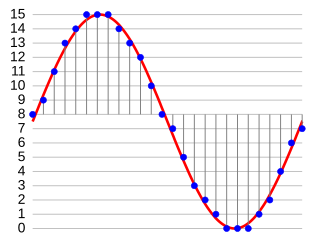
Sampling is the process of extracting sample values from an analog signal at a frequency twice or more of its signal bandwidth and changing it to a discrete sampled signal on the time axis.
Sampling rate (sample): The number of samples per second extracted from a continuous signal to form a discrete signal, expressed in Hertz (Hz).
Example: For example,
the sample rate of the audio signal is 8000 Hz.
It can be understood that the curve of the voltage change with time corresponding to the sampling in the above figure is 1 second, so the following 1 2 3 … 10 must have 1-8000 points, that is, 1 second is divided into 8000 parts, and taken out in turn The voltage value corresponding to the time of 8000 points.
quantizing
Although the sampled signal is a discrete signal on the time axis, it is still an analog signal and its sampled value is within a certain range of values and can have an infinite number of values. Obviously, it is impossible to give a group of digital code to correspond to an infinite number of samples one by one. To express the sample value by a digital code, the “rounding” method must be used to “round up” the sample value by degree, so that the sample value within a certain range of values can be changed from an infinite number of values. to a finite number of values. This process is called quantization.
Compared to the sampled signal before quantization, the quantized sampled signal is, of course, distorted and is no longer an analog signal. This quantization distortion appears as noise when the analog signal is restored at the receiving end and is called quantization noise. The size of the quantization noise depends on how you “round” the sample value.
Sampling bits: refers to the number of bits used to describe the digital signal.
8 bits (8 bits) represent 2 raised to the 8th power = 256, and 16 bits (16 bits) represent 2 raised to the 16th power = 65536; the higher the sampling number, the higher the precision.
The number of samples is indicated here to describe the minimum separation between analog signals.
Assuming our sampling number is 8 and the range of the analog signal is 2, 0, then the minimum interval between digital signals is 2/2^8 = 2/256 = 1/128;
similarly, the sample number is 16, so the minimum interval between digital signals is 2/256/256=1/(128*256)
For example
, the voltage range collected by the audio sensor is 0-3.3V, and the sampling number is 8bit (bit)
, that is, we take 3.3V/ 2^8 = 0.0128 as quantization precision.
We divide 3.3v into 0.0128 as the Y-axis step, as shown in Figure 3, 1 2 … 8 becomes 0 0.0128 0.0256 … 3.3 V. By
For example, the voltage value of a sample point is 1.652V (128 * 0.128 and 129 * 0.128) we round it to 1.65V which corresponds to a quantization level of 128.
In 1950, Bell Labs applied for a patent on Differential Pulse Code Modulation (DPCM). In 1973, P. Cummiskey, Nikil S. Jayant, and James L. Flanagan of Bell Labs introduced Adaptive DPCM (ADPCM).
Perceptual coding was first used for linear predictive coding (LPC) speech coding compression. The original concept of LPC dates back to the work of Fumitada Itakura (Nagoya University) and Saito Saito (Telegraph and Telephone in Japan) in 1966. In the 1970s, Bishnu S. Atal and Manfred R. Schroeder of Bell Labs developed a form of adaptive predictive coding (APC) called LPC, a perceptual coding algorithm that exploited the masking properties of the human ear, and later in 1980 The Code Excited Linear Prediction (CELP) algorithm appeared in the early 1990s , which achieved remarkable compression rates at the time. Perceptual coding is used by modern audio compression formats like MP3 and AAC.
Discrete Cosine Transform (DCT) by Nasir Ahmed, T. Developed by Natarajan and KR Rao in 1974, provides the basis for the Modified Discrete Cosine Transform (MDCT) used by modern audio compression formats such as MP3 and AAC. TCMD by JP Princen, A. W. Johnson, and AB Bradley in 1987, following earlier work by Princen and Bradley in 1986. MDCT is used by modern audio compression formats such as Dolby Digital, MP3, and Advanced Audio Coding (AAC).
list of lossy formats
general
Audio Coding Standard Basic Compression Algorithm abbreviation introduce Market Share (2019) Refer To
Modified Discrete Cosine Transform (MDCT) Dolby Digital (AC-3) AC3 1991 58%
ATRAC 1992 Unknown Adaptive Transformation Vocoding
MPEG layer 3 MP3 1993 49%
Advanced Audio Coding (MPEG-2/MPEG-4) CAA 1997 88%
Windows Media Audio WMA 1999 unknown
Ogg Vorbis Auger 2000 7%
Celtic Restricted Power Overlay Transformation 2011 does not apply
work work 2012 8%
digital to analog converter digital to analog converter 2015 unknown
Adaptive Differential Pulse Code Modulation (ADPCM) aptX / aptX-HD aptX 1989 unknown
DTS digital cinema system 1990 14%
Master of Quality Certification Quality Management Association 2014 unknown
Subband Coding (SBC) Audio Layer MPEG-1 II MP2 1993 unknown
musepack MPC 1997
talks
Further information: Speech coding
Linear Predictive Coding (LPC)
Adaptive Predictive Coding (APC)
Code Excited Linear Prediction (CELP)
Algebraic Code Excited Linear Prediction (ACELP)
Relaxation Code Excited Linear Prediction (RCELP)
Low latency CELP (LD-CELP)
Adaptive Multitariff (for GSM and 3GPP)
Codec2 (famous for lack of patent restrictions)
Speex (famous for lack of patent restrictions)
Modified Discrete Cosine Transform (MDCT)
AAC-LD
Constrained Energy Superposition Transformation (CELT)
Opus (mainly for real-time applications)
Encoding efficiency comparison of popular audio formats.
An audio coding format (or sometimes an audio compression format) is a content representation format used to store or transmit digital audio, such as in digital television, digital radio, and audio and video files. Examples of audio encoding formats include MP3, AAC, Vorbis, FLAC, and Opus. A specific software or hardware implementation capable of compressing and decompressing audio of a specific audio encoding format is called an audio codec; An example of an audio codec is LAME, which is one of several different codecs that implement audio encoding and decoding in MP3 audio encoding software formatting.
Certain audio encoding formats are defined by detailed technical specification documents known as Audio Encoding Specifications. Some of these specifications are written and approved as technical standards by standards bodies and are therefore called Audio Coding Standards. The term “standard” is also sometimes used for the fact that norms and formal standards.
Audio content encoded in a specific audio encoding format is usually encapsulated in a container format. So instead of raw AAC files, users often have .m4a audio files, which are MPEG-4 Part 14 containers that contain AAC-encoded audio. The container also contains metadata such as titles and other tags, and possibly an index for quick searches. One notable exception is MP3 files, which are raw audio encodings and do not have a container format. The de facto standard for adding metadata tags like title and artist to MP3s as ID3s is a hack that works by adding the tag to the MP3 and then relying on the MP3 player to recognize the snippets as malformed audio encoding, so skip the block. In a video with audio file, the encoded audio content is included with the video (in the video encoded format) within the media container format.
An audio encoding format does not specify all of the algorithms used by the codecs that implement the format. According to psychoacoustic models, an important part of how lossy audio compression works is to remove data in a way that humans cannot hear. The encoder implementer is free to choose which data to remove (depending on their psychoacoustic model).
Lossless audio encoding formats reduce the total data needed to represent the sound, but can decode it back to its original uncompressed form. Lossy audio coding formats also reduce the bit resolution of the sound in addition to compression, resulting in much less data, but at the cost of irrecoverable loss of information.
Consumer audio is often compressed using lossy audio codecs because smaller sizes are easier to distribute. The most widely used audio coding formats are MP3 and Advanced Audio Coding (AAC), both of which are lossy formats based on modified discrete cosine transform (MDCT) and perceptual coding algorithms.
Lossless audio encoding formats like FLAC and Apple Lossless are sometimes available, but at the cost of larger files.
Uncompressed audio formats such as pulse code modulation (PCM or .wav) are also sometimes used. PCM is the standard format for Compact Disc Digital Audio (CDDA), and after the introduction of MP3, lossy compression eventually became the standard.








Comments:
This article opened my eyes to the intricacies of MP3 compression. More articles like this, please!
– AudioExplorer
Great breakdown! However, I’d love a deeper dive into VBR encoding techniques.
– TechAudioGeek
Finally, someone addressing the myths! Clear, concise, and enlightening.
– MythBusterListener
Can you share your thoughts on MP3 quantization for podcasters? Looking for practical advice.
– PodcasterPro
As a musician, I appreciate the analogies! Helped me grasp the technicalities effortlessly.
– MusicalSoul
This article left me craving more insights into optimizing MP3s for streaming platforms.
– StreamMaster
Thanks for the myths clarification! I’ve been misguided for so long.
– TruthSeeker
Could you explore the environmental impact of different quantization strategies? Curious to know!
– EcoListener
Kudos for making a complex topic so accessible. Looking forward to more insights!
– ClarityEnthusiast
Great article, but I wish there was more focus on mobile app optimization for music.
– MobileMusicBuff
Personal anecdotes made it so relatable. Excited to apply these principles to my projects!
– ProjectCreator