MP4 Bitrate Control


Free Download Mp4Gain
picture

MP4 Bitrate Control

MP4 Bitrate Control

Let’s talk about MP4 bitrate control

MP4 bitrate control is a critical concept when creating or managing video files. The bitrate directly affects the quality and size of a video file. As an expert in video encoding, I’ve seen how controlling the bitrate can transform a video from grainy and pixelated to smooth and clear. Imagine squeezing toothpaste from a tube—you can control how much comes out, just like controlling bitrate adjusts the video quality and file size.

Bitrate control ensures that your MP4 files are optimized for your needs, whether you’re streaming online, storing files, or distributing videos on a physical medium. With the right bitrate settings, you can maintain excellent video quality while saving on storage and bandwidth. This is a game-changer for businesses, content creators, and casual users alike.

Understanding the basics of bitrate in MP4 videos

Bitrate in MP4 videos determines how much data is used to encode one second of video. Higher bitrates mean better quality but also larger file sizes. For example, if you’ve ever downloaded a video and noticed how some files look sharper while others are smaller, bitrate is the reason.

I like to explain bitrate by comparing it to painting a wall. If you use more paint (higher bitrate), the coverage will be better (better video quality). However, it also uses more resources, such as data or storage space. Striking the right balance is what bitrate control is all about.

Why MP4 bitrate control matters

MP4 bitrate control matters because it determines how a video performs across different platforms and devices. I’ve seen cases where videos with excessive bitrates failed to stream smoothly because of limited bandwidth. Conversely, too low a bitrate resulted in blurry, unwatchable content.

Proper bitrate control ensures:

  • Efficient use of storage space
  • Compatibility with streaming platforms
  • High-quality playback on all devices
  • Optimized upload and download speeds

It’s a delicate balance. For instance, when creating a video for YouTube, I aim for a bitrate that matches the platform’s recommendations, ensuring my content looks professional and streams seamlessly.

Types of bitrate control in MP4 encoding

MP4 encoding offers several methods to control bitrate, each with unique advantages. Choosing the right one depends on your specific goals.

Constant Bitrate (CBR)

CBR maintains a steady bitrate throughout the video. This is ideal for scenarios like live streaming, where consistency is crucial. However, it may waste data during scenes with little movement.

Variable Bitrate (VBR)

VBR adjusts the bitrate based on the video content, providing higher quality during complex scenes and saving data in simpler ones. This approach is perfect for pre-recorded videos where quality is paramount.

Average Bitrate (ABR)

ABR sets a target average bitrate but allows slight variations. It strikes a balance between CBR and VBR, often used for balancing quality and file size.

How to choose the right bitrate for MP4 videos

Choosing the right bitrate requires considering factors like resolution, frame rate, and the intended use of the video. I always recommend starting with the resolution. For example:

  • For 720p videos, a bitrate of 5 Mbps is often sufficient videos usually perform well with a bitrate of 8-10 Mbps.
  • For 4K videos, a bitrate of 25-50 Mbps ensures high-quality playback.

The frame rate also plays a role. Higher frame rates, such as 60fps, typically require a higher bitrate to maintain smooth motion. When I create videos for social media, I lower the bitrate to accommodate platform limitations while still ensuring the content looks sharp.

Real-life applications of MP4 bitrate control

MP4 bitrate control is essential in many everyday scenarios. I remember working on a project for a small business that wanted promotional videos for their website. Their hosting service had strict file size limits, so I used VBR to optimize quality while staying within the restrictions.

Another example is streaming services like Netflix or YouTube. These platforms use adaptive bitrate streaming to adjust the video quality based on your internet speed. This ensures a smooth viewing experience, even if your connection fluctuates.

Advanced tips for optimizing MP4 bitrate

For those who want to delve deeper, here are some advanced tips:

  • Analyze your video’s content. Fast-paced action scenes need higher bitrates than static interviews.
  • Experiment with different encoding settings. Tools like 2-pass encoding can optimize quality without unnecessarily bloating file sizes.
  • Test on multiple devices. What looks great on a high-end monitor might not translate well to smartphones.

When I encode videos for different platforms, I always review their specifications and adjust my settings accordingly. This attention to detail makes a noticeable difference.

Common challenges in MP4 bitrate control

Controlling bitrate can be tricky, especially for beginners. One common issue is overshooting the bitrate, resulting in unnecessarily large files. I’ve also seen users underestimate the required bitrate, leading to poor video quality.

To avoid these pitfalls:

  • Use bitrate calculators to estimate the ideal settings for your video.
  • Test short clips before committing to long encodes.
  • Keep an eye on compression artifacts, such as blockiness or banding, which indicate insufficient bitrate.

Latest words on MP4 bitrate control

MP4 bitrate control is a powerful tool for anyone working with video files. By understanding the principles behind bitrate and using the right techniques, you can create videos that are both high-quality and efficient. Whether you’re a content creator, a business professional, or just someone who loves sharing videos, mastering bitrate control will elevate your work.

For those who want a simple yet effective solution, Mp4Gain offers tools to optimize bitrate and improve your videos. It’s a reliable choice for anyone looking to streamline their video editing workflow.

What is MP4 bitrate control?

MP4 bitrate control is the process of adjusting the data rate used in encoding video files to balance quality and file size. It ensures efficient storage and playback.

Why is bitrate important in MP4 videos?

Bitrate determines the quality and size of an MP4 video. A higher bitrate improves quality but increases file size, while a lower bitrate saves space but may reduce clarity.

What is the best bitrate for 1080p MP4 videos?

The ideal bitrate for 1080p MP4 videos is typically 8-10 Mbps. This ensures a good balance of quality and file size for most applications.

How does variable bitrate (VBR) work?

Variable bitrate (VBR) adjusts the bitrate based on video complexity, using more data for detailed scenes and less for simple ones. This improves quality and efficiency.

What is constant bitrate (CBR) used for?

Constant bitrate (CBR) is ideal for live streaming or scenarios where a steady data rate is crucial. It ensures consistent performance but may not be as efficient as VBR.

Can I change the bitrate of an existing MP4 video?

Yes, you can re-encode an MP4 video to adjust its bitrate. This can help reduce file size or improve quality, depending on your needs.

Does higher bitrate always mean better quality?

Not necessarily. While higher bitrates improve quality, diminishing returns occur beyond a certain point. Proper settings depend on resolution and content.

What bitrate is best for streaming MP4 videos?

For streaming MP4 videos, use a bitrate that matches your resolution and frame rate. For example, 5 Mbps for 720p or 8-10 Mbps for 1080p typically works well.

Comments:

I had no idea bitrate was so important! This article really cleared up a lot of confusion for me. Now I know what to do with my videos.

Thanks for explaining this so clearly. I always struggled with choosing the right bitrate for my YouTube uploads, but this really helped!

This was really helpful, but could you go deeper into how to handle bitrate for 4K videos? I’m working on a project and need more details.

Wow, I didn’t realize bitrate could affect streaming so much. My videos always lag, so I’ll try these tips!

Great article! One thing I’d love to see is a guide for beginners with specific settings for different platforms.

This is such a comprehensive guide! I finally understand why my file sizes were so huge and how to fix it. Thanks a lot!

Honestly, I think this needs even more detail for people working on professional projects. Still a solid read though!


Free Download Mp4Gain
picture


Mp4Gain Main Window
picture


Mp4Gain Features
picture


Free Download Mp4Gain
picture

Bitrate Control Methods in MP4 Encoding

Bitrate Control Methods in MP4 Encoding

Bitrate Control Methods in MP4 Encoding

Let’s talk about bitrate control methods in MP4 encoding

When we talk about bitrate control methods in MP4 encoding, it’s crucial to understand that getting the right balance between quality and file size is key. You’ve probably noticed that when watching videos online or transferring files, you need good quality without large file sizes. Well, I’ve worked in this area for years, and I can tell you firsthand that bitrate control is the secret sauce to achieving this balance. Whether you’re encoding for streaming, playback, or storage, controlling the bitrate properly ensures that your video quality is high, while your file size remains manageable. And let me tell you, the wrong bitrate settings can ruin everything, like trying to fill a gallon jug with a firehose—chaos ensues. So, let’s dive into how bitrate control works, and how you can master it.

Understanding the role of bitrate in video quality

Bitrate essentially determines the quality of your video. It’s like comparing the resolution of an old TV to a modern 4K screen. The more data you allow (higher bitrate), the clearer and sharper your video will look. But with more data comes bigger file sizes. That’s why finding the right bitrate is so important. With too low a bitrate, the video will become pixelated, much like when you try to zoom in too far on a low-resolution image. On the other hand, too high a bitrate creates unnecessarily large files that don’t offer a proportional increase in quality. It’s a fine balance.

Constant Bitrate (CBR) vs. Variable Bitrate (VBR)

When deciding how to control bitrate, you’re typically faced with two options: Constant Bitrate (CBR) or Variable Bitrate (VBR). Both have their pros and cons.

Constant Bitrate (CBR)

With CBR, you’re essentially setting a fixed bitrate for the entire video. This is like setting the speed of a car and sticking with it, no matter whether you’re driving on a straight highway or navigating a twisty mountain road. It’s predictable and ensures compatibility, especially for streaming or broadcasting. However, the downside is that CBR doesn’t account for video complexity. A simple scene with little movement uses the same amount of data as a fast-paced action scene, which can lead to inefficiencies.

Variable Bitrate (VBR)

VBR is more like driving a car with adaptive cruise control. It changes depending on the complexity of the scene. If there’s a lot of action, it increases the bitrate to preserve quality. When the scene is simple, it decreases the bitrate to save space. VBR is generally more efficient than CBR because it adjusts to the content of the video. But it also requires more processing power and can sometimes cause playback issues on devices that expect a constant rate.

Two-pass encoding: The gold standard in VBR

If you really want to optimize your bitrate control, you’ll want to consider two-pass encoding. This method involves scanning the video once to analyze its complexity, then encoding it in the second pass to allocate the appropriate bitrate. Imagine you’re packing a suitcase—you take a look at everything you need to fit inside, then adjust the way you pack to make the most efficient use of space. The result is better quality with a smaller file size. From my experience, two-pass encoding is especially useful for longer videos, where the difference in file size really adds up.

Bitrate control in MP4 encoding: Real-life examples

In real-life applications, bitrate control is everywhere, from YouTube videos to Blu-ray discs. Take streaming services, for example. Ever notice how your video adjusts when your internet slows down? That’s bitrate control at work, using VBR to change the quality dynamically. I’ve had clients frustrated because their videos were buffering, and we had to tweak the bitrate to optimize for streaming. On the other hand, in cases like creating a video for a corporate event, where quality must be consistent, CBR might be your best option to ensure a smooth playback experience on all devices.

How to choose the best bitrate for MP4 encoding

So how do you choose the best bitrate? The answer depends on what you’re trying to achieve. When I work on projects for clients, I start by asking about their priorities. Are they looking for the best possible quality, or do they need to keep file sizes small for easy sharing? If it’s the former, I’ll push the bitrate as high as the medium allows. If it’s the latter, I find that VBR with two-pass encoding offers the best balance. However, if speed and compatibility are more important than anything else, I’ll recommend CBR.

Factors to consider when choosing a bitrate

  • Resolution: Higher resolution requires higher bitrate.
  • Frame rate: More frames per second (FPS) mean more data per second.
  • Device compatibility: Some devices handle high bitrates better than others.
  • Streaming or download: Streaming requires a lower, more consistent bitrate.
  • Storage capacity: Larger bitrates take up more space.

Advanced techniques in bitrate control

If you want to take things a step further, there are advanced techniques to fine-tune your bitrate control. One method I’ve seen growing in popularity is adaptive bitrate streaming (ABR). ABR is the technology behind services like Netflix and YouTube that automatically adjust the quality of your stream based on your internet speed. I remember working with a client who was launching a video platform, and ABR was a game-changer for them. It allowed users with slower internet connections to still enjoy smooth playback, while those with high-speed connections could experience full HD or even 4K quality.

Latest words on bitrate control methods in MP4 encoding

Bitrate control is a vital part of MP4 encoding, and understanding the different methods allows you to optimize both quality and file size. Whether you go for CBR, VBR, or advanced techniques like ABR, choosing the right method depends on your specific needs and the devices your audience will use. As someone who has worked on countless video projects, I’ve found that VBR with two-pass encoding offers the best balance between quality and file size for most cases. But remember, there’s no one-size-fits-all solution. Test different settings to find the right balance for your project. And when it comes to encoding your videos, Mp4Gain offers an excellent solution to help you control the bitrate with ease and efficiency.

Comments:

Man, this article was exactly what I needed. I’ve been having trouble with my videos coming out too big even though the quality isn’t that good. I’m definitely going to try VBR with two-pass encoding now!

– VideoDude101

Great stuff! I do a lot of streaming and was wondering why my videos always end up buffering on slower connections. This article explained everything. Would love to see more about ABR though!

– StreamMaster69

This was really helpful, thanks! I’m still a little confused about choosing the right bitrate for 4K, though. Any advice?

– TechGeek42

I’ve been using CBR for everything and didn’t even know about VBR. I can’t wait to try it on my next project!

– FilmFanatic

This is the first time I’ve read about two-pass encoding explained so clearly. Really helped me understand why my files were so big for no reason.

– SarahTheEditor

Thanks for the article! I was looking for a more detailed explanation of bitrate control and this hit the spot. I’m doing some video work for a local business and file size has been a big issue for us.

– LocalMediaPro

Nice breakdown, but I think you could’ve gone a bit deeper into device compatibility. My videos play fine on my computer, but look terrible on my phone. Any tips?

– JohnVideoMan

I’ve been using Mp4Gain for my personal projects and I gotta say it really simplifies bitrate control. This article just reinforced why I use it!

– CodecKing

I didn’t even know bitrate control was this important. No wonder my last video looked so bad. I’m going to try out your suggestions for my next upload.

– FirstTimeEditor

Good article, but what about HDR videos? Do the same bitrate rules apply there?

– HDRNerd

Related keywords: mp4 encoding, bitrate control methods, CBR vs VBR, video quality, video file size, two

Bit rate

Bit rate

Bitrate

Bit rate refers to the number of bits (bit) transmitted per unit of time, in bps (bit per second).

bit rate

Bit rate is also known as “binary bit rate”, commonly known as “code rate”. Indicates the number of bits transmitted per unit of time. It is used to measure the transmission speed of digital information, often written as bit/sec. According to the number of bits occupied by each image storage frame and the transmission bit rate, the digital image information transmission speed can be calculated [1].
In modern digital communication, the transmission volume of digitized video and other information is large, so it is often measured in kilobits per second or megabits per second, which are written as kbit/sec (or kbps) and Mbit/sec. (or Mbps respectively). ). For example, the amount of information digitized from an ordinary color TV signal can reach 216 Mbit/sec. A good digital broadcast channel can transmit dozens of color TV programs, and its capacity can reach several gigabits or gigabits per second (written as Gbit/sec or Gbps) [1] .
Bitrate is often used to measure the quality of video files.
flexibility edit stream
Because each network is unique and each access line has different conditions (such as length, attenuation, crosstalk environment, etc.), access lines from different telephone companies must support different data rates. For ADSL and VDSL modems, it is best to set the data rate to one of many possible data rates. For example, DMT-based ADSL and VDSL can theoretically change the tariff at fine intervals, and CAP-based RADSL (Rate Adaptive ADSL) also provides some flexibility in tariff configuration [2].
However, telephone companies may want to limit xDSL service to a small set of rates sufficient to provide a variety of services. If a limited set of tariffs can be adapted to a wide range of services, then the management of the services in this case is simpler than in the case of variable tariffs. Telephone companies want the choice of modem speed to be under the control of the network, not the user [2] .
In this mode, the selection of the transmission rate set of the xDSL network must be prudent. In this case, there is a possibility that two adjacent systems receive traffic at very different rates and the system must be able to handle such a situation. The other model, the “best match” approach using adaptive rate ADSL (similar to a voiceband modem), is more beneficial to new network operators and Internet Service Providers (ISPs) [2] .
Transmission control method
Most bit rate control schemes consist of two parts. Part of the encoded bit stream output by the encoder is fed into a buffer. For a constant bitrate channel, the data in the buffer is fetched at a constant rate, and if the buffer is large enough, the bitrate variation caused by the MPEG picture type, etc. can be smoothed out. This is necessary for both constant bit rate transmission and variable bit rate transmission in general. However, in practice, the buffer size is always limited. The buffering process will bring a delay to the system, and this delay is proportional to the size of the buffer. Latency is often a serious issue for real-time image communication, so buffers should be kept as small as possible. That is, long-term fluctuations in bitrate due to changes in scene content or changes, etc. they cannot be softened in this way, so another part is needed. This is to send some measure of the output bitrate to the encoder to control the encoding process, thus changing the output bitrate [3] .

What does MP3 bitrate mean?

What does MP3 bitrate mean?

MP3 bitrate

Bit rate

mp3 bit rate

The rate at which a digital channel transmits digital signals is called the data transfer rate or bit rate.
The word bitrate has many translations, such as bitrate, etc., which indicates how many bits per second the encoded (compressed) audio data should be represented, and a bit is the smallest binary unit, either 0 or 0. 1. The relationship between bitrate and audio and video compression is simply that the higher the bitrate, the better the quality of the audio and video, but the larger the encoded file; if the bitrate is lower, the situation is reversed.

For example: encode audio and video at 500 Kbps.
where bps are bits 1K = 1010 = 1024
b is little
s is the second
p is for (for)
Therefore, encoding at 500 kbps means that the encoded audio and video data must be represented at 500 K bits per second.
In the baseband transmission system, the bit rate is used to represent the code rate of transmitted information.
The bit rate Rb refers to the unit of time
The number of binary bits transmitted within the unit, the unit is b/s. For example, the transmission speed of a computer serial port is up to 115200b/s.
The symbol rate or baud rate Rs refers to the number of modulation symbols transmitted per unit of time, that is, ternary and ternary
The information transmission rate of the multivariate digital code stream in the

In M-ary modulation, the relationship between the bit rate Rb and the baud rate Rs is:
Rb=Rslog2M
The sampling rate refers to the ratio of the sampling samples to the total number of samples, and the sampling rate refers to the number of samples per unit of time. If it is an instrument, the sampling rate is 40MSa/s, which indicates that the number of samples per second is 40M, but it cannot be represented by 40MHz.

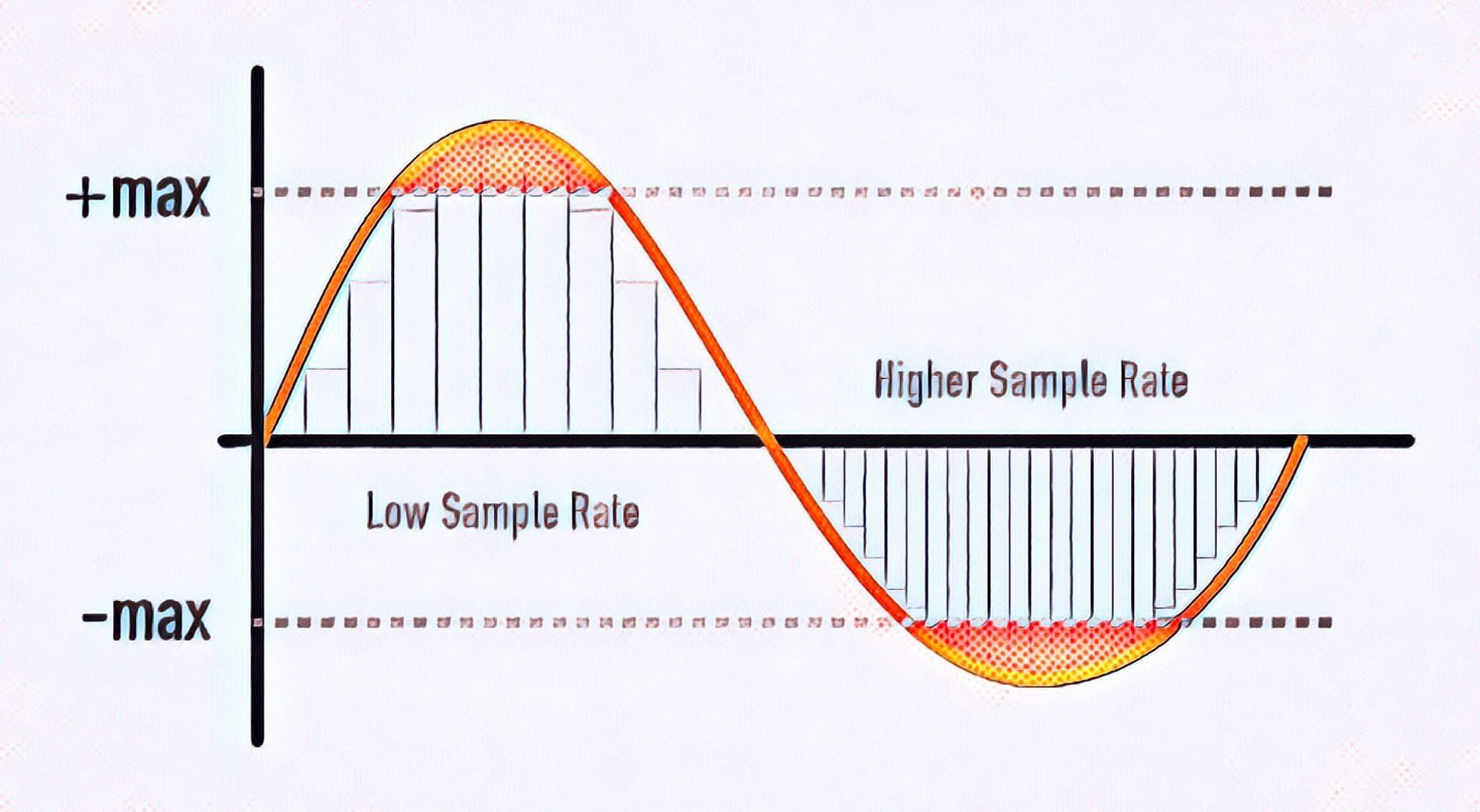
The process of converting analog audio to digital audio is called sampling. In a nutshell, how much data is needed to record a 1 second duration of sound via waveform sampling. A sound with a sample rate of 44 KHz requires 44,000 data points to describe a 1-second sound waveform. In principle, the higher the sample rate, the better the sound quality.

Quality (bit rate)

Quality (bit rate)

Bit Rate

In multimedia technology, quality is often used to judge the effect of audio, and quality here is actually bitrate.

Bit Rate

1. Introduction
2 sound control
3 encoding mode
Introductionedit transmission
The term quality is widely used.
In multimedia technology, quality is often used to judge the effect of audio, and quality here is actually bitrate.
On WINDOWS it is called “bit rate” and on some players it is described as ” bit rate “.
Quality refers to the bit rate at which digital sound is converted from analog to digital format. The higher the bitrate, the better the quality of the restored sound.
sound control edit stream
16 Kbps = phone quality
24 Kbps = increase phone quality, shortwave transmission, longwave transmission, European standard medium wave transmission
40 Kbps = American standard medium wave transmission
56Kbps=Voice
64 Kbps = boost voice (best bitrate setting for cell phone ringtones, best setting for cell phone mono MP3 players)
112 Kbps = FM stereo broadcast FM 128 Kbps = tape (best setting for mobile phone stereo MP3 player, best setting for low-end MP3 player)
160 Kbps = HIFI high fidelity (best setting for mid to high end MP3 players)
192Kbps=CD (best setting for high-end MP3 players)
256Kbps=Studio Music Studio (for music enthusiasts)
In fact, with the advancement of technology, the quality of music is also getting higher and higher, the highest quality of MP3 is 320Kbps, but some formats can achieve higher sound quality.
For example, the emerging APE audio format can provide real audiophile level lossless sound quality and smaller volume than WAV format, and its quality is usually 550kbps-950kbps.
encoding modeedit stream
VBR (Variable Bitrate) Dynamic Bitrate means there is no fixed bitrate. The compression software immediately determines which bitrate to use based on the audio data being compressed. This is a method that takes quality as a premise and takes file size into account The recommended encoding mode;
ABR Average Bit Rate (Average Bit Rate) is an interpolation parameter of VBR. LAME created this encoding mode in response to the low file volume ratio of CBR and the variable size of files generated by VBR. Within the specified file size, ABR takes every 50 frames (about 1 second for 30 frames) as a segment. High-frequency and insensitive frequencies use relatively low traffic, and low-frequency and large dynamic performance use high traffic, which can be used as VBR and CBR, a compromise option.
CBR (constant bitrate), constant bitrate means the file has one bitrate from start to finish. Compared to VBR and ABR, the compressed file size is very large and the sound quality will not improve significantly compared to VBR and ABR.

What is bit rate? Knowledge of the MP3 audio format. Part 2

What is bit rate? Knowledge of the MP3 audio format. Part 2

mp3 bit rate

Bitrate is a benchmark indicator of the efficiency of digital music compression.

mp3 bitrate

The bit rate represents the number of bits bps (bit per second, bits per second) transmitted per unit of time (1 second). We usually use kbps (in simple terms, it is per second) clock 1000 bits) as the unit. The bit rate of digital music on CD is 1411.2 kbps (ie recording 1 second of CD music requires 1411.2 × 1024 bits of data). The higher the bit rate of the music file, the more data (Bit) must be processed in a unit of time (1 second), and the better the sound quality of the music file. However, when the bit rate is high, the file size increases, which will occupy a large amount of storage capacity. 8 to 320 kbps.

1. WMA (Windows Media Audio, Windows Media Audio)

As a Microsoft media compression method, it is a part of the technology that compresses only audio data in Windows Media Technologies. The sound quality is similar to MP3 and can be compressed with half the technology of MP3. It has the copyrighted Windows Media Rights Manager, which can be played by installing in WMP (Windows Media Player, Windows Media Player). Due to the strong influence of Microsoft and Windows, as well as major copyright reasons, the major American record companies EMI and BMG have officially confirmed that they use the WMA method developed and produced by Microsoft. It is believed that this advanced method will become even more popular in the future.

2. MP3 (CBR, VBR, ABR)

MP3 is currently the most widely used and widely used lossy compressed digital audio format, which has been explained above and will not be repeated here.

CBR (constant bit rate)

CBR is the oldest and simplest MP3 encoding (compression) method. When this method is used for encoding, the bit rate of the entire file is the same, in other words, the bit rate used by the MP3 file per second is the same. Although the music file has sections of varying complexity, the encoder always keeps the bit rate constant, unless you use the highest sound quality, otherwise the sound quality of the different sections of the MP3 file will vary. The more complex the passage, the worse the sound quality. Its biggest advantage is that the file size is fixed, which is convenient for calculating storage space.

What is bit rate? Knowledge of the MP3 audio format.

What is bit rate? Knowledge of the MP3 audio format.

mp3 bit rate

Digital audio formats are audio signals that are recorded, processed, and reproduced in digital form.

Mp3 bit rate

The emergence of digital audio formats is to meet the needs of high-fidelity playback, storage and transmission. Simply put, early analog audio formats had issues with playback distortion and glitches due to media wear. Since the advent of CD discs, audio files in digital format have become popular, but another problem has arisen: the limitation of storage volume and the phenomenon of CD disc wear is still present. Saving to a hard drive (in connection with longer storage time) is also not a good solution when storage media (mainly hard drives) are still expensive at the time. The rise of the Internet has created a requirement for long-distance file transmission. Under the restriction of bandwidth, the demand to reduce file size has become more intense. All this has led to the generation of lossy compressed digital audio formats from external factors!

In terms of internal factors, with the improvement of computing and coding capabilities, the progress of various acoustic psychological models has promoted the emergence of various lossy compressed digital audio formats. Some of the most commonly used audio formats in MP3 players are briefly introduced below: MP3 (CBR, VBR, ABR), WMA, WAV, ADPCM, and the emerging audio formats AAC, ASF, and OGG.

Before introducing various digital audio formats, let’s clarify one concept: bitrate.

In the field of computing, all information is digitized. Bit is the smallest unit of data in a computer, it refers to a number of 0 or 1, which is a mathematical binary number, a “0” or “1” , is a bit. For example, when we say a 2-digit number, it means that it is a two-digit binary number, and there are 4 combinations of “00”, “01”, “10” and “11”, which represent 0, “11” in decimal respectively. 1, 2 and 3 are four numbers.

Bit rate, what is it?

Bit rate, what is it?

Bit Rate

as a feature of digital audio and video

Bit rate

Bitrate: literally, the information bit rate. It is common to use the bit rate when measuring the effective information transmission rate through the channel, that is, the “payload” transmission rate (in addition to that, the channel can transmit service information, for example, start and stop symbols for asynchronous transmission or control symbols for redundant coding). The baud rate, which takes into account the total bandwidth of the channel, is measured in baud.

Bit rate is the number of units of information required to store (transmit) one second of a stream of data (generally audio and video files). It is generally measured in ‘kbps’, kilobits per second.

The term bit rate is used in two basic meanings
: channel or device characteristic: the maximum number of bits that can be transmitted per unit of time.
– The size of the data stream transmitted in real time (the minimum size of the channel that can pass this stream without delay).
– A special case is the compressed video or audio bit rate.
Bitrate is expressed in bits per second (bit / s, bps), as well as values ​​derived with the prefixes kilo, mega, etc.

The term bit rate (in conjunction with subjective quality criteria) is often used as a characteristic to evaluate the performance of lossy compression algorithms.

Bitrate characterizes both the density of the information package and its quality. For example, out of two MP3 files compressed with different bit rates, a file with a higher bit rate will have higher sound quality (close to the original). At the same time, a file of a different format, with the same bit rate, can offer both better and worse sound quality.

On an audio CD, information is losslessly encoded at a constant 1407 kbps bit rate.

The MP3 format allows you to encode audio information with constant or variable bit rates from 32 to 320 kbps, that is, they provide five times the compression compared to CD.

Bit rate as a characteristic of digital video and audio

In streaming video and audio formats (such as MPEG and MP3) that use lossy compression, the bit rate parameter expresses the degree of compression of the stream and therefore determines the size of the channel for which it is compressed data transmission. Most of the time, the audio and video bit rate is measured in kilobits per second (kilobits per second in English – kbps), less often – in megabits per second (for video only).

There are three compression modes for data transmission:

– with a constant bit rate (constant bit rate in English – CBR)
– with a variable bit rate (variable bit rate in English – VBR)
– with an average bitrate (English Average Bitrate – ABR)

Variable and average bit rate

The codec chooses the required bit rate based on the parameters (the level of the desired quality) and, during the encoded chunk, the bit rate may change. When compressing audio, the desired bit rate is determined based on the psychoacoustic model. ABR is a variation of VBR in which the codec is compressed to a specified average value.

What is bitrate: a clear explanation for beginners

Bit Rate

Once a student was teaching a class and asked me to give him the clearest possible explanation of what bitrate meant.

Today I am going to share with you that explanation that although it does not refer to sound but an image in the background, it is the same and is very easy to understand.

bit rate

Imagine that you put me in front of a beautiful landscape full of rivers and trees, mountains and Valleys with some Villas with Fields full of flowers and animals.

There is a lot of information there if I had to make a detailed description.

Imagine that you ask me to give you a description in 4 words.

It would have to make a very general description that, being very brief, Nova contains details. Maybe I’ll say something like “a beautiful autumn landscape.”

if after that you tell me that now I will have 14 words to describe what I am seeing.
I’ll be able to give more information Although it will really continue to be very summary, but you could already give some details.
“a beautiful autumn landscape with fields and mountains that have houses, flowers and animals”

If they ask me for the following explanation and they already allow me to use 50 words, I will be able to give many more details.
Although of course I will still have to omit a lot of details.

How many words might I need to give a detailed, spoken portrait of what I am looking at?

Well, this example that I just gave of the four words at the beginning then 15 words later have maybe 500 words later is exactly what the bit rate is.

We are talking about what is the amount of information that our audio or video file can transmit per second and obviously The higher the information There will be more details and therefore a higher quality and on the contrary the lower the information the lower the details and therefore lower quality.

That’s why a bit rate of 320 thousand bits per second will have a much higher audio quality than one of 90,000 bits per second.

Because in music, images and video, the quality always depends on the amount of information.

And in the specific case of audio and video, the amount of information is measured by seconds.

This means how much information it can transmit per second, that is, how many bits it can transmit per second, which means How much information and therefore How much detail, which is synonymous with quality.

With this we will understand very easily that as well as the sampling frequency is also very important and we will explain it in another article.
The rate of bits that are transmitted per second is crucial in determining the quality that an audio or video will have.

Of course, it must be understood that the higher the bit rate per second, the larger the size of the audio file will be because the greater the amount of information stored will be, but this will result in higher quality and greater definition.

Because here the definition concept is crucial.
The higher the bit rate the higher the definition and therefore the higher the quality.

The definition would be the detail of our initial explanation, if they let me use 2000 words to describe a landscape, I will be able to give many details and define them with great clarity. And that will mention a lot of quality.

This As-is applies to audio or video files.

Surely with this explanation it has been much clearer what is the rate of bits per second and why it is important.

What is bitrate, a thorough explanation

Normally when people read or listen to some of the terms they use frequently referred to music or video when playing on a digital device, it is possible that some terms are very confusing for the common user.

Sometimes people do not understand at all what these terms refer to and therefore make bad decisions in this regard, it may also happen that they completely ignore this information which generates an unsatisfactory result.

That is bitrate, a complete explanation.

When we play music or video, we are transmitting information from a file to the medium that reproduces that information. Bitrate measures the amount of information What is transmitted every second.

let’s look at an example that will allow us to understand very clearly what exactly bitrate is.
Imagine that I must tell you what happened at a dinner, but I can only use three words to tell you what dinner was like.

I could say For example “it was very tasty” and already there use the three words you could use. Of course the description and information is too short.
and instead, I can use 10 words, my description will have information and therefore it will be a higher quality description.
“It was a tasty dinner, with a very familiar and warm atmosphere” if you look closely at crypto contains more information so much makes a better portrait of what happened that night.

And if instead of using 10 words I can use 300 words it could be a much clearer story, with better quality.

Well that’s exactly what happens with bitrate. when a song or video is played if only a small amount of bits can be transmitted every second, detail that can be displayed will be poor because many details will have to be omitted. on the other hand, as the amount of bits increases every second, the audio will continue to be enriched so much will be of higher quality.

So now we are clear. Because it is important the amount of information transmitted every second, going to have greater wealth is to say higher quality. then act to what the term bitrate refers and now we understand exactly what it means. It is obvious that more bits per second will take up more space on the hard disk. Why the file will contain much more information And in return we will get more details and more richness in reproduction.
We will have to decide if what we want is to save disk space and therefore we will choose a low bit rate or on the contrary our priority will be quality and in that case we will choose a higher bit rate, with much more information per second. but that will take up much more space on the hard drive.
in the same way that a description of three words occupied much less space but transmitted a much poorer description, on the other hand a description of 400 words will occupy much more space But it will offer description in much more detail and therefore with greater quality.
Did you see that it was very easy to understand what bitrate means?