Why FLAC bit rate is typically around 1000 kbps?


Free Download Mp4Gain
picture

Why FLAC bit rate is typically around 1000 kbps?

FLAC bit rate
FLAC bit rate
FLAC bit rate
FLAC bit rate

The Basics of FLAC

FLAC, or Free Lossless Audio Codec, is a popular format for high-quality digital audio. It uses lossless compression, which means that the audio is compressed without losing any of the original data. This is in contrast to lossy compression, which compresses the audio by removing data that is considered unnecessary. FLAC files typically have a high bit rate, often around 1000 kbps, which allows for the preservation of more audio information.

Why the High Bit Rate?

The reason why FLAC has a high bit rate is that it uses lossless compression. This means that all the audio data is preserved, and the file size is not reduced as much as it would be with lossy compression. While a lossy format like MP3 might have a bit rate of 128 kbps or even lower, FLAC can have a bit rate of up to 5000 kbps or more, depending on the audio content. This high bit rate ensures that the audio is of the highest quality possible.

The Benefits of FLAC

One of the biggest benefits of FLAC is that it offers high-quality audio without sacrificing any of the original data. This means that the audio is reproduced exactly as it was recorded, with no loss of quality. Additionally, FLAC files can be compressed to a smaller size without any loss in quality, which makes them easier to store and share.

The Drawbacks of FLAC

The main drawback of FLAC is that it has a larger file size compared to lossy formats like MP3. This can make it more difficult to store and share, especially when dealing with large collections of audio files. Additionally, not all devices and media players support FLAC playback, which can limit its usefulness in certain situations.

Final Words

In conclusion, the high bit rate of FLAC is a result of its lossless compression, which preserves all the original audio data. While this makes FLAC files larger in size, it also ensures that the audio is of the highest quality possible. Despite its drawbacks, FLAC remains a popular format among audiophiles and music enthusiasts who demand the best possible audio experience.


Free Download Mp4Gain
picture


Mp4Gain Main Window
picture


Mp4Gain Features
picture


Free Download Mp4Gain
picture

What does MP3 bitrate mean?

What does MP3 bitrate mean?

MP3 bitrate

Bit rate

mp3 bit rate

The rate at which a digital channel transmits digital signals is called the data transfer rate or bit rate.
The word bitrate has many translations, such as bitrate, etc., which indicates how many bits per second the encoded (compressed) audio data should be represented, and a bit is the smallest binary unit, either 0 or 0. 1. The relationship between bitrate and audio and video compression is simply that the higher the bitrate, the better the quality of the audio and video, but the larger the encoded file; if the bitrate is lower, the situation is reversed.

For example: encode audio and video at 500 Kbps.
where bps are bits 1K = 1010 = 1024
b is little
s is the second
p is for (for)
Therefore, encoding at 500 kbps means that the encoded audio and video data must be represented at 500 K bits per second.
In the baseband transmission system, the bit rate is used to represent the code rate of transmitted information.
The bit rate Rb refers to the unit of time
The number of binary bits transmitted within the unit, the unit is b/s. For example, the transmission speed of a computer serial port is up to 115200b/s.
The symbol rate or baud rate Rs refers to the number of modulation symbols transmitted per unit of time, that is, ternary and ternary
The information transmission rate of the multivariate digital code stream in the

In M-ary modulation, the relationship between the bit rate Rb and the baud rate Rs is:
Rb=Rslog2M
The sampling rate refers to the ratio of the sampling samples to the total number of samples, and the sampling rate refers to the number of samples per unit of time. If it is an instrument, the sampling rate is 40MSa/s, which indicates that the number of samples per second is 40M, but it cannot be represented by 40MHz.

The process of converting analog audio to digital audio is called sampling. In a nutshell, how much data is needed to record a 1 second duration of sound via waveform sampling. A sound with a sample rate of 44 KHz requires 44,000 data points to describe a 1-second sound waveform. In principle, the higher the sample rate, the better the sound quality.

What is bit rate? Knowledge of the MP3 audio format. Part 2

What is bit rate? Knowledge of the MP3 audio format. Part 2

mp3 bit rate

Bitrate is a benchmark indicator of the efficiency of digital music compression.

mp3 bitrate

The bit rate represents the number of bits bps (bit per second, bits per second) transmitted per unit of time (1 second). We usually use kbps (in simple terms, it is per second) clock 1000 bits) as the unit. The bit rate of digital music on CD is 1411.2 kbps (ie recording 1 second of CD music requires 1411.2 × 1024 bits of data). The higher the bit rate of the music file, the more data (Bit) must be processed in a unit of time (1 second), and the better the sound quality of the music file. However, when the bit rate is high, the file size increases, which will occupy a large amount of storage capacity. 8 to 320 kbps.

1. WMA (Windows Media Audio, Windows Media Audio)

As a Microsoft media compression method, it is a part of the technology that compresses only audio data in Windows Media Technologies. The sound quality is similar to MP3 and can be compressed with half the technology of MP3. It has the copyrighted Windows Media Rights Manager, which can be played by installing in WMP (Windows Media Player, Windows Media Player). Due to the strong influence of Microsoft and Windows, as well as major copyright reasons, the major American record companies EMI and BMG have officially confirmed that they use the WMA method developed and produced by Microsoft. It is believed that this advanced method will become even more popular in the future.

2. MP3 (CBR, VBR, ABR)

MP3 is currently the most widely used and widely used lossy compressed digital audio format, which has been explained above and will not be repeated here.

CBR (constant bit rate)

CBR is the oldest and simplest MP3 encoding (compression) method. When this method is used for encoding, the bit rate of the entire file is the same, in other words, the bit rate used by the MP3 file per second is the same. Although the music file has sections of varying complexity, the encoder always keeps the bit rate constant, unless you use the highest sound quality, otherwise the sound quality of the different sections of the MP3 file will vary. The more complex the passage, the worse the sound quality. Its biggest advantage is that the file size is fixed, which is convenient for calculating storage space.

What is bit rate? Knowledge of the MP3 audio format.

What is bit rate? Knowledge of the MP3 audio format.

mp3 bit rate

Digital audio formats are audio signals that are recorded, processed, and reproduced in digital form.

Mp3 bit rate

The emergence of digital audio formats is to meet the needs of high-fidelity playback, storage and transmission. Simply put, early analog audio formats had issues with playback distortion and glitches due to media wear. Since the advent of CD discs, audio files in digital format have become popular, but another problem has arisen: the limitation of storage volume and the phenomenon of CD disc wear is still present. Saving to a hard drive (in connection with longer storage time) is also not a good solution when storage media (mainly hard drives) are still expensive at the time. The rise of the Internet has created a requirement for long-distance file transmission. Under the restriction of bandwidth, the demand to reduce file size has become more intense. All this has led to the generation of lossy compressed digital audio formats from external factors!

In terms of internal factors, with the improvement of computing and coding capabilities, the progress of various acoustic psychological models has promoted the emergence of various lossy compressed digital audio formats. Some of the most commonly used audio formats in MP3 players are briefly introduced below: MP3 (CBR, VBR, ABR), WMA, WAV, ADPCM, and the emerging audio formats AAC, ASF, and OGG.

Before introducing various digital audio formats, let’s clarify one concept: bitrate.

In the field of computing, all information is digitized. Bit is the smallest unit of data in a computer, it refers to a number of 0 or 1, which is a mathematical binary number, a “0” or “1” , is a bit. For example, when we say a 2-digit number, it means that it is a two-digit binary number, and there are 4 combinations of “00”, “01”, “10” and “11”, which represent 0, “11” in decimal respectively. 1, 2 and 3 are four numbers.

What is the difference between MP3, AAC, AIF, WAV and FLAC files?

Nowadays, thanks to the digitization of music, it is possible to store and reproduce a large number of music goats that are saved on a hard drive or on a player or even that you listen to through streaming.

MP3 WAVE FLAC AAC

As we said, this is thanks to what has been possible to digitize the audio.

Of course cal captures the original audio in its analog version. That is, as we hear it.
A large amount of information is captured, some of which is not even perceptible to our ears and This makes the files that store all the information very heavy.

WAV vs MP3 vs AAC vs AIFF

That is why different formats have had to be created that can have a much smaller size without sacrificing audio quality.

Let’s see the list of some of the most used audio files:

MP3.

This format is created in Germany in 1995.
And its ability to compress sometimes at a rate of 11 times less than the original genre, a true Boom What changed the way we listen to music forever.
From there they began to create a series of devices such as MP3 players or portable phones that were capable of playing MP3 files and I am sure that MP3 became the most popular format in the world.

Some audio purists have questioned that MP3 uses so-called masking in its algorithm for compressing audio. That is simply part of a principle of the human ear. What says that if at the same time two sounds are produced at close frequencies, the ear will only perceive that which sounded louder. For this reason, the MP3 discards those sounds that occur at similar frequencies but at a lower volume and also discards the sounds that are outside the range that the human ear can perceive. After all this the MP3 performs a compression to make it even smaller. That is, it first discards information and then compresses it. This type of format such as MP3 that discards information and then compresses it are known as lossy formats.

WAV.

You could say that this is the format that saves the audio as it arrives without making any adjustments or any kind of compression or discarding it eliminates any information.
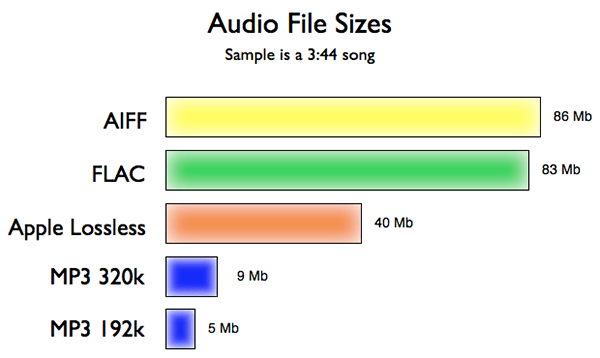
The problem with the WAV format is that it takes up a lot of disk space and this has made it unpopular because it is not really manageable to use in phones or MP3 players and even to send it over the internet.

FLAC.

Unlike MP3, El Flaco only compresses the audio without doing any kind of discarding. It needs to eliminate any information. Even when it is redundant or is outside the auditory range of the human ear, that is why it is called a lossless format. Which means that it is much lighter than the WAV format because it has been compressed. But on the other hand, no information was taken away with which it did not lose any acoustic quality.

AAC.

In an attempt to compete with MP3, this format is created which manages to compress the audio enormously but without modifying the original frequencies. For this reason, it is assumed that although it is very similar to MP3 in its reduced size it has better audio quality.

AIFF.

This format is basically the same as WAV but WAV is for windows and AIFF is for Mac.


Bitrate

It is important to understand that bitrate is what the information rate is. What can pass per minute is decisive for the quality of, for example, an mp3.

An mp3 encoded with a 90 bits per minute bitrate will have a sound quality quite different from the original, whereas an mp3 encoded with a 320 bits per minute ticket will have audio of such high quality that 99% of people will not be able to distinguish what an original WAV file and some say that 100% of people will not be able to distinguish it.

All this of course has generated controversy from audio purists but for the average user who is already going to listen to their music, the sound equipment that is not absolutely professional is the same as an mp3 with a bitrate higher than 160 than a WAV