AAC: Lossy Encoding Is Getting Better – AAC Format Summary


Free Download Mp4Gain
picture

AAC: Lossy Encoding Is Getting Better – AAC Format Summary
AAC Music File Format

At the time of writing this article, the MP3 codec is over 23 years old. So as not to repeat myself with the article (its most recent version), which already describes the OGG Vorbis codecs (and again hello to the Xiph organization, this is also its development), MPC (Musepack), WMA (Windows Media Audio) and AAC, I will briefly describe the format here. AAC in terms of technologies that until recently were at the forefront of lossy coding.

AAC Format

In my humble opinion, AAC (Advanced Audio Codec) is one of the most advanced formats in the field of data encoding. I will describe the main features of this format, starting with the popular profiles that can be represented by a matryoshka (see the figure below):

– Low Complexity Advanced Audio Coding (LC-AAC)

Low decoding complexity is great for implementing a hardware codec; The hardware requirements for CPU and RAM are also low, which has gained a lot of popularity for this profile. It encodes the 96 kbps signal efficiently.

– High Efficiency Advanced Audio Coding (HE-AAC).

The HE-AAC profile is an extension of LC-AAC and is complemented by patented SBR (Spectral Band Replication, thick – “spectral repetition”) technology. It is spectral repetition technology that allows you to “preserve” high frequencies by encoding at low bit rates.

Why is “save” in quotes? Because the king is not real: the codec leaves room for additional information that is used by the codec synthesizer to restore the high frequencies, but since these frequencies are synthesized, that is, they are recreated by the codec, they are, in fact, a rough copy of the high frequencies that existed in the original file. … In practice, a signal encoded at 48 kbps will sound, for example, as mp3 at 98 kbps if it is supported by the decoder; otherwise, the file will simply be played without restoring the high frequencies and its bit rate will correspond to its mp3-like quality.

– High Efficiency Advanced Audio Coding Version 2 (HE-AACv2)

This profile is relatively young (described in 2006), it was created for a more efficient audio coding in low bandwidth conditions.
The second version of the profile is an extension of the first profile, the changes are in the addition of PS (Parametric Stereo) technology. The principle is somewhat similar to SBR technology: the codec also makes room for recovery information from the stereo base, sacrificing precision.

The operating conditions for this profile are the same as for the HE-AAC described above; The lack of profile support from the decoder will make the recording sound in mono.

– AAC-LD (advanced audio coding – low delay)

The AAC-LD profile has advanced coding algorithms to reduce delays (up to 20 ms);

– AAC-ELD (Advanced Audio Coding – Enhanced Low Delay)

This profile, which inherits all the capabilities of HE-AACv2 (analogous SBR and PS technologies are used, but designed for low latencies);

– AAC main profile

This profile was introduced as MPEG-2 AAC or HC-AAC (High Complexity Advanced Audio Coding). Not compatible with LC-AAC;

– AAC-LTP (Advanced Audio Coding – Long Term Prediction)

This profile is more complex and resource intensive (but also of higher quality) than all the others. It is also not compatible with LC-AAC.

That’s all I wanted to write about this codec. I put the greatest emphasis on the technologies that are used in various AAC profiles (which, by the way, generate a lot of abbreviations: AAC, LC-AAC, eAAC +, aacPlus, HE-AAC, etc.), as I will compare them with the from Opus, but the codec does its job: it is widely used in Internet radio, as well as in digital radio transmission technologies: DRM (Digital Radio Mondiale) and DAB (Digital Audio Broadcasting) (you can see these technologies here), YouTube , as an audio track for many videos in mp4, mkv, etc.

2. Introduction to Opus: description of the format

On December 21, 2017, Xiph announced the beta version of the Opus audio codec version 1.3. I will not go into important matters when I describe this codec, since such information is freely available (for example, here, here, and for those who know English, here and here). The release notes for this beta version can be found here. Here I will point out that this codec is an excellent candidate to replace other codecs. It has many advantages:

bit rate from 6 to 510 Kbit / s;
sampling frequency from 8 to 48 KHz;
support for constant bitrates (CBR) and variables (VBR);
support for narrowband and wideband audio;
support for voice and music;
support for stereo and mono;


Free Download Mp4Gain
picture


Mp4Gain Main Window
picture


Mp4Gain Features
picture


Free Download Mp4Gain
picture

Audio file format AAC

AAC files are designed to replace MP3 files. Lossy compression gives you better sound at the same bit rates. AAC files are standardized by ISO / IEC as part of the MPEG-2 and MPEG-4 file families (originally they were members of the MPEG-2 Part 7 filegroup). AAS files contain a higher number of sample rates (compared to MP3) and up to 48 channels. Significantly improved encoding efficiency, including an increased number of filter sets. Enhanced transient signal coding accuracy. Like MP3 files, AAS files suppress sound at frequencies that a person cannot hear. This way you can reduce the file size. Compared to MP3, AAS files are much smaller.

AAC Format

Technical details of AAC files

MPEG-2 Part 7 files are represented by three types of files: Low Complexity AAC-LC, Main Type (AAC Main), and Variable Rate Files (AAC-SSR). AAS files allow temporary noise generation, uneven sampling, and repeated generation of the bitstream format (for 16 stereo channels, 16 mono channels, 16 low-frequency channels, and 16 channels for single bitstream annotation). In 1999, the MPEG-2 Part-7 format was incorporated into the MPEG-4 Part-3 format, allowing the introduction of audio object types as well as constant noise replacement technology. The AAC format is currently described in ISO / IEC 14496-3. Lossy compression uses sound masking to remove unnecessary information while maintaining quality.

Aac format

Additional information about the AAC format

Until now, the AAC format has not yet achieved mass distribution in audio media. However, in a number of parameters it exceeds all existing types of audio compression, which means that it deserves our attention.

What is this?

Let’s start with the definition: AAC is the proprietary (proprietary) option for compressing an audio file. At the same time, the quality loss when encoding is less than with MP3 at the same bit rate. Furthermore, the AAC format is a wideband algorithm for encoding audio that uses two fundamental encoding principles to greatly reduce the amount of data required to transmit high-quality digital audio. This solution is recognized as one of the highest quality implemented using lossy compression technology. The format is compatible with most modern devices, including laptops. It should be noted that ringtones in AAC format can be purchased from the iTunes store and that this store presents music that is only compressed with this solution. It should also be said that the AAC format was originally created as a successor to MP3, which can offer improved encoding quality. The solution was published in 1997 as the new seventh part of the MPEG-2 family.

All the details

Interestingly, the AAC format has a sample rate in the range of 8 to 96 kHz, as well as the number of channels in the range of 1 to 48. MP3 uses a set of hybrid filters. AAC, in turn, refers to the modified discrete cosine transform with an expanded “window” size that reaches 2048 points.

Therefore, compared to MP3, AAC is much better suited for encoding audio with complex pulse stream as well as square wave signals. The format was given the ability to dynamically change MDCT block lengths within 2048-256 points. In the case of a short or simple movement, a small 256-point “window” is used to achieve better resolution. In this case, a default 2048-point “window” is used to maximize encoding efficiency. AAC has several advantages over regular MP3. Noteworthy is the implementation of a large number of audio channels (up to 48), significant coding efficiency at constant and variable bit rates, and sample rates from 8 Hz to 96 kHz (for MP3 from 8 Hz to 48 kHz). and a more flexible special mode called Joint Stereo. The solution is “AAS +”, a codec designed for a low bit rate. It is a combination of SBR and AAC

What is the difference between MP3, AAC, AIF, WAV and FLAC files?

Nowadays, thanks to the digitization of music, it is possible to store and reproduce a large number of music goats that are saved on a hard drive or on a player or even that you listen to through streaming.

MP3 WAVE FLAC AAC

As we said, this is thanks to what has been possible to digitize the audio.

Of course cal captures the original audio in its analog version. That is, as we hear it.
A large amount of information is captured, some of which is not even perceptible to our ears and This makes the files that store all the information very heavy.

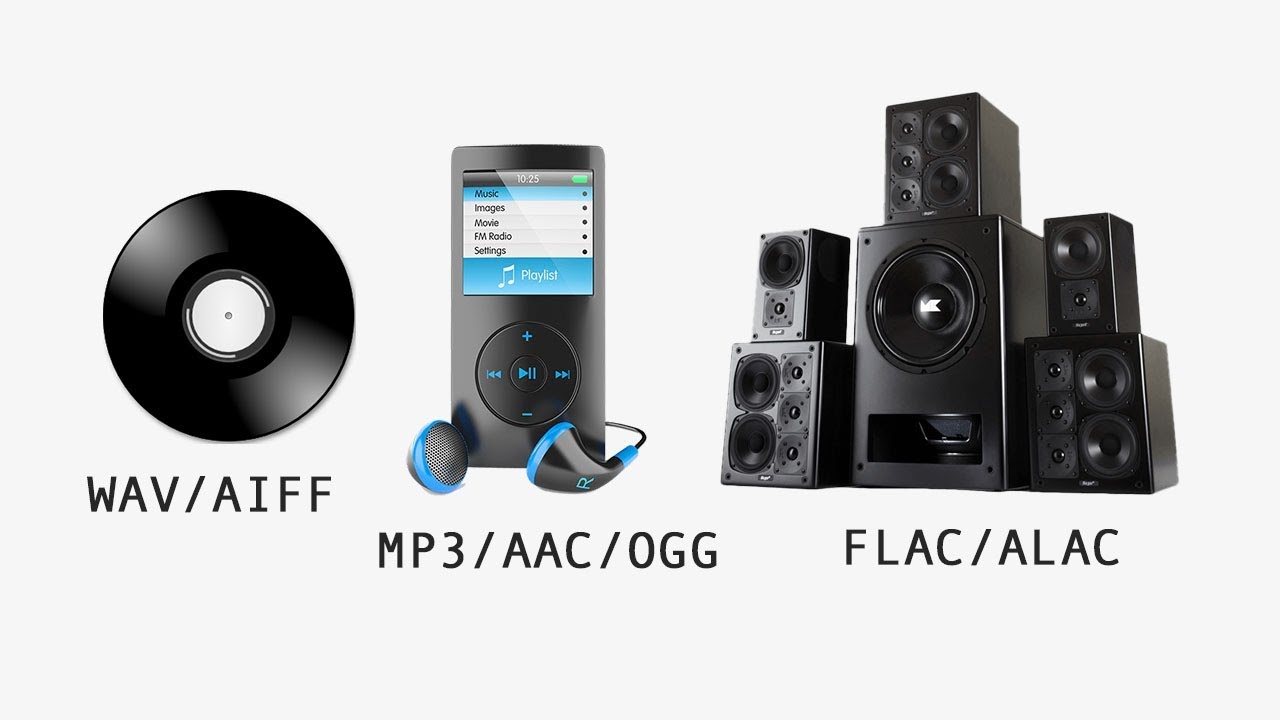
WAV vs MP3 vs AAC vs AIFF

That is why different formats have had to be created that can have a much smaller size without sacrificing audio quality.

Let’s see the list of some of the most used audio files:

MP3.

This format is created in Germany in 1995.
And its ability to compress sometimes at a rate of 11 times less than the original genre, a true Boom What changed the way we listen to music forever.
From there they began to create a series of devices such as MP3 players or portable phones that were capable of playing MP3 files and I am sure that MP3 became the most popular format in the world.

Some audio purists have questioned that MP3 uses so-called masking in its algorithm for compressing audio. That is simply part of a principle of the human ear. What says that if at the same time two sounds are produced at close frequencies, the ear will only perceive that which sounded louder. For this reason, the MP3 discards those sounds that occur at similar frequencies but at a lower volume and also discards the sounds that are outside the range that the human ear can perceive. After all this the MP3 performs a compression to make it even smaller. That is, it first discards information and then compresses it. This type of format such as MP3 that discards information and then compresses it are known as lossy formats.

WAV.

You could say that this is the format that saves the audio as it arrives without making any adjustments or any kind of compression or discarding it eliminates any information.
The problem with the WAV format is that it takes up a lot of disk space and this has made it unpopular because it is not really manageable to use in phones or MP3 players and even to send it over the internet.

FLAC.

Unlike MP3, El Flaco only compresses the audio without doing any kind of discarding. It needs to eliminate any information. Even when it is redundant or is outside the auditory range of the human ear, that is why it is called a lossless format. Which means that it is much lighter than the WAV format because it has been compressed. But on the other hand, no information was taken away with which it did not lose any acoustic quality.

AAC.

In an attempt to compete with MP3, this format is created which manages to compress the audio enormously but without modifying the original frequencies. For this reason, it is assumed that although it is very similar to MP3 in its reduced size it has better audio quality.

AIFF.

This format is basically the same as WAV but WAV is for windows and AIFF is for Mac.


Bitrate

It is important to understand that bitrate is what the information rate is. What can pass per minute is decisive for the quality of, for example, an mp3.

An mp3 encoded with a 90 bits per minute bitrate will have a sound quality quite different from the original, whereas an mp3 encoded with a 320 bits per minute ticket will have audio of such high quality that 99% of people will not be able to distinguish what an original WAV file and some say that 100% of people will not be able to distinguish it.

All this of course has generated controversy from audio purists but for the average user who is already going to listen to their music, the sound equipment that is not absolutely professional is the same as an mp3 with a bitrate higher than 160 than a WAV

What is the AAC?

MP3 has practically become synonymous with online audio, as it is capable of transforming your music into small files, ideal for sharing. However, the fact of having a “reasonable” audio quality displeases many people, opening the market to other more robust formats, such as AAC (Advanced Audio Coding).

AAC (Advanced Audio Coding) Bluetooth Audio Codec

Unlike FLAC, AAC is a lossy audio compression scheme that focuses not on audiophiles, but on users who want high-quality music without sacrificing large disk space or even their portable music players to store them.

Seen by the market as a successor to MP3, this format has big names behind its development, such as Sony, AT&T, Nokia and Dolby Laboratories, and has even been standardized by renowned ISO and IEC institutes. Many of our devices already use AAC as standard, like PlayStation 3 and Portable, Nintendo Wii and DSi, Andoid devices, iPhones and iPod, being the standard format used even in iTunes.

AAC

To explain AAC’s superiority over MP3, let’s look at some points of comparison:

-AAC achieves a higher level of audio quality without increasing file size. This is measured in Kbps (Kilobits per second) and the higher this number, the more transparent the sound will be and the more space will be needed for the file. A song compressed in AAC at 96 Kbps has a clearer sound than an MP3 at 128 Kbps, which means more quality in a smaller size;
-A very important parameter to estimate the “purity” of a song is its sampling frequency, because the higher the margin, the more details are stored. While MP3 has a range of 16KHz to 48KHz, AAC ranges from 8KHz to 96KHz;
An MP3 audio file only supports 5.1 channels in MPEG-2, while AAC is capable of playing up to 48 different channels in MPEG-4;
-The above data only explains the preference of many users and companies to replace MP3, which has been standard since 1993. The only drawback seen by some manufacturers is the need to pay royalties to the Dolby Digital encoder (decoder) and AAC decoder. , but this is something that already happens with the MP3 format, so who knows with a little negotiation things will be resolved.

FLAC or AAC? Find out which audio format is the best

With the “death” of MP3, formats like FLAC and AAC gain more space.

Music consumption on current devices may involve the use of non-MP3 files, as the creators of the format are abandoning their licensing program. Among the new types of audio files that have gained space are FLAC and AAC. With different proposals, they serve broader but conflicting usage and consumption profiles: FLAC is for those who demand the highest quality, giving up space, since the files tend to be large. AAC can be seen as a more conventional option: small file sizes, but with better sound quality than the previous MP3.

MP3 vs FLAC vs WAV vs AAC

Audio formats are divided between lossless (maximum quality) and loss, compact quality and lower

Understand the points that differentiate between FLAC and AAC files to find out which format best suits your needs.

Lossless and lossy audio

Digital audio file formats are divided into two types: lossless (lossless) and lossy (where, conversely, there is loss).

Flac vs AAC

The main characteristic of a lossless file, such as WAV or FLAC, is the fact that the sound stored in the package is faithful to the original: that is, in the process of converting the CD track, all the information has been preserved sound related to the song. completely, without any loss, ensuring high fidelity to the file. The problem with this is that the result is a large file – a WAV track can be over 40MB.

Lossy format refers to an approach in which the conversion of the original audio to the final file (MP3, AAC and etc.) goes through a compression process in which a variable amount is removed (depending on the chosen bit rate ) information to ensure a smaller file size. In the case of MP3, the ratio is 10 to 1: a 40 MB WAV returns a 4 MB MP3, at 128 kbps.

This information, removed in lossy type conversions, is generally automatically defined by the conversion software based on theoretical precepts related to the frequencies that our ears can identify. The problem with this approach is that there are ears and ears, there are sound devices and devices, and there are songs and songs: some details of the songs can be removed in an MP3 or AAC because the conversion ignores them.

And what is bitrate?

Not all AACs and MP3s are created equal: a low bitrate file will be of much lower quality than a higher bitrate version.

Simply put, it is the amount of information that is executed in a certain period of time when you listen to music. If the file is 128 Kbps, it means that 128 kilobits of information are executed every second. If the file is 320 kbps, it is 320 kilobits per second. The higher the value, the larger the sample, and generally the higher the sound quality of the file.

FLAC: lossless audio

FLAC-type sound files are converted to original using a compression process called lossless. This testifies that the compression of the music on a CD, for example, does not represent loss of information: the sound quality faithfully represents the experience of listening to the same track from a medium.

The point is that the FLAC format ends up “charging a high price” for all that quality. First, files get bigger (a single song can be over 20MB in size), which restricts the number of tracks you can store in a player and makes it difficult for anyone who consumes music to stream with Tidal: The weight of the file It can consume your plan and represent a bad experience, if your connection is slow and it is necessary to interrupt the playback to load the song.

Also, in general, the user does not have sound reproduction equipment that really takes advantage of the high quality of the FLAC without losses. Using low-quality headphones, along with inferior media players, can eliminate the benefits of higher quality lossless files compared to MP3 or AAC.

Which is better, after all?

If you value sound fidelity, you have good audio equipment and disk space is not a problem, lossless format is the best alternative: FLAC, ALAC and APE guarantee the highest audio quality. In this scenario, the discussion about AAC loses its meaning, since the gain will only be in the file size, but with loss of quality.

However, the AAC is a good option for those who don’t have high-quality headphones or sound systems. AAC is even a great format for users who have amassed a large, low-bit-rate MP3 library at 128 kbps. If you don’t have good equipment and good headphones, the FLAC is superior.

M4A – AAC format and characteristics

Presentation of the AAC format

AAC (Audio Advanced Coding) is an audio data compression format developed by the Fraunhofer Institute in collaboration with AT&T, Nokia, Sony and Dolby.

As with the MP3 format, it is a destruction of audio data compression, called “lossy compression” (that is, lossy compression), ie the removal of certain auditory information (for example, inaudible frequencies) to the best possible compression rate, keeping a result as close as possible to the original data.

AAC

The AAC format corresponds to the international standard “ISO / IEC 13818-7” as an extension of MPEG-2, standard of the Moving Image Expert Group (MPEG).

The AAC format was chosen by the Apple company as the primary file format on iPods or in the iTunes software.

Frequently Asked Questions: M4A – AAC Format and Features

Technical properties

AAC uses a variable bit rate encoding (Variable bit rate in English, sometimes abbreviated as VBR), that is, an encoding that allows you to adjust the number of bits used per second to encode audio data according to the complexity of current at a given moment. The algorithm used is more efficient than that of MP3, enabling smaller, higher quality files to be obtained, while requiring less resources to encode or decode.

Compared to the maximum of two channels (in stereo) supported by the MP3 format, the AAC format allows polyphonic recording of up to 48 channels. The AAC format also provides sound reproduction in the 8Hz-96.0kHz frequency band, compared to 16-48kHz for the MP3 format.

Files in AAC format, with extension .mp4 (for MPEG-4), .m4a (for MPEG-4 audio) or .m4p (for protected MPEG-4), are generally smaller than files in MP3 format.

AAC Compatibility

The AAC format is not compatible with the MP3 format, this means that you must use a player that is compatible with the format or install a specific codec so that existing players can read files in AAC format.

MP3 y AAC

However, more and more software players allow you to read files in this format, and the latest hardware MP3 players support this format.

What is the AAC format and what are the advantages compared to the mp3?

A designated heir to MP3, this is the most widely used form of encoding today. It is supported, among others, by YouTube, iPhone and Android.

AAC audio format

Over twenty years of honest career, which has allowed music to become truly “pop” and spread around the world, regardless of the playback device used. This is the rather heavy legacy of MP3, a form of multimedia created in the late 1980s and early 1990s by Italian engineer Leonardo Chiariglione. Instead, we now find the AAC, the standard for encrypting audio files developed by Bell Labs, Fraunhofer Institute, Dolby Labs, Sony and Nokia near the end of the last century.

aac format audio digital

Lossy codec, the AAC is considered a model by both ISO (an acronym for the International Organization for Standardization) and IEC (an acronym for the International Electrotechnical Commission) and is an integral part of the MPEG-2 and MPEG-4 specifications. After a few years “in the shadows” of MP3 encoding, today AAC encoding is by far the most common and adopted: it is the standard or default audio format for YouTube, iPhone, iPod, iPad, Nintendo DSi, Nintendo 3DS, iTunes, DivX Plus Web Player, PlayStation 3 and is compatible with PlayStation Vita, Wii, Sony Walkman MP3, Android and BlackBerry.

AAC – Differences with MP3 files

The reason for this success is explained by the many improvements that this model presents compared to the one developed by Chiariglione. First of all, AAC manages to guarantee better audio playback quality for the same file size (and therefore bit rates). This is because AAC encoding has a greater variety of samples (8 to 96 kilohertz compared to 16 to 48 kilohertz samples allowed by the MP3 format) and supports a larger number of audio playback channels (up to 48 channels).

AAC – Portable music player

Added to this is the increased flexibility and flexibility of AAC coding, which allows engineers to design and implement coding and decoding algorithms according to their needs. This flexibility feeds real competition, leading to more efficient and effective algorithms. Simply put, a sound file converted to an AAC encoder at the same bit rate will guarantee, as already mentioned, better playback quality than many other competing loss formats.

How to convert MP3 to AAC

The discussion about converting between MP3 and AAC files is not entirely accurate. While the second is a real audio format used in many areas, the second is an encryption algorithm that can be used by different file formats. The most well-known, in this sense, are “.m4a”, “.mp4”, “.3gp”, “.m4b” and “.m4p”. To convert MP3 to AAC, therefore, you must select one of the forms listed above.

However, converting your MP3 music collection does not require any specific action. You need to select one of the many existing audio conversion programs (or even a special web portal for file conversion) and select the tracks or albums for editing.

AAC audio formats

AAC audio formats

When we talk about the different audio formats that we have available for our work or entertainment, we usually hear that there is the MP3 format, Dolby type sound, and in some cases it has audio in the AAC format.

This last audio format is very characteristic of some movies found on DVD discs, which comes to be a technical specification that means Advanced Audio Coding, or translated into Spanish “advanced audio coding”, and which actually comes to be an extremely important resource for those editors who work in the video area.

Working with the AAC audio format represents having a better sound quality than many of the cases is distributed to different speakers, perfectly defined in terms of the position they should occupy in an appropriate environment; In addition, this AAC audio format tends to occupy a smaller space than an MP3 audio format would occupy, which in the design of a DVD disc comes to be known as Layer 3 type audio, which is widely used in the compilation of audio and video for the formation of a DVD movie. But the important thing is that this AAC format provides high-fidelity audio quality and that many times it is used for the well-known “no-home” formats.

It is there where the conveniences of using this AAC audio format are found, since by occupying 30% less space than an MP3 audio file, having better quality and fidelity in its sound, it is widely used not only by those film editors DVD, but also by iTunes as well as by many music discs they represent today.

AAC (Advanced Audio Coding) is a digital audio signal computer format based on a lossy compression algorithm, a process by which some of the audio data is removed in order to obtain the highest possible degree of compression, resulting in an output file that sounds as close to the original as possible.

features

AAC uses a variable bit rate VBR, an encoding method that adapts the number of bits used per second to encode audio data, depending on the complexity of the audio stream at any given time. AAC is an encoding algorithm Broadband audio that has superior performance than MP3, produces better quality on small files and requires less system resources to encode and decode. This codec is oriented to broadband uses and is based on the elimination of redundancies of the acoustic signal, as well as on compression by means of the modified discrete cosine transform (MDCT), very similar to that of MP3.

Advantage

Superior audio quality for the same bitrate (kbps) your Radio at 32kbps will sound like 128kbps in mp3. Stereo sound support from 16 kbps unlike MP3 that supports it from 40 kbps. Support on Blackberry, Iphone, Smartphone equipment. Members of the codec family aacPlus aacPlus v1 is the combination of AAC and SBR, as the high-efficiency standardization profile in MPEG-4 (HE AAC). aacPlus v2 builds on the strong success story of aacPlus v1 and adds value in all fields where increased compression efficiency of stereo signals is mission critical. aacPlus v2 is a true superset of aacPlus v1, aacPlus v1 is from AAC. With the addition of Parametric Stereo in MPEG, aacPlus v2 is the current state of the art low-bit-rate open standard audio codec. Not compatible with MPEG-1. Sample Rate: 96 KHz, 88.2 KHz, 48 KHz, 44.1 KHz, 24 KHz, 22.05 KHz, 16 KHz. Maximum quality between 320 and 448 kbps (5 channels) and between 128 and 192 (2 channels) Maximum supported bitrate: From 12 kbps (in HE-AACv2 profile) to 448 kbps (in AAC-LC profile)

Three options

Highest quality (resolution at 23.43 Hz and 2.6 ms) Non prediction Scalable sampling rates

Three types of profiles:

AAC-LC: 16 KBps to 448 KBps HE-AAC: 16 KBps to 128 KBps HE-AACv2: 12 KBps to 56 KBps (most efficient profile in audio quality)

Differences Aac plus vs MP3

When deciding which compression format to choose to take full advantage of own resources such as those of the listener in streaming broadcasts, one of these two alternatives is generally considered.

mp3 vs aac

MP3 or MPEG-1 Audio Layer 3:

It is a standard compressed digital audio format with loss, the loss of information from the mp3 format is not audible by the human ear, therefore we will not distinguish the difference between an uncompressed audio file and an mp3 file.

In addition an mp3 file manages to reduce the size of the sound file without influencing its quality, approximately 1 minute of audio in mp3 format occupies 1 MB with a quality almost equal to the quality of Cd.

These advantages have achieved that the mp3 format can be played in almost all audio players, which is the format par excellence for the exchange through the internet, one of the best options at this time to store music with good quality, and also The audio format that is most used in portable players is a standard and therefore compatibility with all media is guaranteed.

The mp3 audio format allows you to select the quality of the audio that we are going to compress, the quality of cd would be equivalent to 128 Kbps (Bit rate), but we can select the compression between 8 Kbps and 320 Kbps taking into account that the higher the transmission of data (Kbps), the greater the use of broadband resources for both the broadcast and the reception by the listener.

AACplus: MP4 / aacPlus (HE-AAC) Enconder v 1.31; Stereo
As in the mp3, in the aacplus there is a solution for the little width for the channels. This is what is known as “Parametric Stereo” and corresponds to what is known as HE-AAC v2. Unlike what happens in the case of mp3, it is not convenient to use this option in high bitrates, in this case over 48kbps.

Considerations:

Quality assessments are expressed in percentages, with 100% being the overall quality of the original file.
The valuations are merely estimates but are intended to faithfully reflect the differences in quality between the different formats to the different bitrates.
The best alternatives for each format have been marked with red, according to the relationship of quality and consumption of own resources when emitting and resources of the listeners to correctly receive the audio.
Conclusions:

The first and most important regarding the mp3 is that, even in its highest quality, it is already obsolete. In any bitrate it is surpassed by the others so it will always be preferable to perform compression to any other of the subsequent formats. Ogg Vorbis and mpc are better quality formats that far exceed the mp3 but we have not included because they are not widely used. There are also several other formats that offer better compression.
For the mp3 the best bitrate is at 128kbps or 192 kbps, with a minimal difference in quality. Above that the difference is imperceptible and inferior to it is widely discernible.
At 72/74% the AAC PLUS format beats its competitors widely in the 48 / 64kbps being the best choice in the range. It will depend on the original file, as well as the greater or lesser preponderance of the high, medium and low. The decrease in fidelity is easily noticeable but it is not too much and many people will have no problem accepting it.
Under 128kbps, the quality of the mp3 drops considerably, while in the AAC PLUS format the decrease is not as pronounced. In the latter, it can be seen that between 128 and 48kbps the decrease in quality is minimal, with a difference of only 7%. Therefore, it is not worth compressing at 128kbps or at 96kbps having the option of doing so at 48 or 64 with a minimal difference in quality.

Advantages of AAC with respect to MP3

The AAC format supports multichannel sound which is an appropriate audio codec for the surround sound of 6 or more speakers, although it is currently not the most supported codec for it. However, MP3 only allows, in its base format, stereo sound.
It can reach a sampling frequency of 96khz, used in recording studios. MP3 is designed for playback only and to reach up to 48khz.
The sound quality is considerably superior to the same birate. This means that it is possible to encode an audio file in AAC with a bitrate lower than the equivalent in MP3 while maintaining the same sound quality. An audio file in HE-AAC encoded at 48kbps can offer a quality similar to an MP3 encoded at 128kbps.
Even at very low bitrates (32kbps or less) the sound suffers little loss compared to MP3. This could be