AAC: Lossy Encoding Is Getting Better – AAC Format Summary


Free Download Mp4Gain
picture

AAC: Lossy Encoding Is Getting Better – AAC Format Summary
AAC Music File Format

At the time of writing this article, the MP3 codec is over 23 years old. So as not to repeat myself with the article (its most recent version), which already describes the OGG Vorbis codecs (and again hello to the Xiph organization, this is also its development), MPC (Musepack), WMA (Windows Media Audio) and AAC, I will briefly describe the format here. AAC in terms of technologies that until recently were at the forefront of lossy coding.

AAC Format

In my humble opinion, AAC (Advanced Audio Codec) is one of the most advanced formats in the field of data encoding. I will describe the main features of this format, starting with the popular profiles that can be represented by a matryoshka (see the figure below):

– Low Complexity Advanced Audio Coding (LC-AAC)

Low decoding complexity is great for implementing a hardware codec; The hardware requirements for CPU and RAM are also low, which has gained a lot of popularity for this profile. It encodes the 96 kbps signal efficiently.

– High Efficiency Advanced Audio Coding (HE-AAC).

The HE-AAC profile is an extension of LC-AAC and is complemented by patented SBR (Spectral Band Replication, thick – “spectral repetition”) technology. It is spectral repetition technology that allows you to “preserve” high frequencies by encoding at low bit rates.

Why is “save” in quotes? Because the king is not real: the codec leaves room for additional information that is used by the codec synthesizer to restore the high frequencies, but since these frequencies are synthesized, that is, they are recreated by the codec, they are, in fact, a rough copy of the high frequencies that existed in the original file. … In practice, a signal encoded at 48 kbps will sound, for example, as mp3 at 98 kbps if it is supported by the decoder; otherwise, the file will simply be played without restoring the high frequencies and its bit rate will correspond to its mp3-like quality.

– High Efficiency Advanced Audio Coding Version 2 (HE-AACv2)

This profile is relatively young (described in 2006), it was created for a more efficient audio coding in low bandwidth conditions.
The second version of the profile is an extension of the first profile, the changes are in the addition of PS (Parametric Stereo) technology. The principle is somewhat similar to SBR technology: the codec also makes room for recovery information from the stereo base, sacrificing precision.

The operating conditions for this profile are the same as for the HE-AAC described above; The lack of profile support from the decoder will make the recording sound in mono.

– AAC-LD (advanced audio coding – low delay)

The AAC-LD profile has advanced coding algorithms to reduce delays (up to 20 ms);

– AAC-ELD (Advanced Audio Coding – Enhanced Low Delay)

This profile, which inherits all the capabilities of HE-AACv2 (analogous SBR and PS technologies are used, but designed for low latencies);

– AAC main profile

This profile was introduced as MPEG-2 AAC or HC-AAC (High Complexity Advanced Audio Coding). Not compatible with LC-AAC;

– AAC-LTP (Advanced Audio Coding – Long Term Prediction)

This profile is more complex and resource intensive (but also of higher quality) than all the others. It is also not compatible with LC-AAC.

That’s all I wanted to write about this codec. I put the greatest emphasis on the technologies that are used in various AAC profiles (which, by the way, generate a lot of abbreviations: AAC, LC-AAC, eAAC +, aacPlus, HE-AAC, etc.), as I will compare them with the from Opus, but the codec does its job: it is widely used in Internet radio, as well as in digital radio transmission technologies: DRM (Digital Radio Mondiale) and DAB (Digital Audio Broadcasting) (you can see these technologies here), YouTube , as an audio track for many videos in mp4, mkv, etc.

2. Introduction to Opus: description of the format

On December 21, 2017, Xiph announced the beta version of the Opus audio codec version 1.3. I will not go into important matters when I describe this codec, since such information is freely available (for example, here, here, and for those who know English, here and here). The release notes for this beta version can be found here. Here I will point out that this codec is an excellent candidate to replace other codecs. It has many advantages:

bit rate from 6 to 510 Kbit / s;
sampling frequency from 8 to 48 KHz;
support for constant bitrates (CBR) and variables (VBR);
support for narrowband and wideband audio;
support for voice and music;
support for stereo and mono;


Free Download Mp4Gain
picture


Mp4Gain Main Window
picture


Mp4Gain Features
picture


Free Download Mp4Gain
picture

Find out in detail what is the MP3 and ACC music format

Find out in detail what is the MP3 and ACC music format

MP3 o AAC

Songs have become part of our daily life and we rarely listen to a single song during our day, during our breaks or in our free time. New music never stops appearing and it is likely that on many occasions we would like to download these songs.

MP3 VS AAC

Many of us listen to hundreds of songs by our favorite bands every day, and we may never really analyze the format of each song in detail. We have heard of the existing formats, but we really do not know the benefits of each of them and their characteristics.

For this reason, Solvetic on this day will analyze in detail the two most common formats at a musical level, such as MP3 and ACC.

What is AAC?

AAC (Advanced Audio Coding) is a new audio format developed by the Fraunhofer Institute in Germany in collaboration with companies such as AT&T, Nokia, Sony and Dolby.

AAC, whose extension is m4a, is responsible for compressing a part of the audio files of an element called lossy compression, that is, some data that affects its optimal quality since inaudible frequencies are removed from the audio element, etc.

This AAC format is based on the international standard ISO / IEC 13818-7 and is basically an extension of MPEG-2. It is important to note that Apple chose AAC as the default format for the iPod and for iTunes, demonstrating its high level of quality.

Among its main characteristics we find:

It uses a bit rate encoding variable called VBR, which adapts the number of bits used in one second to encrypt the audio data.
Supports up to 48 channels for polyphonic sounds
It offers frequencies ranging from 8Hz to 96.0kHz.
They are smaller in MP3 size
AAC focuses on broadband usage
Provide high quality sound
As we can see little by little, AAC is establishing itself as one of the best music formats of the time.

What is MP3

MP3 (Motion Picture Experts Group) is an audio format that delivers quality while drastically reducing file size.

MP3 uses a lossy algorithm with which we can reduce the size of an element without losing its quality. This format, like AAC, was developed at the Fraunhofer Institute in Germany. MP3 has the ability to compress using a lower or higher bit rate, which will affect the sound quality.

Its main characteristics are:

Supports frequencies from 16 to 48 kHz
Allows compression of the audio object with a ratio of 11: 1
With the MP3 format, music is divided 44,100 times per second and each of these parts is 16 bits.
MP3 can contain tags with information about the included file
With these concepts in mind, we will see that AAC and MP3 behave in certain situations.

Audio file size

Both formats perform the function of reducing the size of the original file while maintaining sound quality. At this point AAC reduces the file size more than MP3, for example a 20MB MP3 file will weigh 16MB in AAC format.

compatibility

As we already mentioned, the ACC is being implemented by Apple for its devices, and therefore there is no doubt that the most compatible format is MP3, since since the 90s it has accompanied us on various devices such as cell phones, audio systems, televisions. , team. calculations, etc.

Sound quality

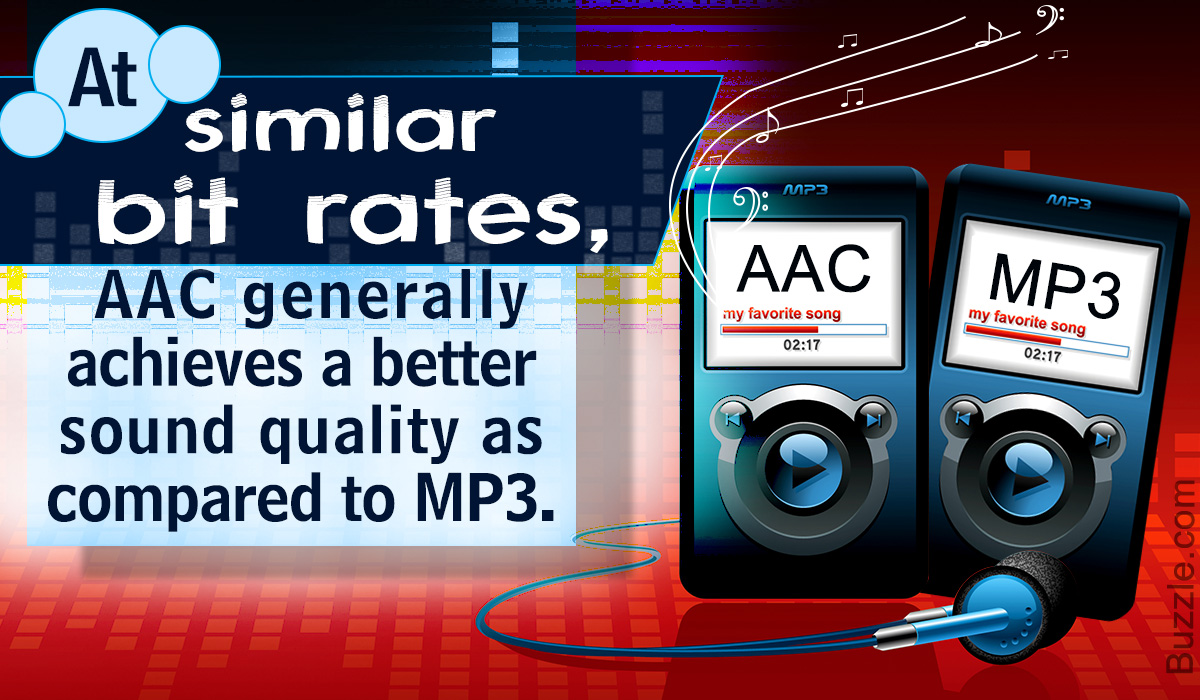
In this regard, AAC surpasses Mp3 for technical reasons such as a higher audio frequency, a higher level of audio compression to eliminate elements that affect its quality, better encoding, among other things.

Next, we will see the relationship between these two audio files:

The death of the MP3 has been mentioned in some places, but this is not really the case where the licenses of this format have stopped being active, so the MP3 will continue to be active in many of the songs we listen to, and there is no doubt that that ACC will gradually gain strength until it surpasses it. MP3 medium term, but for now, AAC users can enjoy and appreciate AAC.

Let’s continue enjoying our favorite songs and remember that the purpose of these files is to offer quality sound in a small storage space.

AAC vs mp3 quality

AAC vs mp3 quality

MP3 vs AAC

Answer 1 :
Q: What is the difference between AAC and MP3?

AAC vs MP3

The other answers here helped to talk about the technical differences between the two lossy compression formats.

I’ll take a different tactic with this answer and explain how they sound different to the ear.

To explain the difference in abbreviated form, at any given bitrate, AAC will sound better in the higher ranges, while MP3 will sound better in the lower ranges.

MP3 compression adds a specific sound to the sound. This is very noticeable at bit rates of 128 kbps and below; everything sounds confusing. At higher bit rates like 256 kbps (where it’s hard to hear) or 320 kbps (where you need high-end hardware to listen to artifacts), MP3 compression is much less of a problem.

AAC compression is much better at high frequencies. “AAC” in AAC is that music sounds weak, especially at low bit rates. If you like music with significant low frequency content (drums, electronic drums, bass, bass, etc.), you will miss some of that bass in AAC files; they just sound like they lack solidity. However, as with MP3, the higher the bit rate, the less problem you will be able to hear.

At any bit rate below 256 kbps, I personally prefer AAC. The lack of solidity in AAC compressed music is less undesirable than in Futz with MP3 compression.

At 320 kbps, these artifacts are very difficult to hear in any compression format, so the fact that MP3 is more compatible in most cases gives this compression algorithm an advantage.

But we also live in today’s world where conventional hard drives have more than 12 terabytes. A completely uncompressed album (that is, AIFF or WAV format) is less than 650 megabytes in size. (** grip calculator **) You can put 18,461 uncompressed WAV or AIFF albums on a 12TB hard drive. So why do we continue to use MP3 and AAC today?

Answer 2:
Both are compressed audio files, and although the audio quality is fairly similar, the AAC format was designed to improve over MP3 in the following ways:

Higher sampling frequency (8 kHz to 96 kHz) than MP3 (16 kHz to 48 kHz)
Up to 48 channels (MP3 supports up to two channels in MPEG-1 mode and up to 5.1 channels in MPEG-2 mode)
Arbitrary bit rates and variable frame length. A constant bit rate standardized with a bit pool.
Higher efficiency and simpler filter bank (uses pure MDCT instead of hybrid MP3 encoding)
Higher encoding efficiency for stationary signals (AAC uses a block size of 1024 or 960 samples, which can be encoded more efficiently than 576 MP3 blocks)
Higher encoding precision for transition signals (AAC uses 128 or 120 sample block size, which provides more precise encoding than 192 MP3 sample blocks)
You can use a Kaiser-Bessel derived window function to eliminate spectral leakage by enlarging the main lobe
Much better handling of audio frequencies above 16 kHz
More flexible articulation stereo (different methods can be used in different frequency ranges)
Add additional modules (tools) to improve compression efficiency: TNS, inverse prediction, PNS, etc. These modules can be combined to create different encoding profiles.

Answer 3:
Both are lossy codecs, aimed at significantly reducing file size without affecting sound quality as much as you might think.

AAC is 2 generations younger than MP3, so by then the algorithms had improved significantly, and most tests confirmed that 256 kbps AAC sounds just as good, if not better than 320 kbps MP3, which is why Apple chose this file format for iTunes.

AAC supports higher sample rates than MP3, although I’ve recently seen some weird MP3 implementations (incompatible with just about everything) that do this too.

After all, storage and internet speed are not an issue, lossy compression should be gone by now in favor of FLAC or ALAC. It seems that some bad habits are very difficult to break. 🙂

Answer 4:
AAC stands for Advanced Audio Coding. It was developed by the same people who invented MP3 and is destined to be its successor. Audio in AAC is better than MP3 in almost all cases.

It is more efficient than MP3 in terms of file size precision (bit rate). In other words, an AAC encoded song will sound as good or better than an MP3 encoded with the same bit rate. Therefore, encoding a file at 256 kbps AAC will give you better sound and smaller file size than MP3 at 320 kbps.

AAC vs MP3: which one sounds better?

AAC vs MP3: which one sounds better?

AAC Vs. MP3

AAC and MP3 are now widespread and established in the hardware and software markets. AAC is often touted as the successor to MP3. But is the successor really better? We tell you who sounds better and why.

MP3 to AAC

What are AAC and MP3?

You are probably familiar with AAC and MP3 from your music downloads, audiobooks and audio software for ripping audio CDs or compressing WAV or AIFF files.
Both formats are lossy audio codecs. In a special practical tip, we will explain what exactly a codec is.
Sound in AAC format is often hidden behind M4A and MP4 file extensions.
In a practical advice we explain in detail the differences between MP3 and MP4.
MP3 and AAC are both based on psychoacoustic models of loudness and masking that were developed in the 1960s by Eberhard Zwicker, for example.
Although there are newer and more precise models, the innovations since MP3 mainly reside in more sophisticated signal processing.

AAC vs. MP3: which one sounds better?

AAC is newer than MP3. Does newer mean better? At least the AAC innovations compared to MP3 have the potential for significantly stronger compression with the same sound quality or, conversely, significantly better sound quality with the same compression:
As described above, both codecs are based on practically the same psychoacoustic models.
However, AAC allows more flexible window sizes to better react to transient or stationary signals, depending on the signal.

Unlike MP3, AAC also offers more flexible windows. Used sensibly, this can improve frequency accuracy in applied spectrum analysis.
AAC also allows for frequency-dependent stereo ensemble. This can save quite a bit of storage space with little effort, as the low frequencies in audiobooks, music, and movie sound are often kept mono.
Since AAC offers significantly more flexibility on the encoder side, even a good MP3 encoder cannot keep up with a good AAC encoder.

On the other hand, a poorly conceived AAC encoder can also sound significantly worse than an MP3 of the same size. If you encode an MP3 optimally, the result can compete with many AAC encoders.

However, in our 2003 audio encoder quality comparison test, AAC wins, followed by Warning, OGG over MP3.
Also in our 2005 AAC encoder audio codec test from Nero also wins.
AAC is also more flexible than MP3 for the user. For example, AAC supports sample rates from 8 to 96 kHz, MP3 only from 16 to 48 kHz. If you go for 96 kHz music DVDs, even the highest quality MP3 won’t give you a good sample rate.
AAC also supports up to 48 channels, MP3 only 5.1. In AAC, in theory, it could also encode audio material for 7.1 sound, high-order ambisonics, Dolby Atmos, and Auro-3D.

By the way, there is an important rule to keep in mind: converting an MP3 to AAC or vice versa is quite detrimental to the audio quality. You should only convert for compatibility reasons, if, for example, your portable MP3 player does not support the AAC format.

Audio file format AAC

AAC files are designed to replace MP3 files. Lossy compression gives you better sound at the same bit rates. AAC files are standardized by ISO / IEC as part of the MPEG-2 and MPEG-4 file families (originally they were members of the MPEG-2 Part 7 filegroup). AAS files contain a higher number of sample rates (compared to MP3) and up to 48 channels. Significantly improved encoding efficiency, including an increased number of filter sets. Enhanced transient signal coding accuracy. Like MP3 files, AAS files suppress sound at frequencies that a person cannot hear. This way you can reduce the file size. Compared to MP3, AAS files are much smaller.

AAC Format

Technical details of AAC files

MPEG-2 Part 7 files are represented by three types of files: Low Complexity AAC-LC, Main Type (AAC Main), and Variable Rate Files (AAC-SSR). AAS files allow temporary noise generation, uneven sampling, and repeated generation of the bitstream format (for 16 stereo channels, 16 mono channels, 16 low-frequency channels, and 16 channels for single bitstream annotation). In 1999, the MPEG-2 Part-7 format was incorporated into the MPEG-4 Part-3 format, allowing the introduction of audio object types as well as constant noise replacement technology. The AAC format is currently described in ISO / IEC 14496-3. Lossy compression uses sound masking to remove unnecessary information while maintaining quality.

Aac format

Additional information about the AAC format

Until now, the AAC format has not yet achieved mass distribution in audio media. However, in a number of parameters it exceeds all existing types of audio compression, which means that it deserves our attention.

What is this?

Let’s start with the definition: AAC is the proprietary (proprietary) option for compressing an audio file. At the same time, the quality loss when encoding is less than with MP3 at the same bit rate. Furthermore, the AAC format is a wideband algorithm for encoding audio that uses two fundamental encoding principles to greatly reduce the amount of data required to transmit high-quality digital audio. This solution is recognized as one of the highest quality implemented using lossy compression technology. The format is compatible with most modern devices, including laptops. It should be noted that ringtones in AAC format can be purchased from the iTunes store and that this store presents music that is only compressed with this solution. It should also be said that the AAC format was originally created as a successor to MP3, which can offer improved encoding quality. The solution was published in 1997 as the new seventh part of the MPEG-2 family.

All the details

Interestingly, the AAC format has a sample rate in the range of 8 to 96 kHz, as well as the number of channels in the range of 1 to 48. MP3 uses a set of hybrid filters. AAC, in turn, refers to the modified discrete cosine transform with an expanded “window” size that reaches 2048 points.

Therefore, compared to MP3, AAC is much better suited for encoding audio with complex pulse stream as well as square wave signals. The format was given the ability to dynamically change MDCT block lengths within 2048-256 points. In the case of a short or simple movement, a small 256-point “window” is used to achieve better resolution. In this case, a default 2048-point “window” is used to maximize encoding efficiency. AAC has several advantages over regular MP3. Noteworthy is the implementation of a large number of audio channels (up to 48), significant coding efficiency at constant and variable bit rates, and sample rates from 8 Hz to 96 kHz (for MP3 from 8 Hz to 48 kHz). and a more flexible special mode called Joint Stereo. The solution is “AAS +”, a codec designed for a low bit rate. It is a combination of SBR and AAC