
AAC vs MP3: which one sounds better?
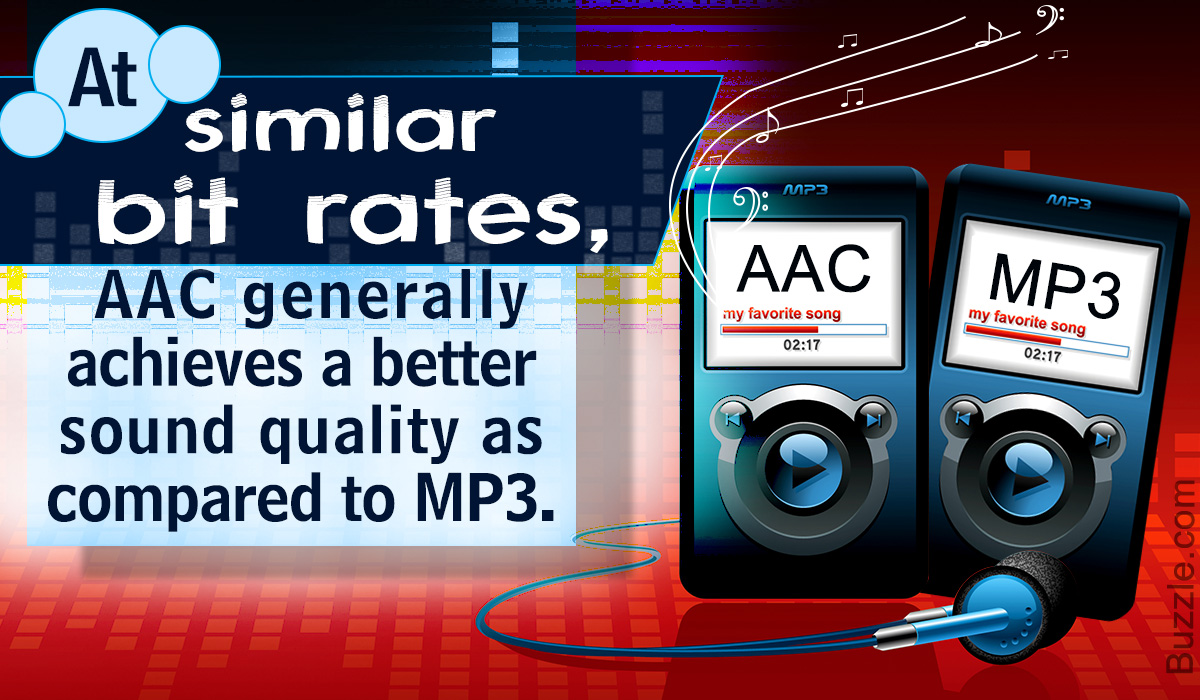
AAC and MP3 are now widespread and established in the hardware and software markets. AAC is often touted as the successor to MP3. But is the successor really better? We tell you who sounds better and why.

What are AAC and MP3?
You are probably familiar with AAC and MP3 from your music downloads, audiobooks and audio software for ripping audio CDs or compressing WAV or AIFF files.
Both formats are lossy audio codecs. In a special practical tip, we will explain what exactly a codec is.
Sound in AAC format is often hidden behind M4A and MP4 file extensions.
In a practical advice we explain in detail the differences between MP3 and MP4.
MP3 and AAC are both based on psychoacoustic models of loudness and masking that were developed in the 1960s by Eberhard Zwicker, for example.
Although there are newer and more precise models, the innovations since MP3 mainly reside in more sophisticated signal processing.
AAC vs. MP3: which one sounds better?
AAC is newer than MP3. Does newer mean better? At least the AAC innovations compared to MP3 have the potential for significantly stronger compression with the same sound quality or, conversely, significantly better sound quality with the same compression:
As described above, both codecs are based on practically the same psychoacoustic models.
However, AAC allows more flexible window sizes to better react to transient or stationary signals, depending on the signal.
Unlike MP3, AAC also offers more flexible windows. Used sensibly, this can improve frequency accuracy in applied spectrum analysis.
AAC also allows for frequency-dependent stereo ensemble. This can save quite a bit of storage space with little effort, as the low frequencies in audiobooks, music, and movie sound are often kept mono.
Since AAC offers significantly more flexibility on the encoder side, even a good MP3 encoder cannot keep up with a good AAC encoder.
On the other hand, a poorly conceived AAC encoder can also sound significantly worse than an MP3 of the same size. If you encode an MP3 optimally, the result can compete with many AAC encoders.
However, in our 2003 audio encoder quality comparison test, AAC wins, followed by Warning, OGG over MP3.
Also in our 2005 AAC encoder audio codec test from Nero also wins.
AAC is also more flexible than MP3 for the user. For example, AAC supports sample rates from 8 to 96 kHz, MP3 only from 16 to 48 kHz. If you go for 96 kHz music DVDs, even the highest quality MP3 won’t give you a good sample rate.
AAC also supports up to 48 channels, MP3 only 5.1. In AAC, in theory, it could also encode audio material for 7.1 sound, high-order ambisonics, Dolby Atmos, and Auro-3D.
By the way, there is an important rule to keep in mind: converting an MP3 to AAC or vice versa is quite detrimental to the audio quality. You should only convert for compatibility reasons, if, for example, your portable MP3 player does not support the AAC format.


