Dynamic Rate Control in Opus SILK Codec


Free Download Mp4Gain
picture

Dynamic Rate Control in Opus SILK Codec

Dynamic Rate Control in Opus SILK Codec

Dynamic Rate Control in Opus SILK Codec

Let’s talk about Opus SILK Codec and its Dynamic Rate Control

As a seasoned specialist in audio codecs, I unravel the complexities surrounding Opus SILK Codec’s dynamic rate control. Today, I aim to go beyond the existing Google results to provide a comprehensive understanding of this vital aspect of audio compression.

Decoding Opus SILK Codec’s Dynamic Rate Control

Rate Control Essence: Opus SILK Codec’s dynamic rate control is akin to a vigilant traffic cop on a bustling road. It dynamically adjusts the bit rate of audio signals, ensuring a smooth flow of information without causing congestion. This ensures optimal sound quality, especially in varying network conditions.

Traffic Management Analogy: Imagine a highway where cars represent audio signals. Opus SILK Codec acts as a traffic manager, adapting to the speed of data flow, preventing bottlenecks, and ensuring a seamless audio experience regardless of the network’s “traffic.”

The Inner Workings of Opus SILK Codec

Adaptive Bit Rate: Opus SILK Codec employs adaptive bit rate technology, analogous to a smart thermostat adjusting room temperature based on external factors. In the audio realm, this means dynamically altering the bit rate to match the complexities of different audio segments, optimizing file size without compromising quality.

Dynamic Adjustments in Real Time: Much like a skilled conductor leading an orchestra through dynamic tempo changes, Opus SILK Codec dynamically adjusts bit rates in real time. This real-time adaptation ensures that the codec is always in harmony with the audio it processes, offering a superior listening experience.

Latest Words on Opus SILK Codec’s Innovations

Evolution in Dynamic Control: Opus SILK Codec is not stagnant; it evolves. The latest innovations in dynamic rate control push the boundaries of adaptability. Picture a codec that learns from each audio encounter, fine-tuning its dynamic rate control for even better performance in future scenarios.

Dynamic Rate Control vs. Traditional Approaches

Dynamic Precision: Unlike traditional approaches that may use fixed bit rates, Opus SILK Codec’s dynamic rate control is like a precision tool. It doesn’t apply a one-size-fits-all solution but fine-tunes its approach, addressing the nuances of each audio snippet with unparalleled accuracy.

Let’s talk about the Future of Dynamic Rate Control

As we gaze into the future of dynamic rate control, Opus SILK Codec stands at the forefront of innovation. The future promises even more adaptive brilliance, with potential applications in emerging technologies such as virtual reality and augmented reality.

Opus SILK Codec’s Impact on Multimedia Experiences

Seamless Streaming: Opus SILK Codec’s dynamic rate control ensures that streaming audio is a seamless experience. Think of it as a master chef adjusting seasoning to perfection—Opus SILK Codec refines the audio “recipe” for optimal consumption.

Enhancing Virtual Spaces: In virtual spaces, Opus SILK Codec’s dynamic rate control becomes the architect of audio experiences. Whether it’s the rustle of leaves or the crescendo of a symphony, Opus SILK Codec molds the virtual auditory landscape, creating immersive and lifelike environments.

The Art and Science of Opus SILK Codec

Mastering Dynamic Harmony: Opus SILK Codec is both an artist and a scientist. It masters the art of dynamic harmony in audio, ensuring that every note is delivered with precision and every silence resonates with purpose.

Innovative Symphony: Opus SILK Codec conducts an innovative symphony of bits, dynamically orchestrating the audio experience. It’s not just about compression; it’s about crafting a masterpiece that transcends traditional boundaries.

Let’s talk about Opus SILK Codec’s Journey

In tracing the journey of Opus SILK Codec’s dynamic rate control, it’s evident that this technology is more than a tool; it’s an enabler of extraordinary auditory experiences. As an expert in the field, I see Opus SILK Codec continuing to redefine the benchmarks of audio compression, captivating listeners with its dynamic prowess.

Opus SILK Codec’s journey is not just a technological progression; it’s a narrative of elevating audio experiences, one dynamically controlled bit at a time.

Comments:

This article is music to my ears! The analogy of Opus SILK Codec as a traffic cop managing the flow of audio data is genius.

– AudioEnthusiast

Opus SILK Codec’s real-time adjustments are like having a personal audio conductor. I appreciate the comparison to a dynamic orchestra!

– MelodyExplorer

Great read! Now I understand why Opus SILK Codec is a game-changer in the audio world. Looking forward to more insights!

– TechJunkie

Informative, but I wish there was more detail on Opus SILK Codec’s future innovations. Can we expect even better audio quality?

– CuriousListener

Kudos on the analogy of Opus SILK Codec as a master chef adjusting seasoning. It adds a flavorful touch to understanding dynamic rate control!

– FlavorfulAudio

This article left me wanting more! Can we dive deeper into Opus SILK Codec’s impact on virtual reality experiences?

– VRExplorer

Opus SILK Codec truly is an artist and scientist. I appreciate the blend of technical insights and creative analogies in this article.

– ArtfulListener

Great job on highlighting Opus SILK Codec’s journey. It’s fascinating to see how it has evolved into a dynamic force in audio compression.

– EvolutionaryListener

As a content creator, Opus SILK Codec’s impact on streaming is a game-changer. It ensures that my audience enjoys a seamless audio experience!

– ContentCreator123

This article provided a fresh perspective on Opus SILK Codec. I can now appreciate the innovative symphony it conducts in audio compression.

– SymphonyAppreciator


Free Download Mp4Gain
picture


Mp4Gain Main Window
picture


Mp4Gain Features
picture


Free Download Mp4Gain
picture

Opus Codec for Immersive Audio

Opus Codec for Immersive Audio: Technical Considerations

Opus Codec for Immersive Audio

Opus Codec for Immersive Audio

Let’s Talk about Opus Codec

As a specialist with extensive experience in the audio technology realm, I understand the curiosity surrounding Opus Codec and its implications for immersive audio experiences. When diving into the technical considerations of Opus Codec, it’s crucial to recognize its role in revolutionizing audio compression. Unlike traditional codecs, Opus excels in preserving audio quality at lower bitrates, making it a game-changer for various applications.

Picture this: you’re immersed in a virtual reality (VR) environment, the crisp sound of footsteps echoing around you as you explore a digital landscape. Opus Codec is the magic behind this, providing a seamless blend of high-quality audio with minimal data usage. Its adaptive bit rate technology dynamically adjusts to varying network conditions, ensuring a consistently immersive experience. This is a crucial differentiator from other codecs in the market.

The Evolution of Audio Compression

In the ever-evolving landscape of audio compression, Opus Codec stands out as a pioneer. Traditional codecs often struggle with balancing audio quality and file size, leading to compromises in immersive experiences. Opus, however, takes a giant leap forward by employing cutting-edge techniques that prioritize both efficiency and excellence.

Consider Opus Codec as the sculptor of sound, intricately carving out details while maintaining a compact digital footprint. This efficiency becomes particularly evident in real-world scenarios, such as streaming music on bandwidth-limited networks. The codec’s ability to deliver high-fidelity audio without straining network resources is nothing short of revolutionary.

Key Features of Opus Codec

  • Adaptive Bit Rate: Opus adjusts dynamically to varying network conditions, ensuring a consistent and immersive audio experience.
  • Low Latency: The codec minimizes delays, making it ideal for real-time communication applications, like online gaming and video conferencing.
  • Wide Range of Applications: Opus is versatile, catering to a spectrum of applications from streaming and gaming to voice-over-IP (VoIP) communication.
  • Open-Source Advantage: Being an open-source codec, Opus encourages collaboration and continual improvement within the audio technology community.

Behind the Scenes: How Opus Enhances Immersive Audio

Let’s delve into the technical intricacies that set Opus apart. The codec employs a hybrid approach, combining both linear predictive coding (LPC) and transform-based coding. This hybrid model contributes to Opus’s ability to compress audio data efficiently while maintaining perceptual audio quality.

Imagine Opus Codec as a skilled storyteller, carefully selecting and compressing audio information to convey the essence of a narrative. This approach ensures that even in data-constrained environments, Opus delivers an audio story that captivates the listener.

Latest Words on Opus Codec

In conclusion, Opus Codec emerges as a powerhouse in the realm of immersive audio. Its technical considerations, from adaptive bit rate to hybrid coding, make it a frontrunner for a wide range of applications. As a specialist deeply immersed in the audio technology landscape, my experience underscores the transformative impact Opus Codec has on delivering unparalleled audio experiences.

Before we wrap up, it’s essential to mention that if you’re seeking an appropriate solution to leverage the potential of Opus Codec, you might want to explore Mp4Gain. While I won’t delve into details here, Mp4Gain has proven to be a valuable tool for optimizing audio quality, complementing the capabilities of Opus Codec.

Comments:

Opus Codec truly revolutionized my gaming experience! The adaptive bit rate makes a noticeable difference. – GamerChamp

Could you elaborate more on Opus’s hybrid coding? I’d love to understand the technical details better. – TechEnthusiast

Kudos on shedding light on Opus Codec’s versatility. It’s a game-changer for content creators like me. – ContentCreator123

Opus + Mp4Gain combo is a winner! Improved audio quality without breaking a sweat. – AudioWizard

Any drawbacks to Opus Codec? I want the full picture before making the switch. – InquisitiveUser

Great article! Opus Codec is the unsung hero of online meetings. – RemoteWorker

More insights into Opus’s real-world applications would be fantastic. – CuriousListener

Opus Codec + Mp4Gain = audio bliss! Thanks for the recommendation. – HappyUser

As a musician, Opus has been a game-changer for sharing high-quality demos. – MusicMaestro

Could you compare Opus to other popular codecs? That would be incredibly helpful. – ComparisonsSeeker

Opus Codec is a gem for podcasters. My listeners noticed the difference right away. – PodcasterPro

Bitrate Part 2

Bitrate Part 2

bitrate

The amount of information transmitted through the channel per unit of time is called the bit rate, and the unit is bits per second (bit/s), called the bit rate.

BITRATE

Bitrate is often used in communications as a synonym for connection speed, transmission speed, channel capacity, peak throughput, and digital bandwidth capacity. The higher the bit rate, the higher the data transfer. Bit rate in video refers to the sampling rate at which an analog signal is converted to a digital signal [4] . Video file quality is often measured in terms of bitrate. [4] .
Distinction of conceptedit transmission
Baud rate is also known as waveform rate or modulation rate. The code for a data unit is represented by a finite combination of numbers, each of which is a symbol (or code point). In electrical communication, an electrical waveform is often used to represent one or more symbols. Waveforms with different characteristics may represent different symbol values ​​or symbol combination values, and the duration of the waveform corresponds to the duration of the symbol or symbol combination it represents. Obviously, the shorter the duration of an electrical waveform, the more waveforms are transmitted in a unit of time, or the more data is transmitted, that is, the higher the data rate. Therefore, we can define the baud rate as follows: In the process of data transmission, the number of waveforms transmitted per unit time on the line is the baud rate, and its unit is “baud” [5] .
“Bit rate” and “baud rate” are speed units defined in two different concepts, and it is often easy to confuse them when you are not careful. When binary waveform is used, baud rate and bit rate have the same value, but their meanings are different [5] .
Difference: Both bit rate and baud rate are units that measure the transmission rate of a modem. In data transmission, data information is represented by binary numbers “0” and “1”, and each binary number is called 1 bit. The number of bits transmitted through the channel per unit of time is called the bit rate, expressed in bits per second, usually abbreviated as bit/s. The number of symbols transmitted through the channel per unit of time is called the baud rate, also called the modulation rate. Bit rate and baud rate are consistent only when modulated with two values. For example, in quadrature modulation, every two bits of the data signal form a symbol, and there are 4 values: 00, 01, 10 and 11, which represent the phase changes of the 4 types of carrier signals respectively, for Therefore, send such a symbol. It is equivalent to transmitting two bits of data, and the baud rate is equivalent to half the bit rate. The usual transmission rates of 300, 600, 1200 and 9600, etc., refer to the baud rate, which indicates that the number of binary numbers transmitted per unit of time is 300, 600, 1200 and 9600 [6] .

Bit rate

Bit rate

Bitrate

Bit rate refers to the number of bits (bit) transmitted per unit of time, in bps (bit per second).

bit rate

Bit rate is also known as “binary bit rate”, commonly known as “code rate”. Indicates the number of bits transmitted per unit of time. It is used to measure the transmission speed of digital information, often written as bit/sec. According to the number of bits occupied by each image storage frame and the transmission bit rate, the digital image information transmission speed can be calculated [1].
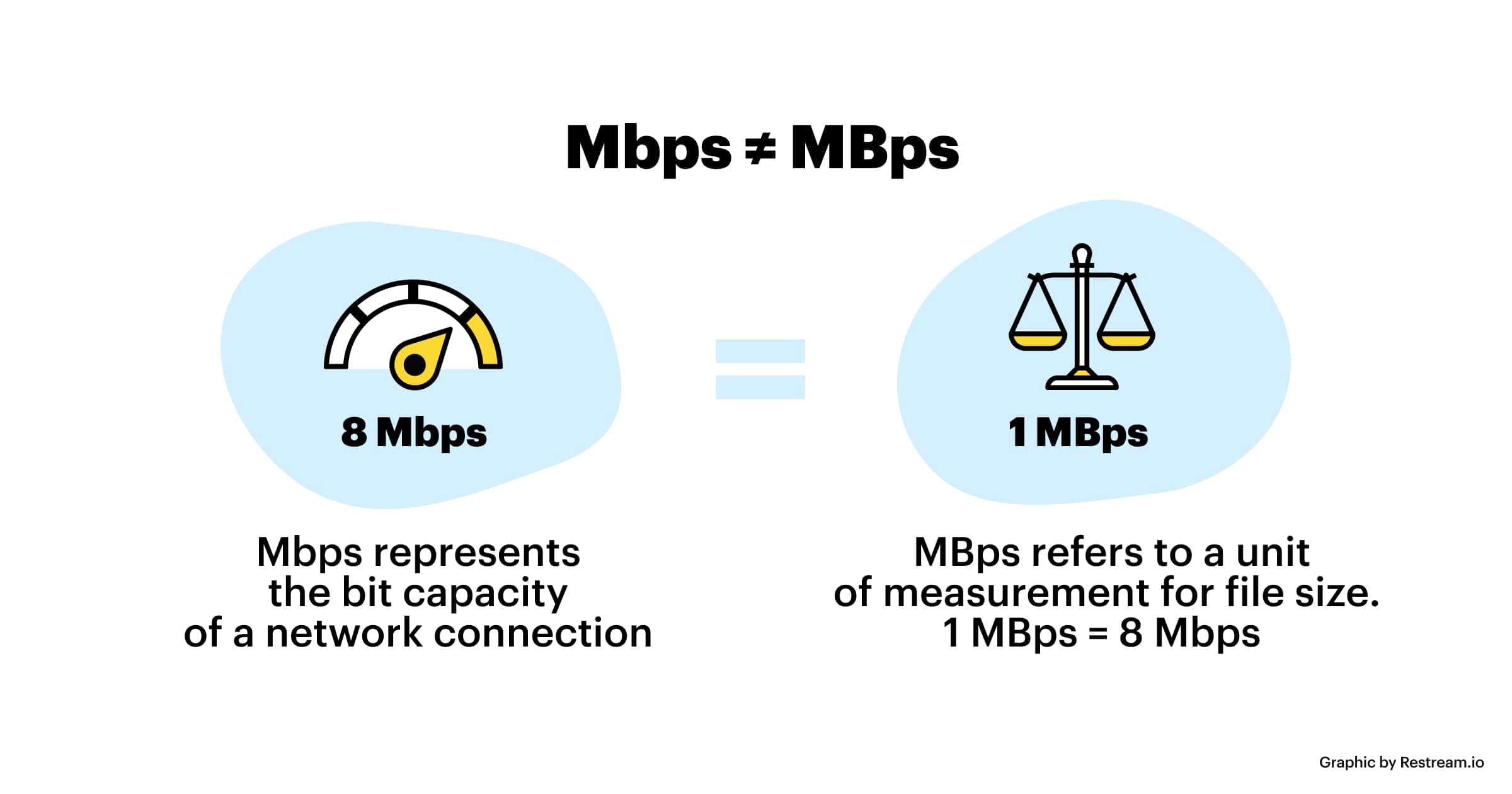
In modern digital communication, the transmission volume of digitized video and other information is large, so it is often measured in kilobits per second or megabits per second, which are written as kbit/sec (or kbps) and Mbit/sec. (or Mbps respectively). ). For example, the amount of information digitized from an ordinary color TV signal can reach 216 Mbit/sec. A good digital broadcast channel can transmit dozens of color TV programs, and its capacity can reach several gigabits or gigabits per second (written as Gbit/sec or Gbps) [1] .
Bitrate is often used to measure the quality of video files.
flexibility edit stream
Because each network is unique and each access line has different conditions (such as length, attenuation, crosstalk environment, etc.), access lines from different telephone companies must support different data rates. For ADSL and VDSL modems, it is best to set the data rate to one of many possible data rates. For example, DMT-based ADSL and VDSL can theoretically change the tariff at fine intervals, and CAP-based RADSL (Rate Adaptive ADSL) also provides some flexibility in tariff configuration [2].
However, telephone companies may want to limit xDSL service to a small set of rates sufficient to provide a variety of services. If a limited set of tariffs can be adapted to a wide range of services, then the management of the services in this case is simpler than in the case of variable tariffs. Telephone companies want the choice of modem speed to be under the control of the network, not the user [2] .
In this mode, the selection of the transmission rate set of the xDSL network must be prudent. In this case, there is a possibility that two adjacent systems receive traffic at very different rates and the system must be able to handle such a situation. The other model, the “best match” approach using adaptive rate ADSL (similar to a voiceband modem), is more beneficial to new network operators and Internet Service Providers (ISPs) [2] .
Transmission control method
Most bit rate control schemes consist of two parts. Part of the encoded bit stream output by the encoder is fed into a buffer. For a constant bitrate channel, the data in the buffer is fetched at a constant rate, and if the buffer is large enough, the bitrate variation caused by the MPEG picture type, etc. can be smoothed out. This is necessary for both constant bit rate transmission and variable bit rate transmission in general. However, in practice, the buffer size is always limited. The buffering process will bring a delay to the system, and this delay is proportional to the size of the buffer. Latency is often a serious issue for real-time image communication, so buffers should be kept as small as possible. That is, long-term fluctuations in bitrate due to changes in scene content or changes, etc. they cannot be softened in this way, so another part is needed. This is to send some measure of the output bitrate to the encoder to control the encoding process, thus changing the output bitrate [3] .

Sample rate and bit rate of MP3 Part 2

Sample rate and bit rate of MP3 Part 2

BIT RATE

The number of digits in the sound is equivalent to the number of colors on the screen, indicating the amount of data per sample.

bit rate

Of course, the larger the amount of data, the more accurate the playback sound, so as not to confuse the sound. of the teapot with the train whistle. In the same way, it is more clear and precise for the image, so as not to confuse blood and ketchup. [However, limited by the function of human organs, 16-bit sound and 24-bit image are basically the limits of ordinary humans, and the higher digits can only be distinguished by instruments. For example, the phone has 7-bit sound sampled at 3 kHz and the CD has 16-bit sound sampled at 44.1 kHz, so the CD is clearer than the phone. ]

When you understand the above two concepts, bitrate is easy to understand. Take the phone as an example, 3000 samples per second, each sample is 7 bits, then the phone’s bit rate is 21000. And the CD is 44100 samples per second, two channels, each sample is 13 bit PCM encoded, so the CD bit rate is 44100*2*13=1146600, which means the CD data volume per second is about 144KB. the capacity of a CD is 74 minutes equal to 4440 seconds, which is 639360KB=640MB.

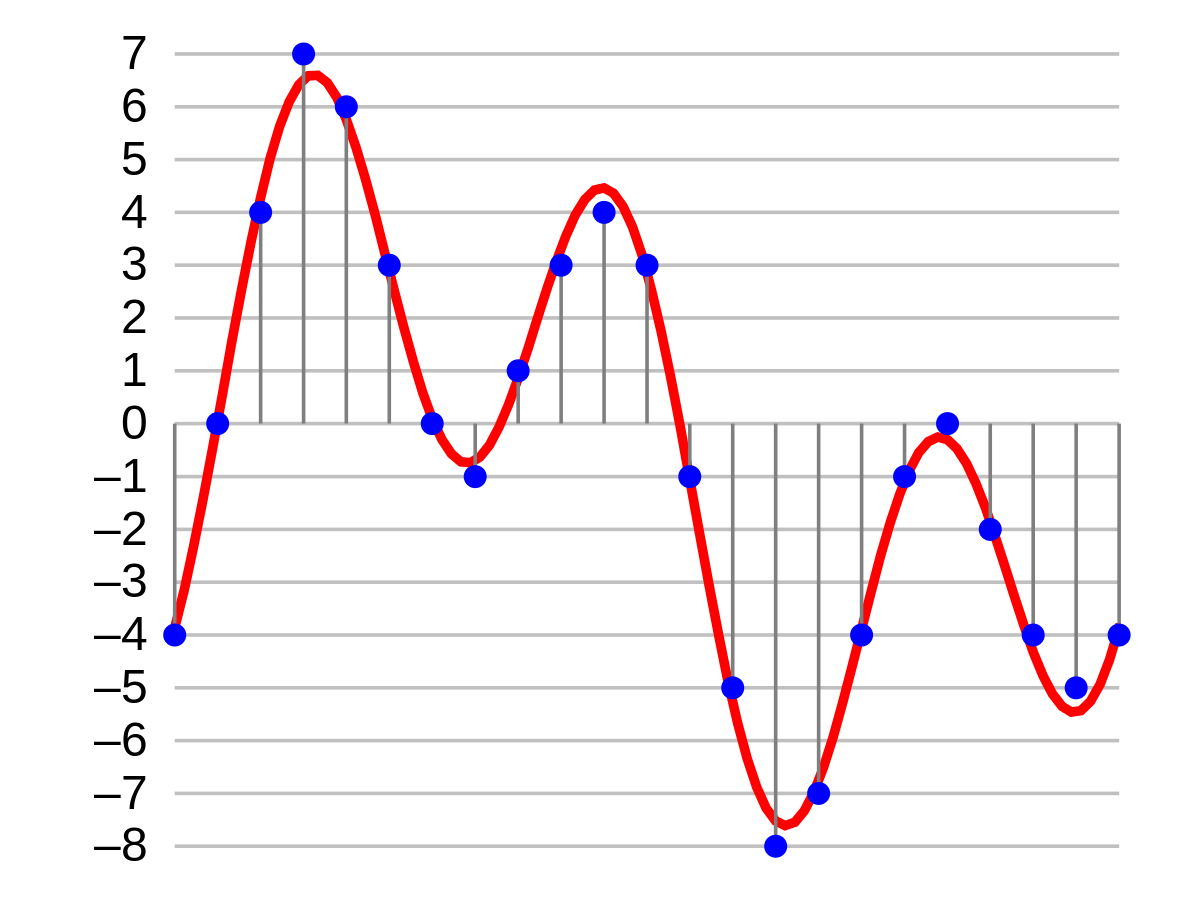
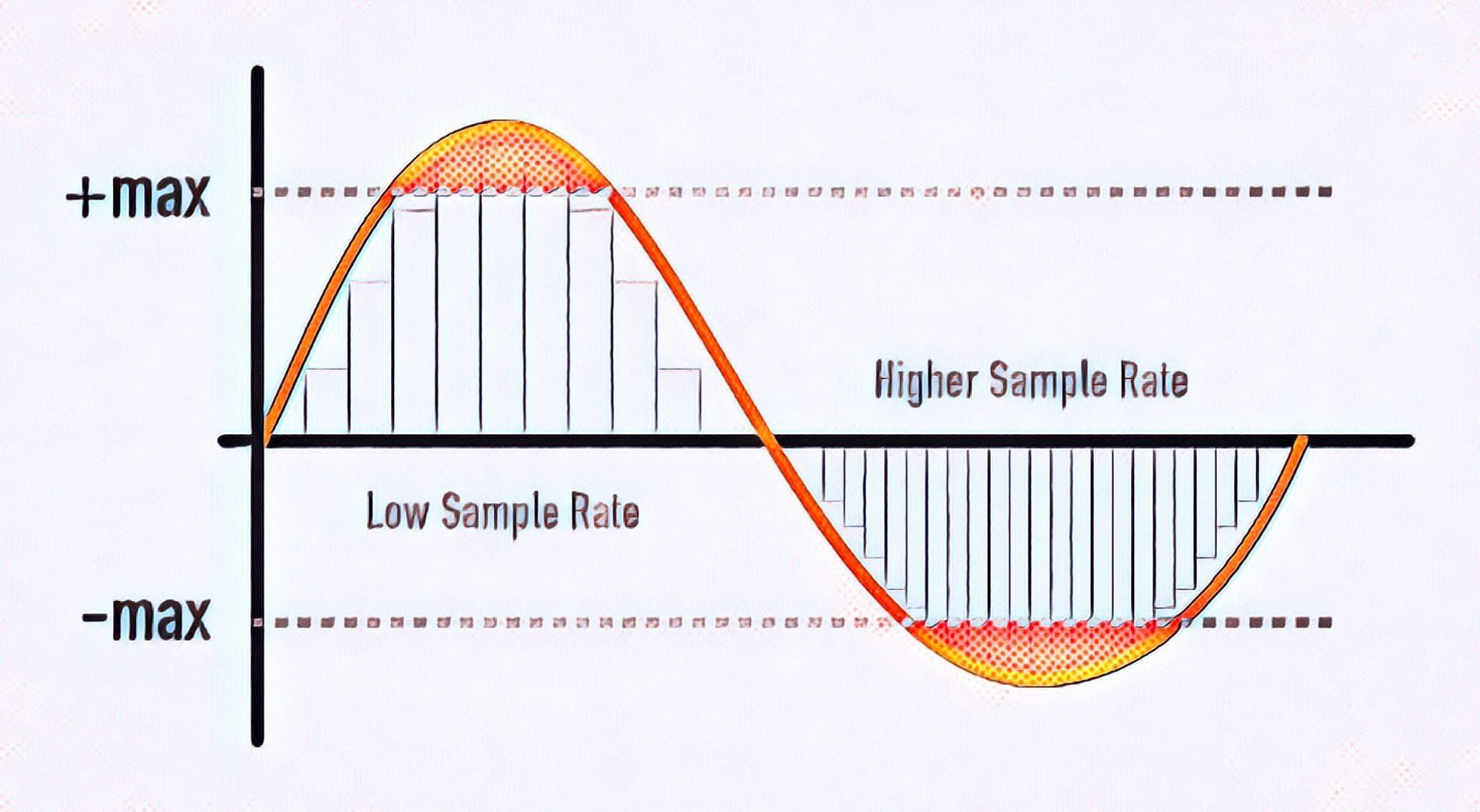
Sound is actually a type of energy wave, so it also has the characteristics of frequency and amplitude, with frequency corresponding to the time axis and amplitude corresponding to the level axis. The wave is infinitely smooth, and the string can be considered to be made up of innumerable points. Since the storage space is relatively limited, in the process of digital encoding, the points of the string must be sampled. The sampling process consists of extracting the frequency value of a certain point. Obviously, the more points that are extracted in one second, the richer the frequency information that can be obtained. To restore the waveform, there must be two sampling points in one vibration. The highest frequency that can be felt is 20kHz, so to meet the auditory requirements of the human ear, at least 40k samples per second, expressed at 40kHz, and this 40kHz is the sample rate. Our common CD has a sample rate of 44.1 kHz. It is not enough to have only frequency information, we must also obtain and quantify the energy value of this frequency to represent the strength of the signal. The number of quantization levels is an integer power of 2, and the sample size of our common CD bit is 16 bits, that is, 2 to the power of 16. Sample size is harder to understand than bit rate. sampling, because it makes it seem abstract. For a simple example: suppose a wave is sampled 8 times, and the energy values ​​corresponding to the sampling points are A1-A8, but we only use 2-bit sampling size, as a result we can only keep the 4 point values ​​in A1-A8 and discard the other 4. If we use the 3bit sample size, all 8 point information is recorded. The higher the sample rate and sample size values, the closer the recorded waveform is to the original signal.

MP3 sample rate and bit rate

MP3 sample rate and bit rate

Bit Rate

When we listen to mp3 and watch movies, we will notice two parameters.

BIT RATE

The most common ones are 44.1 KHz sample rate and 192 Kbps bit rate. So what is the sample rate and what is the bit rate? What is the relationship between them? Explain:

The process of converting an analog audio signal to a digital audio signal is called sampling. In a nutshell, how many data points does it take to record a 1 second long sound via waveform sampling. For example: the sound sample rate of 44.1 KHz is equivalent to spending 44,000 data points to describe the sound waveform for 1 second. In principle, the higher the sample rate, the better the sound quality; sampling frequency is generally divided into three levels: 22.05KHz, 44.1KHz and 48KHz; 22.05KHz can only achieve FM radio sound quality, and 44.1KHz is the theoretical limit of CD sound quality, 48KHz has reached DVD quality.

Sampling rate refers to the sampling frequency when converting sound (analog signal) to mp3 (digital signal), i.e. how many data points are sampled per unit of time. (The data for a sample point is 8 (or even more) bits long.)

Bit rate refers to the number of bits (bits) transmitted per second. The unit is bps (bit per second). The higher the bitrate, the more data transmitted and the better the sound quality.

It can be said that the sample rate and bit rate are like the horizontal and vertical coordinates on the coordinate axis. The sampling frequency on the abscissa represents the data points sampled per second. The bit rate on the ordinate represents the precision when quantizing analog quantities with digital quantities.

The sample rate is similar to the number of frames of moving images. For example, the sampling rate of movies is 24 Hz, the sampling rate of PAL format is 25 Hz, and the sampling rate of NTSC format is 30 Hz. When we play back the still images sampled at the same rate as the sampling frequency, we see a continuous image. In the same way, when a CD recorded at a sampling rate of 44.1 kHz is played back at the same rate, a continuous sound can be heard. Obviously, the higher the sample rate, the more coherent the sound will be heard and the picture will be seen. [Of course, the sampling rate that human auditory and visual organs can distinguish is limited, which is basically higher than sound sampled at 44.1kHZ, and most people haven’t noticed the difference. ]

Quality (bit rate)

Quality (bit rate)

Bit Rate

In multimedia technology, quality is often used to judge the effect of audio, and quality here is actually bitrate.

Bit Rate

1. Introduction
2 sound control
3 encoding mode
Introductionedit transmission
The term quality is widely used.
In multimedia technology, quality is often used to judge the effect of audio, and quality here is actually bitrate.
On WINDOWS it is called “bit rate” and on some players it is described as ” bit rate “.
Quality refers to the bit rate at which digital sound is converted from analog to digital format. The higher the bitrate, the better the quality of the restored sound.
sound control edit stream
16 Kbps = phone quality
24 Kbps = increase phone quality, shortwave transmission, longwave transmission, European standard medium wave transmission
40 Kbps = American standard medium wave transmission
56Kbps=Voice
64 Kbps = boost voice (best bitrate setting for cell phone ringtones, best setting for cell phone mono MP3 players)
112 Kbps = FM stereo broadcast FM 128 Kbps = tape (best setting for mobile phone stereo MP3 player, best setting for low-end MP3 player)
160 Kbps = HIFI high fidelity (best setting for mid to high end MP3 players)
192Kbps=CD (best setting for high-end MP3 players)
256Kbps=Studio Music Studio (for music enthusiasts)
In fact, with the advancement of technology, the quality of music is also getting higher and higher, the highest quality of MP3 is 320Kbps, but some formats can achieve higher sound quality.
For example, the emerging APE audio format can provide real audiophile level lossless sound quality and smaller volume than WAV format, and its quality is usually 550kbps-950kbps.
encoding modeedit stream
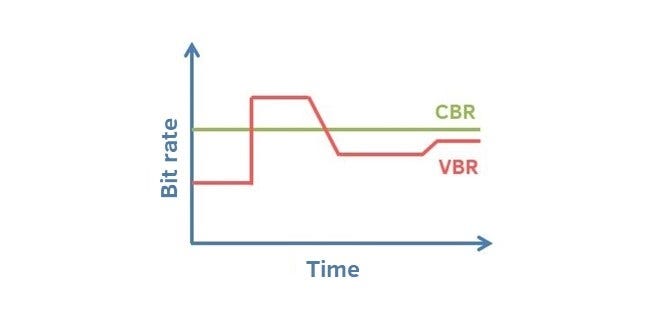
VBR (Variable Bitrate) Dynamic Bitrate means there is no fixed bitrate. The compression software immediately determines which bitrate to use based on the audio data being compressed. This is a method that takes quality as a premise and takes file size into account The recommended encoding mode;
ABR Average Bit Rate (Average Bit Rate) is an interpolation parameter of VBR. LAME created this encoding mode in response to the low file volume ratio of CBR and the variable size of files generated by VBR. Within the specified file size, ABR takes every 50 frames (about 1 second for 30 frames) as a segment. High-frequency and insensitive frequencies use relatively low traffic, and low-frequency and large dynamic performance use high traffic, which can be used as VBR and CBR, a compromise option.
CBR (constant bitrate), constant bitrate means the file has one bitrate from start to finish. Compared to VBR and ABR, the compressed file size is very large and the sound quality will not improve significantly compared to VBR and ABR.